Classic Fiddler From The Early Days Of Bluegrass
John William Hall was born on November 29, 1933 near Front Royal, Virginia and grew up on a small family farm. He went to the Washington, D.C. area in 1951 and soon became an important part of the area bluegrass scene. In 2005, Tom Mindte spoke with John in connection with a book he and Kip Lomell are writing about the life of Buzz Busby. The interview and information provided by Gary Reid and Russ Hooper were valuable resources in preparing this article.
There was not much music in the house other than by his older sister who played piano. When asked about how he got interested in the fiddle John explained, “My oldest brother Earl was in the Navy and while he was away my mother arranged for me to take violin lessons. I was about 11 or 12 years old and I took the lessons for only about six months, or maybe close to a year. Then I started skipping the lessons and using the lesson money to buy cigarettes and candy. When Earl came home from the Navy, he had a fiddle and could play a couple of tunes. I thought, ‘Dang that sounded good!’ So I got my fiddle out and started to play again. And very soon I could play better than him.”
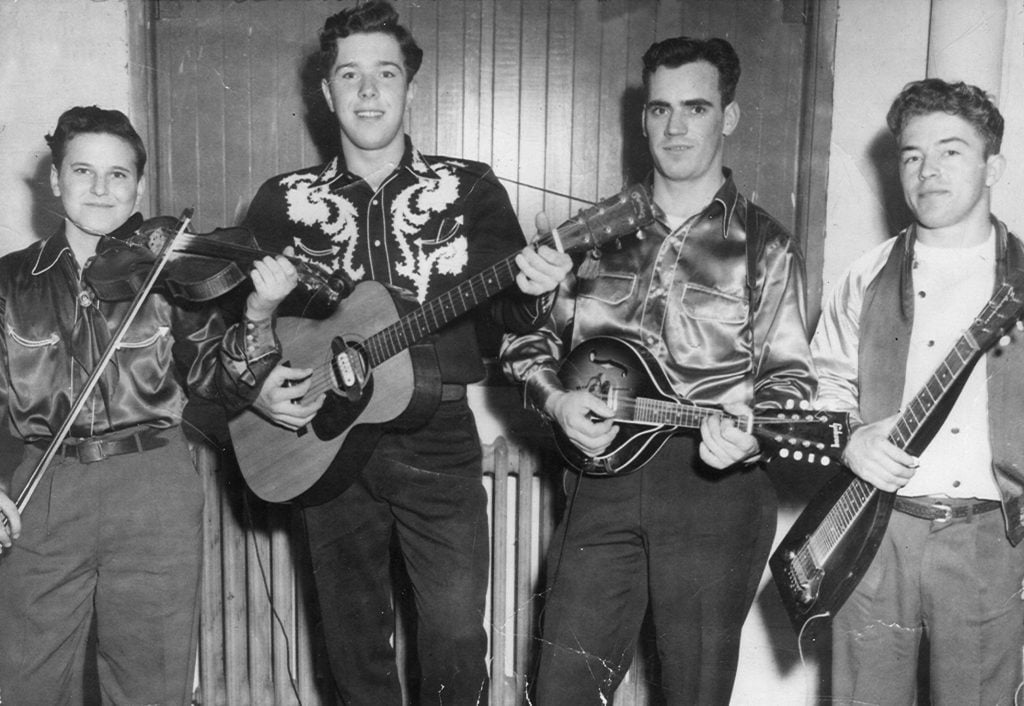
While still a teenager and living at home, John played with two pickers from Front Royal—Junior Strother on banjo and Matur Grove on guitar. Junior played a two-finger style of banjo, so it wasn’t really bluegrass but more of an old-time string band sound. When John announced that he would be going to D.C. to play music with his brother Joe, Matur went to John’s house and tried to persuade his mother and dad to keep him from leaving. John was becoming a very good fiddler so Matur and Junior wanted him to stay home and play with them.
Joe had bought a Gibson A-50 mandolin and the two of them worked up an act and started playing gigs in the Washington, D.C. area with other local musicians. They met Jack Clement who was in the Marines at the time and played some shows with him. Soon after going to D.C. they met Buzz Busby, and being in need of some cash, Joe sold him his mandolin and this is the mandolin that Buzz played throughout his career. Joe returned home to Front Royal, but John stayed in the area and got his first full time gig with Benny and Vallie Cain. He played with them for about two years at the local music clubs and on radio shows on WGAY in Silver Spring, Maryland and on stations in Winchester, Linden, and Strasburg, VA.
John met Scott Stoneman and was a frequent visitor to his house to get tips and help with his fiddle technique. Scott was always full of devilish deeds and he would show John fiddle licks that he knew would be impossible for him to play. When John noisily showed his emotions and frustration, Scott’s mother, Hattie, would become tired of the complaining and shout to them from upstairs. “Scotty, show him something he can play. I’m tired of all this noise.” In spite of Scott’s teasing, he learned a lot from him and quickly became a top-notch player. Some of the popular fiddlers of the time that John admired and listened to were Chubby Wise, Howdy Forrester and Curley Fox.
John stayed with Benny and Vallie until there was a money dispute over a fiddle contest at Watermelon Park in Berryville, Virginia. They had agreed that John would receive any money won for the fiddle contest and Benny and Vallie would receive any money won in the band contest. Judging was done using an applause meter. The park owner, John Miller, awarded first place in the band contest to Curley Smith’s band because there was whistling during the applause for Benny and Vallie which skewed the readings. Benny and Vallie were awarded second place, but for some unknown reason Miller cancelled the fiddle contest. With no fiddle contest John wasn’t paid anything and he felt that having performed in the band, despite the agreement, he should have been paid something. John learned that Buzz Busby would be going to Wheeling, West Virginia to audition for the WWVA Jamboree. So he called Buzz and asked him to pick him up in in Berkely Springs, West Virginia and he would go with him. John didn’t remember who else was in the band and it is not clear from the interview if he ever played shows with Buzz in Wheeling. But soon after joining up with Buzz they often played on the WRVA Old Dominion Bam Dance in Richmond, Virginia.
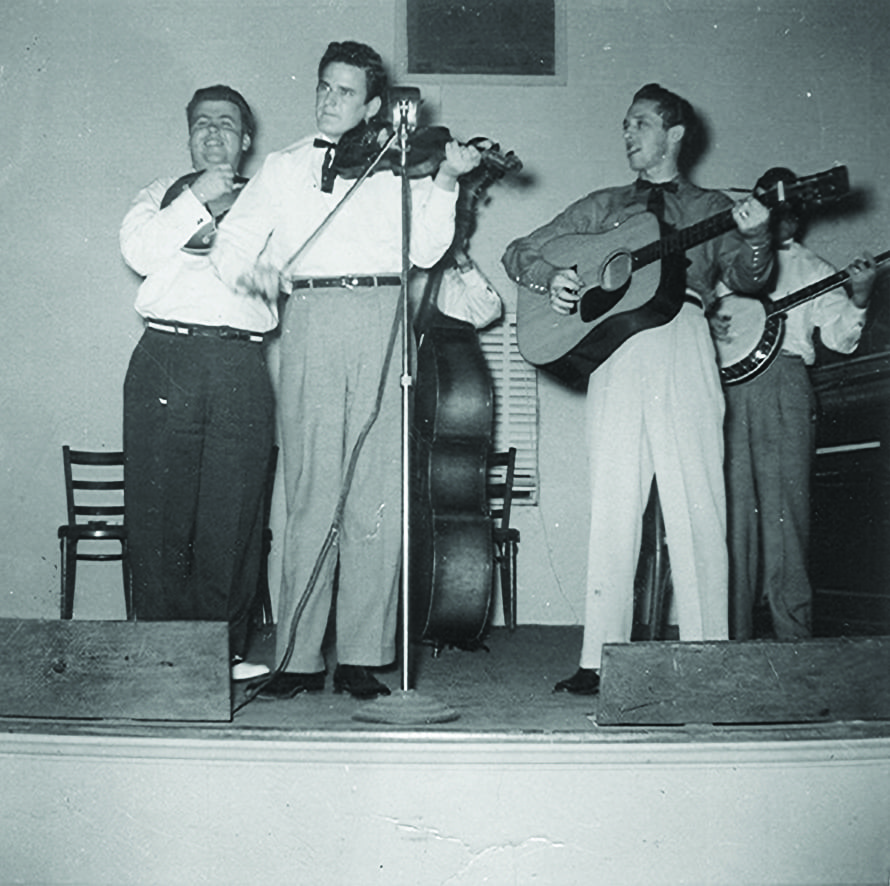
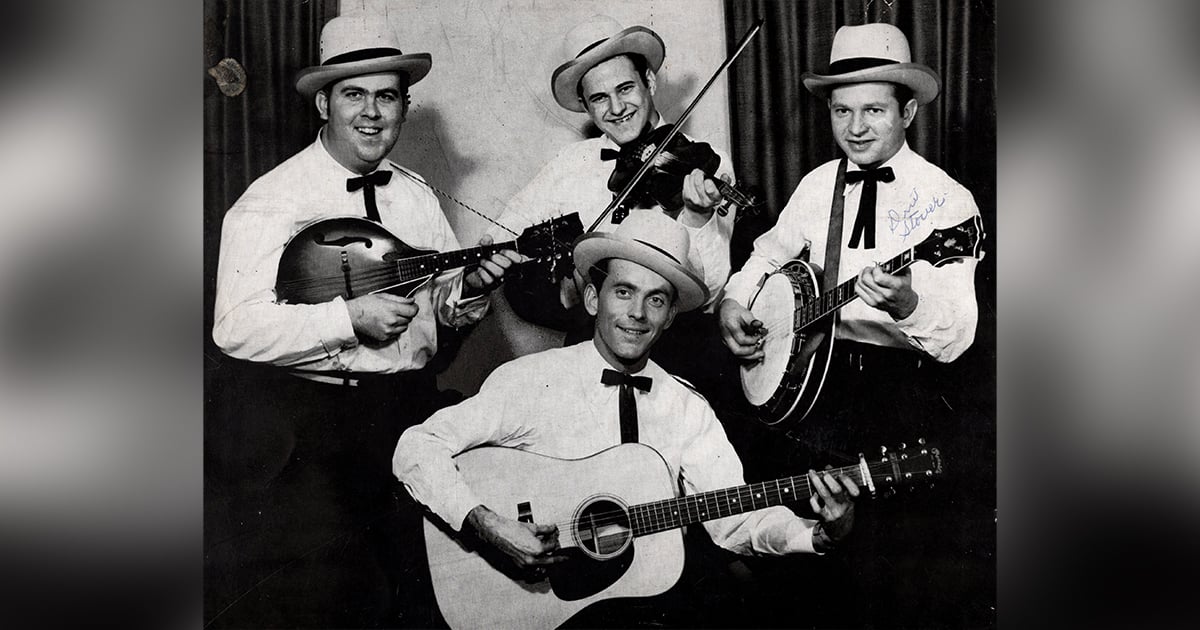
At the 1954 National Country Music Contest in Warrenton, Virginia Buzz Busby and the Bayou Boys won the band contest and John won second place in the fiddle contest. The Washington Post published a story about the contest and the Program Director at WNBW TV (later to become WRC) in Washington, D.C. saw the article in which the Bayou Boys were featured. The station had been looking for a country or bluegrass band to compete with WMAL TV, the local ABC affiliate. Several very popular country music shows were on that channel including the Saturday night televised jamboree with Jimmy Dean at Turner’s Arena. In the fall of 1954 Buzz Busby and the Bayou Boys began a daily television program from 2:30 to 3:00 p.m. The band members for the show were Buzz on mandolin and vocals, Pete Pike on guitar and vocals, John Hall on fiddle, and Lee Cole on bass. Don Stover who had been playing with the Lilly Brothers in Boston joined the band to play banjo.
Stover replaced Don Bryant who had played in the Warrenton contest but had left to join Mac Wiseman on the Old Dominion Bam Dance. The TV show lasted for only about six months primarly because the New York owners, NBC, didn’t appreciate this type of programming. Near the end of the show’s run, John heard one of the staff engineers say that NBC was afraid Buzz’s pants would fall down. Buzz had a pot belly that hung over his belt and when he played his mandolin it looked like he was losing his pants.
The program was very popular and drew a huge mail response. Many aspiring bluegrass musicians were influenced by the program including Bill Emerson, Pete Kuykendall and John Duffey. The program aired during school hours and there were quite a few high school students who skipped last period to watch the show. The band would arrive at the Wardman Park Hotel studio a couple of hours before air time to rehearse the songs and staging. Carl Dagen was the producer and the announcer was Mike Hunnicutt
Many special effects available in the early days of TV were used. For the opening of the show the band was miniaturized and placed on the open door of a rural style mailbox labeled RFD. When John played “Up Jumped The Devil”they put a black hood over his face and a black gown that covered the rest of his body. A black background was used and all that could be seen on the TV broadcast was the fiddle and John’s hands. Everything was done live as this was before video taping was available. Buzz and Pete did a popular comedy routine where they became a corn ball duo, Ham and Scram. John remembers how scared and nervous he was when he was required to kill time with on air conversation during their costume change. And John played fiddle on several songs for an LP album Buzz and Pete did of Ham and Scram songs.
The TV show resulted in more lucrative bookings for the band and a steady paycheck. They announced a show date for an appearance at Watermelon Park in Berryville, Virginia and more than 7000 fans showed up. Unfortunately, the band was booked for a set fee rather than a percentage of the gate. John Miller, the promoter, made out really well and was all smiles that day. When asked about how the TV money was split among band members, John couldn’t recall what he made and commented that he didn’t really care too much about the money. He speculated that Buzz probably received the largest amount but wasn’t upset about this because after all he was the band leader.
After the TV show ended, Pete Pike left the band and began playing country music at the Ozarks, a night spot on 10th Street in downtown Washington. After a disagreement with Buzz’s wife, John left the Bayou Boys and began playing with Pete at the Ozarks. They had an electric lead guitar and played mostly covers of current country music songs made popular by Ray Price, Webb Pierce, and other performers of the day. The gig at the Ozarks lasted a couple of years and during this time they recorded three albums for budget record labels.
In June 1957, John went on a three month USO tour to the far east with Pete Pike and a group of other entertainers. They played shows in Hawaii, Korea, Midway Island, Okinawa, and Wake Island. John had a scary experience one night on the way to a performance. “I’ve never seen dark like that. I forgot my fiddle and had to go back and get it. The building with my fiddle was up on about a four foot ramp and I ran right into it. My feet went out from under me and then the rest of me followed. Anyway, I knew I was there. I got up and found my way in, got the light on, got my fiddle and went on back over to where I was supposed to be. Another time I was out there somewhere at night. Everything was enclosed with a high fence with guards all around. They had a password that you were supposed to remember. A guard challenged me and I just imagined a rifle pointed at me. I forgot the password response and when he said ‘Frog’ I said ‘Fiddle Player.’ He let me pass but I could just imagine and almost see that gun pointed at me.”
After the USO tour John went home to Front Royal to help his dad on the Farm, but in about October or November of 1957 he returned to the D.C. area to play with the newly formed Country Gentlemen made up of Charlie Waller, John Duffy, Bill Emerson and Buck Austen on bass. During this time he also played on the Don Owens TV show which aired from 7:30 to 8:00 pm. After the show ended John would hustle over to the Crossroads Restaurant near Bailey’s Crossroads in Virgina to play with the Gentlemen. John did three recording sessions with them. The first session was “Going To The Races”backed with “Heavenward Bound,” which was issued as a single on the Dixie label. Two more sessions with them in 1958 yielded four songs released on Starday; “Hey Little Girl,” “Mountaineer’s Fling,” “The Devil’s Own,” and “Rollin’ Stone.” However, when listening to these recordings the fiddle is barely heard except on “Going to The Races.” Perhaps the sound of a fiddle did not fit the more modem sound of the Country Gentlemen. When John left the band, Carl Nelson replaced him. After Carl left, the Gentlemen did not use a fiddle except for the short time Ricky Skaggs played with them.
In early May of 1962, John became a Clinch Mountain Boy with the Stanley Brothers. He had moved to Cincinnati, Ohio to play with Earl Taylor along with Walter Hensley on banjo and Jim McCall on guitar. John relates “We were playing in a club called the Snake Pit. And it wasn’t much better than that either. There were a lot of fights and they often had to call the police to calm things down. On one occasion five guys came in to start trouble and the owner and the bartender commenced to fight with them and whipped all five of them.” The Stanley Brothers were in town for a recording session at the King studios and Ralph Mayo, who had played fiddle on the session, came into the Snake Pit and told John that the Stanley Brothers were considering adding a fiddle player to the band. He told John to meet them the next morning at 9 am if he was interested. John met up with them, auditioned, and was hired. At the time the band was made up of just Carter and Ralph and George Shuffler on lead guitar. They had a pretty busy schedule with long drives between show dates. John tells about a conversation with Carter on one of the road trips. “I had bought a record player with a Stanley Brothers disc inside it. That’s why I bought it, because of that record. I told Carter that I bought that record player cause your record was in it. His head swelled up bigger than a pumpkin.”
At a show in Bedford, Virginia a representative of the Stanley Brothers Fan Club was at the show and wrote afterwards: “John Hall, who is a new member, was on the fiddle and is he ever handsome! And so cute. He tells a joke with his soft gentle voice that sounds like George Hamilton IV and he’s a scream. And as Carter mentioned on the show he specializes in those trick tunes such as “Lee Highway Blues” and “Black Mountain Blues.” They played several shows in Kentucky in late June and after their show on Saturday they drove all night to play at New River Ranch in Rising Sun, Maryland on Sunday, June 24, 1962. They arrived at the park with just enough time to clean up and take a short rest.
This writer has a recording of this show and it was absolutely wonderful with John playing exciting show tunes including “Black Mountain Blues” and “Orange Blossom Special.”
The next night they played at the 79 Club on South Charles Street in downtown Baltimore. John knew the boys in the house band and played with them on their opening set. And Carter didn’t like that one bit! Protocol in those days did not allow band members to ever play with other bands. When the show was over and they got back to the motel, Carter angrily admonished John and asked him over and over again, “What have you got to say for yourself?” John was exhausted from the long trip and lack of sleep and finally became angry and frustrated. He replied, “I quit!” and that ended John’s short stay with the Stanley Brothers.
John stayed in Baltimore and took a job with Marvin Howell and the Franklin County Boys and played with them for several months. The band was made up of Marvin on banjo, Russ Hooper on Dobro, Frank Joyner on guitar, Danny Curtis on mandolin, and John on fiddle. They enjoyed a busy schedule playing the local clubs and nearby festivals and fairs. Russ remembers, “We never made much money. When we played at the Charles Hotel in Hughesville, Maryland John most always lost everything he made playing the slot machines at the hotel.”
For many years John had a day job as a Lab Technician at water purification plants in Winchester, Virginia and Beltsville, Maryland. There were several periods over the years that John laid down his fiddle. But during the time he had a day job he played gigs with several Baltimore based country and bluegrass bands. Dan Haller recalls that he played banjo in a gospel band with John for about two years in 1983 and 1984. They played for prison ministries and performed for worship services at prisons in the Mid Atlantic area. Dan enjoyed being with John and admired his playing and sense of humor. John would often say things like “See that big house on the hill? If you want it, you can have it! See that fancy car driving down the road? If you want it, you can have it!” This was certainly an ironic quip that Dan could laugh at even though he has been sightless since birth.
It is hard to determine the time period from the interview, but John spent some time in other parts of the country. On one occasion he went to El Paso, Texas for about six months and worked at the Cabaret Club with local musicians. When he played “Cotton Eyed Joe” the guys asked him, “What in the heck was that?” They play a different version there so John taped the Texas version from the juke box and by the next night he could play it like a native Texan. Before returning to the east coast he went to Kansas City and worked there with some local musicians for several months.
At the time of the interview used for this article John could no longer play his fiddle. He had suffered a stroke a couple of years before and said “I just can’t play anymore. My arm don’t know what to do and my fingers don’t know what to do. I’ve tried a time or two but just couldn’t play. I’ve just about given it up and would probably be better off if I just got rid of the fiddle.” Most probably John’s last public performance was on October 3, 1986 for a Buzz Busby reunion concert at Commonwealth Park in Culpepper, Virginia. The original TV band of Buzz, John, Pete Pike and Don Stover participated.
Sonny Johnson, not a part of the original band, played bass for the show.
Folks that were there said that John really nailed it. He played “Black Mountain Blues”with some great finger picking on his fiddle. John commented that he really couldn’t play well for the show but perhaps this is his modesty showing.
At the time of the interview John was living in a trailer near Front Royal, Virginia. His life as a musician was not financially lucrative, but he had an interesting and productive life with admirers throughout the world. And his life experience also shows the sacrifice so many musicians make to provide the music we love so much. His legacy will be that he is one of the great classic fiddlers of the early days of bluegrass.