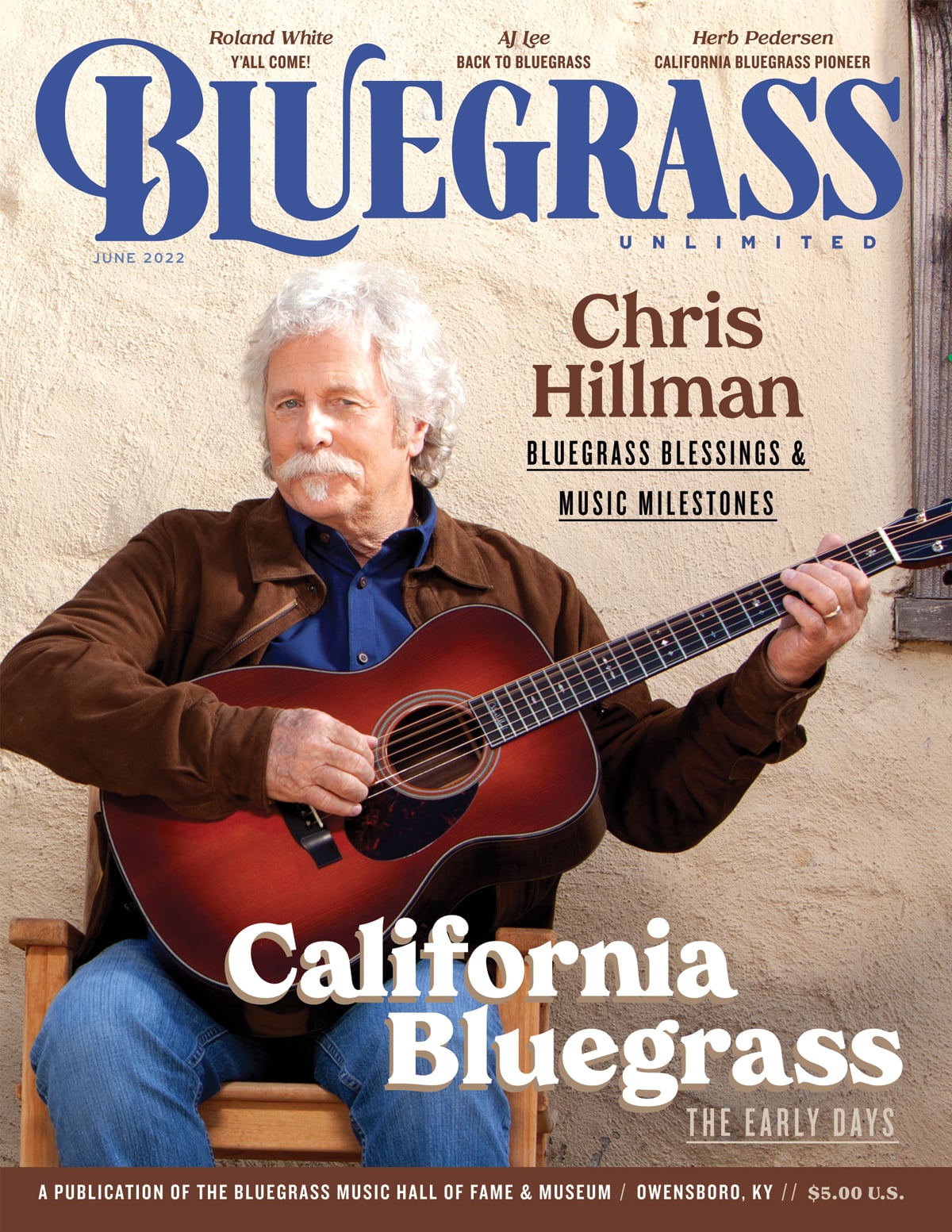
Chris Hillman
Bluegrass Blessings & Music Milestones
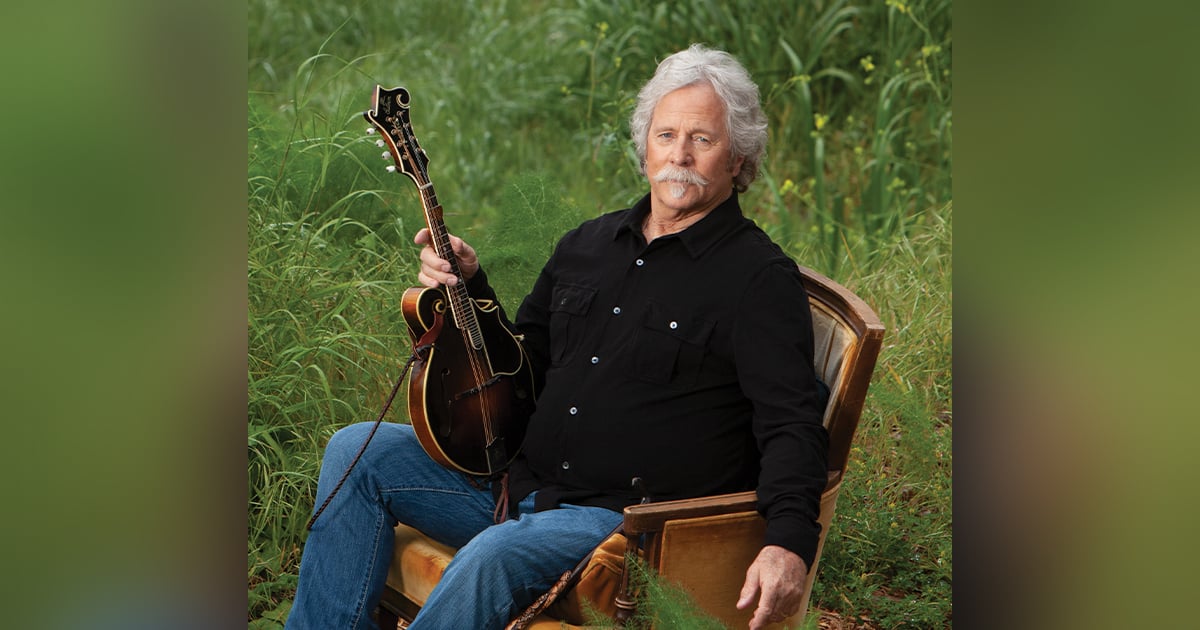
Photo by Lori Stoll
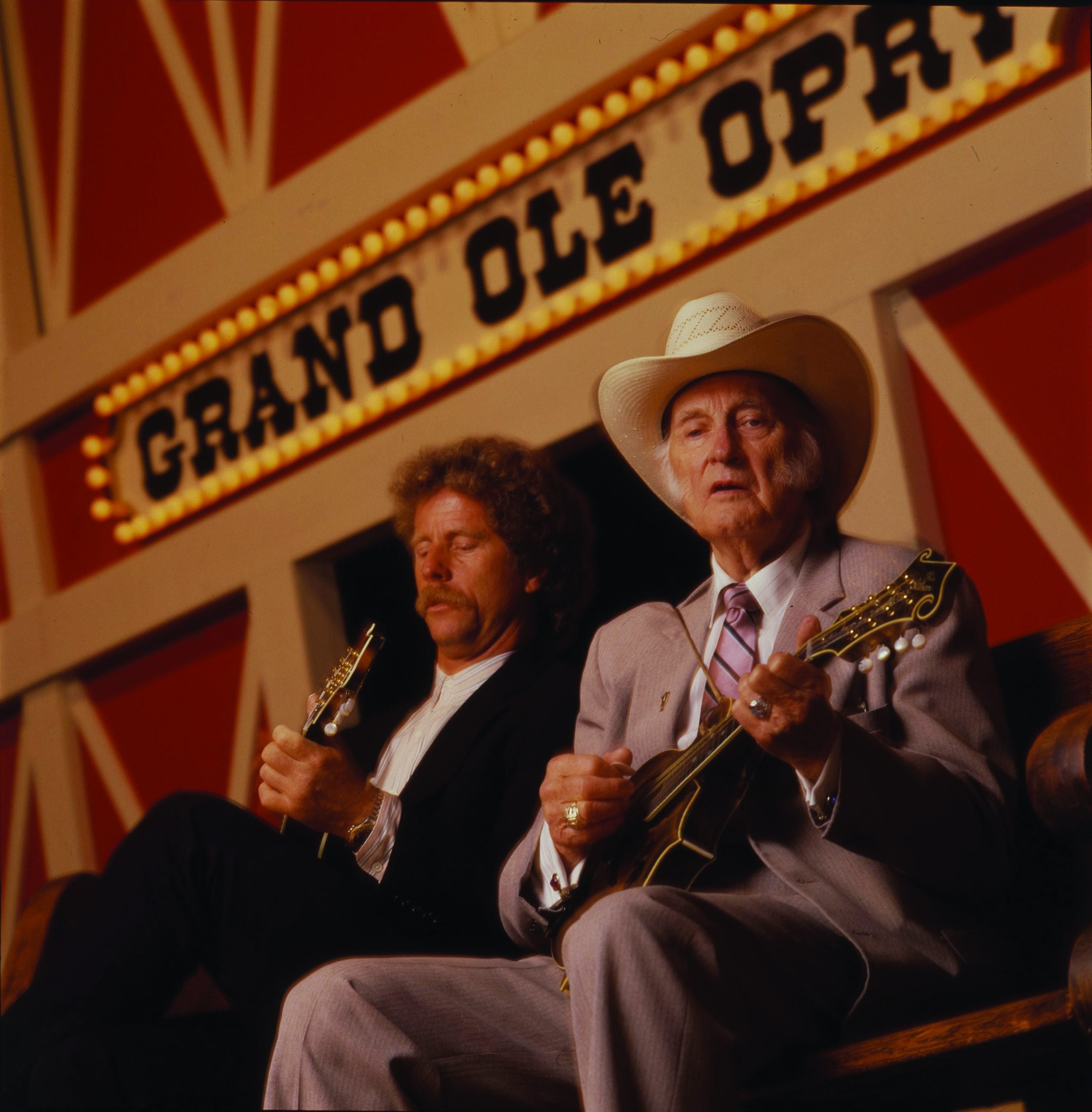
As agreed, the two mandolin players met up at the historic Ryman Auditorium in Nashville. They opened their instrument cases and brought out their vintage Gibson F-5 instruments while a professional photographer stood by to capture their meeting. One was Bill Monroe, the Father of Bluegrass himself. The other was Chris Hillman, co-founder of the Byrds, the hugely successful rock band hailed in the 1960s and ‘70s as “America’s Beatles,” and the Flying Burrito Brothers and the Desert Rose Band, innovative ensembles which would bring him recognition as a “Daddy of Country Rock.”
It was 1989, and Hillman had been invited by Rolling Stone magazine to be part of a special pictorial featuring rock stars and their music heroes. Chris had immediately accepted, naming Bill as his choice. (The pictorial, “Sweet Inspirations,” ran in the September 26 issue.)
“Mr. Monroe showed up dressed to the nines,” Hillman recalls fondly. But why would Bill Monroe show up at all, to be depicted with a rock musician? Perhaps Bill knew that Chris’s musical roots had taken hold in bluegrass and remained there, deeply. Indeed, Chris Hillman’s musical development went hand-in-hand and pick-on-string with the growth of the vibrant California bluegrass scene. The groups in which he played—notably the Scottsville Squirrel Barkers, the Golden State Boys and the Hillmen—are now legendary in West Coast bluegrass lore. Hillman and his friends—Roland and Clarence White; Tony and Larry Rice; Herb Pedersen; Don Parmley; and Scott Hambley, to name only a very few—won bluegrass fame far beyond even California’s expansive territory.
And Hillman keeps returning to his bluegrass and classic country roots. That’s abundantly clear in his recent enthusiastically-received autobiography Time Between: My Life as a Byrd, Burrito Brother, and Beyond (BMG Books). Indeed, “Time Between” is the title of a popular number penned by Hillman during the height of his Byrds stardom. When it was recorded in 1966, the group was still heavily identified with folk-rock and psychedelic sounds. But it’s real country, foreshadowing the Byrds’ landmark 1968 country-and bluegrass-flavored album Sweetheart of the Rodeo.
During conversations, Chris emphasizes the importance of bluegrass as a great, even primally influential American music. To really play country, Hillman maintains, “You have to go through bluegrass school. Bluegrass was the well, the source.” And not just a country source. Chris recognizes Bill Monroe as a major influence on the early “rockabillies,” Elvis Presley, Carl Perkins, Buddy Holly and others. It’s a pleasure to find the 77-year-old Hillman still involved in music projects that are woven throughout with his love for bluegrass and classic country, the joys they bring and the values they represent. (See sidebar on his new program for friend Dwight Yoakam’s SiriusXM channel.)
Although born in Los Angeles in 1944, Chris Hillman had a real country upbringing in the little town of Rancho Santa Fe in San Diego County to which the family moved in 1948. The Hillman “ranch” was only about two acres. But the family kept chickens, his brother raised two hogs (named Benny and Mike) as a 4-H project. Starting at age five, Chris was horseback riding. At age eight, he was gifted with his own horse.
During one of his older sister Susan’s visits home from college, she brought record albums by folk music greats Pete Seeger, the Weavers and Huddie Ledbetter (a.k.a. “Lead Belly”). Young Chris was intrigued. And when he first heard the New Lost City Ramblers—then the most popular and influential old-timey revival band in the world—he was entranced.
Chris was already playing guitar when he saw the Ramblers during a California tour. Founding member Mike Seeger was playing a blond-topped Gibson F-5 mandolin. As Chris vividly recalls, “I thought, that’s what I want to do!” He was additionally influenced by mandolinist John Duffey of the Washington, DC-based Country Gentlemen and that bluegrass group’s powerfully innovative first two albums on Folkways Records.
Like Bill Monroe’s parents J.B. and Malissa Monroe, his music-loving folks encouraged their children’s interest in learning to pick and sing, sometimes with a loving sense of humor. One day, his father David walked past Chris’s room to hear a folk music record being played joyfully (and loudly). “Hey, Betty,” David called out to his wife. “Are you sure Chris wasn’t left on our doorstep by some family from Oklahoma?”
It’s a cherished memory for Chris, one he held onto after a family tragedy of the most painful kind. When Chris was just 16, his beloved Dad sank into despair due to major business setbacks and mounting debts. In July of 1961, he took his own life. Chris’s mother stayed amazingly strong. The family rallied around and moved forward. Music helped.
In 1960, Chris had found a serviceable (and affordable) new Kay mandolin in a music store. He was teaching himself to play when he experienced one of those coincidences-bordering-on-minor-miracles that seem to bless the lives of future music greats. He met a boy named John McLaren who shared his passion for bluegrass and had a high-quality Martin D-18 Dreadnought guitar. They formed a duo with John singing tenor harmonies to Chris’s leads.
Then, another coincidence-bordering-on-miracle: One day, a high school classmate remarked, “I think the janitor plays guitar, and I think he plays bluegrass.” And so it was. Bill Smith was the real deal, a transplant from Arkansas who played both bluegrass and country. He became Chris’s friend and first real music teacher. He coached Hillman on proper chording and rhythm techniques. Recognizing the tremendous quality of Chris’s voice, he urged the youngster to sing more.
When he could arrange the trip, Chris visited the Ash Grove folk music club in Los Angeles with music friends Kenny Wertz and Gary Carr. They saw the greats during their Southern California tours: Flatt & Scruggs, the Stanley Brothers, and Bill Monroe himself. Soon, another happy coincidence/minor miracle: In 1962, the family moved to Los Angeles for its job opportunities and affordable rents. Their little two-bedroom apartment was only minutes from the Ash Grove. There, Chris saw a local band called the Country Boys, known later as the Kentucky Colonels. Their core members were bluegrass-playing brothers originally from Maine, Roland and Clarence White, on mandolin and guitar respectively. When Roland went off to serve in Europe with the U.S. Army, he was replaced by Scott Hambly, who soon agreed to teach Chris.
Scott lived up the coast in Berkeley. Another coincidence/minor miracle blessed Chris: His sister Susan had moved there. So if Chris could afford the train fare from L.A. he had a place to stay. Scott helped Chris take his mandolin skills to a new level. And Chris soon moved up to a Gibson F-2 mandolin as well.
After graduating high school, Chris was invited by Kenny and Gary to return to the San Diego area as a member of their new bluegrass band, the Scottsville Squirrel Barkers. (Its memorable moniker referred to a squirrel-bagging technique in which the hunter would shoot out the tree bark immediately below where the critter was perched. The squirrel would tumble to the ground, whole and ready to be taken home for supper.) With Kenny on banjo and Gary on guitar, and the equally-dedicated Larry Murray on Dobro and Ed Douglas, bass, the Squirrel Barkers seemed a viable undertaking. Chris’s mother—ever supportive of his serious music efforts—gave permission for him to quit his day job in an L.A. department store and move to San Diego.
In addition to playing local gigs, the Squirrel Barkers made epic California bluegrass road trips, piling with their instruments into Ed’s Volkswagen van and driving 130 miles one-way to Los Angeles for Monday night open mic “Hoots” at the Troubadour. During this period, they met the Pine Valley Boys, who’d relocated from Berkeley down to L.A. One of its members—a particularly talented banjo picker, singer and aspiring songwriter named Herb Pedersen—would become one of Chris Hillman’s most valued friends and collaborators, a relationship that continues to this day.
Lasting proof of the Squirrel Barker’s talents is their album Bluegrass Favorites, made for the indie label Crown Records (Crown CLP-5346). The young men cut the entire very enjoyable LP in one four-hour, live-in-the-studio, straight-to-2-track session. “That’s one of the better records I’ve made,” Chris comments, “because we were playing without fear, without thinking much about it. We were just going for it because we had so much passion and love for the music.”
In the fall of 1963 Gary and Kenny received draft notices, so talented replacements were recruited to fulfill remaining show obligations. One of these was then-banjo picker Bernie Leadon whom Chris would one day bring into the Flying Burrito Brothers country rock band. Bernie went on to help found the Eagles, also a hugely successful rock act influenced by country music.
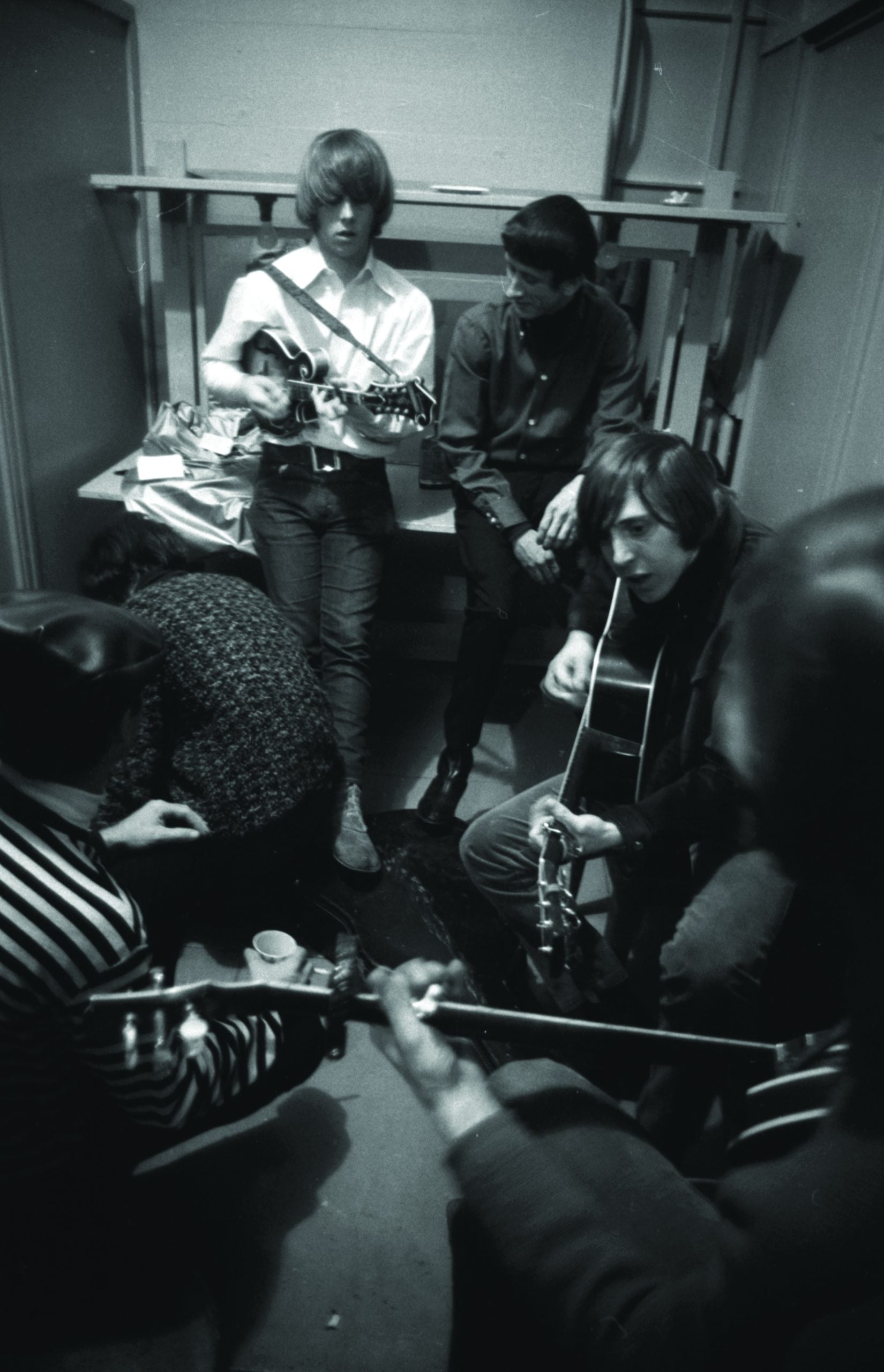
His mandolin and vocal talents burgeoning, Chris was recruited by banjo picker Don Parmley for his band the Golden State Boys which also featured brothers Vern and Rex Gosdin on guitar and bass respectively. (Don and his son David would one day be mainstays of the nationally-popular Bluegrass Cardinals.) The Golden State Boys eventually cut a solid album titled The Hillmen, after the new band name they’d adopted. It was recorded on spec by producer Jim Dickson who hoped to land the group a contract with Elektra Records. That never came to fruition, and the Hillmen broke up in mid-1964. (However, their LP was released in 1969 by Together Records and in 1995 by Sugar Hill Records.)
But then occurred perhaps the greatest bluegrass-related coincidence/miracle of Chris’s career: Dickson invited him to join a rock music act he was assembling as an American answer to the now wildly-successful Beatles. (When Jim asked if Chris could play electric bass, the answer was “Yes” – then Chris scrambled to buy the instrument and learn enough on it to avoid disaster.) “I went straight from a bluegrass band into the Byrds,” Hillman observes.
Dickson recruited other folk-style ensemble players, Jim McGuinn and David Crosby. In fact, Jim (who later changed his name to Roger) played banjo as well as guitar. The newly-formed group—named the Byrds—clicked vocally, instrumentally and as powerful songwriters. The rest is American music history. (And it provided inspiration for the semi-satirical Byrds hit “So You Want to Be a Rock ‘n Roll Star,” penned by Hillman and McGuinn.)
The Byrds’ folk music connection was quite real. Among their chart-topping, million-selling records were covers of “Mr. Tamborine Man” by Bob Dylan and Peter Seeger’s “Turn! Turn! Turn!” Later, there were more crossovers. Chris recruited his old friend, bluegrass guitar wizard Clarence White, for the group. (Indeed, one of Clarence’s first contributions was a stunning countrified electric guitar solo for “Time Between” on the Younger Than Yesterday album.) In 1968, they both contributed mightily to the landmark country and bluegrass-flavored Byrds album Sweetheart of the Rodeo.
A highlight of the album was an almost straight-bluegrass treatment of the Woody Guthrie ballad “Pretty Boy Floyd.” Roger McGuinn planned to kick it off on banjo. Says Hillman, “Roger is a great banjo player but more in the old clawhammer or frailing mode.” When McGuinn’s intro failed to gain much traction, a banjo player and fiddler hired for the sessions good-naturedly suggested, “Maybe I ought to do that for you.” With equal good nature, Roger agreed. The banjo picker was John Hartford, steeped in bluegrass and a few years away from the immense success of his song “Gentle on My Mind” and his subsequent stardom. “John was such a great guy, and he’s just a gem on that record,” says Chris, also lauding Hartford’s soulful fiddle intro to “I Am a Pilgrim.”
The contributions of John and Clarence to Sweetheart of the Rodeo are part of their immense musical legacies. Chris recalls both Clarence and his now-recently departed brother Roland as kind, modest and generous musicians, virtuosos who were perfectly willing to share techniques with sincere novices. The album, Chris notes, “was not critically acclaimed when it came out. It was not a big seller. But what Sweetheart eventually did was open the flood gates for people to open their ears and minds to country music. And they started pouring through.”
Post-Byrds, Chris joined with guitarist/singer/songwriter Gram Parsons (who’d played in the Byrds) in the Flying Burrito Brothers. Although its name was an amusing mashup of circus and food imageries, the outfit was a serious pioneering effort in country rock, further establishing Hillman’s central role as a “daddy” of the style. When Gram wanted to include duets with a female vocalist on his first solo album, Hillman introduced him to a gifted young singer named Emmylou Harris, thus helping launch Emmylou’s own extraordinary career.
Chris also became a friend and eventually (in the band Manassas) musical collaborator with Stephen Stills, previously of the rock supergroup Crosby, Stills, Nash & Young. In 1972, Chris accepted an invitation to play on some recording sessions that Stills was doing in Florida.
During a break, Stephen had an assistant bring out an oblong instrument case. “What do you think of this?” he asked Chris. Then he opened the case to reveal a gorgeous vintage Gibson F-5 mandolin. “Ohmigod, it looks like a Loar!” Chris exclaimed. And indeed it was, a 1924 classic, its interior label signed by legendary Gibson company acoustic engineer Lloyd Loar – making it one of the most sought-after instruments of its kind, its high-climbing value now in the hundreds of thousands of dollars.
At the time, Chris was playing a mid-1950s Gibson F-5. Nice enough, but in no way comparable to the “holy grail” of a pristine 1920s Lloyd Loar. In the space of a 16th note, Chris accepted Stephen’s invitation to try it out it. “So what do you think?” asked Stills. “It’s beautiful,” the awestruck Hillman managed to reply. “It’s yours,” Stephen said.
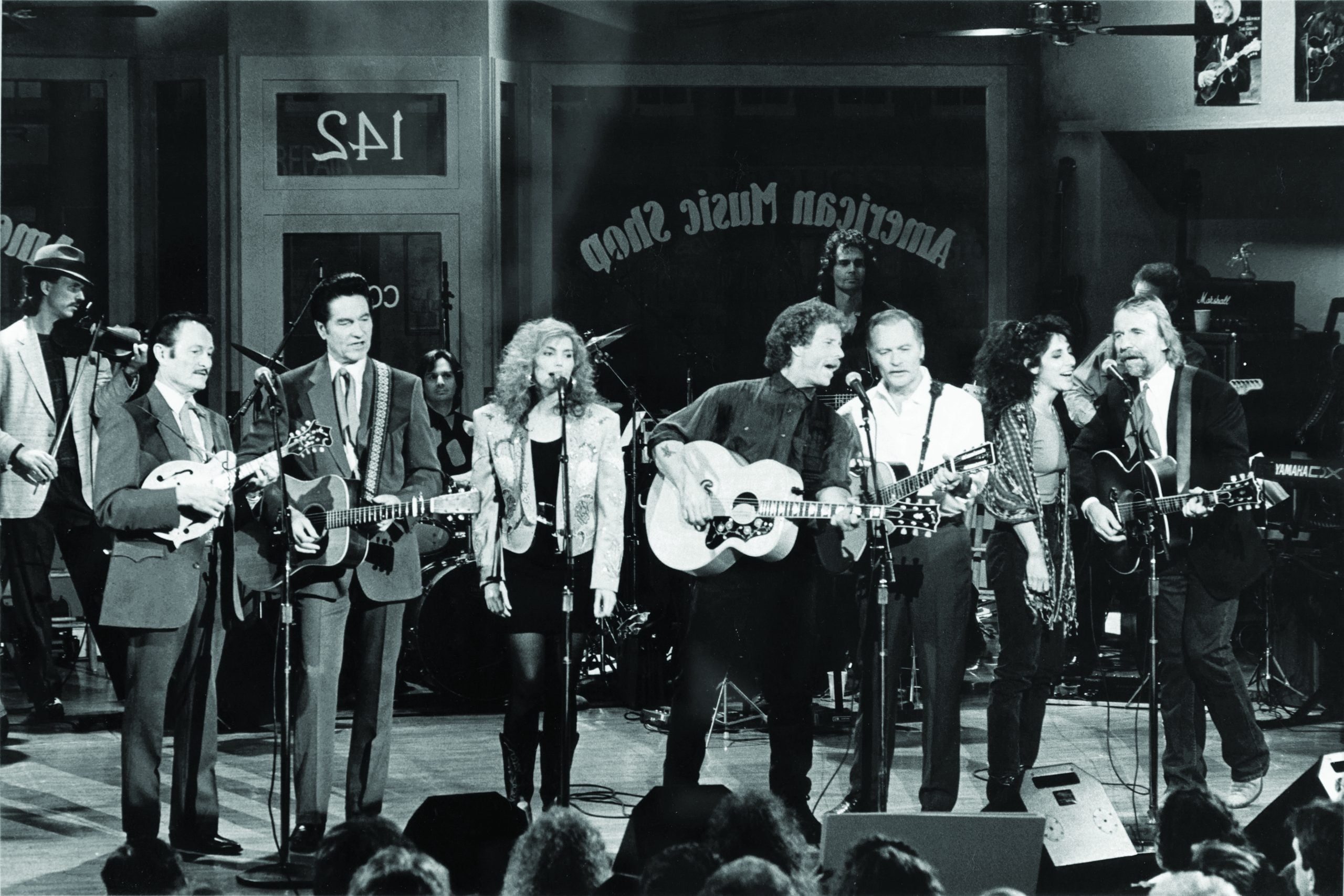
Staggered by such almost incomprehensible generosity, Chris tried to refuse. But Stills explained: A few years previously he’d acquired it from Nashville-based instrument expert George Gruhn for the now-comparatively paltry price of $2,500. And Stephen reminded Chris that in the mid-1960s he’d helped Stills’ band Buffalo Springfield get a high-profile, career-boosting gig at the Whiskey a Go-Go, a Los Angeles rock music mecca. Stephen had never forgotten Chris’s kindness. And it would just make him happy for his friend to have a wonderful mandolin. Chris finally accepted and has treasured his Lloyd Loar Gibson F-5 ever since.
Among the best of Chris’s traditionally-influenced country rock ensembles has been the Desert Rose Band, co-founded with frequent collaborator Herb Pedersen and multi-instrumentalist John Jorgenson. (see “Together Again: Chris Hillman & Herb Pedersen” by Larry Nager, Bluegrass Unlimited, May 2011). Desert Rose ended its first flowering in 1993, but has bloomed again with successful reunion tours.
Meanwhile, Hillman’s powers as a songwriter were attracting notice in the bluegrass world. Mandolin player/singer Larry Rice, brother to flatpicking guitar legend Tony (and both friends from Chris’s youth), introduced bandleader/banjo great J.D. Crowe to the Burrito Brothers numbers “Sin City” and “Devil in Disguise,” co-penned by Chris and Gram Parsons. The versions by J.D. Crowe & the New South were trend-setters in their day and are now considered bluegrass classics.
But for Chris Hillman, perhaps the greatest miracle of all was meeting the woman who became his loving wife and, later, his equally caring manager, Connie Pappas Hillman. They’d met in late 1968 at a folk music club. Chris was immediately struck by her beauty and intelligence. They dated briefly and happily. But their lives and careers went in different directions. Then, in the summer of 1974, they reconnected at a show Chris was playing with his star combo, the Souther-Hillman-Furay Band. They married in 1979 and have two children, Catherine and Nicholas.
Connie spent 43 years in the upper regions of the pop music business in high-responsibility capacities with Elton John’s organization. She’d started in 1973 as executive vice president of the superstar singer/pianist/songwriter’s Rocket Record Company, later served as his North American tour producer, before retiring in 2016. Now she’s happily assumed the roles of Chris’s manager and vice president of his company Bar None Music. “I’m a very blessed man,” he says. “We have a wonderful family, and she’s also a brilliant businesswoman. I wish she’d been my manager 30 or 40 years ago.”
Far from causing role strain as wife and husband who are also manager and client, “it’s a wonderful thing in our lives,” Connie says. “And,” she adds with an appreciative laugh, “he likes to close the office at 4:30 p.m.! It works well, his doing the creative side and mine being the business side.”
One major business item: Later this year, the publishing components of Chris’s songs will return to him. (He’s always retained his writer’s share.) “Some people are selling theirs, Chris is getting his back,” Connie reports. “It’s a wonderful thing.” This encompasses the songs he wrote or co-wrote in the Byrds through the Flying Burrito Brothers. (He’d retained rights to his songs from the Manassas band days forward within his own publishing catalog.) In addition to income benefits, Connie explains, Chris can oversee usage so his songs won’t promote products or positions with which he’s not comfortable.
Chris and Connie are now grandparents and enjoy a circle of dear friends from the music industry. But despite such latter-day joys and contentment, they are no strangers to adversity—and overcoming it. In the evening of December 4, 2017 – the day of Chris’s 73rd birthday – a brushfire whipped into a horrific inferno by high winds destroyed their neighborhood near Ventura, California, plus a staggering total 280,000 acres.
What you grab during a desperate rush to safety speaks clearly about your priorities in life. For the Hillmans, in addition to passports and other vital documents, it was family photos, Chris’s Lloyd Loar Gibson F-5 mandolin plus a vintage Martin D-28 guitar, and religious icons they’d acquired on a pilgrimage to Jerusalem. (Just after the Hillmans fled in their car, a passing firefighting detachment managed – despite losing water pressure in a failure of the city’s pumping system — to save their home except for two rooms.)
Faith and music are both central practices in their lives. Chris was an evangelical Protestant Christian, and Connie is a Greek Orthodox Christian. “After about ten years of our marriage,” says Chris, “I had a strong calling to examine and explore the Orthodox faith.” He accepted that faith in 1996. His love of old-time Southern gospel music stands him in good stead as a singer in his church’s choir. Indeed, a dear friend who’s also an Orthodox priest presented him with a specially-made trophy as “The Greatest Hillbilly Tenor in the Orthodox Church.”
Just as Chris was blessed to learn from talented bluegrass mentors in 1960s California, he gives pointers to today’s aspiring pickers and singers. “In the 1960s, our learning tools were record players,” he recalls. “I just got 70 to 85 percent of what was on the record and made up the rest. Which is actually what you should do.” Chris explains: “We start out as imitators, but we have to go to being innovators. Don’t copy for the rest of your life. Take the best stuff and expand on it. But keep it within the integrity of what that musician was doing when you first heard them.”
In singing as well as picking, he advises, “It’s not what you know. It’s what you do with what you know.” For Hillman, a new star who seems to embody this approach to mastering bluegrass is Billy Strings. “He gets it,” Chris says with respect and enthusiasm. “And he’s got it!”
And speaking of lessons … did Bill Monroe teach Chris Hillman anything during their 1989 magazine photo session at the Ryman? Yes, indeed. During a break while photographer Glenn Hall reloaded his film cameras, Chris and Bill sat and sang together. Chris suggested the Monroe gospel classic, “The Old Cross Road.” All was fine—until Hillman drew a total blank on the last verse. And Bill whomped him with his hand. “He backhanded me to the leg,” Hillman recalls with a laugh. “Not abusive, but like `Wake up and pay attention, boy!’” Monroe then sternly sang, “Soon your life will be over, you’ll have to face the old cross road …” Chris quickly took up his dropped vocal and got through this embarrassing—but fondly recalled—intersection in his music career.
And sure enough, Chris Hillman has remembered all the verses to “The Old Cross Road” ever since.
Richard D. Smith is the author of Can’t You Heard Me Callin’: The Life of Bill Monroe, Father of Bluegrass and a frequent contributor to Bluegrass Unlimited.
*Photos from Chris Hillman’s “Time Between: My Life as a Byrd, Burrito Brother and Beyond