Carley Arrowood
Fiddling and Singing New Colors of Bluegrass
With the March 2024 release of Colors, her second album for the Mountain Home Music label, Newton, North Carolina-based band leader Carley Arrowood is singing and fiddling her way into the hearts of a growing fan base. After graduating from high school, Arrowood toured the world as a fiddler and harmony singer with Darin and Brooke Aldridge and their frequent collaborator, John Cowan. For the past four years Arrowood has been leading her own band, her singles are charting, and the International Bluegrass Music Association has already recognized her with two Momentum Awards: Instrumentalist of the year in 2017 and Vocalist in 2023.
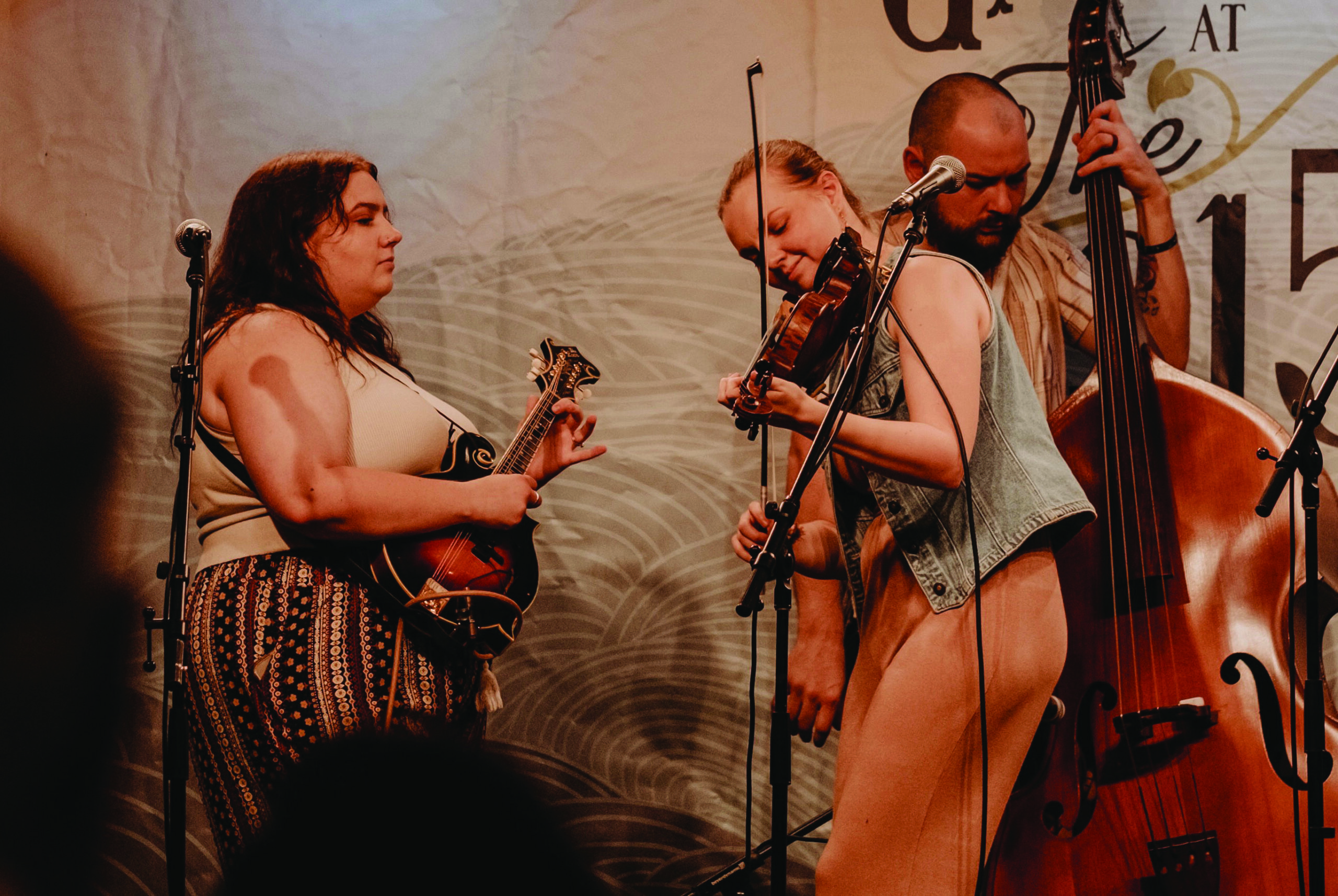
Carley’s drag on the fiddle bow is reminiscent of Alison Krauss, but the music she and the band create is totally unique, painting from a fresh, exciting palette of bluegrass the music listening world is just beginning to discover. Carley’s heartfelt and wide-ranging vocals, her virtuoso tone on the fiddle, and her ability to play anything from barnburner fiddle tunes to Celtic melodies and contemporary love songs, plus her poetic storytelling prowess as a songwriter, are impressive for an artist of 27. She’s also blessed with a talented and cohesive band, including sister Autumn Watson on mandolin and vocals, brother-in-law Paul Watson on bass, Sawyer Whitman on banjo, and husband Daniel Thrailkill, a gifted flatpick and fingerstyle guitarist, singer and songwriter.
Carley’s parents played piano and guitar, but her first serious interest in performing was sparked at a 4-H competition when she heard 14-year-old Todd Elliott play “The Devil Went Down to Georgia.” Nine-year-old Carley was impressed with Todd’s ability to tell a story with the fiddle and entertain the crowd. Soon she was signed up for lessons with Todd’s teacher, Jan Daugherty.
“She started me on classical violin,” Carley said. “We drove up to Lake Lure and took lessons every week.” Autumn started out on mandolin with instructor Dennis McEntire, later picking up violin and viola with Daugherty. McEntire introduced the girls to bluegrass and put together their first band, Carolina Jasmine. “Once a week we’d go to his place, The Pick Shack, in Shingle Hollow, North Carolina, and practice and have lessons,” Carley added. “He’d show me stuff on the fiddle and teach Autumn mandolin. We were homeschooled, so we had a lot more time for music and travel.”
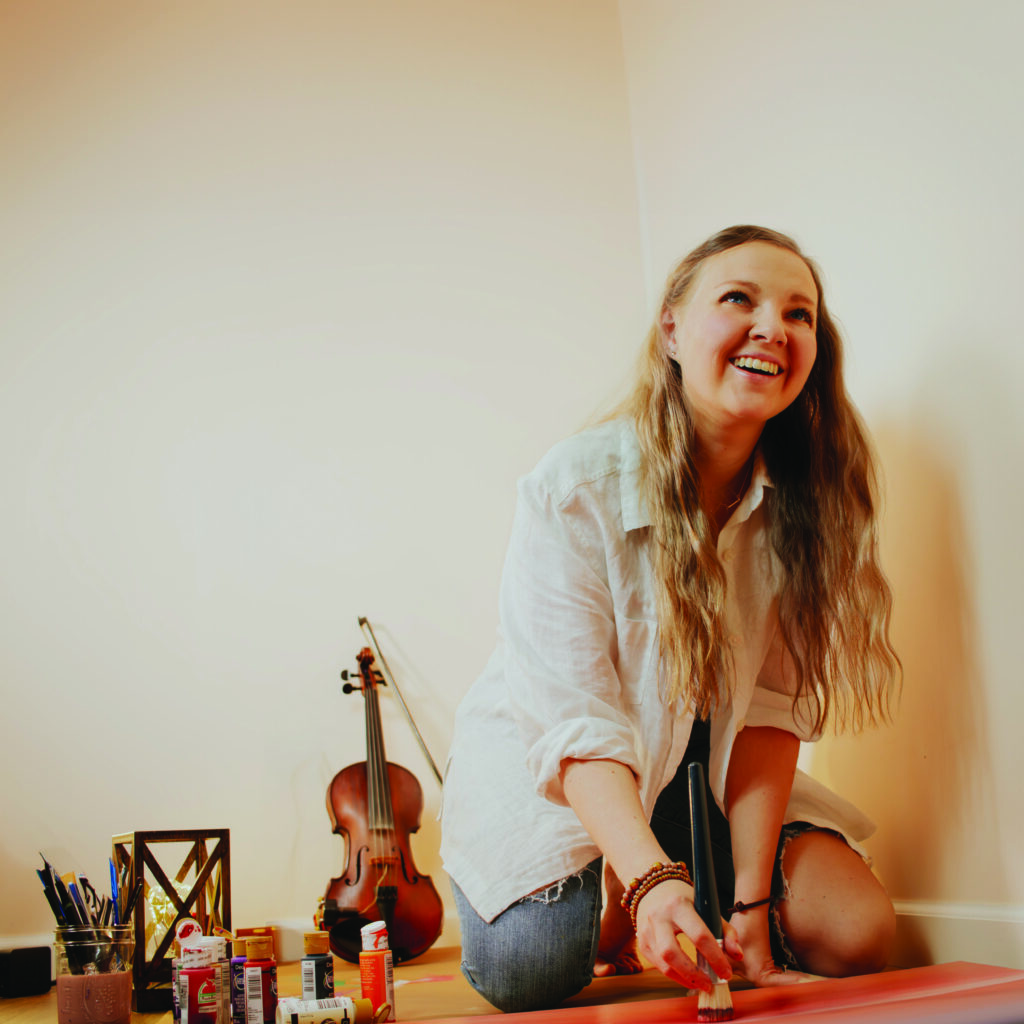
Carley continued with Suzuki violin for four and a half years, becoming concert master with the youth symphony in Hendersonville, North Carolina, at Blue Ridge Community College. “That was fun, but I couldn’t sight read music as well as everyone else,” she said. “Eventually I moved up to the older age group symphony and did that for a year before I realized I loved improvising better than playing what’s on the page.”
Around the same time the Arrowood sisters were taking weekly banjo and mandolin lessons from Kristin Scott Benson (The Grascals) and husband Wayne Benson (IIIrd Tyme Out). “I played banjo for about four years until I started playing fiddle with Darin and Brooke Aldridge, and then the banjo took a back seat,” Carley said.
In high school Carley and Autumn toured locally with a band called Most Wanted Bluegrass. They won contests locally and regionally, played at Dollywood, and appeared on local television programs. Both sisters grew up singing in church from a very young age—something they still do. “That was happening the same time as youth symphony,” Carley recalled. “I still absolutely love classical music, but I don’t have quite the heart for it that I do for bluegrass. When people ask me, ‘Are you classically trained?’ I just say, ‘Yeah, that’s what I started with, and it gave me a great foundation for playing the fiddle.’”
Reigning South Carolina State Flatpicking champion Daniel Thrailkill was named the 2018 IBMA Momentum Vocalist of the Year the same year his band, The Trailblazers, was honored as Momentum Band of the Year. (Go to YouTube to listen to Daniel sing the Stevie Wonder cover, “For Once in My Life” with The Trailblazers for a sample of their progressive bluegrass sound.)
Originally from Mount Ulla, North Carolina, Daniel started with seven years of piano lessons. “My father is a pastor and my mom plays piano,” he said, “so we grew up singing hymns. Being homeschooled, we would start the day with music. Once we got to an age where we could sing parts, I would sing either alto or tenor—depending on where my voice was at the time, my brother would sing bass, and my mother and sister would sing alto or lead. Learning that way helped develop our ears for singing harmony.”
Weary of piano lessons by age 12, Daniel was given a guitar. “I was learning how to play fingerstyle guitar, and it kind of took off,” he said. “What I found eventually was that I was way more interested in how what I’d learned on the piano worked on the guitar. I went to church with a fellow who played banjo, and his teacher also taught mandolin – which was what I wanted to learn next. So I started taking mandolin lessons from a guy named John Marler, who also taught Zeb Snyder. Marler said, ‘Man, I could show you all this stuff on guitar a lot easier,’ so I started taking guitar from him and really got into bluegrass.”
Next Daniel, his brother Will on bass, and banjo player John Lee started The Back Creek Bluegrass Boys. (Back Creek was the name of the Presbyterian church Daniel’s father pastored in Mount Ulla.) “We did that from 2016-2021 and kept listening to good music, wanting to play like Tony Rice and Bryan Sutton,” Daniel said. “Carley and I first met at the Union Grove Fiddlers Convention in Harmony, North Carolina, on a cold, rainy day in April, 2014. The Back Creek Bluegrass Boys were playing that day, and Carley was playing with a band in a contest.”
Carley and Daniel started dating in 2018, and they enjoyed playing as a duo at church. “When she launched her solo career in 2020 we started playing together more,” Daniel said. After she completed the 2014-2020 stint with Darin and Brooke Aldridge, Carley and Daniel married on June 26, 2021.
Carley has played a fiddle made by Lenoir, North Carolina, luthier Bob Kogut since 2018. “The fiddle is #199, and I love it,” she said. “The top is spruce, and the back and sides are curly maple. I use a Joule bow from Coda Bow. The balance points in it are incredible, and the frog in the Joule design is slightly shorter, so there’s more room at the bottom for long bows and chopping.”
On fiddle Arrowood’s primary influences have been Alison Krauss, Aubrey Haynie, Stuart Duncan, Jim VanCleve and Máiréad Nesbitt (formerly with Celtic Women). For vocals, she mentions Alison Krauss and the lead singer of Selah, Amy Perry. “Our church does a lot of music from Sovereign Grace Church and City Alight,” Carley said, “and they don’t have super powerhouse vocals. They’re soft enough to not be too showy, but they’re strong enough to get the point across. That’s something I’ve tried to do—to sing wider when I need to and still be able to control the volume. Singing that kind of worship music has helped me as a vocalist.”
In addition to his first teacher, Daniel Thrailkill lists influences and heroes Tony Rice and Bryan Sutton on guitar, and Rice again for vocals, along with jazz singer George Benson and Michael McDonald of the Doobie Brothers. “There are a lot of peers I listen to,” he added. “I was in guitar contests growing up with people like Alan Shadd, Steve Lewis and Presley Barker. People like that always drove me to seek to be a little better.”
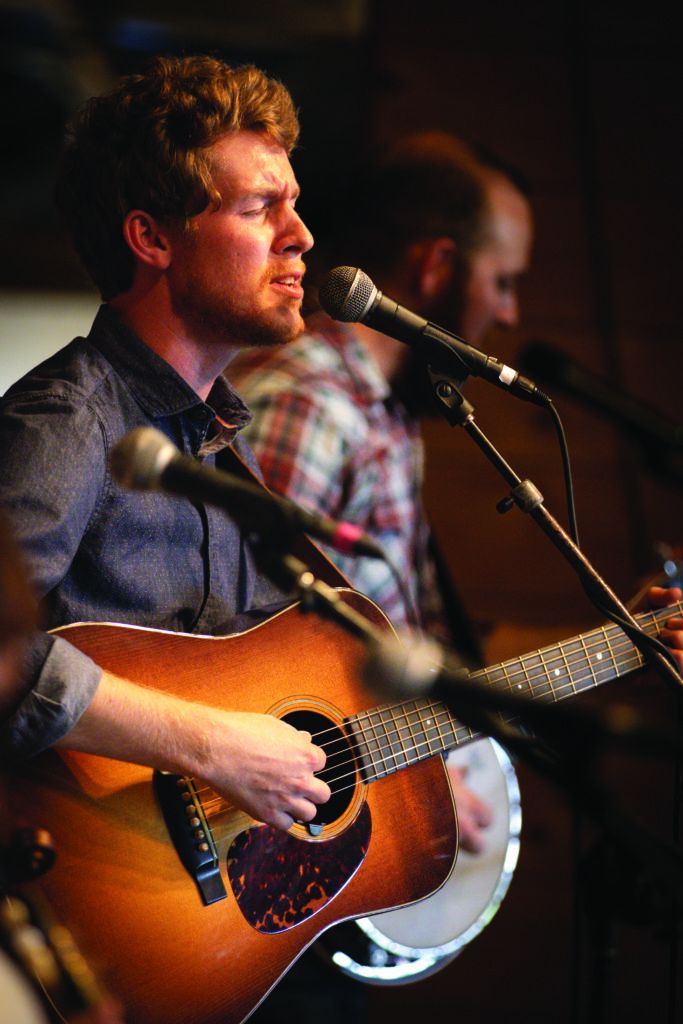
Carley and Daniel have toured with mandolinist Nick Dumas and Branchline, and Carley has frequently guested with the bluegrass gospel band, Chosen Road. After the birth of their daughter, Eliana Hope, who will turn one in June, 2024, Daniel has continued to play with Dumas occasionally as well as in his wife’s band.
“This is a new season of life, and spending a little more time at home is where I’ve needed to be this past year, being Ellie’s Mama,” Carley said. “I may eventually start teaching again, but right now I love being with her. We plan on homeschooling. We’re going to be there for that, and all the other fun stuff. She travels pretty well. One or the other of her grandmas watches her when we’re on stage. In October of 2023 we did some stuff with Nick Dumas and his band, and my sister came with us as a babysitter. Ellie likes the music!”
When not playing the guitar, Daniel’s day job is rebinding Bibles. “We are seeking to play music as much as we can,” he said, “but staying at home and being able to rebind Bibles has been a good thing.” Thrailkill had his father’s Bible rebound in Alabama in 2020, and he got interested in learning the trade. It takes five or six hours to do one Bible, and he can do half a dozen a week. There’s quite a waiting list, and he is becoming known nationally for his work. “I went to college at UNC-Charlotte, but this was something that fell in my lap,” he said. “It’s a sweet thing to be able to work at home and to also be able to pursue music. I use goat skin, cow hide, and I’ve done a few in shark skin. Goat skin is the historic binding for Bibles.”
Carley and Daniel couldn’t be happier with their touring band. “We have a big time,” Carley said. “My younger sister, Autumn Watson, plays mandolin and sings harmony, and she sings some lead. She’s a great songwriter as well. She wrote one of the songs on the new album, ‘This Mess We Made.’ Her husband, Paul Watson, is an incredible bass player, and they currently make their home in Rutherfordton, North Carolina. Autumn and Paul and I played together in two bands, growing up. After graduating, Paul toured with Monroeville five years, and then he moved back home when he and Autumn started dating. It was after that when we got the band together. It was like coming full circle to play with Paul again. Sawyer Whitman, from Hudson, North Carolina, is our banjo player. It’s hard to find a banjo player who can back up a vocalist like he can.”
When he’s not on the road, Sawyer works as a chimney sweep with his father in Lenoir, North Carolina. “Sawyer grew up playing bluegrass and has a really good traditional style,” Daniel added, “but he also knows how to play more melodic things and has a good ear for that.”
In the band vocal department, Daniel said, “It’s fun to sing with Carley and Autumn with the family harmonies. It’s also very fun to sing some of the songs Carley has written, or that Carley and I have written together—although my contributions to co-writing are usually a period or comma here and there, or maybe a word,” he joked. “Autumn is a very gifted songwriter. We look forward to doing more songs that she’s written. It’s a good group.”
Carley has a rich low- and mid-range in her lead vocals, but she can also nail the high notes when she needs them. She sings, writes and plays with undeniable heart. Autumn sings tenor above her sister most of the time, but she’s also got an impressive vocal range. Daniel covers the lower harmony part, and the trio’s vocal blend on the new album is seamless.
In addition to quality of musicianship and song arrangement, the amount of good original material they present and the depth of songwriting from Carley, Autumn and Daniel is striking for artists still in their twenties.
“It’s hard for me to write songs just ‘off the wind,’” Carley said—“to write just to write. It’s got to be something that hits right for me. Daniel and I wrote ‘Chasing Indigo’ after a dry writing spell, and then all of a sudden we worked on it four or five hours one day and had it going. Right now I’ve got a lot of one and two line ideas that could be something really good, but I’m waiting on the right inspiration to hit. I don’t write all the time, but when I do, I really want it to mean something.”
“Moondancer” is a song about a girl and a wild horse that brings to mind the panoramic imagery of Michael Martin Murphey’s “Wildfire.” The young woman in the song is set out for adventure chasing thunder on the ground, a rhythm like a heartbeat in the snow—impressive metaphors and similes for the sound of hoofbeats. The song is based on a short story Carley wrote at age fifteen. “I always had the idea of one day turning it into a song,” she said. “I usually write love songs or story songs. ‘Moondancer’ is kind of cool because it’s got some Cherokee in it. I just found out that Daniel has some Cherokee in him, and I do on both of my parents’ sides.”
“Silas and Cora,” was Carley’s effort at a “bluegrass killin’ song,” she said. “I’d never written anything like that, and I wanted to see if I could do it! I came up with the names of the characters, the first line and the chorus happened, and I thought, ‘Well, this could be cool.’ A fan of Becky Buller’s story songs, Carley reached out to her to co-write. “I spent hours one day trying to get that song where I wanted it,” Carley said. The final version is perfect, and now Silas and Cora join the long list of star-crossed lovers led by Romeo and Juliet, and Barbara Allen and Sweet William.
Carley said she can be bit of a perfectionist—probably a good trait for someone who plays a fretless instrument! “If I write something I don’t like, I’ll get stuck until I can get it to where I want it,” she said. “Daniel has tried to teach me, ‘Just write something and fill in the space, and you can come back later and think of something better,’” she laughed. “I’m getting better at that. A lot of times if I’ve got a line, a melody will automatically come when I’m writing it. I used to write a poem and try to put music to it, but if I can write the melody with the words, it’s a lot easier. That’s been what’s happening lately.”
The last cut on the new album was penned by former Alison Krauss and Union Station band member Tim Stafford (Blue Highway) and Bobby Starnes. “The message in it goes with Autumn’s song, ‘This Mess We’ve Made’” Carley said. “You go through some difficult things, but it doesn’t matter. You always end up choosing the person you love despite the hard times. Everything makes loving that person worthwhile.”
“Deeper in Love” is a Josh Shilling and Bill Whyte song. “The first time we heard it, Autumn said, ‘Shut up and take my money,’” Carley laughed. “It was so good, and it fit what we were going for with an upbeat, contemporary love song.”
The other cover on the new project is “O The Blood,” a fan favorite Carley was asked to record. “It’s a Gateway Worship song,” she said, “and then we heard Selah, a Christian band, cover it later. I heard it in an Easter cantata at church, and I can’t remember if Autumn or I sang lead. I’ve always loved the message in it, and it’s such a pretty song. The first time the three of us sang it in a church service, we could barely get through it. My favorite part is the end where there are no words. Daniel plays ‘What can wash away my sins?’ on the guitar, and I answer with the fiddle: ‘Nothin’ but the blood of Jesus,’ from the old hymn. We finished it the first time, and we were all on the verge of tears.”
Carley likes to listen to songs that have multiple levels of meaning, so that’s the type of music she loves to write and sing. “We’re not straight up traditional bluegrass,” Daniel said, “but it’s not an inaccessible progressive style. We’re trying to find a good spot with a singer-songwriter, contemporary bluegrass sound that’s still very relatable. Maybe people who don’t listen to bluegrass will enjoy it, too. There are songs that we just love on this album and a sound that we just love, and we hope other people will enjoy it, too.”
In addition to Carley, Daniel and Autumn, the new album features Kristin Scott Benson and Tabitha Benedict (The Foreign Landers) on banjo, Jeff Partin (Rhonda Vincent & the Rage) on Dobro and bass, Nick Dumas on mandolin, and Tony Creasman on percussion. Carley loved working with Jim VanCleve (Appalachian Road Show) as producer. “He brought a lot of new energy,” she said. “He was super encouraging about everything, he has an incredible ear for what would sound good, and he was not afraid to add more layers of instruments or try different effects that we wouldn’t have thought of. He’s a studio engineering genius, as well as being a fiddle superstar. Jim also produced my senior high project demo CD when I was in high school, so it was fun to work with him again after 10 years!”
“Jim knows how to get the most out of people in the studio and how to talk to and inspire people,” Daniel said. “He got us angry—in a good way—when we needed to be. He took the time to make sure we were in the right mindset to sing. Not once did he say, ‘Hey Carley, let me show you how to do this on the fiddle.’ He’d just say, ‘You’ve got it, and you’re doing it!’”
Fans are aware that Carley Arrowood is a Christian. It’s rather uncommon for an IBMA Award recipient to quote an Old Testament prophet at the podium, but she did: Isaiah 26:12 – “Lord, you establish peace for us; all that we have accomplished you have done for us.”
Carley’s band has a set of gospel music ready if they’re invited to play a church, but they don’t see themselves as a bluegrass gospel band. Albums will have a couple of gospel songs on them, and a typical live set may have two to three. Daniel said his parents and Carley’s folks taught them that “being a Christian and playing secular music is okay. Every song doesn’t have to trumpet the gospel from the rooftops. It’s more about your manner and your walk in life and loving people,” he explained.
“Mickey Gamble at Mountain Home has said the same thing to us,” Carley added. “We definitely don’t want to shy away from doing gospel songs. Our hope is to let people know there is truth behind them. It’s not just another song or something we play because it’s historically a part of the bluegrass genre. It’s the heart behind what we do. If you think about it, we’re all going somewhere someday, and it’s important to have your heart right before the Lord. We want people to think a little bit about that.”
Some believe there is power in the words themselves. Isaiah 55 says, “As the rain and the snow come down from heaven, and do not return to it without watering the earth and making it bud and flourish, so that it yields seed for the sower and bread for the eater, so is my word that goes out from my mouth: It will not return to me empty, but will accomplish what I desire and achieve the purpose for which I sent it.”
“If you put scripture in songs, that’s the living and active word of God,” Carley said, “and if people are singing it and if it’s his will, it’s going to do something. It will plant a seed, and that’s important.”
Carley Arrowood is pretty happy with life these days, although she is always looking for new venues and opportunities to share her music. “It’s such a gift to be able to do what I do with the people I love,” she said. “God has been so good, and I cannot wait to see where he takes us next and what he does with this new release.”