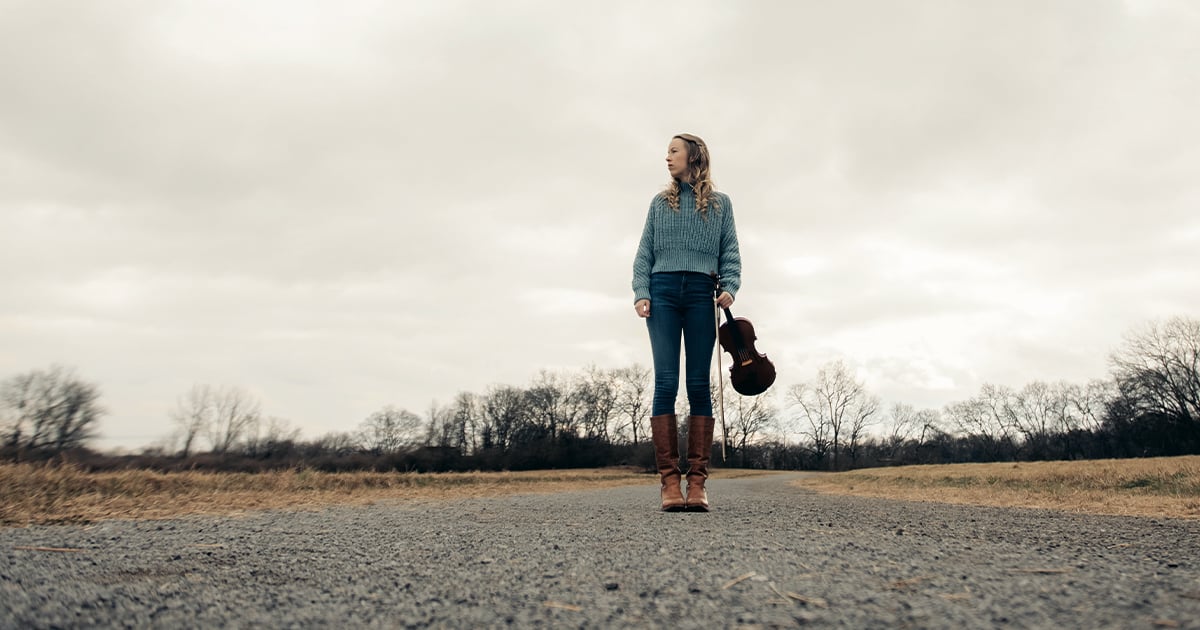
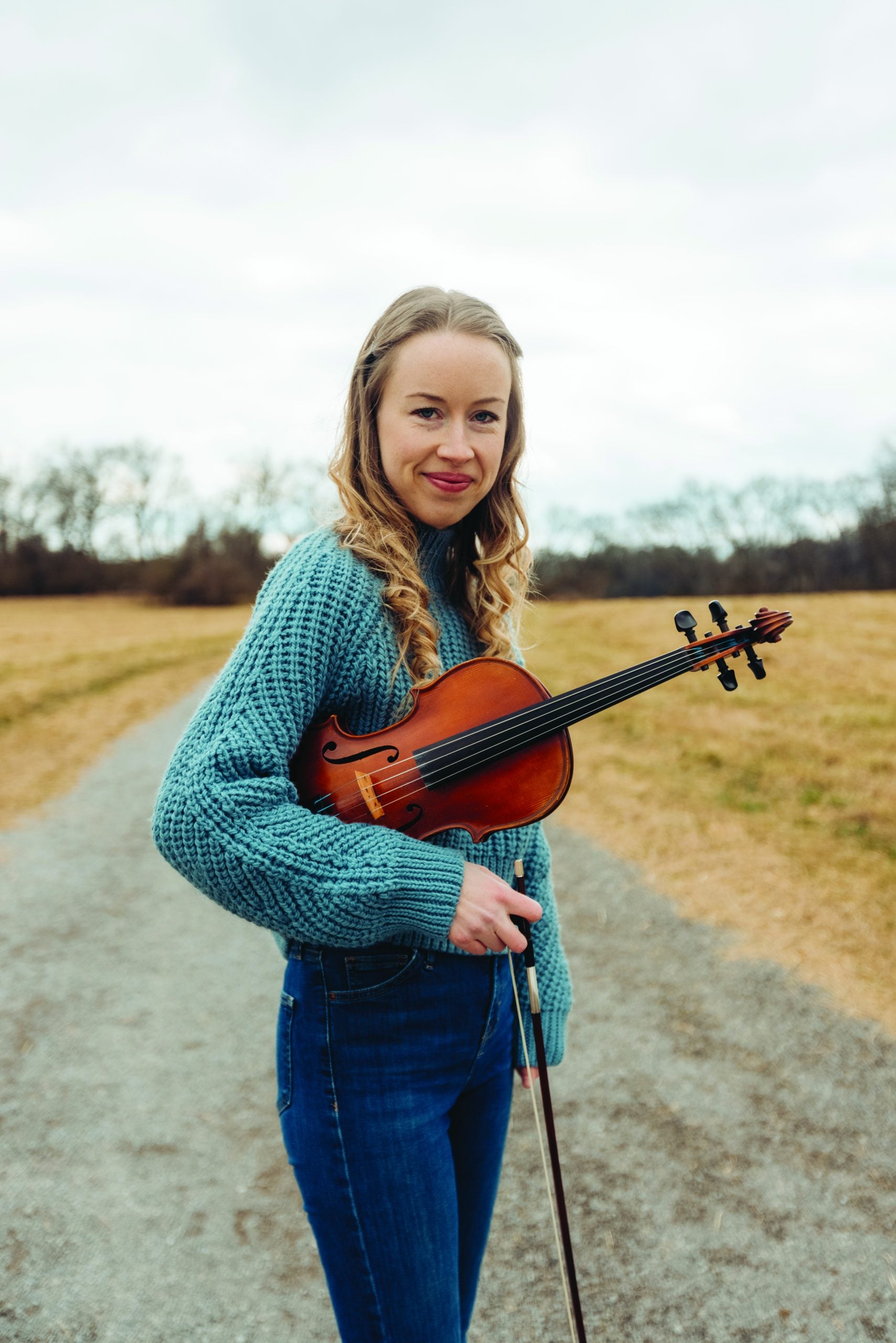
Bronwyn Keith-Hynes
Proving Bluegrass is Alive and Well
Photos by Jake’s Visuals
Shortly after I accepted the job as the managing editor of Bluegrass Unlimited magazine, I received an email from a subscriber expressing his concern about the state of bluegrass music. His contention was, “Bluegrass is dead. Young people just aren’t interested in it anymore.” With no disrespect to this subscriber, I had to chuckle at first because I have been hearing older people make this same statement since I first started listening to bluegrass and attending festivals in the late 1970s. But, here we are over 40 years later and bluegrass music is still alive and well.
The next thought I had turned toward the CD that had been living in my CD player, and getting a daily listen, for a couple of weeks. It was the new album from Bronwyn Keith-Hynes titled Fiddler’s Pastime.
In addition to the absolutely superb fiddling by Keith-Hynes, other musicians who help her create my favorite CD of 2020 were Sierra Hull, Wes Corbett, Sarah Jarosz, Laura Orshaw, James Kee, Chris Eldridge, Tim O’Brien, Jake Stargel, Jeff Picker, and Harry Clark. With the exception of Chris Eldridge and Tim O’Brien, these other phenomenal pickers’ ages land within a few years of the 30-year-old mark. While they are certainly no longer teenagers—teenagers could not play this well—they are still relatively young, and they are inspiring younger people. Add to that list above so many more of the talented bluegrass musicians who are in that same age range and I feel that the future of bluegrass music is in very good hands.
When I first heard Bronwyn play the fiddle, the thing that came to mind was, “She has really worked very hard at this.” The precision and clarity of her notes, the fluidness of her bow, the fierceness of her attack on the up-tempo numbers, the finesse and fine touch on the slower tunes, and the overall energy, or vibe, of her music convey a musical maturity well beyond her years. That led me to think, “She must have started when she was very young.”
In assuming that Bronwyn started playing young, I was correct. She first picked up the fiddle when she was only 3 years old. However, she did not begin learning how to play bluegrass until she was in her late teens. Bronwyn said, “My family was living in Vermont. When I was 3, I was in downtown Burlington and saw two girls busking. I said, ‘I will do that!’ Sometimes I’ve told the story by saying my comment was, ‘I want to do that!’ and my mom has always corrected me and said, ‘No, you said, ‘I will do that!’”
Soon after that incident in Burlington, Bronwyn’s parents rented a violin and she started taking Suzuki lessons. She said, “My Suzuki teacher also taught me how to play fiddle tunes…songs from the American catalog like ‘Oh, Susannah.’ I gravitated towards that.” By the time she was 6 or 7, Bronwyn started studying with a fiddle teacher. That teacher taught the Cape Breton style of fiddling. When she was 10, Bronwyn traveled to Cape Breton to attend a fiddle camp.
While she was still 10 years old, Bronwyn’s family moved to Virginia. The only fiddle teacher that they could find in the Charlottesville area taught Irish fiddling. She said, “My dad’s side of the family is Irish, so it was a cool way to connect to that.” The family traveled to Ireland every year where Bronwyn would participate in Irish music sessions and even compete in Irish fiddling contests.
Bronwyn’s first exposure to bluegrass fiddling came when she was about 16 years old and attended the Swannanoa Gathering music camp where Nicky Sanders was the fiddle teacher. She said that the thing that attracted her the most to bluegrass fiddling was its improvisational aspects. She also felt as if there were more professional jobs available in the world of bluegrass music versus that of Irish music.
While she was there at camp, Bronwyn met several people who were either attending the Berklee College of Music in Boston, or getting ready to go there. She said, “I got inspired because one of my close fiddle buddies was getting ready to apply. When I got home, I told my parents, ‘I want to go to Berklee next year.’” She worked hard to finish her home school studies, applied to Berklee, was accepted and in 2009—at the age of 17—she was off to Boston.
The year 2009 was when Berklee officially began their American Roots Music Program and the school was thick with an influx of young talent around that time, including students such as Sierra Hull, Courtney Hartman, Molly Tuttle, and Alex Hargreaves (to name a few) and teachers John McGann, Darol Anger, Wes Corbett, Matt Glaser, and Joe Walsh. It was a tremendously rich musical environment for the young fiddle player.
At Berklee, Bronwyn dove head-first into the world of musical improvisation. She said, “At first it was a real struggle to make the transition. I didn’t know how chords interacted with the melody. She took private lessons with John McGann, Matt Glaser, and Darol Anger. She credits John McGann, who had a background in both Irish music and bluegrass, for helping her learn to take the first steps toward being an improvisational player. “He explained to me how to start manipulating a melody and changing it in small rhythmic ways,” she said. “The first tune we worked with was ‘Temperance Reel,’ which I was familiar with from Irish fiddling.”
Over time, Bronwyn discovered that the first step in learning how to improvise on a tune is to break the melody down to its core notes and familiarize yourself with that “skeletal” melody. The next step is to fill the spaces between those melody notes with eighth note repetitions of those melody notes. Executing this step, she explains, helps provide an intuitive sense of the time duration between melody notes. From there, instead of repeating the melody notes, other notes that are diatonic (in the scale of the key) and close to the melody notes can be substituted for the repeated melody notes. From this point, improvisations can build slowly, continuing to work within the context of the chord changes and diatonic scales at first, and then, later, expanding with note selections outside of the key.
Bronwyn explained that when first working to improvise, you don’t have to recreate something entirely new. She learned from John McGann that small changes in rhythmic placement of the notes, or minor additions, embellishments, or rearrangement of the melody will suffice when first learning. She said, “At first you only change the melody in a couple of areas, maybe the last four bars.” She adds, “John would always tell me, if you find that your improvisations are getting boring, you are probably not playing enough melody.”
Regarding her introduction to bluegrass, Bronwyn says that she was “grabbed by the more modern stuff first,” like Alison Krauss and Del McCoury. Regarding her fiddle playing, she said, “Casey Driessen’s version of ‘Jerusalem Ridge’ caught my ear, and Matt Glaser pointed me in the direction of Michael Cleveland. He has been a huge inspiration.” Bronwyn also said, “One thing that actually made a big impact on me was a recording Darol Anger gave me of Stuart Duncan playing variations on fiddle tunes at a fiddle camp and I remember specifically Stuart’s 4 or 5 minute version of ‘Forked Deer’ that I learned note-for-note for the next lesson. That was another breakthrough moment. It was one of the first times I’d heard someone improvise that thoroughly, and that well, on a fiddle tune and so I actually broke it down and learned it.” She adds, “Matt Glaser also would always push me in the direction of Benny Martin and Kenny Baker.”
Because Bronwyn submitted a lesson to the Bluegrass Unlimited web site where she taught a Vassar Clements lick, I asked her about Vassar’s influence. She said, “That came a little later while I was still at Berklee. I would hear people playing Vassar licks at jam sessions and that led me to start listening to him.”
Today, with the live performance slowdown caused by COVID, Bronwyn has been spending some time “digging back into older generations of fiddlers.” She says lately she has been listening to the fiddlers of Flatt & Scruggs from their boxed sets and also listening to a lot of Bluegrass Album Band recordings.
In addition to studying at Berklee, Bronwyn was involved with jamming and playing pick-up gigs while she was in Boston. “The Cantab Lounge had a weekly bluegrass night where a couple of bands would play upstairs and people would be jamming downstairs,” she recalls. After graduating from Berklee, Bronwyn stayed in Boston an additional five years because of the rich musical environment. It was while jamming and gigging in Boston that she met the other members of the band Mile Twelve. The bass player from Mile Twelve was also a student at Berklee. The banjo player, BB, had come to Boston from New Zealand and she chose Boston because of its music scene.
“There is a history of bluegrass bands coming out of Boston. After I graduated from Berklee I stayed there, but I was at loose ends,” Bronwyn said. “I had to now figure out how to make a living. I had some private students and some local gigs, and I was practicing a lot.”
About a year after Bronwyn graduated from Berklee, the band Mile Twelve came together with David Benedict on mandolin, Catherine “BB” Bowness on banjo, Bronwyn on fiddle, Evan Murphy on guitar and lead vocals, and Nate Sabat on bass and lead vocals. The band was smart about working to make their presence known and they started booking gigs.
“We put up good material on the website and started to book some local gigs,” she says now. The band’s first festival gig was at Grey Fox on the Emerging Artist stage. Bronwyn adds, “Our first festival outside of New England was in the Florida Keys. That was pretty cool because they booked us on a cold call as a completely unknown group.”
The band also went to the IBMA convention and booked their own showcase room. They peppered the showcases in the room with their own band’s show in between the showcases for other bands who were, at the time, a bigger draw. They got noticed. In 2017, the band won the IBMA Momentum Award for “Band of the Year” and in 2020 the band won the IBMA “New Artist of the Year” award. Additionally, in 2018, Bronwyn won the IBMA Momentum Award in the “Instrumentalist of the Year” category. In 2014, she had also won the Walnut Valley Old Time Fiddle Championship in Winfield, Kansas.
While attending Berklee, Bronwyn had taken a semester of lessons with banjo player Wes Corbett. She said, “Since he is a banjo player, we worked on more general musical concepts.” A couple of years ago, she decided to move to Nashville, and rented a room from Wes when she first arrived. She said, “We spent a lot of time playing fiddle and banjo tunes when I moved to Nashville.” The two musicians also spent time writing new tunes.
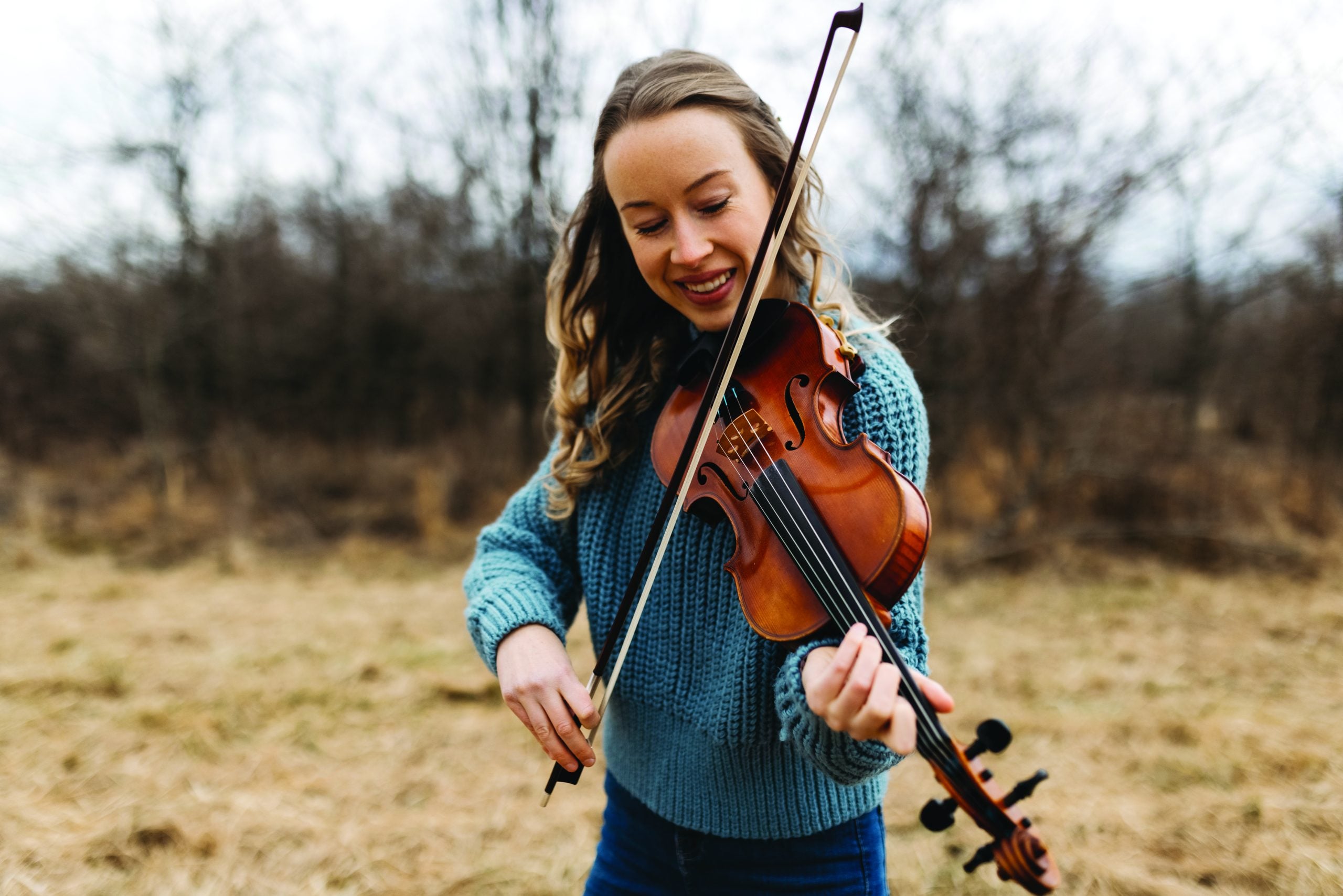
When Bronwyn decided to record her solo album in 2020, she said that Wes Corbett was the first person to come to mind to produce the album. On this album, Fiddler’s Pastime, she included four tunes that she and Corbett wrote together. Although they had written more material, she said, “We whittled it down to our favorites.”
Regarding the other tunes on the recording, Bronwyn said she “wanted to include some special guest vocalists, such as James Kee, Sarah Jarosz, Chris Eldridge, and Tim O’Brien. I choose the songs on the recording with them in mind. I wanted to find songs that would feature them. Some of my favorite bluegrass fiddle albums, like those by Aubrey Haynie and Michael Cleveland, feature guest vocalists. I think half the fun of a bluegrass fiddle album is hearing the fiddler play backup to a singer.” Although Bronwyn sings harmony in Mile Twelve, she has not been featured as a lead vocalist, although she said she may step out and try singing lead in the future.
The band that Bronwyn brought into the studio for Fiddler’s Pastime includes Harry Clark on mandolin, Wes Corbett on banjo, Jake Stargel on guitar, and Jeff Picker on bass. Laura Orshaw is also featured on fiddle on one tune and Sierra Hull plays the mandolin on a tune. Regarding the recording process, Bronwyn said, “We tracked it together with live takes. It took six days of tracking and was finished at the end of January.” The CD was engineered by Ben Surratt, mixed by Dave Sinko, and mastered by David Glasser.
Regarding the future, Bronwyn said, “We are waiting to see what happens. The next recording will be with Mile Twelve.” Meanwhile, she has been spending much of her time during the pandemic teaching one-on-one Zoom lessons. She also intends to start making some downloadable teaching videos that present a long-term curriculum of her design.
In addition to teaching beginning fiddle players, Bronwyn says that her students who are not new to the violin typically are people who are classically trained and have a desire to learn how to play fiddle tunes, or they are intermediate-to-advanced fiddle tune players who want to improve their skills.
When asked about the challenges inherent in teaching a classically trained musician to play fiddle music, Bronwyn said, “The biggest issue is learning about chords and how they function. They don’t usually have that fundamental groundwork and it is important when learning how to improvise. There is also a fast vibrato that becomes a habit to use everywhere for some classical violinists, so a common thing we talk about is changing that to the slower, wider vibrato that is used on longer notes in bluegrass fiddling,” she explains.
Regarding her work with her students who already have a background playing the fiddle, she said that many of them are interested in learning how to play back up. Bronwyn will usually start working with them by showing how to connect double-stops through chords and how to play long lines that are connected to chord tones. Additionally, Bronwyn will analyze her student’s technique with an emphasis on solving tone, intonation, and timing issues.
Although I don’t play the fiddle, I love listening to great fiddle players. Over the years I’ve had my favorites…Paul Warren, Kenny Baker, Bobby Hicks, Byron Berline, Rickie Simpkins, Aubrey Haynie, Shad Cobb, Stuart Duncan, to name a few. Each time I hear one of these great players, it revitalizes my interest in fiddle music. I experienced this same excitement for the sound of the fiddle when I listened to Fiddler’s Pastime. And I’ve now added Bronwyn Keith-Hynes to my list of favorite fiddlers. With musicians like her, and those who perform with her, I have no doubt that bluegrass music is in good hands and will be alive and well for many decades to come.