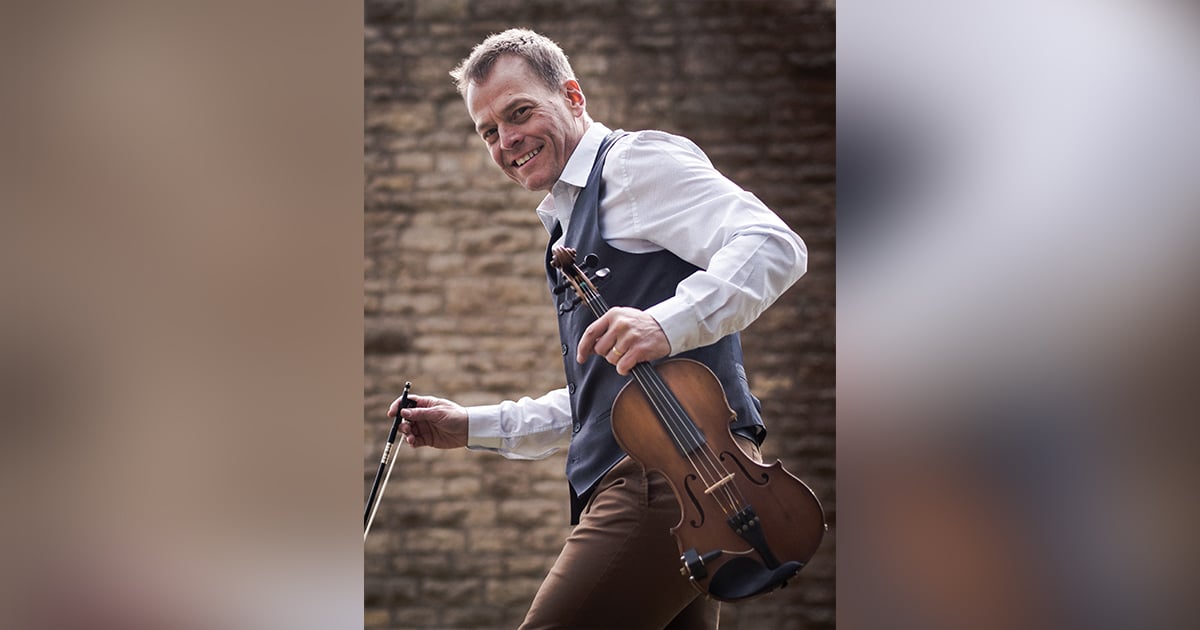
Brian Wicklund
and the American Fiddle Method
In 1998 fiddle player Brian Wicklund wrote and published his first instructional book for fiddlers, titled The American Fiddle Method. To date that book, distributed by Mel Bay Publications, has sold over 75,000 copies. In 2000, a second volume in the series was published. In 2002, Brian was looking for a place to record videos to accompany his books and either through a recommendation from Mel Bay Publications owner Bill Bay, or our mutual friend Adam Granger, or our meeting at the Grey Fox Festival—I can’t recall—Brian ended up shooting those videos at a studio that I was using to shoot instructional videos for Flatpicking Guitar Magazine. The studio was next door to the Flatpicking Guitar Magazine office in Pulaski, Virginia and while shooting the videos, Brian stayed at my home.
While Brian was filming the videos, I had the opportunity to watch him teach to the camera and I checked out his books. While he was at my home, Brian was kind enough to give both of my young daughters fiddle lessons. So, I was able to observe him do that as well. During that week I came to know Brian as a wonderfully warm, good-humored, and generous person and an incredibly patient and talented teacher. I learned a lot about teaching music just by observing him do it and I started recommending his books to anyone who was interested in learning to play the fiddle. In 2017, Wicklund brought his teaching talent and method to an online format that has the same title as his books—The American Fiddle Method (americanfiddlemethod.com).
Background
Brian Wicklund started studying the violin using the Suzuki Method when he was seven years old. He said, “I liked learning the violin, but I didn’t practice a ton. I was a little bit of a flunky, I guess.” That changed when he was about nine years old and Brian’s mother, preparing to write a paper on country music for an anthropology class, brought home a copy of the Foggy Mountain Banjo album by Lester Flatt & Earl Scruggs and the Foggy Mountain Boys. Brian said, “When I heard that, I just flipped out. I thought it was the coolest thing anybody could do. Paul Warren was the fiddle player on that record and it just seemed so fiery and energetic.”
Evidently Brian’s father “flipped out” as well because he bought a banjo and started to teach himself how to play out of the Earl Scruggs banjo book. Brian started to pick up the fiddle melodies from the recording and what his dad was playing on the banjo. The family also started attending bluegrass events and jam sessions. Brian said, “There has been a strong bluegrass community in the Twin Cities area since the early 1970s.” Brian joined his first bluegrass band when he was twelve and when he was thirteen he got “turned on to” Kenny Baker and took a trip down to Bill Monroe’s festival in Bean Blossom, Indiana to hear Baker play. He said, “I was just blown away. I bought every Kenny Baker album that I could with all of my fiddle contest winnings. I slowed down the records and tried to figure out how to do it like Kenny.”
During his college years, Brian continued to play in various bands, which included playing in a band in Japan while he was studying aboard there. Brian earned an education degree and then, instead of opting to use his degree to teach school, he became a full-time musician. His first band after college was Stoney Lonesome. Brian said, “In the band’s heyday we were frequent guests on the Prairie Home Companion radio show.”
Brian has been a full-time musician ever since. He has played as a sideman for a number of prominent bands, including Kathy Kallick, Chris Stuart, and the Judith Edelman Band (with Matt Flinner). Today he fronts his own progressive bluegrass band called the Barley Jacks, who have just released their third recording titled Coming Down the Mountain.
Over the past three decades, Brian has taught fiddle at many bluegrass camps and workshops across the country, including Rockygrass, Augusta, Sore Fingers, Grand Targhee, Nash Camp, and Grey Fox. He was the director of Grey Fox’s Bluegrass Academy For Kids for a decade. Brian started his own American Fiddle Method Camp (originally called Fiddle Pal Camps) in 2009 in Minnesota, Wisconsin and Massachusetts but is consolidating his efforts to just the Minnesota camp this year. Fiddle instructors from Celtic, old-time, bluegrass, blues and jazz genres teach at the camp and integrate their coursework with the guitar and mandolin teachers. The 2022 camp will be held in Stillwater, Minnesota in June.
The Birth of the American Fiddle Method (AFM)
Having been introduced to the violin through the Suzuki Method, Brian borrowed some of the Suzuki principles when developing his method for teaching the fiddle. Brian said, “The thing that I think Suzuki does well is teaching technique through repertoire. Students can get lost in etudes and exercises because they can be boring or tedious. The method that I develop teaches techniques through songs.”
Brian added, “Suzuki is also a method based on learning by ear—reading comes later. Learning the fiddle is an oral tradition. You don’t learn how to speak by learning a word a day or analyzing sentences. You learn to speak by being immersed in it and mimicking the sound. So, my fiddle method is built on call-and-response. You hear a phrase and then you play it back.”
When Brian first showed me his American Fiddle Method books, I was not only impressed at how he introduced various fiddle techniques through the student’s learning of tunes, but I was also felt like adding lyrics in the book and vocals with the CD that came along with the books was a great idea. The recordings are of a full band playing, and singing, these tunes. Usually when a book teaches fiddle tunes like “Boil ‘em Cabbage Down,” “Cripple Creek,” “Camptown Races,” “Old Joe Clark,” “Angeline the Baker,” “The Girl I Left Behind Me,” “Redwing,” “Turkey In The Straw,” etc. the fiddle is the only instrument on the recording. I feel that in hearing the song played in a band context, hearing a singer singing the words, and having the lyrics in the book, the student can learn the basic song melody faster.
Brian said that his method has been very popular with Suzuki violin students who are looking to transition to playing fiddle tunes because of the similarities in the methods. He said that adult beginners have also found the books very helpful.
The American Fiddle Method Goes Online
In 2017, Brian started to present his fiddle method using a video streaming format on the web. He built the online lessons from the material that appeared in his books and on his earlier videos. To date there are seven courses offered on the site—AFM 1 (beginner), AFM 2 (beg/intermediate), AFM 3 (intermediate), Bluegrass 1, Bluegrass 2, Scottish 1, and Scottish 2. The American Fiddle Method courses were reviewed in the April 2021 issue of Bluegrass Unlimited. The newest courses, Bluegrass 1 and Bluegrass 2, are reviewed in the reviews section of this issue.
In addition to the courses, the American Fiddle Method website provides a Fiddle Tune Library. This library includes over 100 tunes that are taught on video (played at a slow tempo), with sheet music provided. These tunes have come from the various instructors that have taught at his fiddle camp over the years.
In the future, Wicklund intends to continue to add to the fiddle tune library, expand the course offerings to include Irish and old-time fiddle instruction, and plans to start live, guided courses next fall. Classes meet once per week for eight weeks to progress through the AFM curriculum. Brian said, “The online class will be like a ‘fiddle boot camp’ with expectations of practicing between lessons and the opportunity to get direct feedback from the instructor. These courses are really motivating for students as they work together in a class.”
If you are looking to learn how to play the fiddle, or improve your current skill level, I highly recommend that you check out Brian Wicklund’s American Fiddle Method at americanfiddlemethod.com.