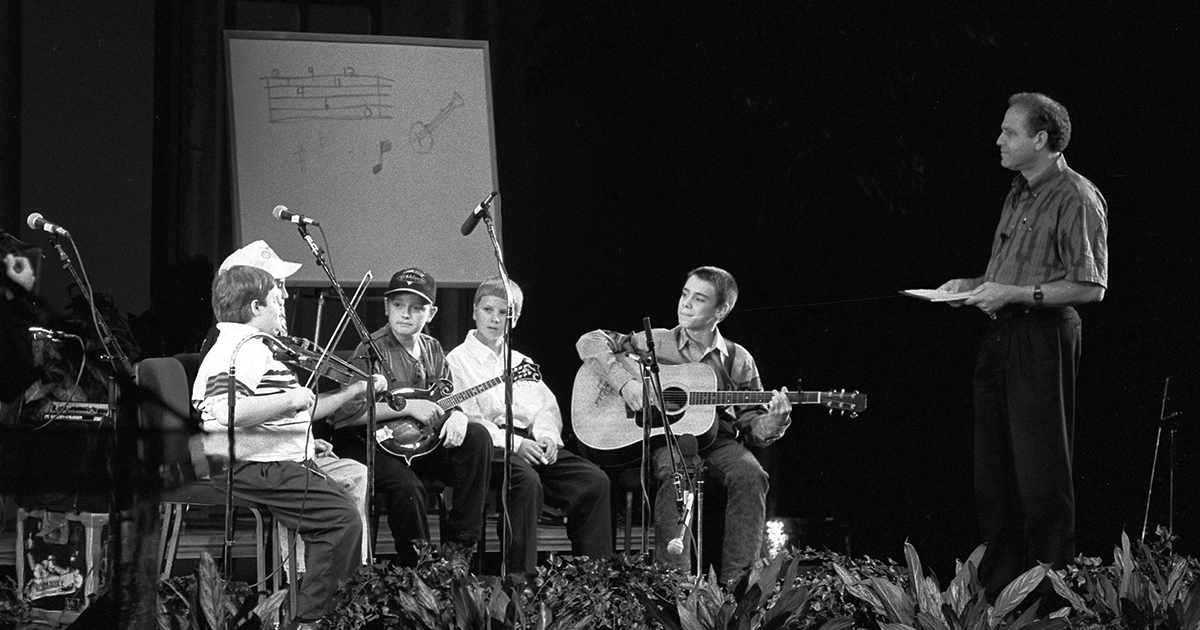
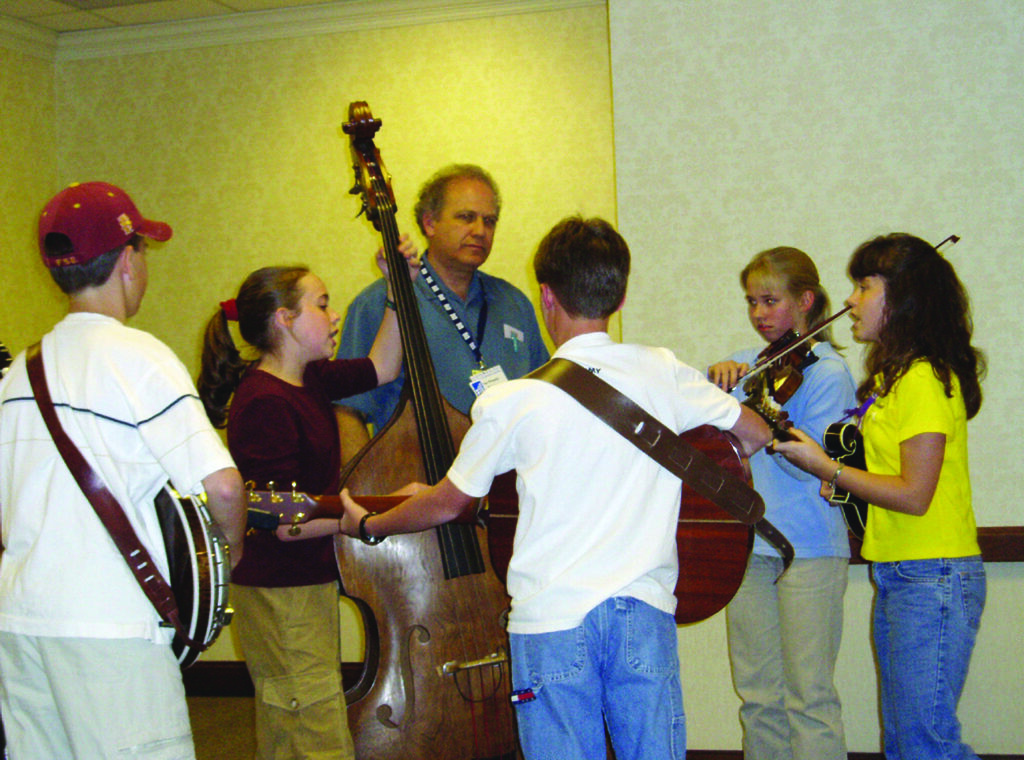
Bluegrass Youth All-Stars (1993) and the Young American Bluegrass Idols (2003)
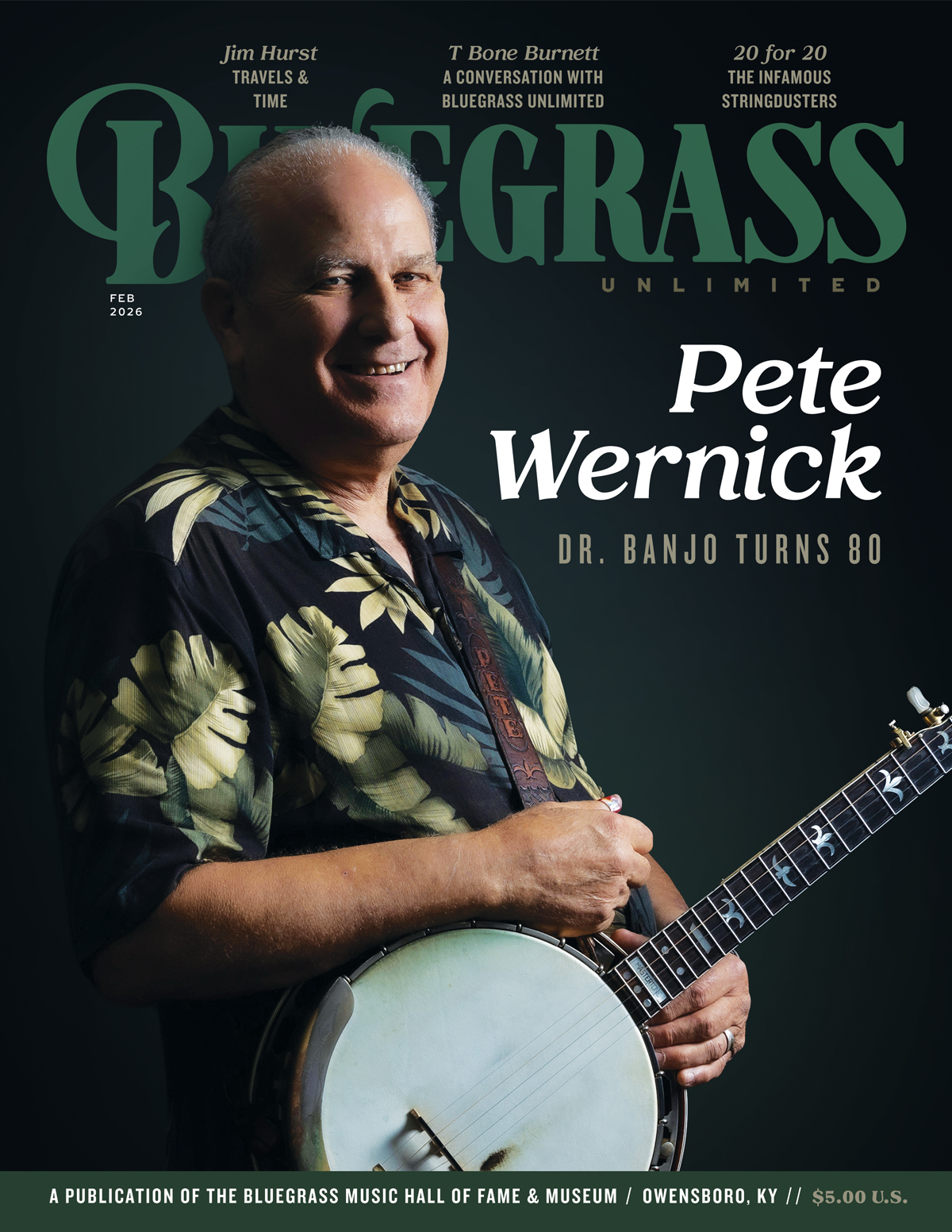
In the early days of the IBMA conference, kids’ involvement was nearly non-existent. Former IBMA president, Pete Wernick—who put together a kids band to perform at the 1993 IBMA awards show—explains, “In 1993 when the Bluegrass Youth All-Stars appeared on the awards show, that was the first time that kids had ever been on stage at the awards show and I dare say that it may have been the first time that kids were even at the annual conference. Kids just didn’t come because it was during the school year, and everything was geared to the business aspects and the professional groups. A few months after that first performance, Bluegrass Unlimited ran an extensive article by Tim Stafford about all the startup youth programs in different places and ways to help them. That helped grow general recognition and enthusiasm about kids in bluegrass.
“And then the following year, a lot of kids came to the conference, and IBMA started kids programs and a youth membership, and got more organized, promoting bluegrass in schools. There was a new awareness and energy to roll out the red carpet with Kids on Bluegrass, which I think had already started in California, and build some infrastructure to support young people learning and playing the music. From then on, there were always a lot of kids at the IBMA conference. Some were homeschooled kids or kids that were allowed to get off from school, and even some kids from other countries. In North Carolina, you could be excused from school if you were doing something educational in music.
“I brought in Dan DeWayne from the Strawberry Festival in California for a whole IBMA session about that festival’s innovations, which included three different levels of youth activities. That was well attended and led to more kids’ programs starting at important festivals. IBMA has done a beautiful job with the Kids on Bluegrass program. But it wasn’t there at first.”
Today, the International Bluegrass Music Association’s (IBMA) Kids on Bluegrass program is very popular and a big deal. Over one hundred youth apply to participate in this program at IBMA’s annual conference. IBMA’s website explains this program as follows: “The program matches kids of similar abilities, offering them the opportunity to create and arrange music both instrumentally and vocally, and to perform in a band with their peers. Many IBMA Kids on Bluegrass alumni have gone on to become professional musicians, including Sierra Hull, Sarah Jarosz, Casey Campbell, Cory Walker, Nick Keen, Alex Hargreaves, Seth Taylor, Molly Tuttle, Austin Ward, Christian Ward, Gaven Largent, Ivy Phillips, Cory Piatt, and Wyatt Ellis.” And there are many more.
When asked to provide the story of the Bluegrass Youth All-Stars, Pete Wernick said, “It is the thing that I am most proud of that I did in IBMA.” Here is that story.
The 1993 Bluegrass Youth All-Stars
Covering the Johnson Mountain Boys break-up in a Washington Post article in 1988, titled “Singing the Blues for Bluegrass,” writer Richard Harrington declared that bluegrass was “fading” and suggested that there was a general lack of interest in the music among young people. Pete Wernick, who was the president of the IBMA at the time, was dismayed by Harrington’s assessment of the future of bluegrass and set out to prove him wrong. Wernick said, “It was a huge article and a lot of people are quoted saying that no young people are interested in bluegrass anymore. I knew, from my travels, that this was completely inaccurate. I had met quite a few brilliant young musicians, including Chris Thile, Josh Williams, and Cody Kilby, who’d come to my banjo camps. In 1992, I proposed to IBMA that we make a statement at the awards show by presenting an all-star band of eleven-year-olds, including those three kids and also Luke and Jenny Ann Bulla.”
The proposal did not fly in 1992 due to reluctance to have one less spot for a professional band, but Wernick did not give up. He said, “They didn’t see the significance and the extent of these kids’ talents. I needed to prove the power of the idea, so the next year I went and created something of a press kit for the band I was imagining, with excerpts of cassettes I had from each of those kids [Thile, Williams, and Kilby] because they had been recording music. If you listened to it, they sounded like pro players, but they were eleven-year-olds. I included photos and bios of each of the kids, including the Bullas, and I was finally given the go-ahead. I lobbied real hard that year because I knew that growth spurts would happen soon and the amazing ‘little kids’ effect would be lost.”
As luck would have it, in 1993, a film crew led by filmmaker Bob Mugge was at the IBMA convention to make a 90-minute film about the event, called Gather At The River. Months ahead, Wernick contacted the families and was able to get Chris Thile, Josh Williams, and Cody Kilby on board. Unfortunately, the two Bulla kids were not able to attend. Wernick remembers, “I felt bad losing Jenny Ann because I was hoping to include a girl. I asked around to get a fiddle player. Tony Williams, Josh’s dad, said, ‘Well, there is this kid Michael Cleveland. He’s blind, but he’s really good.’ I said, ‘Let’s get him!’”
Wernick continued, “I got in touch with Michael’s dad, and Michael had a friend, Brady Stogdill, who could play bass, and he got recruited. I then had to arrange for fifteen people to get to Owensboro the day before the show…the parents of the five kids and the five kids. It was the first time they’d all met each other, and they were excited to be together. I have an awesome video of the kids jamming like all blazes when they first met.”
Wernick rehearsed the band for the show and selected “Wheel Hoss” and “Heavy Traffic Ahead” to perform. He said, “I selected ‘Wheel Hoss’ because it is just a cool Bill Monroe tune. I chose ‘Heavy Traffic Ahead’ because it was the very first studio cut recorded by the classic bluegrass band with Monroe, Scruggs, Flatt and Chubby Wise. It starts with each instrument playing a short signature lick. I also liked the idea of future bluegrass stars singing about “heavy traffic ahead.”
I wanted to create a surprise, so rather than saying, ‘Here they are, a bunch of young kids to blow your mind and play “Wheel Hoss,” I put together a little skit. I asked the kids not to dress up. This was back in the day when people attending the award show wore tuxedos and evening gowns. I had them wear typical attire like T-shirts and ball caps so I could present this as though they were just regular kids. Then, we would surprise everyone with how good they could play.”
Wernick wrote the skit to have all of the kids say something. He explained, “To start the skit, the narrator says, ‘Pete Wernick does these bluegrass workshops. Let’s look in on one of his workshops.’ I’m also dressed in normal apparel, and I have a whiteboard that, as part of my humor, has a quite unplayable tab written on it. I say, ‘Let’s hear your homework assignments.’ Then one by one, they play the signature licks from the intro of ‘Heavy Traffic Ahead.’ I liked how that made a full circle. These are children in 1993 playing bluegrass music that was recorded in 1946, and they are playing the exact licks first played by Scruggs, Flatt, Monroe, and Wise. They play their licks, and then I say, ‘That’s good. You all did your homework assignment.’ I then say, ‘You know, the Washington Post put out a big article saying that bluegrass is on its last legs and kids don’t like it and they are not into it.’ In the skit, they say, ‘Oh, that is so wrong. I show this to all of my friends, and they like it!’ Then Michael says, ‘Oh, look, there are some microphones!,’ (more Wernick humor).
“They go over to the microphones and play ‘Wheel Hoss.’ When we rehearsed, they wanted to make a special arrangement so there’s a twin banjo part, and twin fiddle and mandolin, and Chris had a pretty cool way to play ‘Wheel Hoss.’ I explained to Cody, who could play both guitar and banjo, that after he plays his guitar break, he’ll need to switch fast to banjo in the middle of the tune. As it turned out, he has just enough time to put the guitar down and pull out his finger picks, and, exactly in time, he has his banjo picks on, and he’s playing twin banjos with Josh. If you watch the movie, you can hear the people in the audience going nuts when these kids played ‘Wheel Hos.’ like pros. They got giant applause because people really hadn’t heard any of these kids. And part of the effect was that they were little, and had high voices, and they really looked like pip-squeaks.
“I’d assumed they’d get an encore, so I had them work up a short version of ‘Heavy Traffic Ahead,’ with Chris and Josh singing. The filmmaker, Bob Mugge, interviewed us all, and Michael talked about how he likes to jam. I talked about why we put together the kid band.
“But something else that went into the movie, that many people remember, was Michael Cleveland meeting Doc Watson. Michael had to go to the bathroom after the show. His dad was taking him to the dressing room and I walked along with them. As we go into the dressing room, we see Doc Watson jamming with Dan Crary, Tim O’Brien, and some other people. I saw that Michael was being led right by Doc, and I realized that this was a special opportunity. I introduced them by saying, ‘Doc, Michael here is a really good young fiddle player, and he is also blind.’ Doc invites him to jam, and they start playing Michael’s favorite, ‘The Orange Blossom Special.’ While this is happening, people realize that there are two blind musicians jamming, one seventy and the other thirteen, and they summoned the film crew. Two guys came in with cameras and got right next to them without making a sound. They recorded them playing and a conversation between them, talking about being blind. Doc says, ‘You have a God-given talent that nobody can rob you of.’ Michael replies, ‘So do you!’ That was typical Michael because he is so forthright and quick.”
The movie was played many times in the coming years on The Nashville Network. Wernick said, “The whole performance of ‘Wheel Hoss’ and the conversation between Doc and Michael got into the movie and got a huge audience, all thanks to the fact that it happened the year Bob Mugge was there.” Clips of the band playing ‘Wheel Hoss’ and the conversation between Doc and Michael can now be found on YouTube.
Reflecting back on that band, Wernick said, “Kids in bluegrass need special nurturing because their parents have to drive them around to get together with any other kid. One of the real thrills of that first band is that all of these kids had never gotten to play with other kids who were as good as them. Chris was in Nickel Creek, and Sean [Watkins] was an excellent player, but he was not on that level yet. Chris had won the National Mandolin Championship a few weeks earlier.
I’m happy that I had this opportunity to advance the fact that youth are coming on strong in bluegrass, and there would be a giant new generation of bluegrass players. As far as I am concerned, they are now up there with the founding fathers, and I think the founding fathers would approve because they all know how to play real bluegrass.”
The 2003 Young American Bluegrass Idols
Ten years after the Bluegrass Youth All-Stars performed at the IBMA awards show, and the members of that band were making names for themselves in bluegrass music, Pete Wernick wanted to give it another shot. He said, “I thought, ‘Wow, it is the ten-year anniversary.’ By this time, I had met Sarah Jarosz and Cory Walker. I am no longer the IBMA president, but I said, ‘I’d like to do this again, is that all right?’ I thought I could get all five of the original guys from 1993, now in their twenties, and then I would put together another band of twelve-year-old all-stars. I invited Sierra Hull, who I didn’t know yet, but I knew about her. By word of mouth, I got a girl named Mary Beth Estes to play fiddle and Will Jones on guitar. Because Sarah Jarosz could play bass, I asked her if she would mind playing bass instead of mandolin. Then I realized that she and Sierra could do a slow intro with twin mandolins. Then they kicked ‘How Mountain Girls Can Love’ into high gear, and Sarah grabbed the bass and sang. The 2003 band was called Young American Bluegrass Idols, a takeoff on American Idols, which was a TV show at the time.”
Recalling how this band was received, Wernick remembers, “They did ‘How Mountain Girls Can Love’ with trio harmony, and everybody played real good. But it wasn’t the shocker like the first one was. After they performed the song, all five of the now grown-up guys from 1993 came out unannounced, and all ten of them played together.”
One potential conflict in bringing the original five members to the show in 2003 was that Chris Thile was getting married two days after the awards show. Wernick said, “Chris had to get clearance, which could have been touchy, but he wanted to do it, and he made a point of getting there, and two days later, he got married. But he spent some time hanging out with the kids’ band, and that is when most of them met Chris for the first time. Chris is really a wonderful guy when it comes to mentoring younger kids. So, that was very touching to me that he made a point of hanging out and mixing it up with the five kids from the young band. The older kids were now heavily involved in their bluegrass careers. They were no longer the little kids. They were young bluegrass stars.”
Commenting on the future of bluegrass today, Wernick said, “I think that it is thrilling to see little kids playing really high-level bluegrass for a number of reasons besides just the sheer amazement of it. One reason is that when they start early, it is in their bones for life. And it makes sense that they’re the best people to inspire other kids. All of the kids that I’ve talked about, even though they could have gone on to careers in other kinds of music, they are all deeply grounded in bluegrass. Bluegrass gave them a place. Bluegrass gave them the honor of acceptance.”