Bluegrass Unlimited Celebrates the IBMA Hall of Fame Induction Class of 2025
Featuring The Bluegrass Cardinals, Hot Rize and Arnold Shultz
Whenever I have interviewed bluegrass musicians who were born and raised west of the Mississippi River, not only do I tend to ask them about the bluegrass scene in their part of the world, I also ask them if they felt like they grew up far away from the region of the country that was considered to be Ground Zero for the bluegrass genre.
Many times, the answer is usually yes, as musicians distinctly remember making that trek to Kentucky, Tennessee, Virginia, North Carolina, or the Baltimore-Washington DC area for the first time, or they eventually made the move and came east to stake their claim.
The Bluegrass Cardinals
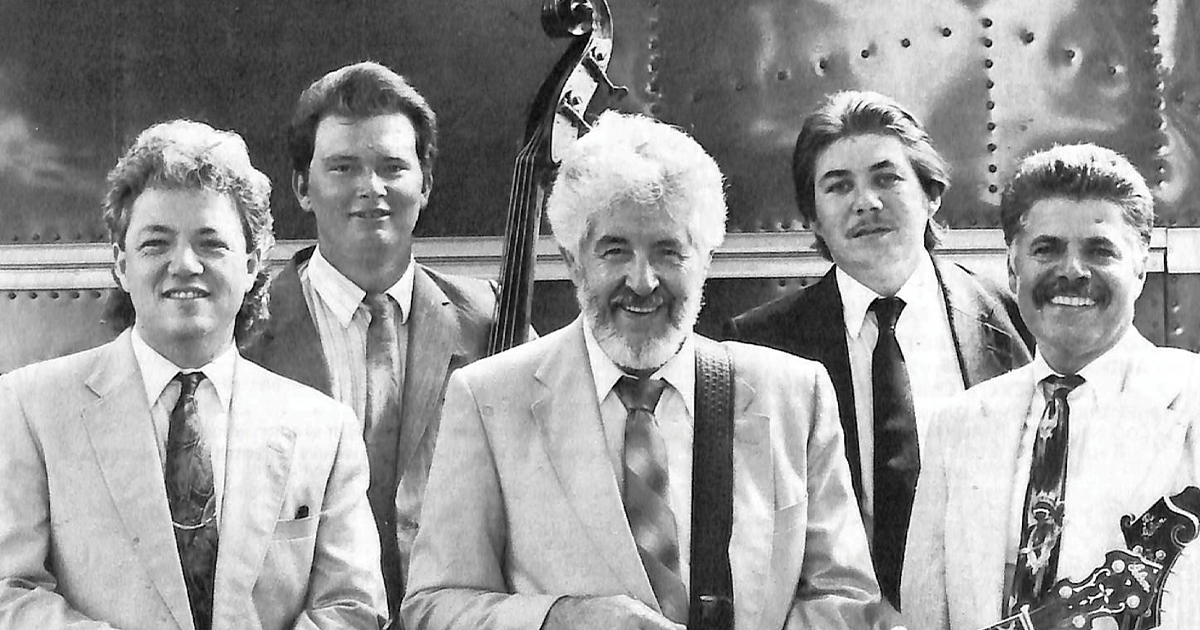
When it came to the true life story of Don Parmley, however, the patriarch of the Bluegrass Cardinals, one of the newest bands to be inducted into the IBMA Hall of Fame in 2025, he did the opposite. Born in Monticello, Kentucky, in 1933, in the central/southern part of the state, he began to play clawhammer banjo at 12 years of age. Parmley then switched over to the three-finger style of picking the instrument after hearing Earl Scruggs on the Grand Ole Opry. Living within 150 miles of Nashville, WSM-650 would have come in clear on the AM radio dial in 1945, which is the same year that Parmley began to play the five-string, and the year that Scruggs first played on the air with Bill Monroe’s band at the Ryman Auditorium.
As a young man in the Bluegrass State, Parmley’s talent began to blossom, and he would perform with notable musicians such as Hylo Brown and Carl Story. By the time the Korean War began in the early 1950s, however, he was in the U.S. Army. Parmley first trained as a tank driver, but then he was asked to share his music with the troops, which was done to make them less homesick. After the war ended, Parmley married his wife, Betty Jean, and that is when they had a decision to make.
Good jobs were scarce in Parmley’s part of Kentucky, yet instead of going to Detroit, Ohio, Baltimore, or the Washington, DC area to look for work, the couple headed west to California.
Now, all of these years later, we think of the migrations of workers to California as happening a century or more in the past, with the famous book about the subject, John Steinbeck’s The Grapes of Wrath, being the template. Yet, the fact is, The Grapes of Wrath book was published just 21 years or so before Mr. and Mrs. Parmley moved west, and the movie version of the book won two Academy Awards just 16 years prior to their migration.
Once in the greater Los Angeles area, the small but fervent California bluegrass community welcomed Parmley with open arms. He played with legendary bands like the Golden State Boys and The Hillmen, performed and recorded with artists such as Glen Campbell, Vern Gosdin, Doug Dillard, and Chris Hillman, and eventually formed the Bluegrass Cardinals with Randy Graham and his teenage son David Parmley in the early 1970s.
Parmley also spent some time in Hollywood. When I was a kid and I watched the reruns of the Beverly Hillbillies TV show, I knew that the program’s theme song was played by Flatt and Scruggs. But I also wondered if the occasional loping banjo riffs that appeared during various episodes were also played by Earl Scruggs. As it turns out, those fills were performed by Parmley.
As the Bluegrass Cardinals began to gain some steam, they took a residency at the Busch Gardens amusement park. Then, with Parmley in his 40s, he and Randy Graham eventually decided to leave their day jobs and steady band gigs behind and make that big move east to the aforementioned Ground Zero region of bluegrass music. They were getting older, they thought at the time, and it was a matter of now or never. So, the trio loaded up their vehicles and moved to Washington, DC.
In the July 1979 edition of The News Virginian newspaper, both Don Reno and Don Parmley were interviewed at the Orange Blossom Park festival. In the article, Reno says this about the Bluegrass Cardinals, “They are a good group that plays good, straight bluegrass music, but they left the West Coast two years too soon. That’s where the action is today.”
When Parmley is interviewed, he blatantly disagrees. “There is not as much work on the West Coast as back here,” said Parmley. “Bluegrass isn’t growing fast, but it’s getting better all the time.” Parmley also says in the article that when he first moved to California, he stopped playing music for six to seven years.
Randy Graham also vividly remembers those early years in California and the move to Washington, DC. Here, in this new interview with BU, Graham talks about the Bluegrass Cardinals’ journey.
“The southern California bluegrass and acoustic music scene during the Folk Music ‘Hootenanny’ era was a pretty big deal, but because it was a niche-type of music, everybody knew everybody that played it,” said Graham. “For me personally, blind luck played a huge role in this story. I was playing with several local groups out there while Don had played with bands like The Golden State Boys, the Blue Diamond Boys, and The Hillmen.”
At one point, Graham experienced what he calls “Stroke Of Luck Number 1.” “The Golden State Boys played on TV on a show called Cal’s Corral, and during all of the airtime on the show, they changed bands every half hour. My Mom would watch it and she really liked the way that Don ‘hunkered down,’ as she called it, when he played the banjo. Then, one day, I was invited to a jam session, yet I didn’t know where I was going. A friend of mine named Tom Mullen said, ‘Hey, there is going to be a jam session at somebody’s house down in Artesia, so why don’t you come down there with me?’”
“It turned out to be Don Parmley’s house,” continues Graham. “At the time, all I wanted to do was to play the guitar and sing. So, Don and I hit it off immediately. He liked the way I played the guitar, yet at that time, I was an undisciplined tenor singer who was used to singing duets with my family and friends. But Don really helped me with my trio singing. He said, ‘You have a great instrument, but you just have to learn how to use it,’ and we struck up a lifelong friendship. I was 19 years old.”
Before David Parmley began to play music, Don and Graham formed a band that at one point featured Larry Rice on the mandolin and Bobby Slone on the fiddle. After Rice and Slone moved to Kentucky to join J.D. Crow’s band, Parmley asked Graham if he would play the mandolin while his young son David played the guitar. Now performing under the title of The Bluegrass Cardinals six days a week at Busch Gardens, all of this activity led to Graham’s “Stroke of Luck Number 2.”
“The idea of moving east was a very big decision,” said Graham. “Don and I both had very good day jobs, while David was just a kid, and he didn’t have anything to lose. He didn’t even have a driver’s license at the time. Don was 13 years older than I was, and I was 13 years older than David. I was working for the American Motors Corporation as the Owner Relations supervisor for all of the Los Angeles Zone, that ran from just south of San Francisco to the Mexican Border to all of Arizona. So, it wasn’t an easy gig to give up. Don and I sat down and talked about the move east over a long span of time. The hard part was telling my family, which I did over Thanksgiving dinner, and I’ll just say this: it sure got quiet. I think my Dad thought I was going to be the head of IBM someday or something, and when I told him I was leaving town to play music for a living, it was five minutes of absolute silence, which was deafening. He thought I had lost my mind, but my Mom was kind of supportive of the idea.”
Watching all of this happen was the young David Parmley. At the time of the move, he was a teenager and ready to rock. That began the journey of the Bluegrass Cardinals’ attempt to make a name for themselves in the East.
After the relocation, and because of their ability to play and the power of their vocals, The Bluegrass Cardinals were eventually accepted into the greater bluegrass world, and they became a top act on the circuit.
Sadly, Don Parmley would pass away in 2016. When Don Parmley died, I sent a message to the late and great Tony Rice, asking him if he had any words to share about those early California days when Parmley played with his father in the Golden State Boys. It would be one of the last conversations I would ever have with Tony, and it became an article at the time here in Bluegrass Unlimited Magazine.
Here are some excerpts from that now-historic conversation.
“The Golden State Boys were made up of my father, Herb Rice, along with my uncles Hal Poindexter and Leon Poindexter, and my uncle Walter Poindexter was their banjo player at the time as well,” said Rice. “As fate would have it, Walt was drafted into the Army so the Golden State Boys did not have a banjo player. So, Dad got in contact with Don and he came over to the house and they played together and after my father heard him play, he asked Don, ‘How would you like to join us?’ And, the rest is history.
The news of Parmley’s death nine years ago mostly sparked many memories from Rice’s younger years back in California. “When I was a kid and David Parmley was a kid, it was always such a joy when Don and Aunt Betty were coming over to the house because that meant they were bringing David,” said Rice. “Being little kids, you can imagine how us two became friends there. Don’s passing has hit me real hard today. When I heard that first Ralph Stanley died not even a month ago, and now Melvin Goins and Don Parmley have died as well, at age 65, it really makes you aware of your own mortality in a way that can kind of shake you up a little bit.” Rice would pass away in 2020 at 69 years of age.
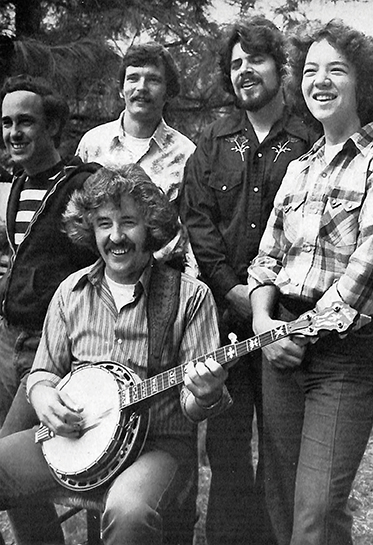
After life in the Bluegrass Cardinals, David would form his own band, the Continental Divide, and would spend time as a bus driver, working with the Del McCoury Band for many years. Currently, David is recording a new album for the 615Hideaway label that will feature old Bluegrass Cardinal songs as well as new original cuts.
“The folks at the IBMA called me about a month before word about us getting into the Bluegrass Hall of Fame and Museum got out,” said David Parmley. “IBMA Executive Director Ken White called me and said, ‘I just want to let you know that the Bluegrass Cardinals have been voted as one of the next bands to be inducted into the IBMA Hall of Fame.’ It felt great. My Dad has been gone for 9 years now, and it’s just good that the call finally did happen. My Dad would have been very proud of this honor, but he was also not the kind of person who would let anybody know that he felt that way. He was the kind of guy who kept his emotions to himself. He was never much for awards shows and all of that kind of stuff, but deep down, I know good and well that he would be very proud of this accomplishment.”
When one gets the news that they are being inducted into an important institution like the IBMA Hall of Fame, things immediately change as they think about their plaque on the wall at the Bluegrass Hall of Fame and Museum in Owensboro, especially when they realize the names on the wall next to them. Then, it becomes a universal experience. It becomes almost forever, and it is heavy to deal with for many.
“Oh, I know that, and I’m very glad that this has happened,” responds Parmley. “I’m happy about it because we really worked hard through those years. We travelled on many roads and drove a lot of miles. It is good that we were recognized for the fact that we did work so hard. When I look back, when we started this band, Dad was driving a bus for the Continental Travel Agency on the West Coast and one day he said, ‘You know, if I’m going to drive a bus, it’s going to be for my own band, so I’m not going to keep hauling other people around.’
“My Dad, Randy, and I would sit around and work on harmony singing for years, even before we formed the Bluegrass Cardinals,” said Parmley. “Eventually, Randy said he was ready to quit his day job and do something else. I was still in high school, and we all decided to make the move.”
When the Bluegrass Cardinals made the decision to work their way towards the sunrise, they did an eight-week trial run on tour, and that is when lightning struck in Columbus, Ohio, which became another of Graham’s aforementioned “Strokes of Luck.”
“We booked a show at a college bar in Columbus, and it so happened that Frank Godbey and his wife had come in to the club to see us, because they didn’t know who we were,” said Parmley. “Bill Bryson was playing the bass with us then, and Dennis Fetchet was playing the fiddle. Frank was writing for Bluegrass Unlimited Magazine at the time, and he was blown away by our band.”
The end result was an article about the Bluegrass Cardinals written by Godbey and published here in Bluegrass Unlimited that helped to blow the band wide open.
“When we played in DC on that initial tour, Walt Broderick, who owned the Red Fox Inn, said, ‘If you guys want to move here, Wednesday nights are yours if you want it,’” said Parmley. “That was a one steady gig, and then we found another place called Charlie’s West Side in Annapolis, Maryland, and they said we could have their Tuesday nights. So, we knew that we had two nights a week of steady gigs if we were ready for it. By the time we had moved to DC, we were working every day of the week except on Monday. Then, we eventually played for President Carter at the White House, and we travelled the world, doing gigs for the U.S. government in the Middle East and elsewhere, playing at embassies in India, Sri Lanka, Egypt, Jordan, and Pakistan. We also played in France, Holland, and Germany.”
Hot Rize
In the 1970s, just as the Bluegrass Cardinals made plans to head east, the members of the band Hot Rize were moving west to Colorado. Pete Wernick and Nick Forster came in from New York, Charles Sawtelle had moved to the Rocky Mountain State from Texas, and Tim O’Brien had migrated there from his home state of West Virginia.
Hot Rize formed in 1978 after all four artists finally found each other along the Front Range of the Rocky Mountains. Sawtelle worked at the Denver Folklore Center, where Forster worked for a while as an instrument repairman, and Wernick and O’Brien met through jam sessions that were held in the area.
At that point, Wernick was already known in the music world for his membership in the band Country Cooking and their early 1970s albums released on the Rounder Records label. The group featured Tony Trischka, Russ Barenberg, and other artists. Wernick’s first instructional book on playing the banjo sold a lot of copies as well, so he and his wife, Joan, made the move to Niwot, Colorado. Sawtelle had also gained notice for his time in the band Monroe Doctrine, and O’Brien began his Colorado journey with the group The Ophelia Swing Band.
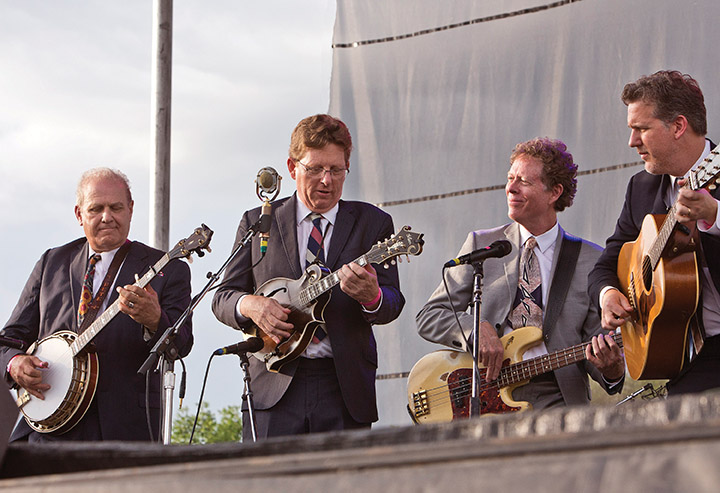
An early version of what would become known as Hot Rize briefly featured guitarist Mike Scap, a talented musician whom O’Brien had known from the Ophelia Swing Band. Eventually, the classic version of Hot Rize came together when Forster became the bass player and Sawtelle moved to the guitar chair, which melded wonderfully with Wernick on the banjo and O’Brien on the mandolin and fiddle.
When the foursome decided to tour full-time, it was Wernick that booked the band for the first four years of its existence. What is funny about that task, looking back, is that it was in the age just prior to the advent of widespread cell phone usage and before the advent of the internet and email. That meant you had to reach out to book gigs at various venues by using either a landline phone or a phone booth.
“Booking the band consisted of all telephone calls,” said Wernick. “Many was the time when we’d be on tour and crossing Kansas on I-70 on our bus, and I’d have to say, ‘Look, I have to call this guy at 2 o’clock.’ So, we had to pull the bus off the interstate and find a phone booth and then put coins in it, and a lot of times, the person wasn’t there when I would call them. That is when we had to just get back on the interstate and keep driving and try again later. That is why booking a show could be tedious work because to do it, you had to reach the person on the phone and talk to them live to make it happen. Back then, we also had to have a supply of glossy photos of the band, and we had to mail out vinyl albums to the people that booked the shows so they could hear our music. It cost 14 cents to send an album through the mail back then, and that meant a lot of time spent with cardboard and tape.”
Hot Rize quickly made their mark in the bluegrass world, especially after the release of their first self-titled album. That recording featured songs that are still standards in the genre, like “Nellie Kane,” “Ninety Nine Years,” and more.
The look of the band also became a part of their lore, whether it was dressing in disguise as their electric-instrument-playing alter-egos known as Red Knuckles and The Trailblazers, or their normal Hot Rize brand.
“Charles had a lot to do with our band’s attitude, you might say,” said Wernick. “He was the guy that made us shine our boots and do everything in a professional way instead of a hippy-dippy way, which was our inclination. Charles hated to drive by a Goodwill store and not go in, and we would look through these barrels of silk ties from the 1950s. He would say, ‘Look, that tuxedo is only ten dollars. You’ll wear it sometime, so buy it. It’s just ten dollars.’ We all ended up with Goodwill suits. Then, at a gig in New Mexico, just for fun, we all decided to wear our used fancy suits that we had purchased, and folks thought we looked good in those suits. And, while onstage, we felt cool to be wearing them, so we kept doing it.”
After becoming a known quantity and accepted in the bluegrass community, despite their different Colorado sound, Hot Rize began to rise up in the ranks. Twelve years after their formation, Hot Rize became the first-ever IBMA Entertainer of the Year award winners in 1990. One year later, their album Take It Home received a Grammy Award nomination. And, along the way, they began to meet and get to know their first-generation bluegrass heroes who were still alive then.
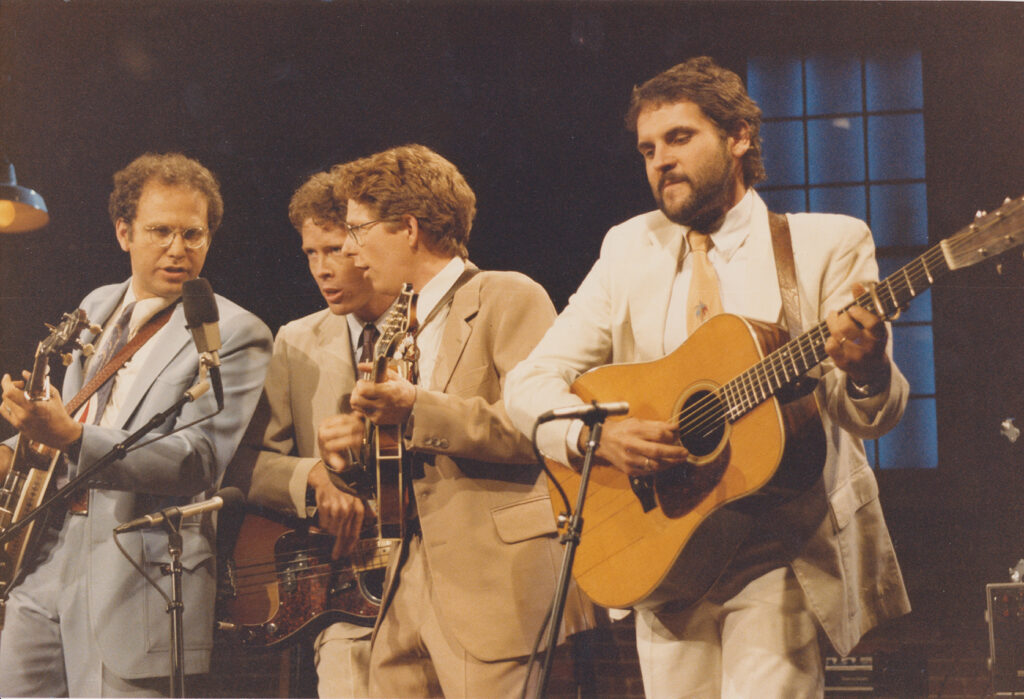
“You know, I was in a jam session late one night at a festival in Canada with Bill Monroe, singer Maria Muldaur, and Garth Hudson from The Band,” said Nick Forster. “This happened back at the hotel at 3 o’clock in the morning. Garth was playing the accordion, I was playing the guitar, and Bill had his mandolin out. Then, at one point, we swapped instruments. Bill took my 1936 D-18 guitar, and I played his mandolin, and he said, ‘Now, I’m going to play a number called the ‘Arkansas Stomp.’ He also said that night, ‘I don’t think I’ll have the time, but I have a whole other (genre of) music in me.’ Maria also sang ‘Sitting Alone In The Moonlight’ and other tunes. The hotel had a hospitality room downstairs, and we were just staying up too late and fooling around.”
Sadly, Charles Sawtelle died in 1999 after a long battle with leukemia. When the remaining members of Hot Rize decided to regroup three years later, they brought in the great guitarist Bryan Sutton, who has been a permanent member of the group since then, and who will go into the IBMA Hall of Fame with the four original artists.
“Bryan was a perfect choice for us for so many reasons,” said Forster. “The main one was that he loved the band. Bryan also loved Charles, and he had his picture taken with all of us in Hot Rize as a teenager while backstage in Denton, North Carolina, many years ago. So, he grew up really liking our sound and Charles’ guitar playing, and yet, Bryan does not sound like Charles on the guitar. He doesn’t try to imitate him. It was really a beautiful transition to watch as Bryan adapted to being in the Hot Rize guitar chair after coming in from Ricky Skaggs’ band. With Ricky, Bryan was used to playing fast and hard and loud, filling as much space as possible. So, when he first started playing with us, I said, ‘Bryan, here is the thing about Hot Rize; Pete’s banjo is rolling and Tim has a loose right hand with his mandolin rolling as well, while also hitting the offbeat, and I have the low end covered with the bass. So, in our band, you can literally stop playing completely at any time, if you want to do it, during any song, and it will be fine with us. That kind of blew his mind. He didn’t do that, of course, but he could have if he wanted to.”
Bryan Sutton has long been one of the best guitarists in the bluegrass genre, with ten IBMA Guitarist of the Year awards to prove it. Still, he is massively humbled to be going into the IBMA Hall of Fame with Hot Rize.
“We found out a little bit before the public did, and I am very happy for Pete and Tim and Nick,” said Sutton. “I know that Pete was on the phone in the early days virtually every day of the week with promoters and he did a lot to build that band into what it became, which has been a passionate force in the world of bluegrass when it comes to getting the word out about our music, by supporting younger musicians and by organizing people. This honor is a good testament to Pete’s legacy as a member of the band and to who he is as a person. I recognize that there are two versions of Hot Rize, and it is the 20th-century version of the group with Charles that represents most of their hit songs and all of the heavy touring that they did. They were and are the main energy of the band. But I do feel fortunate to be a part of that legacy and to be able to help them spread and share that legacy over the last 20 years or so. Obviously, though, this group would not be in the Hall of Fame without those years from 1978 to around 1999.”
Sutton agrees that joining Hot Rize helped his musicianship to evolve, especially when it came to finding space in the songs and adapting to how Wernick, Forster, and O’Brien played as individuals and collectively.
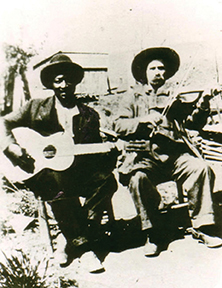
“The secret sauce of Hot Rize, or any other good band, is to make more out of less, where subtraction is just as effective as the addition,” said Sutton. “That is especially true in bluegrass music, where there are minimal instruments being played compared to some rock bands, for example. I think all musicians go through that kind of evolution, and I was fortunate to get to realize a lot of that in real time while playing and performing with those guys in Hot Rize.”
When it comes to getting a phone call out of the blue from someone that normally doesn’t call you, and that person says that they want to tell you something that is ‘very important,’ the message is either bad news or good news. In either case, the real-time hesitation as the conversation begins can be intense.
“I was up at the Montana Fiddle Camp, where I was teaching the mandolin all week, when I got the call,” said O’Brien. “There was no phone service where we were, but we did have some internet, and I was checking my email, and I got this ping, which was Ken White telling me to call him when I got the chance. When I did call him, the news of the induction was very cool, and I was totally amazed. I knew that this honor was certainly possible at some point, and maybe even likely, but I wasn’t expecting it. That same night at the Montana Fiddle Camp, there was a Teacher’s Concert and then a student jam session afterwards, and guitarist Chris Luquette was an instructor there. One of the last songs we played at the jam was ‘Blue Night,’ which was made famous by all of us in Hot Rize. There were about a dozen pickers there, and we were passing the song around, and everyone got a solo, and when it got to Chris, he played Charles Sawtelle’s solo note-for-note. That really touched me, and it felt really good.”
When that happened in front of O’Brien that night, having just heard his Hall of Fame news, it reminded him that Hot Rize was noticed and still remembered by later bluegrass generations that were not even born when the group began.
“We are definitely a part of the fabric of the bluegrass genre, and that is a great honor,” said O’Brien. “I told them right before that jam that I had gotten the call and to keep it a secret for now, and when we played that Hot Rize song, I almost teared up as it kind of took my breath away. The funny thing is that back in the day, when we played at the traditional bluegrass festivals, we were the ‘newgrass band,’ yet in Colorado, we were the ‘traditional’ band. Bill Monroe was a little suspicious of us, as he was with almost everybody. But the guys in the Seldom Scene were really supportive of us, as were the folks at the Birchmere venue. The late Pete Kuykendall of Bluegrass Unlimited Magazine was supportive of Hot Rize as well. Those guys were interested in the bluegrass genre continuing forward, and they were supportive of anyone who was working hard at it.”
What is amazing about the above interviews is that they were done by living human beings speaking into a phone by Hall of Fame artists whose music was listened to by the masses via recordings. Those are obvious statements, yet it also leads to the story of our final inductee into the Bluegrass Hall of Fame, Arnold Shultz.
Arnold Shultz
Arnold Shultz, of course, was the great guitarist and fiddler who played with Bill Monroe when Monroe was a teenager living in northwest Kentucky. Shultz was an African American artist who lived during the time of Jim Crow apartheid in the United States of America. He died in 1931 at only 45 years of age, and despite his influence on Monroe and other musicians like Kentucky guitar great Merle Travis, no recordings were ever made of him playing music, nor do we know what his voice sounded like.
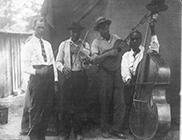
Arnold Shultz was born as the son of a former slave in 1886, just 21 years after the end of the Civil War. Shultz worked as a coal miner and did other jobs while playing with his family’s band as a young person. Later in his short life, he played with many other combinations of musicians as he became an adult.
According to many reports, Shultz could play the slide guitar and the fiddle, he could play ‘hillbilly’ square dance music, and he could play the blues. One of the few things that successfully breached the race issues of that time period was music. Music lovers of all stripes wanted the best musicians in their midst to provide the best entertainment possible, and in Ohio County, Kentucky, that was Shultz. And, white musicians wanted Shultz in their bands as well because his talent was apparently undeniable.
As for Shultz’s time with Bill Monroe, both of Monroe’s parents had passed away by the time he was a teenager, and that was when he was taken in by his uncle Pendleton Vandiver. Uncle Pen and Shultz were buddies who liked to play music together, and Bill was soon playing with both of them on a steady basis.
In 1986, Dave Higgs did a video interview with Bill Monroe in Denver, Colorado, for The Mandolin Café website. During the conversation, Monroe talks about his time being around Arnold Shultz.
“Arnold was a Black man, and he could really play the guitar and really play the blues,” said Monroe. “I always loved the blues. I heard different people around Rosine, Kentucky, play the guitar and play the blues, but he was a fine guitar man. Merle Travis and other people like that also played a fine guitar and the blues. So, I just had to put some blues into my music in the bluegrass style instead of taking it the old-time way they used to play it. You will find the blues in a lot of the songs and the instruments that we play.”
Another cool way of looking at that time in Monroe’s life is to realize the atmosphere that it all happened in, not only with the race issues, but the reality of the music community in that region of Kentucky. What I mean is that Shultz was already considered the go-to musician of his era there, and yet he brought along Monroe to play at paying gigs with him on occasion. Sometimes, it would just be Shultz and the teenage Monroe performing together at dances as a duo. That means that even at a young age, Monroe’s talent was considered to be real and clear.
Later in life, Bill Monroe would be inducted into both the IBMA Bluegrass Hall of Fame and the Rock & Roll Hall of Fame, and rightly so. Here is an interesting idea to consider. Back in 2004, I interviewed the late bluegrass legend Jimmy Martin, and he told me this about Monroe being inducted into the Rock & Roll Hall of Fame. “Let him get in all the hall of fames he can,” said Martin. “Stand him right up there, because I told him one time, I said, ‘Bill, you play rock and roll mandolin and you don’t know it.’ He said, ‘I don’t play that dang rock and roll.’ I said, ‘You don’t know that you play rock and roll mandolin, the way you chunka-chunka-chunka-chunka?’ I said, ‘Listen to rock and roll blues and then listen to ‘Brakemen’s Blues.’ Why, you’re rocking on down the line, Bill. And when you kick off that ‘Muleskinner Blues,’ that’s a kickoff of a rock and roll song as I’ve ever heard.’ And he said, ‘I don’t play that dang rock and roll.’ I said, (laughing) ‘OK, Bill.’ Yeah, he did play it, and hooray for it. That’s the reason why he is different, and nobody else can play it. He had it all. When they think they’re playing that mandolin like Bill Monroe, they’d better let me get up there with my guitar, and I’ll show them they’re not. There isn’t anybody that can touch him.”
The fact is, Jimmy Martin is right, as many of Monroe’s early riffs influenced what would become rock and roll music. So, if you think about it the right way, what that means is if Arnold Shultz’s bluesy influences on Monroe’s playing led to what would become bluegrass music, did those same influences lead to Monroe’s riffs that would, in turn, also influence the creation of rock & roll music as well? It makes one wonder if Shultz should be in multiple halls of fame instead of just one.
As of now, however, it is an overdue yet beautiful fact that Arnold Shultz will finally be the first African American to be inducted into the IBMA Hall of Fame, 94 years after his death and 139 years after his birth.
Here is one last fascinating aspect of Shultz’s influence on Monroe. Later in his interview with David Higgs, Monroe speaks of his love for playing the guitar and how his musical life could have gone down a different path because of his time spent with Shultz. “I wanted to play the guitar, but there were three of us brothers, Birch Monroe, Charlie Monroe, and myself, and Birch wanted to play the fiddle and Charlie wanted to play the guitar, and that stopped all of that,” said Monroe. “Otherwise, I might have played the guitar and never originated bluegrass music.”