Bluegrass in Vermont
Bennington College
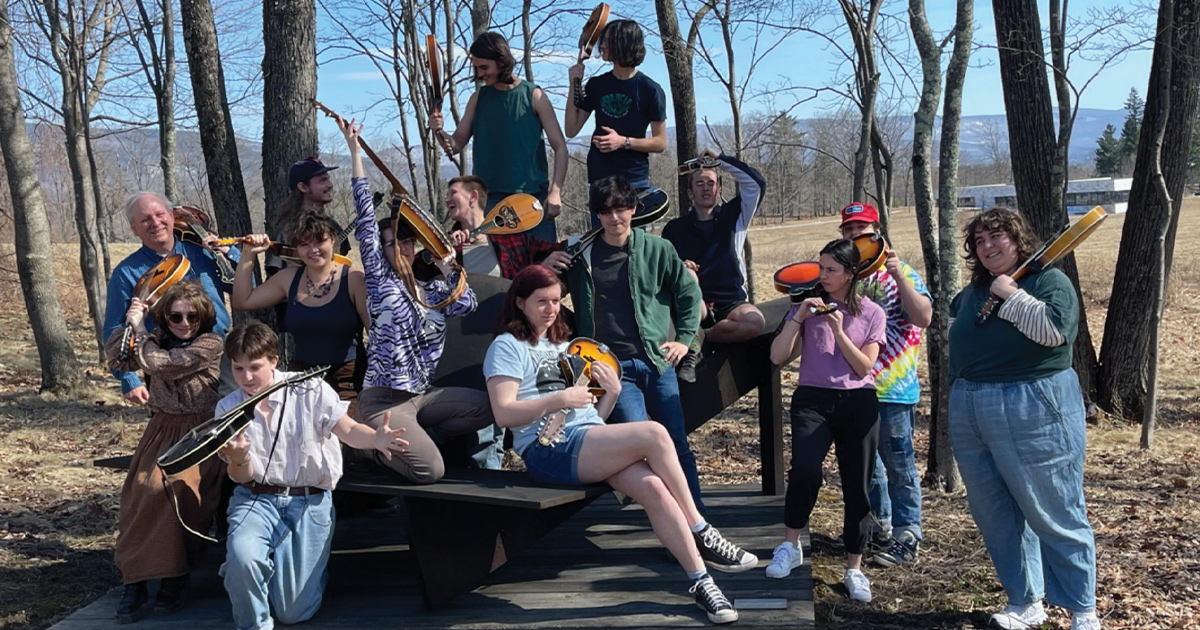
Bennington College in Bennington, Vermont started as a women’s college in 1932 and transitioned to a co-educational institution in 1969. One of its claims to fame is that the college was “the first to include visual and performing arts as an equal partner to the liberal arts curriculum.” As a performing art, bluegrass slowly began to enter the picture at Bennington when, in 1998, a student in the music department at the college was interested in learning how to play the mandolin.
Legendary songwriter and performer Steve Gillette’s wife, Cindy Mangsen (also well-known performer), worked at the library at Bennington and heard about the student wanting to study the mandolin. So she reached out to John Kirk, who had played the mandolin on one of Gillette’s albums. Kirk agreed to teach that student private lessons. The next semester he had more students interested in the mandolin and said, “By the way, I can teach banjo too.” So, the banjo was added. By 2002 John was teaching 14 students and he added lessons for fiddle and mandolin. Since that time, John’s program at Bennington has continued to grow.
John Kirk became interested in folk music when his older sister brought home a Kingston Trio album. His sister also brought home records by other folk artists such as Odetta, Pete Seeger, and the Smothers Brothers, and later the soundtrack to Deliverance. The family would sing songs such as “Freight Train” and “If I Had A Hammer” when riding together in the car. John began singing in the choir in school and by the age of nine was learning to play the guitar.
John went to college to the State University of New York at Fredonia to study voice. While in school, a friend named Jack Bowden asked, “Do you know anyone who want to buy a banjo?” John bought the banjo and he and Jack got together to learn out of the Earl Scruggs book. When asked how he became interested in bluegrass, John said that he had seen John Hartford play on the Glen Campbell Show and heard the Old and In The Way and Will The Circle Be Unbroken albums. Shortly after he started learning to play the banjo, he added fiddle and mandolin. He said that Jack Bowden’s brother, Richard, was a fiddle player and strongly influenced him on that instrument.
It was during his college years that John started performing in various bands and shortly after college he started to meet some old-time musicians at a weekend music retreat that he attended. In 1976 John McCutcheon was a guest at the retreat and it was through McCutcheon’s influence that he grew to love old-time music. Allan Block was also a guest at the retreat. Block (father of acoustic blues guitarist and singer Rory Block) famously owned a sandle shop in New York City that was the hub of the Washington Square Park folk music scene during the 1950s and 60s. Block was an old-time fiddler and John Kirk took his first music road trip down south with Allan Block and was able to meet many of the old-time musicians and string bands in the Appalachian region during the trip. John said, “We followed the old-time music route.”
In 1982 John Kirk (on fiddle and vocals) and Mark Murphy (bass) joined the group Walt Michael and Company and started touring. He said, “One of my first gigs on the road with Walt was at the Kentucky Fried Chicken festival in Louisville. I had only been playing fiddle about four years and I walked back stage and there was David Grisman warming up in one corner, Ralph Stanley in another corner and Mark O’Connor playing the fiddle like a crazy person. I was just gobsmacked!” John stayed with Walt Michael until 1990. He said, “We played a lot of bluegrass festivals including the early days of Winterhawk. We also did a lot of school educational programs in New York state and northern New Jersey.”
In the mid-1980s Walt Michael & Co played for the Green Grass Cloggers and John “took a shine” to one of the cloggers, Trish Miller. They married in 1986. After leaving Michaels in 1990, John performed and toured with a variety of other bands, but he and his wife (who plays guitar and banjo) also decided that they could make music on their own. One avenue that they pursued was to play in schools in and around the area of central New York where they were living. John said, “We played all kinds of elementary school, middle schools and high schools starting in 1986 and we are still doing it every once in a while.” They also played the children’s stage and the dance stage at the Winterhawk festival.
In addition to performing for school aged kids, John had also started to teach them how to play in about 1980. John said, “That goes back to my college teacher and mentor Rick Bunting. He had developed a program at a middle school and high school in a little town in rural New York to teach kids to play guitar, mandolin, or banjo. They would spend a year in his general music class learning these instruments. I got to substitute for him in that class and I taught for six months in 1980. He was the person who taught me how to work with a classroom of people with all different abilities and how to get them to play together. We used a combination of old folk songs, bluegrass songs, old-time music songs and kids songs. That model was successful and is something that I’ve taken with me.”
After he got the job teaching at Bennington, John said that the president of the college called him in for a meeting in 2003 and asked, “Can you connect me with any other areas of study?” John said, “The reason that I am teaching this is that in public education and college education if you learn to play one of these instruments, you are probably going to play it the rest of your life. It is portable, it is easy to carry around and you can find people to play with. If you learn to play the trumpet, clarinet, French horn or tuba, you are probably not going to play it again after you graduate, unless you are highly motivated. It is going to go into the closet. With traditional instruments you can learn all of the theory and things about music that are related to education, but in the long run it would be great if you could get out of here and make personal music the rest of your life and you’ll know how to teach yourself and find resources to go farther.”
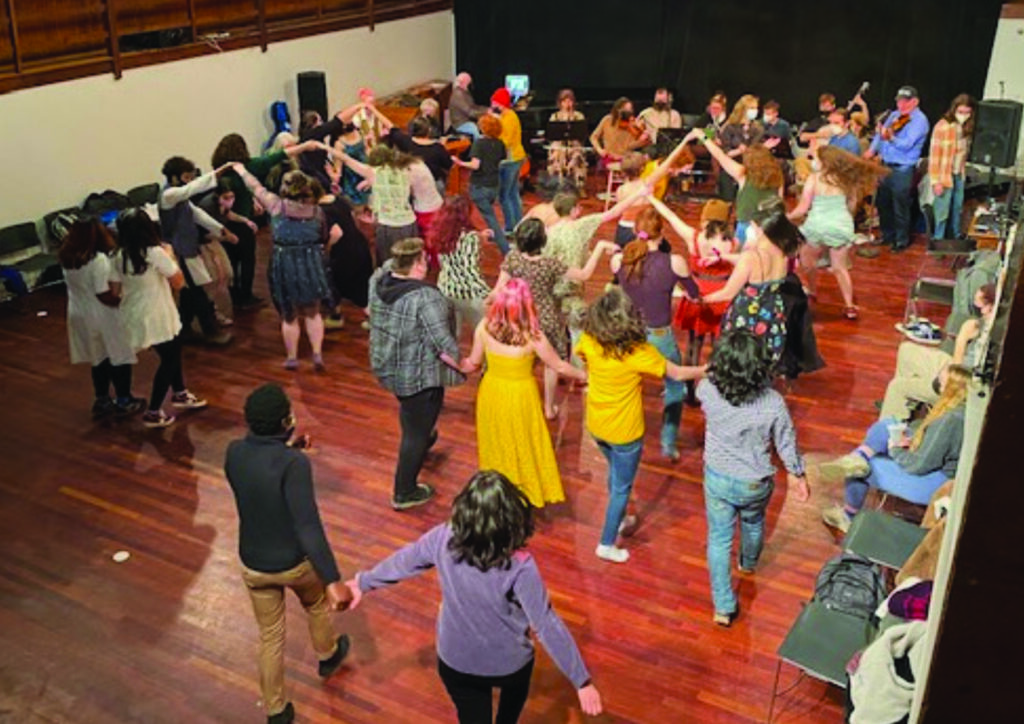
After hearing what John was saying, the college president said, “Go on…” John then took the opportunity to suggest a course called Traditional Music in North America and every student in the class would be learning and instrument. After a lecture on some form of traditional music—bluegrass, old-time, Canadian, ballads, Spanish music from Mexico, or American Indian music—the students would learn to play the music. Occasionally some of those classes would just be playing the whole class going through the repertoire.” Not only was the college president receptive to the idea of the North American music class, but that led to other classes, such as a Celtic music class and a string band class that performs for contra dances at the school.
In addition to those classes mentioned above, John also teaches instrument-focused classes (mandolin, banjo, guitar, fiddle, and ukulele). These are group classes and he typically has 10 to 20 students per class. He also teaches a music theory class, with everyone in the class learning music theory with an instrument in hand. He estimates that he teaches about 80 to 90 students per semester.
John’s wife Trish also sometimes helps John in the banjo classes and also teaches private banjo lessons at Skidmore College in Saratoga Springs, New York, teaching 5 or 6 students per semester. John also teaches private students on guitar, mandolin and fiddle at Skidmore. He said, “We bring her banjo students together with my students three times per semester to play together. I have more bluegrass students now at Skidmore because they are infatuated with Billy Strings.”
John Kirk has spent over forty years introducing kids from elementary age all the way through college to bluegrass and old-time music in the state of New York. Having been inspired by his own music teacher at SUNY, he is passing it on to the next generation in a big way.