Bluegrass from a Coffee Can
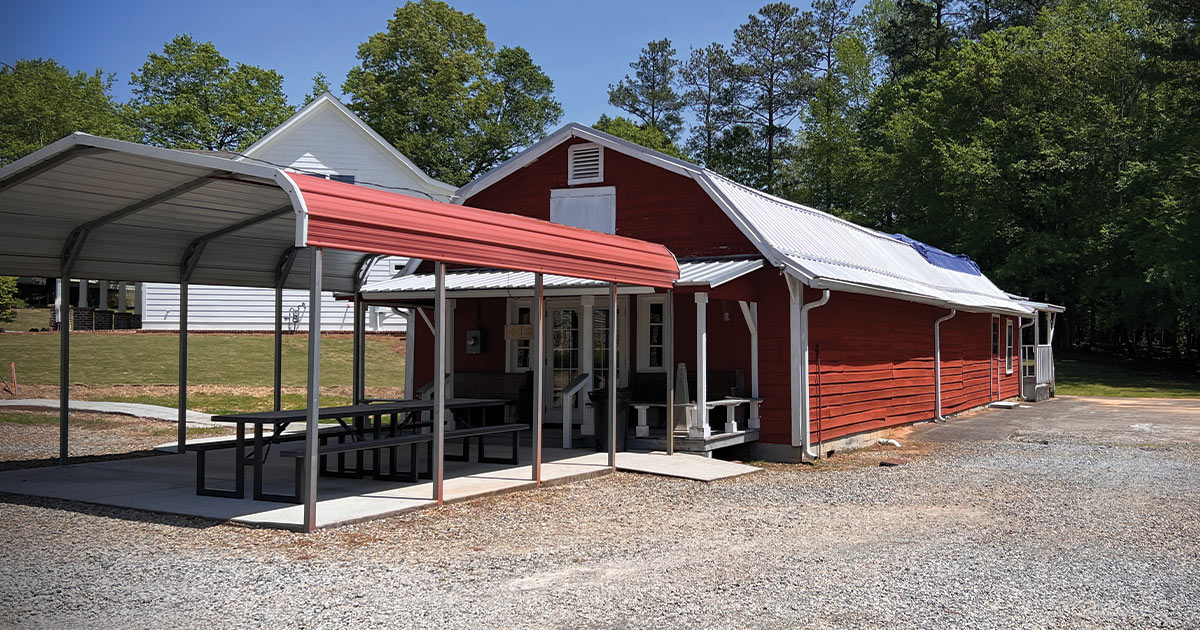
The 60th Anniversary of Suwanee, Georgia’s Everett’s Music Barn
“We had a lot of company” Rena (Everett) McDaniel reflected. “It seemed normal to stay up until four, five, or six o’clock on Sunday morning because there were still people here playing…right outside my bedroom door.” She was relating childhood memories of her life in the old house next to the now-famous Everett’s Music Barn in Suwanee, Georgia. In Aprilof this year, the beloved venue is turning 60-years old.
“It was also normal,” she added, “to help my sister, Diane, clean the barn.” She recalled that in addition to picking up paper cups and napkins, the cleaning involved gathering and cleaning 50 to 60 ashtrays. Rena noted that they were all donated by a local funeral home, then added with an ironic chuckle, “Maybe it was good for their business.” Although smoking was allowed, long hair and short skirts were not, as a sign on the door clearly proclaimed.
In the early days of the venue, it was rare to find people outside of the immediate area who were familiar with the place. Nowadays, it difficult to find any bluegrass musicians and fans around the country who are not aware of it. “You couldn’t name all the people who have stood on that stage,” Rena’s older brother Tommy chimed in. Rena nodded in agreement and whispered sentimentally, “The friends we’ve made!”
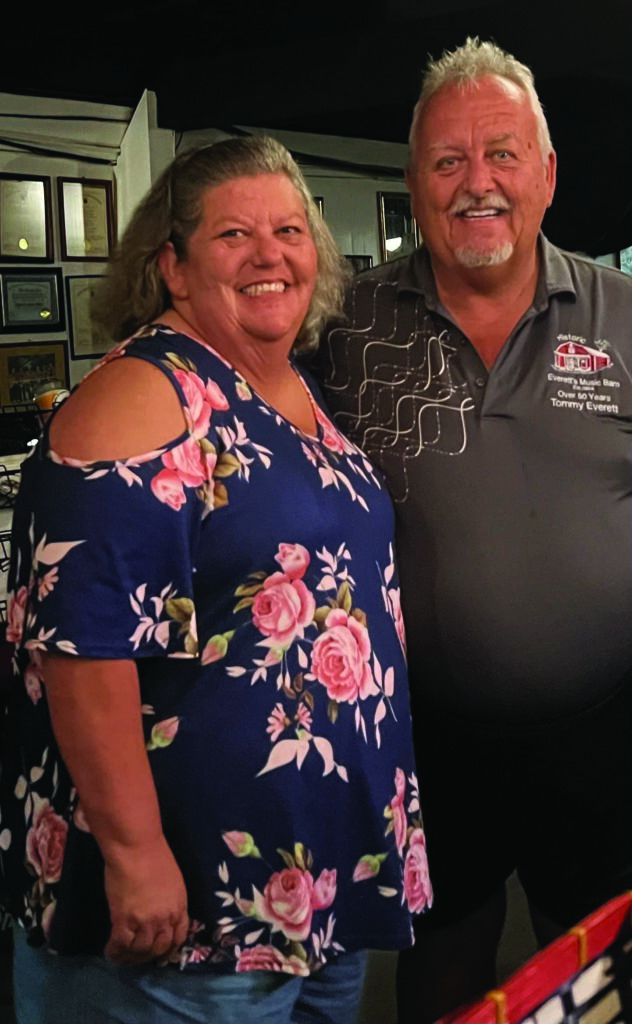
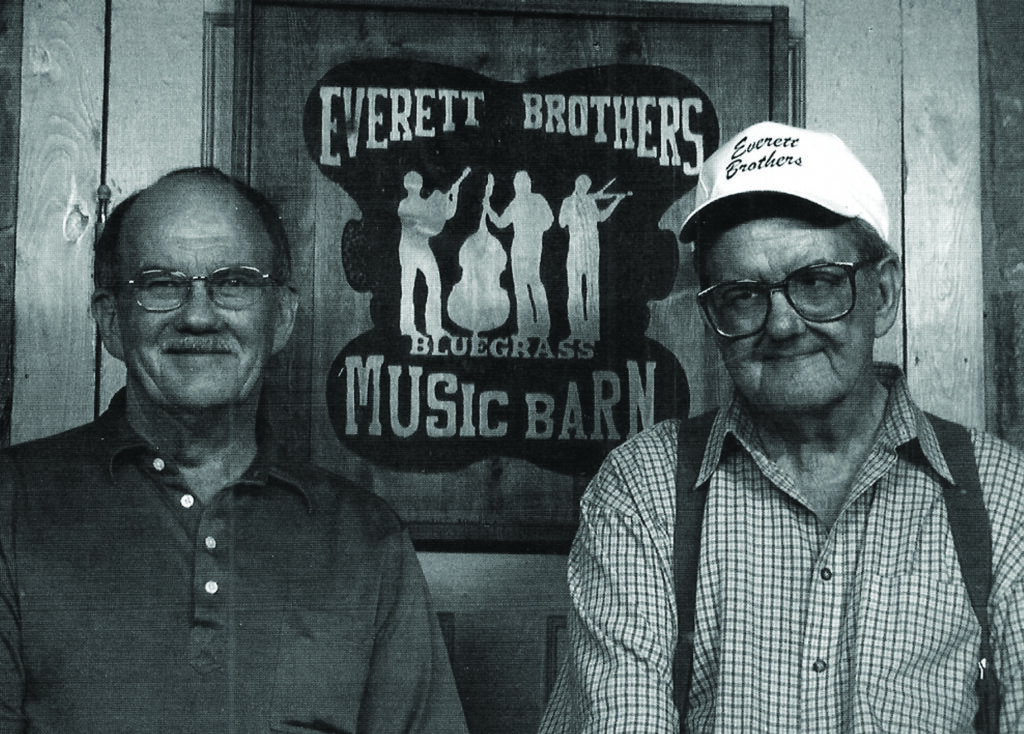
Tommy and Rena are the keepers of the flame of the tradition their father and uncles spearheaded. Sadly, both Randall and Roger Everett—the two key players in the Everett’s band, have left us, but their niece and nephew—children of Leroy Everett, have managed to keep the family flame burning. The spark that ignited that flame was struck by a senseless tragedy. Their uncle Jerry of the Gwinnett County police department was murdered along with his two fellow officers, Ralph King Davis and Jesse Gravitt in April of 1964. Jerry’s brothers—Randall, Roger, Kelly, George, and Leroy—although devastated themselves, did their best to comfort their parents, Lee and Carrie (usually called “Daddy Lee” and “Ma” Everett).
Unfortunately, fate wasn’t yet through dealing out tragic cards to the Everetts. While they were still grieving Jerry’s death, Leroy’s wife, Dorothy, always called Dot, passed away in the hospital just three days after Rena was born. “So here’s my daddy with all these youngins and a new baby,” Tommy summarized. The hospital wouldn’t let Rena come home to the old homestead where Ma Everett was planning to raise her, because there was no inside plumbing. So, as a bluegrass family is prone to do, all the patrons, musicians and family joined together. They built a bathroom on the side of the house.
During those dark days, Jerry’s brothers definitely needed something to provide some comfort, especially for Ma and Daddy Lee. This would come in the form of homegrown country and bluegrass music. Randall picked the guitar and sang, Roger played the banjo and sometimes sang harmony, and Leroy thumped the bass. Their close friends and fellow musicians, Roy and Ruth Westray also joined in. Before long, neighbors toted their instruments to the Everett house, pulled up chairs, and joined in the jams. Four years later, the house was bursting at the seams with musicians. That prompted the building of a “music room” addition in 1968. Tommy remembered that while the adults played in the music room, he and the other kids were told to stay away from the pickers, and the women gathered in the kitchen to play Rook.
Then it was time to reach out to people who couldn’t drop by to hear them. They recorded shows on a reel-to-reel tape player to send to two nearby Georgia radio stations. Roger and Randall lined up a radio show in Buford and the Westrays took a tape to a station in Cumming. They recorded two different shows since they both had different sponsors—whose commercials Randall read between the songs.
As word spread about the new place to head for a good evening’s bluegrass jam, it wasn’t long before the seams of that room were also bursting. That was the origin of the Music Barn. Everyone agreed they needed a larger building to hold the crowds that were beginning to show up to enjoy the music. The other thing they all agreed on was—they didn’t have any money to build it. That’s when fate, which had dealt so many tragic cards to the family, finally played a winning card. A family friend who owned a lumber yard in nearby Norcross told the Everetts that he needed to tear down an abandoned apartment building and they were welcome to take all the boards, window frames, and flooring they wanted if they could transport them.
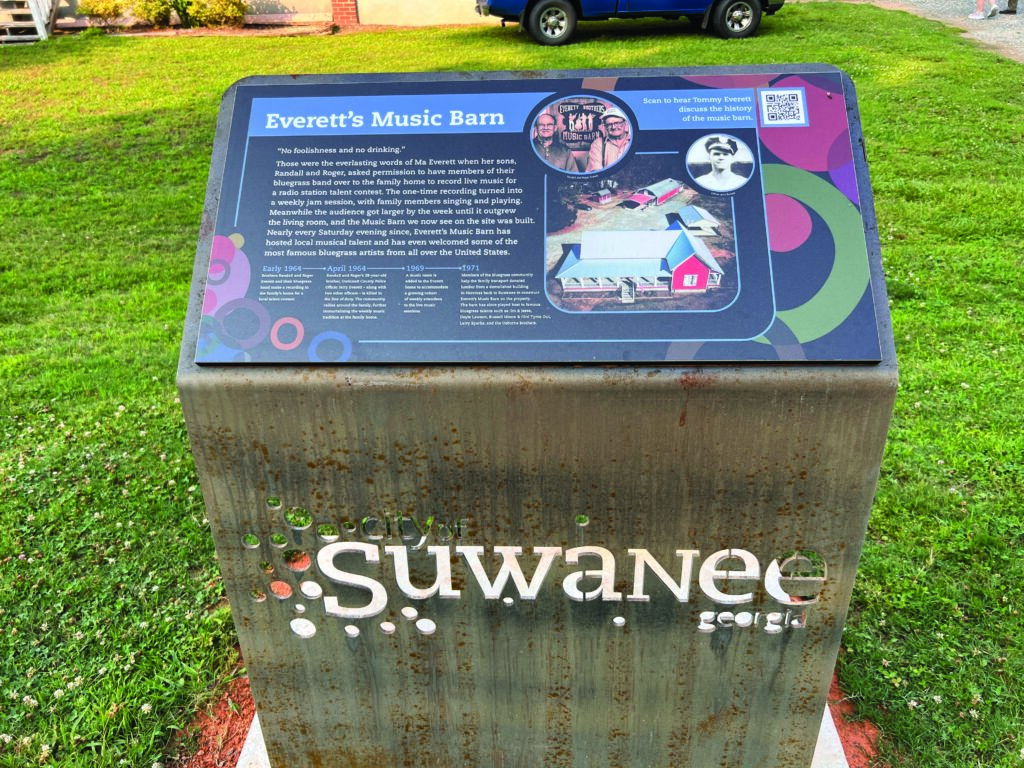
That was all the musicians needed to hear—the light of their dream was beginning to glow. They headed out with pickup trucks and eventually, as Roger Everett once put it, “took everything but the dirt.” All the bluegrass lovers turned into amateur carpenters. Leroy, who had some experience in building, drew out a basic plan for the building on a large piece of cardboard, and they were off and running. The children even pitched in to straighten out the nails pulled from the lumber by hammering them on rocks. The dream was beginning to transform from a sketch on a piece of cardboard into a real building. By the summer of 1971, it was ready to open.
Once again, though, bad news followed on the heels of good. In November of that year, Leroy died of a heart attack. This tragedy left his six children parentless since their mother had passed away shortly after Rena was born. Tommy, who was 13 at the time, remembered that after the funeral, all his uncles and aunts decided they would each take a kid home with them. Rena was living with Ma Everett, but the remaining brothers and sisters would be on their own. “I remember the talk around the table,” Tommy reflected, “‘I’ll take her’ and ‘I’ll take him,’ ‘They’ll be fine.’”
While they were busy dividing up the children, Michael, the oldest son, overheard their plans and suddenly shouted “We’re not splitting up!” Following up on his promise, he quit school and got a job. Diane, two years older than Michael, was already working in a hospital and agreed to move to a closer one and use her salary to help keep them all under one roof. Ma Everett let them put a little single-wide trailer in the wooded area behind the music barn. “We lived in that trailer and raised each other,” Tommy stated with justified pride. “They were poor times, but we didn’t even know we were poor until later on.”
The music barn helped give them a sense of shared purpose. Not only did the music help to sooth their losses, but as folks poured in from around the area, their “family” slowly expanded. Month-by-month the news of the barn spread throughout the bluegrass world. Nationally known bands learned there was a new little bluegrass music venue down in Suwanee, Georgia. The first band to include it in their schedule was Doyle Lawson and Quicksilver. Before long, the Bluegrass Cardinals from Los Angeles performed at the barn. Then Larry Stephenson, a Cardinals member, came with his own band. Junior Sisk and Alan Bibey dropped by with the North Carolina-based Blue Ridge, as did Jim and Jesse from Virginia. “Seeing Jim and Jesse on that stage,” Tommy exclaimed, “Holy cow that was incredible!”
The music wasn’t the only “incredible” feature. The regularly-scheduled covered-dish dinners became the talk of the community. They were often held inside the old house and on the front porch. “There was nothing but tables,” Rena reminisced. “People would enter through one of the bedroom doors, go down the porch, and exit…guess where? Through my room!”
Folks brought in goodies from every conceivable food group. And just in case there wasn’t enough food to fill the tables, Ma Everett fired up her oven and turned out a nearly endless stream of pies, cobblers and cakes—always baking two of each to make sure nobody ever went hungry. When she topped it all off with over 100 biscuits and gallon after gallon of iced tea, it was so good everyone there wanted to “slap their grannies.”
As the venue’s 60th anniversary approaches, the barn’s patrons have become spoiled. They now expect to see national groups scheduled along with local and regional bands. And they also expect to see the top-tier musicians shaking their hands and mingling with the crowd. From the beginning, the visiting bluegrass professionals have treated their fans like new-found friends. Long-time barn patron Carol Weikel agreed. “They were just the same as all of us,” she confirmed, “That was their attitude.” Some of this attitude may have sprung from the fact that they were also treated like old friends and family by the Everetts. “We fed ’em dinner,” Tommy related. “Jim and Jesse, the Osbornes, Lost and Found, the Country Gentlemen. They all ate here.”
It wasn’t only the entertainers who felt the family ties. Those who came to see them play were just as tight-knit. Carol’s husband Bill noted that “Nobody knew what level of society the other barn fans were on or what kind of job they had.” “That’s the main thing to me,” Carol agreed, “It’s an equalizer.” All the professional musicians who stopped by to perform and meet their new Suwanee, Georgia, friends have left Tommy and Rena with some great memories.
They can reminisce about the time Melonie Cannon’s bus got stuck in the yard; or when Rhonda Vincent with the Sally Mountain show would arrive at noon, join them for lunch and then jam with the barn crowd until their show started; or when New Quicksilver stayed and played all night during a snowstorm. There was also the time Kenny and Amanda Smith and a group of about 20 were jamming in the house. When Rena came in between songs to let Kenny know his van was blocking other cars,” she quietly said, “I hate to barge in.” Then one of the group joked, “Oh no, here comes the jambuster.” “There was a lot of bluegrass,” Rena observed with a wistful smile.”All the time!”
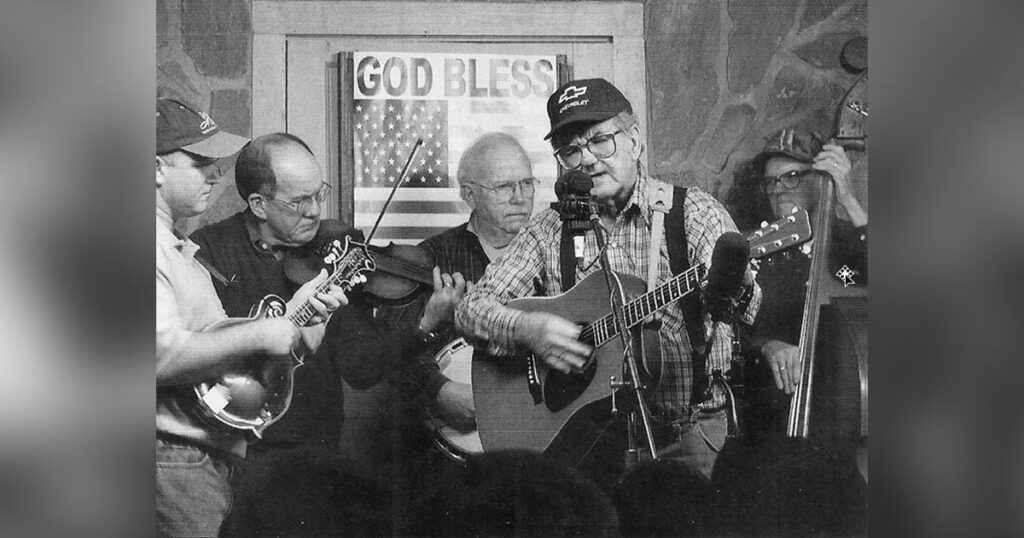
Although everyone enjoyed the visiting professional musicians, they always looked forward to hearing the house band. When Randall and Roger and their friends and band members—Don Norman, Bobby Autry, Darrell and Ron Wilson, and others— stepped out onto the stage, their fans knew they were going to hear bluegrass the way it was meant to be played. Randall had fallen in love with bluegrass music as a youngster. His father took him to see Flatt and Scruggs play in the parking lot at the grand opening of the Winder, Georgia, hardware store. On the way home, Randall turned to his dad said “I’m going to learn how to play that music.”
But the rollercoaster ride of good and bad luck continued. The company that insured the structure told them they would have to put a new roof on the barn. A new roof for that large a building would cost about $10,000. The family tried for four years to raise the money, but just couldn’t do it. Other expense always came up, like floors falling in or a porch that needed to be refurbished. Once more, however, it appeared the good Lord must like bluegrass music. “We were having a fundraiser,” Tommy said, “and a fellow from about three rows back, walked up to me. ‘Mister Everett,’ he stated, ‘I want to help you with your barn project.’” Tommy smiled and told him that he appreciated it and he could put his donation it in the coffee can up front.
Then a second time, the fellow approached him with the same offer. Once again, Tommy thanked him for his generosity and pointed him toward the coffee can. Finally, while standing in line at the covered dish supper, the visitor told Tommy he would like five minutes of his time. A little while later, Tommy and his wife, Julie, walked over to talk with him. He said his name was also Tommy and he was with Accent Roofing in Lawrenceville. “I have never been here before,” he said, “but I really love what you are doing for the community. I love the history and the heritage.” Then to Tommy’s shock and delight, the visitor got straight to the point: “We’re putting a roof on your property.” “And a blessing was answered,” Tommy Everett enthused.
Not long after that, during a doctor’s visit, a nurse asked him if he had met Tommy from Accent Roofing. She said she had sat beside him in church and during their conversation, told him about the music barn in Suwanee and how much she had enjoyed it. Intrigued, he stopped in for a visit during their fundraiser—and offered to provide a free roof. Once more, the family circle had reached out to add another member.
Another blow came in 2015 with the passing of the eldest sister Diane. She had been a vital part of the music from the beginning. In fact, she was the glue holding everything together—handling everything from booking the bands, managing the concessions, and handling publicity. Rena had already begun helping out more with the operations of the barn after Diane was hospitalized for an extend period of time. After Diane’s passing, Tommy handed Rena her contact book and calendar, and said, “This is your job now.”
Without hesitation, Rena stepped up and took over. Her brother Russell came on board as well. They worked side-by-side, serving coffee and slicing up cakes and pies—always wearing a smile. Sadly, the family lost Russell in 2021. And again, one of the family stepped up. Rena’s husband, Steve McDaniel, slid right into place at the concession area and has been there ever since. He makes a great cup of coffee as well fantastic barbecue for special nights and the fundraisers.
As if they hadn’t survived enough setbacks, a black cloud once again drifted over the scene. Ma Everett always owned the property and left it in her will that when the last child of hers passed away, the property was to be sold outside the family and the money divided. Since all the other siblings had passed on, the property reverted to the remaining sibling who, unfortunately, put it up for sale. When the word traveled about the music barn’s demise, one after another of the grieving musicians and patrons began to talk about schemes to save their favorite barn—like each of them forking out a thousand dollars and along with the other donors, paying the $58,000 asking price and owning it as a group. As reality sank in, though, it seemed a little less than practical for one piece of property to have 58 owners.
As it sat empty for months, despite a couple off-property get-togethers of the barn family, the cold realization was setting in that the music barn and all the warm moments and hot music might well fade into history. But at one of the gatherings in Sugar Hill, Georgia, fate again stepped in—this time with a refreshing piece of good luck. Tommy, despite never having been an announcer, worked up his nerve and stepped up to the microphone to introduce the bands. After the event, two people walked up to him, Kathleen Webb and Chris Lybeer. Kathleen said they were entertaining the idea of buying the property. None of them had ever been there, but they were aware of its important local heritage. “We don’t know anything about it,” Kathleen said, “but don’t want to see history destroyed.”
“Well, I like to have fainted,” Tommy reflected. She asked him if they could reopen the music barn. Tommy said he would be very happy for them to, “as long as it’s run like we’ve always done—with no alcohol and no rude behavior. It’s just a country place.” Kathleen, teaming up with John Garrett and Chris Lybeer, bought it the next month. Since it had been closed for months, the place was in disrepair. It was time for the little bluegrass “family” to once again snap into action– and they did! “Everybody showed up for work days.” Tommy said, “Cleaned everything out, replaced everything, brought in volunteer sound equipment, and we re-opened.” That re-opening, he declared, “was one of the biggest blessings I’ve ever been a part of.”
Yes, during the last 60-years, one obstacle after another has popped up, but the music barn’s family has always kept the barn going—first by passing around Daddy Lee’s old felt hat, and later with a coffee can on the counter of the snack area. Tommy explained that having grown up in the little trailer with his siblings in a rural area, his family was small. But with all the new friends from the bluegrass community, he added, “It has become giant.” Jamie Johnson of the Grascals observed the same thing when they played there: “It’s little, but it’s mighty!”
“Even today,” Tommy stressed, “We don’t take credit cards, Pay Pal, and all that. We’re just a coffee can. If you don’t have any money, come in, eat a hot dog, sit down, catch you next time.’” That donation coffee can has helped provide bluegrass music for thousands upon thousands of patrons, musicians, and out-of-town visitors. It has also proven something about the power of a close-knit bluegrass family. In spite of personal tragedy, financial challenges and all the rest—they can “take a lickin’ and keep on pickin’.”