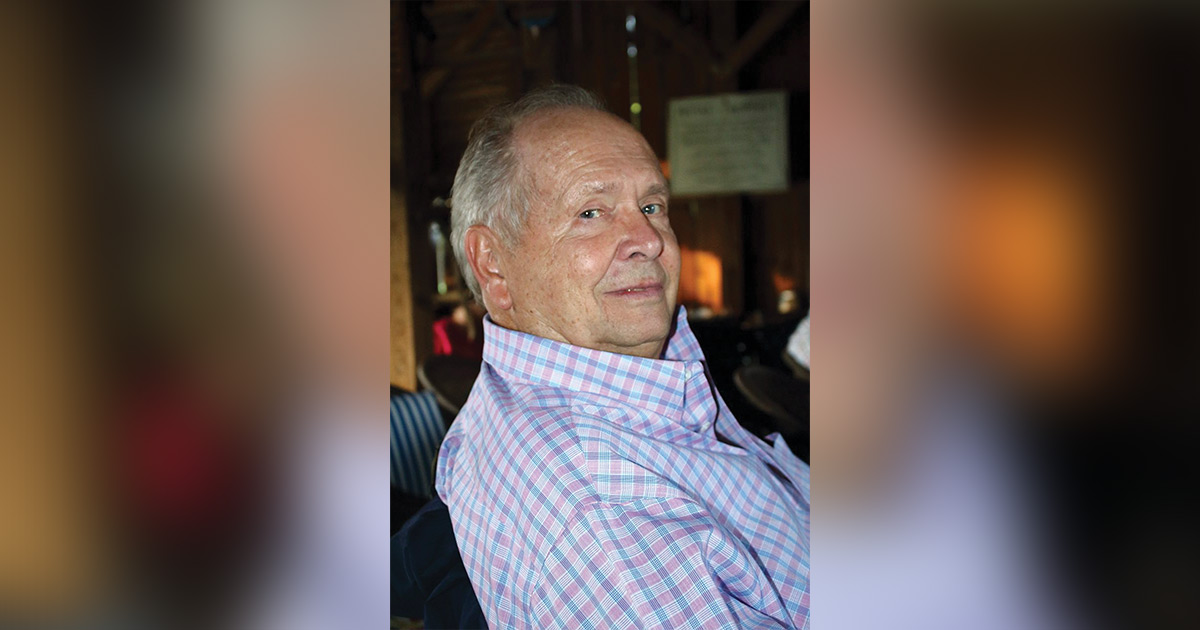
Bluegrass Friendships, Associations and Storytelling
Photo by Ed Henry
When Bill Monroe reportedly said, “Bluegrass has brought more people together and made more friends than any music in the world,” he could have been describing the history of the Seven Mountains Bluegrass Association (SMBA), which is celebrating its fortieth anniversary this year in York County, Pennsylvania.
As Monroe’s quote continues, “You meet people at festivals and renew acquaintances year after year,” it explains how Dick Beckley’s life has led to his hundreds of bluegrass friends on Facebook.
Before Facebook, for decades Beckley seeded and cultivated a network that has enabled him to promote more than a hundred shows for SMBA. Beckley, who is not a picker, has attended hundreds of events, including IBMA conferences, beginning in Louisville in 1997 and annually thereafter through the second year in Raleigh in 2014.
Beckley’s earliest bluegrass memories are of listening to broadcasts of the Wheeling Jamboree and the Grand Old Opry in the 1940s, while sitting by a Montgomery Ward Airline floor-model radio at his grandparent’s home. Until his late teens, he spent most of his weekends and summers visiting their home, which was once a C & O Canal Lockhouse across the Potomac River from West Virginia, in Williamsport, Maryland. Beckley remembers that “Grandpap called the music on those shows ‘string music,’ but I always called it ‘hillbilly music’ because I thought I was a hillbilly, and was proud of it!”
Beckley’s prospects to become a picker soured in the sixth grade. His violin instructor had failed to excite him during a couple of years of lessons which emphasized tablature learning and the practice of movements. Those lessons ended abruptly when Beckley verbalized his frustration in response to his teacher’s refusal to teach him how to play the “Orange Blossom Special.” Repeating what he said to his instructor, with an impish smile Beckley added, “You can’t print that!”
While in high school in Frederick, Maryland, Beckley was encouraged by his friend, Bill Berry, to try again as a fiddler so he could join The Bluegrass Travelers, a regional band that has enjoyed some local success. He declined, and never again felt the urge to play a musical instrument.
After graduating in 1957, Beckley attended the University of Maryland for one semester as a Business Administration major, but he “hated it and quit!” He left an interim job to attend barber school and was hired to work in a shop in Gaithersburg after only six weeks. While learning his craft as a barber, Beckley enlisted in the Navy Reserve in 1961. He has no regrets about those decisions.
During Vietnam, Beckley served on active duty from 1963-1965 on a ship stationed at the Naval Amphibious Base at Little Creek, Virginia. Since his LST vessel was too small to warrant a fulltime barber, Beckley’s barbering skills were valued by his ship’s commanding officer, so “they hid me out whenever Admiral McCain came aboard for any kind of inspection.”
Beckley eventually leveraged his barbering skills and entrepreneurial nature into the ownership of four barbershops based out of Frederick, which traded as “Gentleman’s Choice.” At one time, his payroll had thirty-six employees.
Frederick’s location at the eastern edge of the Appalachian mountains and close to Washington, Baltimore and Gettysburg made it convenient for Beckley to access quality bluegrass venues. Asking Beckley about his earliest memories of attending live bluegrass shows opens a treasure chest of stories, notably about Charlie Waller and the Country Gentlemen at the Shamrock Club on M Street in Georgetown, and John Duffey and the Seldom Scene at the Red Fox in Bethesda.
In the mid-90s, Beckley’s passion for snowmobiling attracted him to the Adirondacks, where he lived on twenty-six acres in a mobile home while he constructed a new house. For several years, he managed the operation of his Frederick barbershops remotely from Old Forge, as he became an active member of the Adirondack Bluegrass League and attended Central New York Bluegrass Association events.
While living in upstate New York, Beckley remained connected to his Frederick network and barbershops by returning in summers to work in the shops, while the employees he had enabled to become partners took vacations. He ultimately returned to the Frederick area, before relocating in 2002 to York County, Pennsylvania, where he lives today with his wife, Karen, on a seven-acre, rural homestead. Eventually, in 2004 Beckley sold his partners the two barbershops which had remained open.
It was not until the fall of 2001 that Beckley attended his first Seven Mountains Bluegrass Association (SMBA) concert in York, Pennsylvania, at the invitation of a friend to see James King. “I had been scouting for a place to lay down my bluegrass roots after moving back from upstate New York,” Beckley recalled, “and I had become good friends with James King since meeting him around 1990 at Gettysburg.”
SMBA concert promoters were nervous when King had not yet arrived, ten minutes before he was scheduled to be on stage for their 7:00 show. Newcomer Beckley, who was not surprised by his friend’s lack of punctuality, reassured them that “James King might be late, but he has never missed a concert.” Sure enough, King arrived shortly after, and “The Bluegrass Storyteller” was on the stage to begin his concert by 7:15.
Beckley remembers that his first involvement to arrange a show for SMBA was in the fall of 2005 when he received an urgent phone call from the SMBA president. Aware that Beckley was well connected, the president asked if he could replace a band which had cancelled suddenly, only two weeks before their scheduled show.
Beckley called Kim Fox in Nashville, who had relocated from Old Forge, New York, where Beckley had become friends with her when he volunteered for the Fox Family Festival. She was not available to play, but recommended that Beckley call the mandolinist from her band, Jesse Cobb. He had begun to play with some other guys in a new band that Fox believed might be available on short notice. Two weeks later, an unknown band out of Nashville, anchored by musicians from the Berklee College of Music in Boston, was playing on SMBA’s stage.
Between sets, Beckley asked a longtime chair of SMBA’s music committee for her opinion of the band. She graded them as “a D minus because they play too much progressive (stuff)!” Beckley let the band know that the SMBA audience had expected to hear traditional bluegrass, and asked if they could play a strictly traditional second set.
After the second set brought the audience to its feet, the critic said, “I would have given them an A, but because of that first set, I’ll give them an overall B minus.” Her evaluation reflects the reluctance of some fans of traditional bluegrass, including Beckley and many others among the current SMBA membership, to embrace the progressive style of bluegrass.
Beckley remembers the progressive band which saved that 2005 SMBA concert and admits that “I never invited them to return because I didn’t think they would be well attended or warmly received.” Now, Beckley would be glad to invite The Infamous Stringdusters to return to the SMBA stage “for old times sake” to play one set from their 2017 “Tribute to Bill Monroe” and another from their recently released “Tribute to Flatt & Scruggs,” but laments that “I doubt we could afford them.”
Shortly after The Infamous Stringdusters’ 2005 concert, Beckley was recruited to become a member of SMBA’s music committee. While president of SMBA from 2010 until 2018, in 2014 he also became music committee chair, a role he retains today.
When he was elected president of SMBA in 2010, Beckley reminded the board that it was attendance at the concerts that generated revenue which offset the cost of the jams, newsletters, and annual picnic. He told the board that he was going to represent that half of SMBA’s membership who, like himself, were not pickers but fans who supported bluegrass by attending SMBA’s shows. Beckley recalled that “they knew I was opinionated; and I told them that if they did not want me to represent the point of view of the members who were not pickers that they should not elect me. I served nine years as president and left on my own terms, so I assume I did all right.”
One of SMBA’s founders was Walt Crider, a picker who twice served as SMBA’s president, including a term immediately before Beckley. Crider remembers being one of a dozen or so pickers and non-pickers who began to organize over forty years ago. Their first promotional efforts were for local bands at Dantes, a southcentral Pennsylvania restaurant and nightclub, before SMBA later moved to an alcohol-free environment. Crider recalled that York County native, Del McCoury, and his young sons also played a couple of SMBA’s earliest shows.
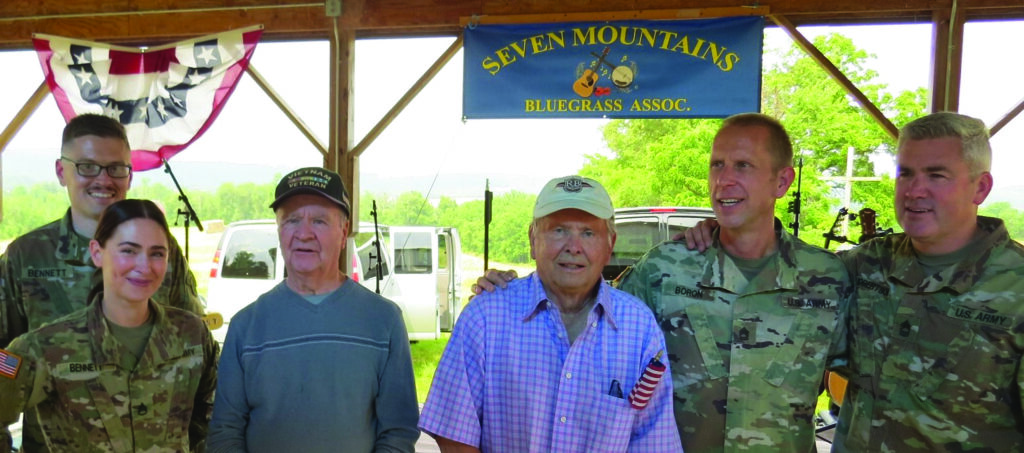
The exact details of SMBA’s history are still being gathered from various newsletters and other records. Recently, hats were embroidered with “1982-2022” to celebrate its forty-year anniversary, although the group did not incorporate as a Pennsylvania non-profit until March 31, 1999. As part of SMBA’s fortieth anniversary celebration this year, Beckley arranged for the Seldom Scene to perform at SMBA’s July picnic.

When Beckley left as SMBA president, the non-profit organization had nearly 400 households as members. Post-COVID, SMBA now has around 300 dues-paying households as members.
Normally at least 150 individuals who are SMBA members and about 50 who are non-members attend an SMBA concert. A recent audience of 310 to see the Lonesome River Band was the largest post-COVID attendance; and the all-time record of 401 was set in 2018 by one of the last concerts of Flatt Lonesome.
Over the past ten years as an uncompensated promoter, Beckley has arranged more than 100 concerts for SMBA. He notes that “the best musicians are not always the best businesspeople, but if you look at the top names today, they either are good businesspeople or they have a good agent.” Beckley named Laura Mainer as an example of a good agent because “she does what she says she will do and returns contracts promptly.”
Beckley attempts to cooperate with other promoters’ schedules. When a nearby church recently engaged a headline performer for the same night as SMBA’s concert, attendance suffered at both events. Since a band gets a percentage of the revenue, everybody suffers when a show has too many empty seats because of competing events.
Beckley’s dedication as SMBA’s concert promoter was the reason he remained at the Gettysburg Bluegrass Festival on a cold and rainy Sunday morning in May 2016. A majority of the hundreds of fans who had been camping at the festival since Thursday had packed up to escape the forecasted rain.
Faithful fans of The Dry Branch Fire Squad had stayed to hear Ron Thomason open the Sunday morning with a folksy homily and lead his congregants in the customary singing of “If I Could Touch the Hem of His Garment” before they folded their chairs and left. A few more fans, hopeful that the rain would hold off, arrived to fill in the area near the stage before a gospel set by Darin and Brooke Aldridge. Brooke shivered as she told the audience that, after hearing the Gettysburg weather forecast while they were on their trip north, they had stopped on Saturday to purchase warmer clothing.
As the Aldridges ended their set, the chilly rain began to fall harder. Most of those who had remained near the stage accepted their invitation for a “shake and howdy” and fled to shelter of the nearby merch tent. Although more than 100 fans remained 50 yards from the stage under the protection of a large white tent at the crest of the natural amphitheater, less than two dozen fans who were dressed for the rain remained in chairs near the stage. After packing his motorcoach that was parked near that white tent, Dick Beckley put on his rainsuit to join them. It was Gettysburg’s 72nd bi-annual festival and he had attended nearly all of them.
Even though Beckley had filled SMBA’s schedule with ten concerts from October 2016 through May 2017, he was beginning to consider bands for the following season. Trinity River Band was about to begin the third set of the day and Beckley intended to scout them. Underneath his rainsuit, Beckley wore a jacket with a SMBA logo and the name Beckley embroidered on the chest.
After the Trinity River Band finished an impressive set, a nearby fan engaged Beckley in conversation. Beckley shared what he knew about the relatively unknown family band, comparing them favorably with other gospel acts he had heard over the years. As he ended the conversation by saying “I need to go talk with them to try to get them for next year’s concert schedule,” Beckley told the man, “You really ought to come to a Seven Mountains’ concert if you want to hear top-notch bluegrass music.”
Seventeen months later, in October 2017 Dick Beckley introduced the Trinity River Band as the first show of SMBA’s concert season to an audience of more than 200 at the Goodwill Fire Hall near York, PA. Just as the lengthy interval between a scheduling commitment and a performance was typical, it has not been unusual for the Beckleys to become friends with the musicians who he engages for SMBA concerts.
In August 2018, the Beckleys invited fellow “glampers” to share a pot-luck lunch with the Trinity River Band after their performance at the Gettysburg Bluegrass Festival. As the Harris family from Callahan, Florida shared stories of being on the road and performing as Trinity River Band, their affection for the Beckleys was evident. They reminisced about how Beckley had helped them to arrange two impromptu gigs in southcentral Pennsylvania churches to offset the expense of making a special trip from Florida to play at their friends’ wedding in Delaware.
The Beckleys’ snowmobiling days in New York are now behind them; they no longer travel to attend IMBA events; and they have sold their Class A motorhome, so they no longer stay overnight at festivals. But they remain active both with SMBA and as members of the Gettysburg Region of the Antique Automobile Club of America (AACA), which Beckley joined in 1978.
Although they are beginning to down-size their collection of classic and antique cars, their 6,000 square foot metal barn garages more than a dozen vehicles, as well as a woodworking shop for another of Beckley’s hobbies. He refers to the 1995 Indy 500 Pace Car as “Karen’s Vet,” but she said her favorite car is a classic 1935 Auburn Cabriolet “because Dick and I bought it together.”
Among the remaining collection is a 1953 Buick Super Estate Wagon. A self-described, “full-blown automotive and photography nerd,” banjoist Russ Carson of Ricky Skaggs’ Kentucky Thunder, featured the Beckleys’ “Woodie Wagon” on the cover of his 2014 release of Avenue of Giants.
Listening to Dick Beckley recall names and facts from his lifetime as a fan of traditional bluegrass is a journey. He rarely responds to a question with a simple answer, but instead spins colorful details together in stories which often conclude with an opinion that reflects Beckley’s conservative and patriotic outlook, and his love for traditional bluegrass music.
Carson and fiddler Patrick McAvinue are two young musicians who Beckley met due to his SMBA membership. For a while, the two played together for Audie Blaylock, another of Beckley’s friends. Remembering Blaylock led Beckley to recall an IBMA event in Louisville that became life-changing for Darren Nicholson.
Blaylock was in sudden need of a mandolinist. Beckley knew Nicholson, who was on the scene to play with the Beckleys’ friend, Alicia Nugent. A successful set led to a job offer for Nicholson to tour with Blaylock’s band. That tour led to Nicholson meeting Blaylock’s niece, Jennifer, who Nicholson married. Beckley recalls Nicholson greeting him with a bear hug while exclaiming, “you are the reason I met my wife!”
Among Beckley’s thousands of barbershop customers was Darren Beachley, who got his first haircut from Beckley. When Beachley became a lead singer and guitarist for Doyle Lawson and Quicksilver, Beckley told him “I knew you were going to be a great singer because you squealed the whole time I cut your hair!”
Decades later, when Beachley was torn between an exhausting life on the road and a desire to spend more time with his family, Beckley advised him to “get a day job and play music when you want to, not when you have to.” Beachley has since thanked Beckley for encouraging him to do so; and Beachley has grown into a successful career as an environmental services director for healthcare in the Baltimore/Washington area.
Beckley identifies Jerry Salley as a treasured friend with whom he shared many late nights after they met at an IBMA suite of the late Bertie Sullivan of Mississippi, who was Beckley’s age and was once voted as Promoter of the Year for Society for the Preservation of Bluegrass Music of America (SPBGMA). Beckley says, “of the hundreds of people I have met in bluegrass, there is no one I admire more as an artist, entrepreneur and person than Jerry.” Beckley smiles as he proudly says, “Jerry always tells me, ‘Dick, you are a great American!’”
Beckley recalls a summer evening in June 2008 as “one of the highlights of my life.” James King offered to play an uncompensated private event for the Beckleys, as a favor on his way home to Virginia from an appearance at a Pennsylvania festival. Karen Beckley got a sheet cake decorated with “Welcome to The James King Band.” She recalls that “it was a great party, but since James arrived three hours later than we had expected him, we had to cut the cake before he arrived so we could feed the guests.” Arriving just after 4:00, King and his band still managed to play three sets before dusk for the two hundred guests who gathered at the Beckleys’ York County homestead.
One of Karen’s favorite memories is when the Beckleys attended Kody and Mary Rachel Norris’s September 2019 wedding at their home in Mountain City, Tennessee. Karen remembers that “Mary Rachel looked beautiful in her wedding dress, and wore cowgirl boots underneath it. . . She had semi-circular church pews arranged as seating in their yard . . . It was all perfect!”
Parallel with his friend James King, whose musical talents earned him the moniker “The Bluegrass Storyteller,” eighty years of life as an extroverted aficionado of bluegrass music have provided a wealth of material for Dick Beckley to hold court as a bluegrass storyteller in his own right. The lives of both storytellers have centered on the importance of bluegrass music as a cultural expression to be both performed and enjoyed.
Their love of bluegrass music was the catalyst and common ground for the improbable friendship that formed despite vast differences in the personalities of the musical artist, who was often an hour late and a dollar short, and the promoter, whose head for business pays attention to detail.
A feeling of hope is present when bluegrass friendships form among people who have little in common other than their innate love for “hillbilly string music.” Associations have value when they nourish those friendships with the joy of music and enable enriching conversation.