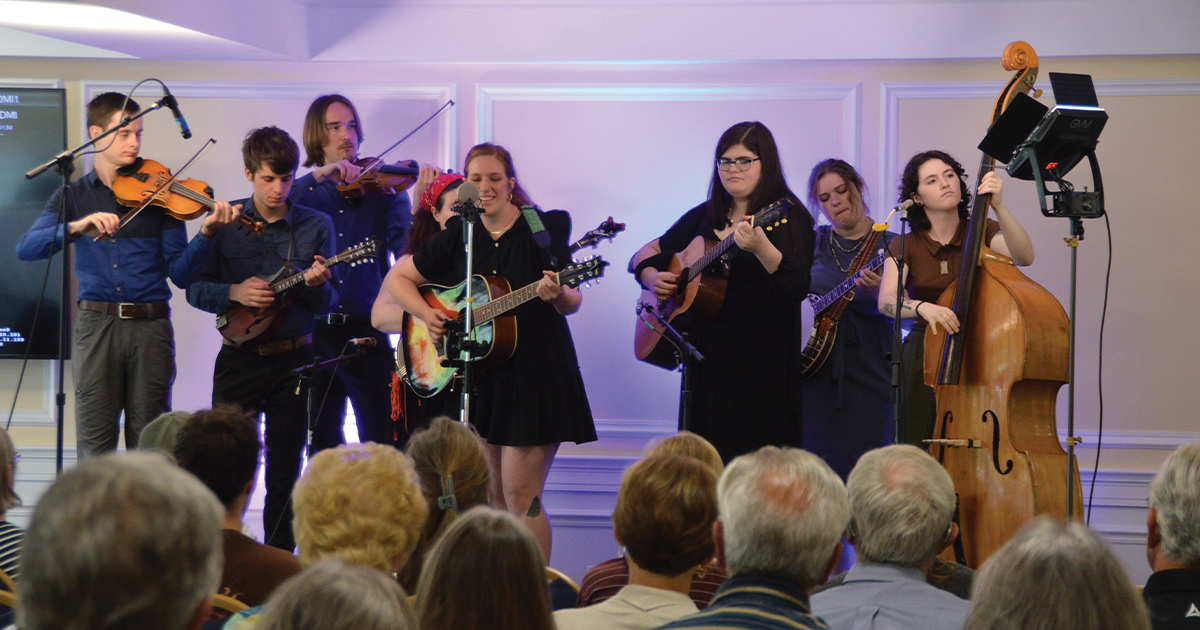
Bluegrass Ensemble
Berea College
Every year in July, since 2021, Bluegrass Unlimited has featured a series of articles titled “Bluegrass Goes to College” where we feature a number of college-level bluegrass music programs. If you have been following this series, you may have notice that the name Raymond McLain pops up several times. Raymond was involved with two of the programs we have featured, the one at East Tennessee State University and the program at Morehead State. The Raymond McLain that was involved with those programs was Raymond W. McLain. However, Raymond’s father, Raymond K. McLain preceded his son’s involvement in bringing bluegrass to college by helping to establish bluegrass as an academic field of study at Berea College in the 1970s.
Raymond K. McLain was a classically trained musician who earned a music degree from Denison College in Ohio. He then did graduate level work in music composition at Harvard University and in folk music studies at the University of North Carolina. McLain had grown up in Lexington, Kentucky and in 1954 he returned to Kentucky to take a job at the Hindman Settlement School (in Hindman, Kentucky) as the recreation director—a job that was formerly held by his wife, Betty. Two years later he became the director of the school. An article written about McLain in the October 1972 issue of Bluegrass Unlimited, stated: “Among the innovations he introduced at the school was a ‘music mobile’ which traveled up the hollows to encourage children to express themselves musically.”
In 1971, McLain joined the music faculty at Berea College as the resident ethnomusicologist. The year before, in 1971, the college had created an Appalachian Center and appointed Loyal Jones as its first director. Jones set up the program and recruited faculty to teach classes in Appalachian studies. At Berea College, McLain and Jones initiated the first college-level course in bluegrass music and also initiated other Appalachian music and dance courses. The above-mentioned BU article revealed, “The courses he teaches have names like ‘The History of Popular Music’ and ‘Musical Experience in the Traditional Idiom,’ but what they are really about is getting together and jamming — playing, feeling, discussing and learning to appreciate folk and bluegrass and country music from a personal as well as an academic viewpoint.”
The article continued, “The classes are as likely to be held in the huge living room of the McLain’s house as in a formal classroom, the students sprawled around the room, McLain perched on a log in front of the fireplace, Betty McLain in the kitchen fixing hot chocolate and cookies for the class, everybody playing an instrument singing whether they know how or not, trading the instruments back and forth, being encouraged by McLain to try new songs, new skills, ‘The way to learn to sing is to get up and sing,’ he tells one shy co-ed. A more accurate title for the course might be: ‘Music as Fun and Therapy.’ The students hate to leave.” As might be expected in such a welcoming and enjoyable environment, student interest in the classes blossomed.
When asked about how his father came to work at Berea, Raymond W. McLain explained that Berea had a “faculty tour” whereby they would bring faculty members who had come to the college from other parts of the country to rural Kentucky to familiarize them with the mountain region. A bus load of faculty, along with the school’s president and dean, came to Hindman and asked the McLain’s to play music and answer questions. The president and the dean were so impressed with McLain that they asked him to come and teach at the college.
At first, the formal bluegrass and Appalachian music classes were historical in nature. McLain would bring in people that he knew in the music business—Asa Martin, Bill Monroe, Snuffy Jenkins, Pappy Sherrill, Lily May Ledford, Bradley Kincaid, just to name a few—to talk with the students and answer questions. McLain would certainly encourage students to learn how to play and sing the music, but formal accredited classes in bluegrass instruments were not part of the program at that time.
McLain stayed at Berea for seven or eight years, until the McLain Family Band’s touring schedule got so busy that he didn’t have time to teach. Raymond W. McLain explained that when his father started the program he taught two semesters a year. When the band started to get busy, he cut that back to one semester a year. Then, as the band’s schedule continued to increase, McLain left Berea. Atossa Kramer filled in for McLain when he was not there and took over the program when he left. When McLain left, the class that Kramer taught was more focused on general Appalachian music and less on bluegrass.
In 1999 a student, Joe Dinwiddie, advocated for an Appalachian instrument instructor to be brought to the faculty in the music department. The college responded by hiring Berea alumnus Al White—who had played with the Bluegrass Alliance and the McLain Family Band—to come on board to teach bluegrass instruments and establish a bluegrass ensemble at the college.
Al White, originally from New Mexico, had moved to Kentucky to join the Bluegrass Alliance in 1975. Glen Lawson had just left the band to join J.D. Crowe. Shortly after Al joined the Bluegrass Alliance, playing mandolin, the band’s leader, Lonnie Pearce, hired an 18 year old Vince Gill to play guitar and sing. Al’s first gig with the Alliance was at the DJ convention in Nashville where he met Alice McLain of the McLain Family band. Al and Alice married in 1977 and Al joined the McLain Family Band, and is still with the band today. Al and Alice are both graduates of Berea College and still live in Berea.
When Al first came to teach at Berea, he offered applied lessons in guitar, mandolin, fiddle, banjo and bass. In 2000 he also started to offer the ensemble class. Students received credit for the instrument classes, which were held for a half hour each week. Al said that he also sometimes allowed serious students to take an hour-long lesson each week (and get double credit). Students in the ensemble also received credit for that class, which met once a week for about two and a half hours.
During Al’s time at Berea the bluegrass ensemble performed for many local events and during spring break each year they participated in a one week tour. Towards the end of Al’s time at the college the band also performed at IBMA’s World of Bluegrass. Additionally, Al took the band to Ireland six times and to Denmark once. The foreign tours would last two weeks and occurred just after the students finished their classes in the Spring. The band was also able to travel to Japan on three occasions as part of a delegation that was sent from Madison County, Kentucky. The band performed at receptions and at a festival large festival in Hokuto City in Yamanashi Prefecture.
Al White remined at Berea until his retirement in 2020. After White retired, the college hired a graduate of the program, Sam Gleaves, to replace him. Gleaves had been a student at Berea from 2010 to 2014. Gleaves, a native of Wytheville, Virginia had grown up playing old-time music and singing mountain ballads at fiddler’s conventions. He also spent time playing music for square dances. During his four years at Berea, Sam earned his bachelor’s degree in an independent major focusing on folklore and oral history. He performed with the bluegrass ensemble for all eight of the semesters he was a student at Berea. While a student at Berea, he focused on the fiddle and banjo as his main instruments.
After graduating in 2014, Sam recorded his first album of original songs with the help of Cathy Fink and Marcy Marxer. In 2018, Sam started teaching at the Hindman Settlement School, basically filling the position that Raymond K. McLain left in 1971. The position had been filled by Randy Wilson for about 30 years prior to Sam taking the job. Through his experience as a student at Berea, his work at the Hindman Settlement School, and gaining experience teaching at music camps—such as Augusta Summer Heritage Workshops in West Virginia, the Common Ground on the Hill Tradition Week in Maryland and the Swannanoa Gathering in North Carolina—Sam learned how to teach a variety of musical instruments and lead ensembles.
Sam is currently the director of the program that started with Raymond K. McLain in the early 1970s and was expanded by Al White from the late 1990s through 2020. An exciting new development at Berea is the inclusion of a Traditional Music minor. Recently a proposal for the minor was submitted by Professor Elizabeth DiSavino and Dr. Emmanuel Stokes. The proposal was accepted in the spring of 2023 and the minor will be offered starting in the fall of 2023.
Sam Gleaves stated that the proposal was submitted because all of the classes that would be required for this minor were already being offered in the music department. In addition to the bluegrass ensemble, the music department also supports ten other performing ensembles and half of those are dedicated to diverse forms of traditional music. The music department continues to offer applied lessons in Appalachian instruments along with a variety of others, including gospel piano, Mariachi instruments, and African drumming.
Over the years, some of the students who have been a part or the bluegrass program at Berea have gone on to achieve successful careers in music. Aside from Sam Gleaves, siblings and Mountain Fever recording artists Theo and Brenna MacMillan were also members of the bluegrass ensemble. Additionally, Darrin Hacquard, Ryan Blevins, Jonas Friddle, Cory Shenk, and Deborah Payne are all alumni of the program who are actively teaching, recording, or performing music.
Having started in 1971 with Raymond K. McLain, Berea College was probably the first college level program to include bluegrass music and the program continues to grow. If you are interested in learning more about his program, you can contact Sam Gleaves at [email protected].