Home > Articles > The Artists > Bluegrass, Blurgrass & Everything in Between
Bluegrass, Blurgrass & Everything in Between
A Conversation with Darol Anger & Mike Fiorito
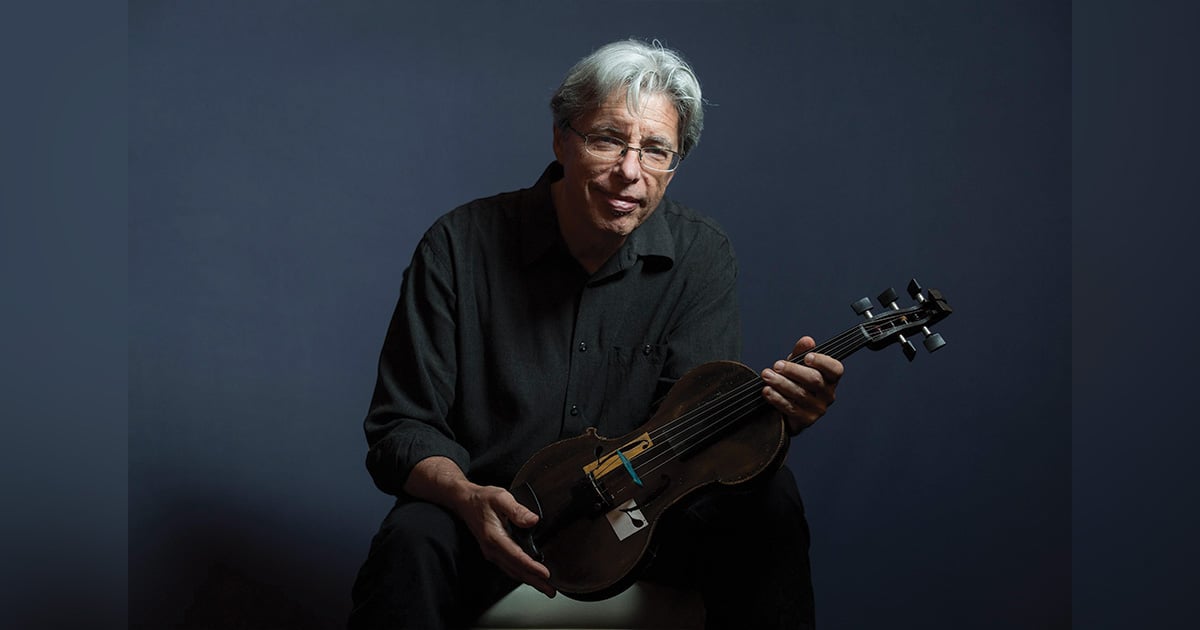
After seeing him perform at the 2022 Grey Fox Bluegrass Festival, I had the good fortune to chat with contemporary string music innovator and fiddler extraordinaire, Darol Anger, in July 2022. Anger has played with Republic of Strings, the Turtle Island String Quartet, the David Grisman Quintet, Montreux, Psychograss, The Duo and other ensembles. He is currently a member of Mr. Sun, an American string band quartet. Anger is Professor Emeritus at the prestigious Berklee College of Music. He also runs an innovative online Fiddle School with www.ArtistWorks.com.
M: Thanks for taking the time to chat.
D: Of course.
M: As a guitar player myself, I am a huge admirer of yours and Grant’s [Grant Gordy] level of playing.
D: Hardly anybody is at Grant’s level.
M: I do a lot of banter when I play and I’m just very curious. I noticed that you and, well, Mr. Sun in general, Béla Fleck, Jerry Douglas, you guys like stage banter.
D: We do a lot of instrumental music. And we sometimes incorporate singing. Joe [Joe Walsh] is of course a good song interpreter and a great songwriter. But when it comes down to it, most of my career has been spent doing instrumental music and developing that, you know, as best we can. You need to provide context when you’re doing instrumental music, whether or not it’s informational or just helping the audience or us to relax. I actually relax more if I get to talk about the music, a reason for why it was written or what it’s about or how we approached it. In Grant’s case, he’s naturally very funny. I have let Grant kind of take over the banter because I used to go on pretty long verbal peregrinations. I was a fan of people like Ellen DeGeneres and Steven Wright, and they’ve got that way of collapsing logical categories and spouting non sequiturs, and I tend to do that too. I think it relaxes everybody. Although there are times when somebody will yell out from the audience “play the tune!” I understand. I’m trying to mitigate that a little bit.
M: I know what you mean. I joke around a lot when I host an open mike event in Brooklyn and my objective is to not think about what I’m going to say. That could get you in trouble, but the people that come know who I am, and they know I’m a decent person and seem to be OK if I say something that’s outrageous. I think it really does help because you guys are doing complex music and it keeps the performance fun and light. And I really love the vocal stuff, too.
D: Yeah, I do too. I love having vocals mixed in. I think again, it helps people orient themselves to the music. People need a story no matter whether it’s in words or not. And I think people are better at handling a nonverbal story, if it’s mixed with verbal stories. Joe is so good with that stuff and he’s willing to sing a lot of words. That’s one thing I’ve noticed. Joe is like John Hartford; he can sing wordy songs well. Kind of goes with his mandolin playing, which is startling, so alert and complicated. And he has good diction too, which is very important.
M: I’ve noticed, if it’s a simple melody, people can follow and repeat it. [Hums the first notes to Eine Kleine Nachtmusik]. People’s brains can’t hold long phrases. Listen to Dizzy Gillespie. I have a hard time repeating his musical phrases. But words seem to carry us, even those of us who are close listeners of the music. I love some of the vocal songs you do like “Tamp Em Up Solid.” They get the crowd fired up and they just keep the flow going. I really like that. I’m not saying that you should do more vocal tunes. I just think it’s great that you have vocals in the mix.
D: We’re always looking around for songs. Joe’s a steady, but not hugely prolific, song composer. But he does steadily produce great stuff, and he’s definitely prolific with the instrumental tunes. We’re always looking for songs that will work with Joe’s voice. Joe’s the best at finding stuff. Ray Charles’s songs really work for Joe. And yeah, that Eddy Arnold tune we do [“Just a Little Lovin”] is great. We’re thinking about working up that Johnny Cash song, “Get Rhythm.” Because rhythm is one of our obsessions. With any acoustic string band, rhythm is going to be an obsession because, you know, you don’t just say, oh, we’ll just let the drummer handle it. Everybody’s the drummer.
M: You guys are very rhythmic. There’s a kind of pop and fizzle to everything you play. The tunes make me snap my fingers and tap my foot.
D: One of the nice things about this band is that we’ve sort of come out the other side of that. You spend a lot of years when you’re younger fighting about it, discussing it, trying to get people to play together and I think we’ve all sort of come out the other side where we understand where we each put the beat and how to manipulate the beat for different tempos. That’s one thing that I’m seeing: a lot of the younger groups are still trying to work that out and they maybe get one particular groove going and then they’ve got that and then it takes years sometimes to understand how to move to another groove. With the Turtle Island String Quartet, we spent a lot of time trying to understand and put across not only our jazz grooves, but pop grooves and other kinds of various R&B grooves, too. So now, that’s one of Mr. Sun’s strengths. We can do a lot of different grooves and it’s not even that big a deal.
M: It’s organic. It’s not forced. I hear it very authentically.
D: That’s cool. That’s great. I’m glad it comes across.
M: I really enjoyed your set on Saturday. I was completely engaged and listening and enjoying the laughter, the complexity and all of that together.
You started to play with David Grisman at 21. How were you prepared for that?
D: I had only known bluegrass existed for about seven years prior to that. But I was very much following what David was doing at the time. The Muleskinner Band, Old & In the Way, etc. I had already seen a performance of a group called the Great American Music Band, which included David and Richard Greene. I’d taken some classical violin lessons and I was working on trying to be a lead electric guitar player. That’s when everything changed for me [at 13].Richard was the first guy that I ever heard play the fiddle, and it was in the context of a rock band, Seatrain. I thought that I could apply lead guitar ideas to the violin. There were already 200 guys ahead of me, just in my high school, on electric guitar. But if I could find the electric guitar stuff on the violin, like Richard was doing, then I’d have a niche, at least, you know, in my county. [laughs]
And then I discovered bluegrass and all that. Fiddling, the huge panoply of fiddle players, and all the different flavors of fiddling, Grappelli and Ponty, came over the next couple of years. Originally, I got turned on to music via the Beatles. You get ruined for any pure traditional style if you emulate the Beatles because they were combining so many different things and that was their ethos, you know. Bluegrass of course is a hybrid form too.
You look into their sound, and I just thought, that’s how you do it. And then I saw these other guys do it. People like Richard, Byron, David Grisman and Vassar Clements, other people that were playing my instrument.
Bluegrass requires a certain amount of virtuosity. Traditional fiddle players play in open keys, and they groove on the melody and that’s it, but once you get into bluegrass, you’re switching through all these different roles, you’re backing up, you’re complementing the singer, you’re playing rhythm.
M: Chopping, all kinds of stuff.
D: Yeah, your job changes with almost every verse of the song. You’re playing in difficult keys for the instrument. I was prepared in that way, and I was always listening to blues, rock, and jazz, and all these different styles and I was living in a university town in California where a lot of people were playing music and were involved in the same kind of quest.
M: Was that Berkeley?
D: Santa Cruz, California, just a little south of the San Francisco Bay area where I went to high school. And at that time, in the late 60s, there was so much going on. A lot of music was happening, and of course David [Grisman] was living in the Bay Area too. It wasn’t just like I was a fan. I got introduced to him by Todd Phillips, who has played bass with just about everybody, including Tony Rice and Joan Baez…not at the same time! He was taking mandolin lessons from David and of course he wound up playing mandolin and the first version of the David Grisman Quintet. And I was buddies with Todd because we were in rival bluegrass bands. Our band wanted their pizza gig because they were on a nicer side of town.
M: I’ve told Richard Greene that he’s the bluegrass Paganini.
D: I’m sure he loves that. There are some parallels there for sure.
M: Even just the way he holds the violin in that Muleskinner TV performance. He’s so tall and confident. The way he plays reminds me of that pose atop the mountain, the classic Paganini one.

When we chatted at Grey Fox you said that you don’t consider Mr. Sun to be a bluegrass band. I had this long conversation with a friend who’s a classically trained musician, and he believes that music should be played in its pure forms only. And I thought to myself, what music is pure? Is Jazz pure? Is bluegrass pure? Is even classical pure? Everything comes from somewhere and is built on what came before.
D: You could probably describe our music as blurgrass.
M: Blurgrass. That’s new. I haven’t heard that one. I like that. [both laughing]
D: It’s shocking to me that somebody hasn’t coined that term. I might be the first person to name it.
M: I want to write that down. [I subsequently did a Google search on blurgrass and couldn’t find it].
D: I keep looking for the term, but I haven’t found anybody using it yet. Maybe that’s my contribution to the nomenclature. But the suffix “grass” gets applied to acoustic string bands, right? When you put grass in there, you know there’s going to be an acoustic fiddle, an acoustic mandolin and an acoustic guitar. The original “grass” was obviously bluegrass. I think “grass,” you know, for better or worse, has sort of become like a shorthand identifier for this kind of acoustic string ensemble thing. So, you can put whatever style you’re identifying with on top of that. You get jazzgrass, rockgrass, jamgrass, blurgrass, whatever.
I think most musicians get a rash when they’re put into some kind of box like that. We can play bluegrass, but we aren’t exclusively bluegrass. We like playing bluegrass. Bluegrass is the most exciting music in the world for about eight and a half minutes. And then you realize this is just all going to be like that. Like that. It’s a lovely form. It’s classicized. It’s like Mozart or something, right? It’s easy to play bad, really difficult to play well. It’s laid out. There’s a role for every instrument and everybody knows what they’re supposed to be doing at any particular time. It’s sort of a closed form, right? If you’re going to innovate in bluegrass you sort of have to innovate in the direction of virtuosity, like you have to be better, cleaner, and faster. If you try to incorporate other harmonic things, then it’s not bluegrass. I remember that famous remark of David’s: “I started Dawg music because I didn’t want to mess up bluegrass.”
But you have to respect that style. We’re not a bluegrass band. For instance, we don’t have a banjo. We don’t sing in that particular style, but we will do material that’s considered bluegrass. There’s a lot of overlap. We all spent a lot of time playing bluegrass and trying to play it correctly. But now we’re more into R&B, really. We’re exploring ways to put an R&B style into the Acoustic String Band, or do more singer-songwriter tunes, or just jazz. I’ve spent a lot of years playing jazz with the Turtle String Quartet. Mostly the jazz people were completely into what the Quartet was doing. They loved it. But, you know, occasionally we might get a review of a show or something from a self-styled critic who says, “This is not jazz. Jazz is the sound of a smoky saxophone on a street corner at night and you’re wearing a trench coat.” The identifiers of some forms of music are not necessarily musical; they’re about the way you wear your hair, or your clothes, or what you’re doing or drinking. Surprisingly though, jazz and bluegrass are two of the styles that the actual identifiers are mostly musical. It’s about what you play. Are you playing the Lester Flatt lick, for instance? It’s about the core of the music and that’s very cool.
M: One thing I really like about bluegrass is this inclusion of the people that taught you. And you’re passing the baton to younger folks. Bluegrass has a very pedagogical approach. At the Grey Fox show, Jerry Douglas was very insistent about getting younger people on stage, providing bluegrass music education to kids. Your generation was taught by the previous generation, and now you’re doing the same.
D: It’s one of the few fields where the older musicians are respected so much that way.
M: And the older musicians want the younger musicians involved, right? It’s kind of a bidirectional thing.
D: It’s a beautiful thing. I go to these IBMA conferences and people that I never suspected come up to me. All these heavy bluegrass cats. They say, I love what you did on that DGQ record. And I’ll say thank you and I think you’re really great too. The breath of acceptance is always surprising. But it’s really about showing respect for what people are doing well. One thing about bluegrass is that so many of the fans play. The lines are blurred between the audience and the players. Seems like the people that are elected to be on stage are like just doing R&D for everybody else. That’s why it’s so robust as a style. Like, “Here’s something you might try in the parking lot later.” There’s a lot of knowledge floating around, like it’s a classic American hobbyist thing.
M: Like amateur astronomers.
D: Like astronomers. That’s so true. It’s like car culture. In bluegrass, you’ve got the instrument makers, the players, the history. And it’s highly integrated. I love that. It’s very strong. And there’s a deep sharing that goes on.
M: And there’s a lot of tradition. You know, as much as people break from it, everyone recognizes it. And there’s a lot of homage to the tradition. I find the history of tradition fascinating. But as a writer, not necessarily a player.
D: But that’s the thing! You do play, you know, and you understand what’s going on. Something happens.
M: I’m a good guitar player, but I grew up in New York City. My first glimpses of bluegrass were through Hee Haw and Beverly Hillbillies, and eventually Old & In the Way. And then it just eked in through the perimeter of the culture. Eventually I sought it out. I went back to the roots.
D: Look at Béla, he’s from New York City. And he’s become one of the greatest bluegrass players who ever lived.
M: What can you say about Mr. Sun and how you are jelling with this group of musicians?
D: I’ve been around for a long time, and continuing to persist, you know, has helped. Eventually you’re going to locate the people that are into what you’re into. Both Joe and Grant, apparently, did a lot of listening early on to some of the recordings that I was on. There are 10 years of me playing with David in the David Grisman Quartet.
M: The first seven albums or something, right?
D: I was on most of those. Joe and Grant were attracted to the kind of music I was helping to create. You get that basic affinity from square one. Both Grant, Joe, our first bassist Ethan Jodziewicz, and our current bassist Aidan O’Donnell got emotionally involved in what I and those guys—Tony, David, Todd—were doing. They understood it. In all music, there’s a story and there’s you trying to get people to feel something in a certain way. And if you’re all on board with telling the story in the same way, even if you’re making it up to some extent on the spot, it comes together. That’s why we’re attracted to playing together in the first place, just because we tend to be OK with telling the story in the same way. We all respect each other and understand each other and what we’re each trying to do.
M: It’s funny because I said to Grant, when you’re playing, I have no idea what you’re doing. It looks like alien arithmetic or something. And he said, “Sometimes I don’t know what I’m doing.” Like he’s feeling his way. It’s not intellectual. It’s just that he has a gift.
D: One thing I love about Grant’s playing is that he is always willing to experiment, and you know it’s not even like he’s deciding to experiment, he just has to do it. I’ve always been that way and some people might say, well, that’s the mark of a messy player, you know? I’m kind of sloppy sometimes, but for me, I value the exploration thing and certainly Grant does too. One of my favorite things to do is just listen to Grant play. And to have a little input into what he’s doing, cause if I play something at him, he’ll hear it and he’ll react to that. And mainly we’re just trying to crack each other up. Most of the time.
M: That’s what Grant said. And you have such a signature sound. When you say messy, I never hear it that way. I hear it as innovative exploring and we’re there with you. It’s a bit of a high-wire act. Those of us that are listening are into that sort of thing. “Is he going to make it?” we think. For example, listening to Enrico Caruso, he does these vocal acrobatic things. I’m thinking, how is he going to resolve that phrase? How is he breathing? Is he going to die of a heart attack in the delivery of that final note? But he gets there. And those of us who listen closely join him on that journey. It’s dramatic. This is not unlike what you’re doing.
D: That’s a real compliment to be compared to Caruso. Thanks.
M: I thought it was interesting when Béla was playing at Grey Fox with his ensemble. Looking at the stage, I then turned to look at the audience. What was cool is that there were young people, older people, hippies, people in their 20s, girls in their 20s in short shorts. People were hooting and hollering. They were digging it. It was so genuine.
By the way, I don’t think you’ve ever recorded with Peter Rowan before, right? I couldn’t find anything.
D: I’ve played with him many times, but I don’t know if I’ve ever recorded with him. I have experienced many of his quirks as well as his brilliance. You know, he has brilliant moments, and nobody gets a tone like him on guitar. He’ll often do a left turn on you when you’re playing. Peter is like a Kennedy, someone sort of blessed but who has survived so much. He’s a sort of a Camelot figure. And he’s also a trickster figure and incredibly knowledgeable. He’s got solid control of what he’s doing as a cultural explorer. Of course, he played with Bill Monroe. We only see the tip of the iceberg a lot with Peter, you know, the tip of what he’s doing. But there’s always something bigger happening under the surface. He’s a source for the material, and being a source gives him depth and breath.
M: Totally agree. When I initially spoke to him for a short article, he was blowing my mind with all this bluegrass lore. And he’s such a brilliant raconteur and poet, not to mention a kind of philosopher. This prompted me to ask him to work on the book with me. The project evolved into my book, Mescalito Riding His White Horse. The book had to be unconventional to reflect Peter’s uniqueness.
D: I can imagine.
M: What’s next for Mr. Sun?
D: I can say all the quotidian things like, we’re going to keep playing together until we drop. Two recording projects in the works. Blah blah blah.
Are you going to the Green Mountain Festival? A lot of the young people that I’ve worked with over the years are going to be there, and the Punch Brothers and Hawktail and others. It should be a really good time. It’s in August.
M: I’ll think about it. I’ve gone to a few festivals this year. I’ve brought my family with me too. I’ll have to check in with my wife. I’ll let you know. But thanks again, I really appreciate it. It has been great fun talking to you.
D: Thanks again for paying attention to the music. It’s always a validation. You know, somebody like you, a writer, wanting to talk to us musicians. Thanks.
M: [blushing] We love what you do and so it really goes both ways. Thank you for the music and for being open to talk.