
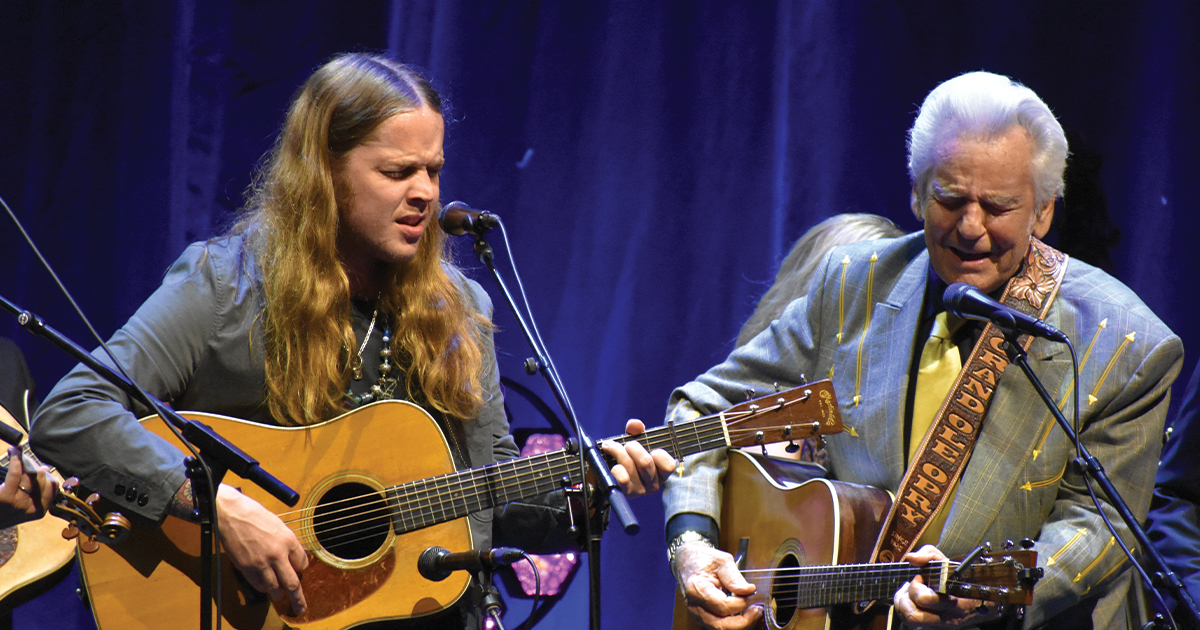
Billy Strings at the IMBA Conference 2025
Introducing Billy Strings as the keynote speaker for the IBMA World of Bluegrass, Executive Director Ken White called him a “generational talent” and acknowledged the kind of “watershed moment” that comes along every twenty years or so, putting “bluegrass music in the center of popular culture.” Along with such phenomena as Will the Circle Be Unbroken and O Brother! Where Art Thou, he suggested, we now have Billy Strings.
With a mix of humility, humor, and authenticity, Strings delivered a poignant address that not only gave a glimpse into how traditional bluegrass roots shaped him but also demonstrated the keen ear for detail that has shaped his original songwriting as well.
Not surprisingly, when someone has the success Strings has experienced, particularly in a genre not known for selling out arenas, the naysayers will have their day. Strings related accounts of early experience when he was judged on superficial appearances. His own narrative included the experience as a youngster at festivals, being shut out of jams, and being frisked by police as he arrived at his first IBMA World of Bluegrass.
However, the keynote address and the subsequent interview by Tom Powers did not focus on those incidents—isolated or not—but instead shared his pure love for the music that shaped him and, he says, saved his life.
Billy Strings’ appearance at the 2025 IBMA Conference could not have been better timed. Each year, members of the most recent Leadership Bluegrass class are charged with developing and presenting a master class for the opening day of the IBMA business conference during World of Bluegrass. The Class of 2025 chose to focus on ways to honor the past while moving into the future and to have a growing, vibrant community while respecting the traditional roots of bluegrass.
During the planning sessions, the subject of Billy Strings and his phenomenal success emerged. Wouldn’t it be great, some suggested, if he could throw some of his momentum toward the organization? Without a word, class member Josh Rilko, mandolinist for Sierra Ferrell, shot an email to his friend Billy to raise the possibility.
Much of the groundwork for Billy Strings’ eventual appearance during this year’s fall conference and festival was laid two years ago, when Strings was unable to attend the ceremony in Raleigh when he was named Entertainer of the Year. When he dropped by the IBMA office to pick up the trophy, he told White he would have loved to attend but, he noted, “my manager keeps booking gigs.”
White assured him, “If you’ve got an arena full of folks who want to hear your music, you should probably go do that.” When Strings insisted he really wanted to be there, White said, “I told him, ‘It’ll work out when it’s supposed to.’ I think it just lined up that this was the year to do it.”
The organization’s leadership started talks early with Strings’ manager Bill Orner about how to integrate Billy into the event, says White, “without it turning into World of Billy instead of World of Bluegrass. We threw out a couple of ideas, and the keynote was the one that resonated.”

On the opening morning of the IBMA Business Conference, Ross Willetts, director of Minnesota Bluegrass & Old-Time Music Association, served as moderator for the panel by Leadership Bluegrass Class of 2025 to discuss how to honor the traditions while moving into the future. With a look toward 2035, when IBMA will celebrate its 50th anniversary, he started by presenting what he called three “Big, Hairy, Audacious Goals”:
• Artists will make a viable living in bluegrass.
• Bluegrass organizations will be thriving and sustainable.
• Bluegrass audiences will be growing and engaged across generations.
Serving on the panel were Theresa Gooding of the California Bluegrass Association, Stephen Mougin of Sam Bush Band and Dark Shadow Recording, and C. J. Lewandowski of the Po’ Ramblin’ Boys. Recurring themes surfaced in the comments and suggestions by the panel and by audience participants. Mougin suggested “trying not to be scared of new things,” pointing out, “Throughout history, the names you know are people who did something different—from Beethoven to Bill Monroe.”
Lewandowski reminded the audience that “Everything that is traditional now was progressive one time.” He made the simple suggestion: “Be kind,” particularly since he noted, “Bluegrass is a large community. It’s a family, so don’t be holding grudges!”
The panelists and session attendees emphasized the importance of mentorship through such formal programs as Kids on Bluegrass, as well as through informal connections forged between seasoned performers and aspiring pickers at festivals and at the IBMA World of Bluegrass.
That same afternoon, Strings delivered his keynote address, followed by an interview with Powers, host of the podcast Toy Heart. The well-attended session more than resonated with attendees.
In the opening remarks, Strings remained self-deprecating, explaining, “I missed the last few years back in Raleigh, but only because I’ve been out on the dusty old trail, spreading the good word of the bluegrass gospel as far and wide as I can.”
Strings described the impact of bluegrass music on his life from his early childhood, when he heard his dad playing and wanted to learn to pick as well. He cited those early influences he discovered as his father played the songs of “such legends as Doc and Merle, Lester and Earl, Stanley Brothers, Jimmy Martin, Larry Sparks, and The Osborne Brothers til his face was beet red.”
Strings accounted for his own journey, starting with a plastic toy guitar with neon-colored buttons down the fret board that would have played tunes when pressed, except, he said, “I never had batteries.” He graduated first to a guitar called Norma, which his father bought him for thirty dollars from an antique shop, and later borrowed a friend’s Ibanez guitar.
Throughout his address, Strings acknowledged the impact of adults who encouraged him, such as the members of the local hunting and fishing club, who paid him $200 to play bluegrass music when he was only still a kid.
Strings said he figured out part of what he wanted to say in his keynote address when Junior Sisk called and asked him to join his band on stage for a song beforehand. He described times when he showed up at festivals eager to pick and was “boxed out of jams,” presumably based on appearance and assumptions.
“I didn’t feel like it was a skill thing because I felt like I could hang,” he said. “It became very clear to me that there was this side of the scene that I didn’t belong to, and even though we were all into the same music, there was an invisible divide.”
Referring to Sisk, he said, “He’s not afraid to have long hair up there with him. I’m going to try to mix up the camo and tie-dye a little bit and stir up the Nag Champa with the Roll Tide.”
Echoing the sentiments of the morning panel, he said, “These experiences taught me how bad this kind of exclusion can be for the whole scene. To me, bluegrass is beautiful because of the diversity of sounds and influences.”
Strings was perhaps most eloquent when he talked about the music itself, noting, “It has branches now; the trunk of the tree is firmly planted with roots reaching down deeper and stronger than ever, and the beautiful buds on Bill’s bluegrass tree are blossoming and reaching up towards the big blue sky.” Describing the flowers on the tree, he expressed pride at seeing his bluegrass peers playing big stages, naming Josh Rilko, Oliver Craven, Bryan Sutton, and “the great Seth Taylor out there playing stadiums with Post Malone.”
He added, “As bluegrassers, we sometimes act like crabs in a bucket trying to pull each other back down, scared to lose our polite, perfect little poster children to the evil clutches of success.”
But, he added, “This music will inevitably grow, and we should continue to spread the word as far as we can because this is a true American art form that deserves so much more from the general population than a simplistic portrayal of country living. It deserves more than a stereotypical image of a banjo player in overalls with a piece of wheat hanging out of his mouth. It is a richly nuanced and sophisticated genre that demands incredible skill and artistry from its musicians and has a strong commitment to musical excellence and deep cultural roots.”
In the interview, Powers continued to explore Strings’ bluegrass origin story, drawing out his stories of going as early as age four to festivals and to the VFW Hall with his father, where he encountered “the suits” and the bingo crowd. He remembers hearing the instruments and the three-part harmony coming out of the speakers, and being blown away.
Powers sought to understand what road brought Strings back to bluegrass after spending time in heavy metal bands in high school. Strings admitted that part of what drew him to other genres was the desire to play with people his own age.
Strings also described the impact of his parents’ descent into addiction, leading him to leave home at fifteen. A turning point came when he took his mother’s car without her knowledge, popping in the cassette tape in her player—to find it was “Rank Stranger.”
He says, “I started slowing down that old car, and I eventually pulled over; that music hit me so hard in that moment because my life felt like going down the drain.” At the time, he was playing in bands that kept breaking up. “Rank Stranger” hit him like a wakeup call.
He also described coming around to the jam band scene, an acquired taste he did not get at first. He described his impression of the Grateful Dead, saying they “sounded like five people playing five different songs all at the same time, and so I just didn’t get it. I didn’t understand why do you have to play a song for thirty minutes and not do anything.” Playing on stage with Greensky Bluegrass helped to bring him around.
Strings also acknowledged the people who encouraged and mentored him, particularly when he moved to Traverse City, Michigan, after squeaking through high school. “I moved up there, and all of a sudden, it’s Technicolor.” For the first time, others encouraged him that he could be a working musician.
For members of the audience during the keynote and interview, perhaps the most poignant statement Strings made came as he described the turning point in his career when he parted ways with his former partner, Don Julin, and moved to Nashville. Evoking images of his earlier years, he said, “I’m not running toward success; I’m running away from poverty.”
Reflecting on that moment in the interview, Ken White said, “That’s the theme of bluegrass musicians for generations over. I think that’s partly Bill Monroe’s story and Jimmy Martin’s story.”
While the keynote and address composed the formal part of his week in Chattanooga, Strings also agreed to present the Momentum Awards for Instrumentalists of the year to Kyser George and Rainy Miatke, and he presented the Martin Billy Strings D-28 guitar to Hayden Reidling, winner of the 2025 guitar contest.
Originally, Strings had not committed to attend the Thursday night awards ceremony, since he was scheduled to play Willie Nelson’s Farm Aid the next day, but he stayed on, picking up Entertainer of the Year and joining hosts Steve Martin and Alison Brown and a full stage of pickers for the grand finale, a high point of a great evening.
During the day, though, Strings strolled through the exhibit hall and the conference center, stopping to play Jimmy Martin’s guitar, which was brought to the conference by Martin’s son Buddy, surrounded by onlookers, with some of the younger kids sitting at his feet.
“He respects the music so much,” said White, “and it comes through in everything he does. Taking time with the kids was awesome, and stopping by to sing one with Paul Williams was totally unplanned.”
During a week marked by high points and milestones, Billy Strings showed up and solidified his rightful place in the bluegrass family through his generosity of spirit, his love for the music, and his respect for the tradition. By gaining entrée into the broader musical world, he continues to introduce the best of bluegrass to new enthusiastic audiences, paving the way for others.