
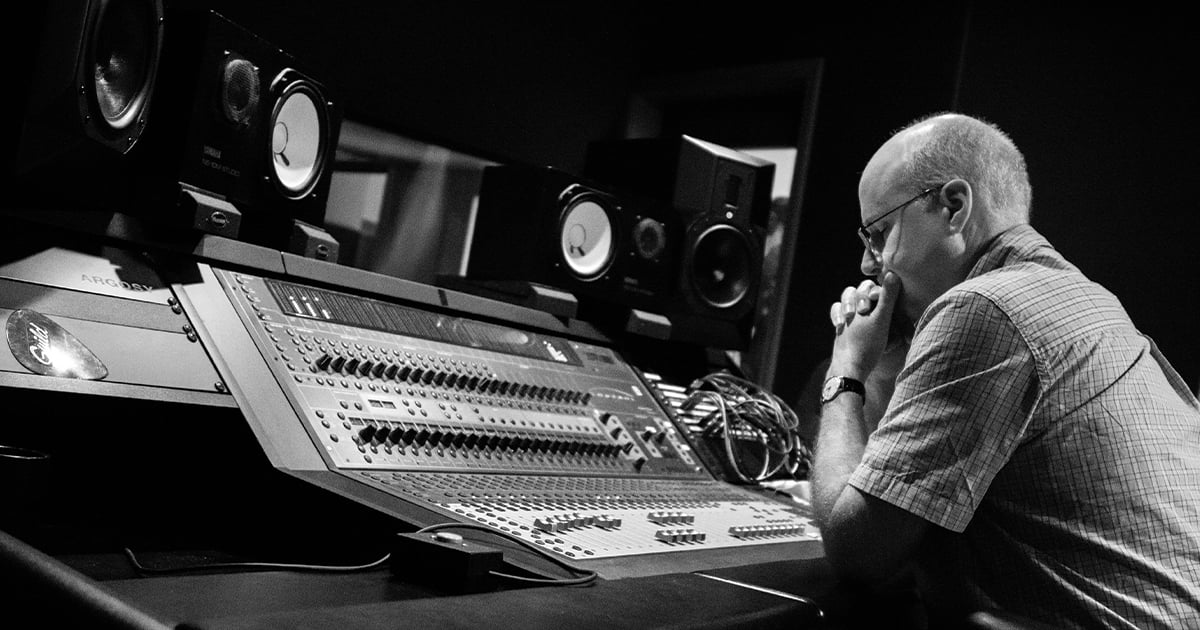
Ben Surratt Living His Dream
Photo By CarsonPhotography
Young kids are often asked, “What do you want to be when you grow up?” I would guess that a fairly low percentage of adults actually end up fulfilling those childhood dreams. For musicians it might be different though. I have interviewed many bluegrass musicians who became enamored with a musical instrument at a young age, never thought about doing anything else, and ended up being professional musicians. They followed their dream and passion, and they were able to “live the life they love.”
Ben Surratt is someone who is currently living the life he imagined when he was young, but his dream was not to be a performing musician—he wanted to record music. Ben remembers life as a child living in Swoope, Virginia, “When I was a kid, I was learning bluegrass guitar from my mom’s youngest brother, Sam Oliver. Her middle brother, Tommy Oliver, was a banjo player. I spent a lot of time with him (Uncle Tom), learning music as well. He had a bluegrass band called the Hankey Mountain Express and they needed a soundman. I was fourteen at the time and they started taking me out with them to do sound. So, in my early years, I did a lot of live sound work.”
Running sound for his uncle’s bluegrass band was not Ben’s first exposure to working with live sound. Ben recalled, “I was always a gear nut when I was a kid. My parents would have these picking parties and dad would be hanging microphones from the chandelier and running them over to the recorder so that we could record live jam sessions on 8-track and reel-to-reel. My job would be keeping an eye on the tapes and keeping an eye on the levels and stuff like that. I was super excited to be around that kind of stuff.”
When he was nearly sixteen, Ben got a job with Gary Major of Major Recording Company. He said, “They were looking for someone to go out on the road with them. They did sound at bluegrass festivals all over Virginia and West Virginia. They needed someone to go out there with them and they took me on. I was like the kid brother to these two other brothers. I would go out and set up the stage for everybody, having taken notes on where the microphones needed to be, then I would run inside this mobile truck that they had and every couple of hours they would let me mix. Gary Major was really helpful to me…he would put me in the frying pan just to let me fry and figure things out. But he was always there to bail me out if I got in trouble.”
When Ben entered college at James Madison University to study Communication Arts (1978-1982), he added to his engineering experience by getting into radio. He said, “I helped produce a bluegrass radio show at JMU’s public radio station, WMRA, there in Harrisonburg while I was in college. The whole time that I was at JMU I pretty much lived at the public radio station. I was working on the bluegrass show, but I was also an intern for the engineering department. So, I would go to various sites around campus and record faculty or student recitals—or if some big performer would come in, I would record them. These would be turned into programs that would be broadcast over the public station. I also did a similar thing at UVA in Charlottesville. I was always interested in the equipment and driving it around and making it do what it needed to do.”
When he finished his college degree, Ben thought that he wanted to pursue a job in radio engineering. He got a job in Staunton, Virginia as a disc jockey and he and the chief engineer at the station became best friends. Ben said, “I was studying radio engineering and I thought that is what I wanted to do. From the station in Staunton, I went to a one-kilowatt AM station, WKAV, in Charlottesville as the engineer. From there I moved across town and took care of an AM and FM (WINA/WQMZ) station. It is a tough job because you wear a pager 24 hours a day and if something breaks, you own it until it is fixed. I loved broadcasting, but being a broadcast engineer was something that I realized was not the passion. I really wanted to record. I just didn’t have the opportunity in that area.”
By this time, Ben had married Missy Raines and the couple started thinking that they needed to make the move to Nashville. In Charlottesville, Missy had been playing with the band Cloud Valley, and then moved on to play with Martha and Eddie Adcock. Ben and Missy got married in December of 1987 and made the move to Nashville in 1990 where Ben started taking recording/music business classes at Belmont University. He said, “I attended Belmont for two years and took every recording class that I could. I also worked for Randy Blevins. He sells and services recording studio equipment. I was fixing tape machines and recording consoles there with Randy. The work that I did there led to work at some recording studios. Probably the best thing that I ever did was to start to do all the work that I could at the Hilltop Recording Studio in Madison. Anytime they needed a weekend guy or evening guy, I would volunteer. It was a bustling place for bluegrass recording.” At Hilltop Ben had the opportunity to work with bluegrass acts such as Larry Stephenson, David Parmley, Ronnie Reno, the Rarely Herd, and Claire Lynch.
By the mid-to-late 1990s the business model for recording studios started to change with the move from analog tape to digital recording platforms. When computer-based digital recording became more common, engineers started working out of their homes. Budgets from record labels also began shrinking with the wane of retail CD sales. Ben remembers, “It was getting difficult for people to afford to pay me and pay a studio to do a record. I knew that if I was going to continue working with my friends in bluegrass, I was going to have to adapt to what the market would bear.” Ben and Missy decided to look for a home that would be ideal as both a living space and a recording studio.
In 2003, they found the perfect space. Ben said, “I was at Hilltop one night and Lee Groitzsch, a long-time and well-respected engineer here, came by. I told him that I was looking for a house and he said, ‘I was at this estate sale. You need to see this place.’ Missy and I saw the house and I did the most impulsive thing I’ve ever done in my life. Not only did we put a contract on that house that night, but we put our house up for sale that night.” Ben and Missy still live in that house today and Ben has run his studio out of the basement since 2004.
Ben’s first client at his new place, The Rec Room Studio, was Pine Mountain Railroad, with Missy producing the record. After that, the word got out that Ben had his own studio and people kept coming in to record. Some of the artists and bands that he has worked with—either at his home studio or the studio at Compass Records—include The Gibson Brothers, Larry Stephenson, Peter Rowan, Claire Lynch, Jamie Hartford, The Steel Wheels, Chris Jones and the Night Drivers, The Osborne Brothers, Missy Raines, Bronwyn Keith-Hynes, Mile 12, Tristan Scroggins, David Benedict, Wes Corbett, The Farewell Drifters, comedian/composer Ray Stevens, and more. Ben has won two IBMA Sound Engineer of the Year Awards, as well as other projects that have won IBMA awards, and has been nominated for Grammy awards for his work with Peter Rowan and Missy Raines, and has won a DOVE music award for his work with Pine Mountain Railroad.
While engineering work has been Ben’s main focus over the years, he has also produced, or co-produced, a number of projects. When he is sitting in the producer’s chair, Ben says that his goal is to get the best performance out of everybody. He said, “A lot of that is just vibe and attitude and making sure that everything is easy going, people are fed, they have water to drink, and they are having a good time. Keeping things relaxed is the best way for people to stay creative.”
In addition to his work as a recording engineer and producer, Ben spent nine years on the board of the International Bluegrass Music Association (IBMA). During this past year he was the Chairman of the Board. Regarding his work with IBMA, Ben said, “It was a lot of work, but also one of the most rewarding things that I’ve ever done in my life, period. It is hard to describe what an honor it is to be part of that organization. I served with some incredible people who really care about bluegrass. It feels so good to be a part of this bluegrass community…it is the best. I wouldn’t trade the experience for anything.”
In the recording world there are bands who love to record live takes—when the band is all playing together at the same time—because there can be a great energy to that type of recording. Others prefer to play to a click track and record every part separately and work to make it all sound perfect. Ben works both ways saying, “Whatever it takes for my client to be proud of what they have done, I’m down for. My job is to facilitate their vision the best that I can.”
Ben Surratt has certainly facilitated his own vision. He has come a long way since he was a young kid helping his father string microphone wires across a chandelier at home jam sessions. That young kid probably never imagined that one day his work recording jam sessions at home would lead to being nominated for a Grammy award. But, Ben lived his dream and that is exactly where that path has taken him.