
Banjo Whisperer
The phrase suggests a mystical or wizardly sort, surrounded by banjos and the tools used to bring them closer to the ideal. Marc Horowitz is THE Banjo Whisperer.
While researching this story about Marc, everyone I approached (banjo players, designers, builders, and musical contemporaries) quickly responded with effusive praise. Marc’s daughter Leah Horowitz (an accomplished singer, actress, dancer, and Broadway veteran) provided insights she had as a child exposed to her father’s world of folk and bluegrass music and his being a much sought after accompanist.
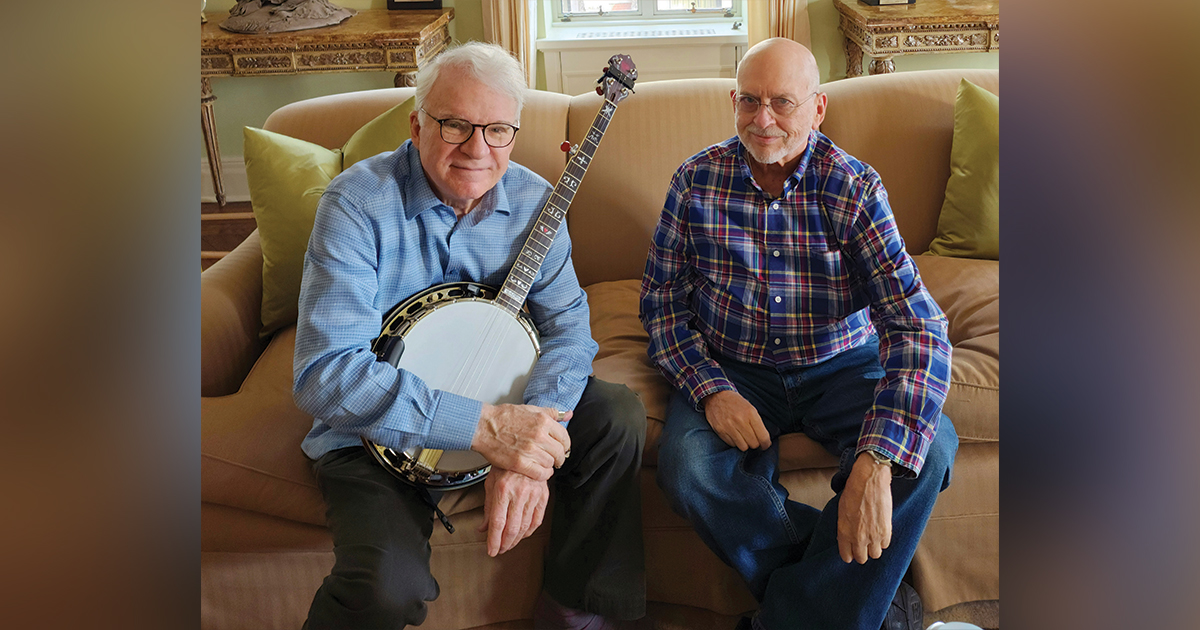
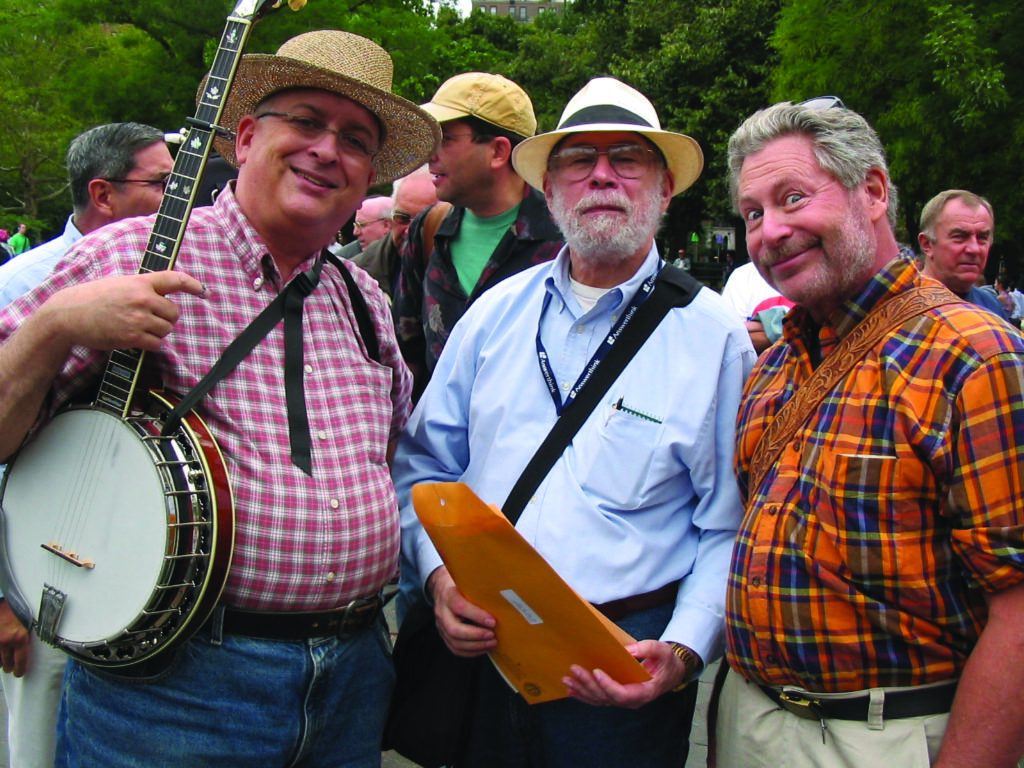
We’ll begin the story with the photograph at the top of this story. Steve Martin (the other one) is one of Marc’s most loyal customers and friends. Steve is holding a Gold Tone OB-Béla “Bluegrass Heart” signature model, a banjo that Marc conceived and then worked with Gold Tone to develop. More about that banjo a bit later.
Steve wrote, “Marc sets up all my banjos, which is a great help and professional benefit to me. But the real joy is in listening to him play as he determines if the banjo is sounding its best. He also is a historical figure and seems to know everybody!” High praise from a universally recognized artist. Notably, Steve’s comments are not limited to Marc’s set-up work but also make note of his musicianship.
Marc Horowitz was born in Brooklyn, NY in 1947. Starting with guitar in 1957, he took up five-string banjo in 1960, and mandolin around the same time. He began first with “frailing” or clawhammer style, then tackled Scruggs-style shortly thereafter. Practicing banjo six to eight hours a day all through high school, Marc won his first banjo contest at the Philadelphia Folk Festival in August, 1966. His first professional gig was at age seventeen; a recording session for a Wetson’s Hamburgers commercial.
Marc has recorded and/or toured with Patrick Sky, Doc Watson, Steve Goodman, Tom Paxton, Hall & Oates, Jay & The Americans, The Phoenix Singers, Judy Collins, Andy Kaufman and many other artists. He’s logged hundreds of recording sessions for commercial jingles and albums, played in Broadway show orchestras and on the Broadway stage in Foxfire (in a trio with Kenny Kosek and Roger Mason, accompanying Keith Carradine). Marc has played on film scores including The Missouri Breaks (with a score written and conducted by John Williams), starring Marlon Brando and Jack Nicholson and directed by Arthur Penn.
Marc’s former students include Béla Fleck, Henry Sapoznik, Mike Kropp, Pete Schwimmer and scores of others. He’s conducted clawhammer banjo workshops at the Park Slope Jamboree (Brooklyn, NY), The Joe Val Festival (Waltham, MA) and many other venues. He took part in the historic Keith-Style Banjo Summit at the Grey Fox Bluegrass Festival and was on the faculty for both Mandolin Camp North and Banjo Camp North.
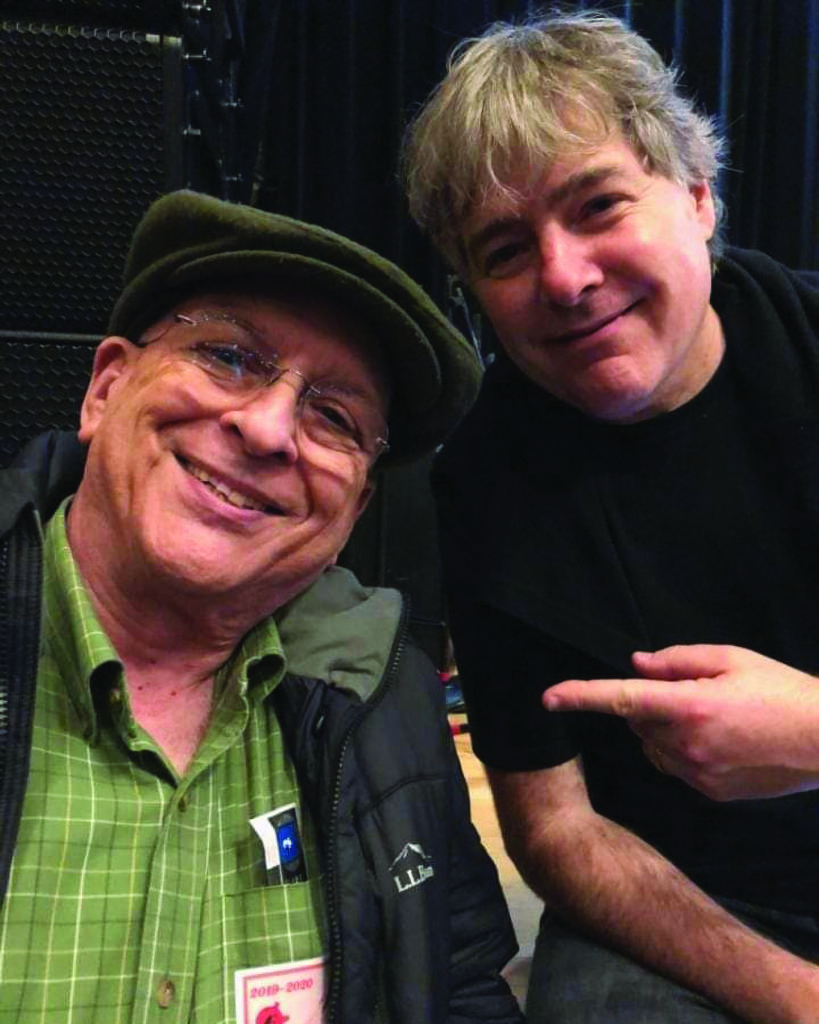
From Béla Fleck: “Marc was referred to me by my first banjo teacher, Erik Darling. When I turned sixteen, Erik felt it was time for me to move on to Marc, so I started taking lessons from him. He lived out in Brooklyn; an hour-long subway ride I would take straight from high school. Marc was a lot of fun; a big personality whose heart and soul came through when he taught banjo. I loved my time with him. It was never boring, and I always left with more than I could assimilate right then. One summer out in the country, I transcribed everything on the cassettes from every Marc lesson, and it was transformative.
“I think it was Charles Sawtelle of Hot Rize who had a business card that simply said ‘expert’ on it. Marc should have had one of those, too. He seemed to know everything about everything banjo. I have always deeply enjoyed the times when I had a great teacher because it meant I could be guaranteed to learn something amazing every lesson. My wide-open eyes kept getting wider as he showed me how Scruggs Style, Keith Style, Reno Style, and all the others functioned. Eventually he pointed me at Tony Trischka’s stuff, and everything pretty much exploded at that point. Finally, after he’d spent the entire week trying to learn some pesky complicated Tony thing to show me, he said ‘Here’s Tony’s number. He lives in the Bronx. Now get outta here, kid.’ Or something like that. So, on I went to the Bronx to Tony for lessons.
“I stayed in touch with Marc through the years. He had always said, ‘If you’re gonna be a real banjo player, you’ve got to get a real banjo.’ In 1980, he called me in Lexington, Kentucky where I was living and playing with Spectrum. He said—and he’s said this to me only a handful of times—’Béla, if you only listen to me one time, this is the time. Get your money together and buy this style 75 that just came into Mandolin Brothers. Don’t mess around.’ Marc, being the expert he was, I did so. It was $4,500 I believe, and it was all the money I could scrape up. And it was the wisest decision ever because I am still playing that banjo, and it certainly was a great investment to boot.
“Some years later, he told me the same thing about an original five-string mahogany pre-war flathead he owned which was on the cover of the Masters of the Five-String Banjo book. It was about twenty-five grand at the time and I passed on it because I didn’t like the sound. I should have listened to Marc.
“Marc has always been very able on lots of instruments; critical, insightful and a great problem solver. If you needed mandolin, guitar, or even pedal steel, he could get the job done. The setup part of his abilities was something I learned more about recently. It wasn’t part of the picture back then. His clawhammer playing certainly has flowered as well.”
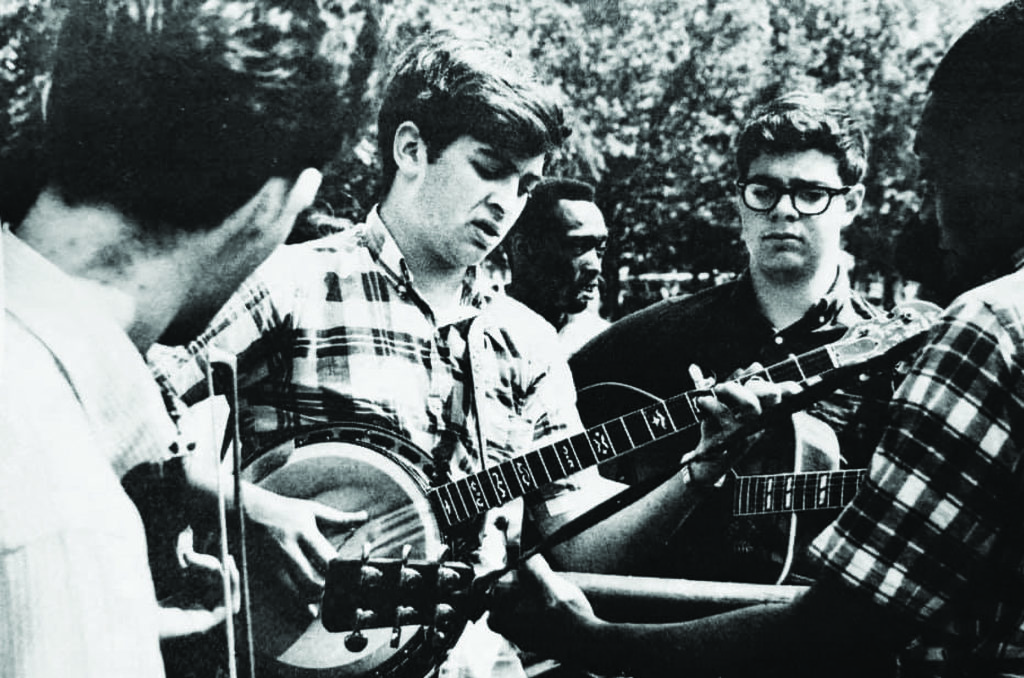
Tony Trischka and Marc have long been friends. The admiration from Tony is deep and he’s a fan as well—“In 1965, or so, my parents took my sister and me to visit my grandmother, who lived right on Washington Square Park in New York City. On a Sunday afternoon during that sojourn, we walked across the street and into the park and witnessed a bluegrass jam session. The banjo player and mandolin player were really good, and I took a picture or two of the band with my Instamatic. Many years later I found those photos, and waddaya know? It was a young Marc Horowitz with a cowboy hat on and Boston-based Richie Brown on mando. Marc was Béla’s second teacher (after Weavers alumnus Erik Darling), and he sure did a good job! I got to know Marc in 1973 when I moved to NYC to join Breakfast Special. We’ve been friends ever since. He’s always been a wonderful picker, be it Scruggs, melodic or single-string style. Then, after not seeing him for some years, whoa! He turned out to be a great clawhammer player as well. Not just good, but great! These days, in addition to banjoizing, he’s doing fantastic set-up work. Thanks for everything Marc!”
Richie Brown is a successful dentist in Cambridge, MA and has long been prominent in the bluegrass scene as a revered Monroe-style mandolinist. He’s known Marc since the early days of the bluegrass explosion in New York’s Washington Square Park. Dr Brown’s praise and memories are endless. By his own account, Richie’s knowledge and skill grew greatly while sharing music with Marc. He writes, “Marc was the player who always knew the music and how to make other musicians better.”
Marc’s multi-talented daughter Leah Horowitz grew up with a father who was constantly in demand for his musicianship. Leah’s Broadway career includes roles in Follies, Les Misérables, White Christmas, The Woman in White, Fiddler on the Roof, La Cage Aux Folles, and Thoroughly Modern Millie. She has sung on sessions for commercials, albums and cast recordings, done cabaret and regional theater as well as doing narration for audio books.
From Leah: “Growing up with Marc Horowitz as a father meant constant, unrelenting music around the house. Banjo music, of course, both live and recorded, but also a wide range of styles he enjoyed listening to and talking about. Through him I not only inherited some great musical genes, but also a nurtured love of the Beatles, Orff’s “Carmina Burana,” and Sondheim (even though his love of Sweeney Todd meant me living in fear of hearing that horrible steam whistle every time he listened to it). I think between the nature and nurture of both of my parents (my mother, Christine, also has great pitch and loves musicals), I was destined to end up in some sort of musical career. But I don’t know if I would have had the courage to pursue a Broadway career without the support of a father who had been there himself. Because of that, my life was not a pipe dream to my parents; they both knew it was a possible and tangible goal. My dad, especially, has always believed in me even when I haven’t believed in myself, and that has meant the world. I think everyone who’s lucky enough to be his friend or student enjoys that same kind of support, as well.”
We’ve heard from students, setup clients and his daughter, but you may ask for more evidence of Marc’s lofty place in the banjo world. Well, some very well-known banjo manufacturers and designers have sought his advice and assistance over the decades.
This note from Chuck Ogsbury, founder of the original Ode banjos and later of Ome Banjos—“I’ve known Marc for many years, but our relationship gathered steam when he inspired me to expand the Ome 5-string old-time banjo line about fifteen years ago. Unlike most players, Marc is very knowledgeable about both old-time and bluegrass playing styles and with the instruments used for each styles. Marc was a pleasure to work with and has a great ability to get the best out of an instrument. Great sense of humor and fun to work with.”
Tom Nechville, founder of Nechville Musical products writes, “It seems that I’ve known Marc forever. I first met him at a NAMM show in the early 90s and then at Banjo Camp North. He has always taken a keen interest in new banjo technology. He also put his money where his mouth is. He jumped in with both feet when I was building banjos in my garage: he bought one of the prototypes of my NUVO banjo with a graphite composite neck and our integral “Capobility” system. He was one of my first truly knowledgeable customers who became a team member and fellow banjo thinker. I love the way Marc’s mind wraps around the inherent problems with the banjo and strives to find solutions. Marc is truly a kindred spirit and a kind gentleman. He has helped me legitimize my ideas, especially in his native territory of the Northeast. I will aways be grateful for his help and advice.”
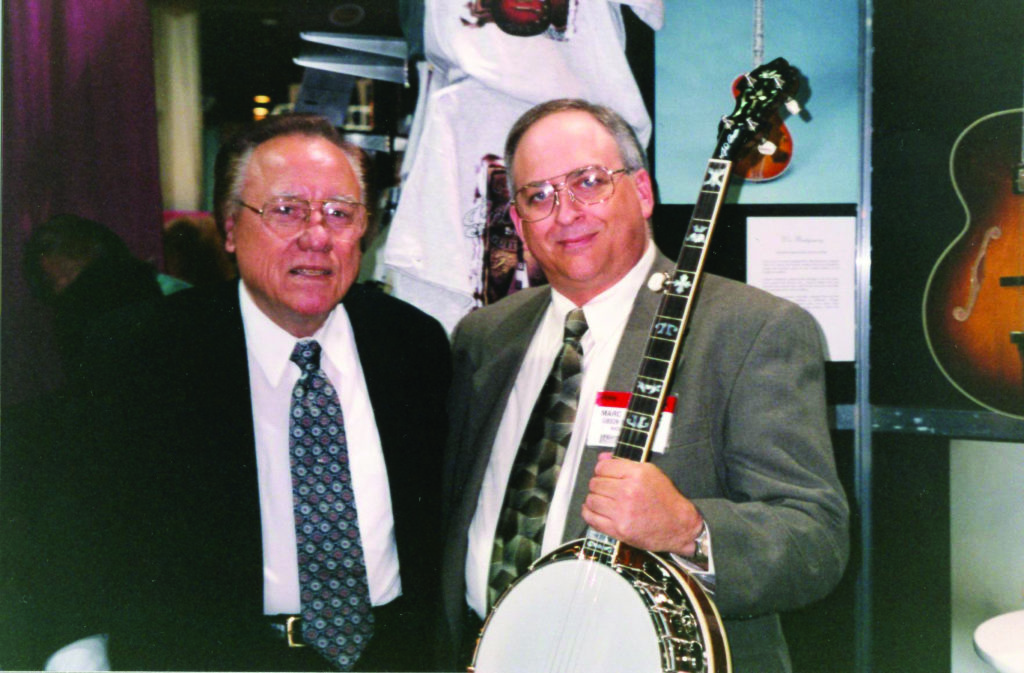
Marc sold Gold Tone instruments at retail when he worked as Stan Jay’s right-hand man at Mandolin Brothers Ltd, and later served as Northeast US sales representative for the Gold Tone Music Group. From the beginning of his working with Gold Tone, he contributed advice in the design and development of new models.
Wayne Rogers of Gold Tone said, “I’ve known Marc since the founding of Gold Tone. He has always been for me the “go-to guy” for all banjo info; playing technique, history, construction, setup, vintage instruments, you name it. Marc is an expert on anything banjo. Performance-wise, no one else comes to mind that’s as expert in playing and teaching two main styles: bluegrass and old-time. He did sales for GT for many years and at every trade show he helped me with my playing. Recently a customer I referred to him for a banjo setup in NYC wrote to thank me for my recommendation. After dealing with Marc, he stated ‘He’s a national treasure.’ I agree.”
Modern banjo notable Gabe Hirshfeld shares that same level of deep admiration—“When you look in the dictionary under the word ‘expert,’ there should be a picture of Marc Horowitz’s face smiling back at you. My good friend Marc’s brain is an unmatched resource of deep musical and banjological knowledge that, if you’re a banjo person like me, makes every conversation with him an incredible learning experience. He has mastered the arts of bluegrass and old-time banjo, is a fantastic teacher, and he has the keenest sense of how your banjos (and mine) should be set up and dialed in for that sparkling brilliant tone. Quite frankly, the man is a one-of-a -kind true banjo guru. He’s a heck of a good friend too!”
About the “Bluegrass Heart” Béla banjo: While speaking with Wayne Rogers one day in the fall of 2021, Marc was telling Wayne how pleased he was with his OB-3 “Twanger.” He told Wayne that he thought that the pot assembly would make a great starting point for a “road banjo” for Béla; a one-off instrument designed to mimic Béla’s beloved Style 75. Béla had expressed a need for something like this, Marc told Wayne, and maybe we could make him one to try out.
They sent a Twanger to Béla to see if he’d warm to the idea. At first, he was skeptical. After a couple of weeks of tweaking it however, he said “This may have possibilities.” A prototype neck was built to emulate the neck shape and dimensions of the original neck that noted luthier John Monteleone had built for the Style 75 Béla got in the early eighties. Two more prototypes followed, incorporating some subtle changes he requested. At this point, the notion of an actual production model began to be discussed and the rest is history. Marc, Béla and Wayne worked together to develop the OB-Béla “Bluegrass Heart” signature model, and the label inside the rim says so. Each label bears Béla’s hand-signed autograph. He now tours with two of these; there can be no greater accolade than that.
My apologies but would someone please let me know how to contact Steve Martin. Due to importance of his personal information, please let him know that on 09/05/25…I have been corresponding with him for a month.
I want to provide Steve Martin with vital information. I want him to be safe.
It was such a shock and disappointment and a bit embarrassed.
Whoever was twittering with me read like my perception of Steve Martin.
I want to warn him and be sure he is aware of this person who ended up saying he was not Steve Martin and was on chat. Let me alert him and give email..etc
The person is now harassing me many times a day. He knows my information as well as Steve Marin.