

Aynsley Porchak
Any dyed-in-the wool fan of bluegrass fiddling will instantly recognize the names of such legendary fiddlers as Chubby Wise, Jim Shumate, Fiddlin’ Arthur Smith, Kenny Baker, and Bobby Hicks. The list goes ‘On and On,” as Bill Monroe would say.
One name you might not yet be familiar with is Aynsley Porchak. This young Canadian fiddler is settin’ the woods on fire with her amazing bluegrass fiddling. She not only won the US grand master fiddle championship (2015), but also the Canadian grand master fiddle championship (2017). No other fiddler has ever clinched both of these prestigious competitions. Before that, she also beat all her rivals at the Tennessee state fiddle championship (2014).
In December of 2017 I found out that Aynsley was in the bluegrass program at East Tennessee State University in Johnson City, just up the road from my home in Asheville, North Carolina. The next thing I knew was that she had joined Carolina Blue, an up-and-coming bluegrass band based in nearby Brevard, North Carolina. I already knew the band, because a few years earlier they picked live on my “Country Roots” radio show on WCQS, an NPR station in Asheville. I immediately got in touch with the band and invited them to play live on the air. They accepted. When the band walked into the studio, I was delighted meet Aynsley for the first time.
The band was so good that I gave them all the airtime they wanted that night, nearly two hours. I didn’t want them to stop. When the band paused to take a break, I asked Aynsley if she would play Kenny Baker’s “Roxanne’s Waltz.” She said she would be delighted to play it, but the band didn’t know it. But with her coaching, they learned it on the spot and expertly backed her up when we resumed broadcasting a few minutes later. It turned out that Carolina Blue liked the tune so well that they soon incorporated it in their sets.
Recently, I sat down with Aynsley to learn what sparked her interest to want to play the fiddle. She explained that when she was a young child, her mother used to put her in the car seat and drive around the countryside near Ontario, Canada with the radio on to help her fall asleep. What parent hasn’t done that! Her folks weren’t fans of traditional music, so it came as a surprise when her mother was turning the dial on family car’s radio when little Aynsley cried out from the backseat, “Stop it, Mommy, stop it right there!” It was a country music station that her parents never listened to. However, her mom kept the radio on that channel until Aynsley fell asleep. The next time they went for a drive, the exact same thing happened. “Stop it right there!” It was that country channel again. After Aynsley was able to articulate a little better, her mom figured out that it was the fiddle that her daughter liked so much. Knowing that, her mom soon took her to a local fiddle contest not far from their house. Aynsley had fallen in love with the fiddle and firmly told her mom that someday she wanted to play that instrument.
That time came when Aynsley was nine when her parents arranged for her to take fiddle lessons from Gerald Hamilton, a well-known fiddle instructor in the area. Gerry had taught a number of fiddle champions over the years, including super fiddle star Shane Cook. Gerald instantly realized that this little girl was serious about learning to fiddle. Even in their first lesson, Gerald could easily detect Aynsley’s determination, laser focus and drive.
Aynsley started on the Ontario fiddle contest circuit when she was 11 years old. “I started fiddle lessons at age 9, which was much later than most of the kids I was competing against. I soon realized I had some catching up to do. Most of my competition were classically trained, and while I was brought up reading sheet music, I never took lessons from a classical instructor. It took me a few years to get the hang of competing and get my nerves under control. The Canadian competitions were honestly even more competitive than I expected going into it, and while everyone was very kind and supportive behind the scenes, there was definitely a very serious undertone to the whole thing.”
Over the eight years that Gerald Hamilton worked with her, he not only exposed her to Canadian reels, jigs, hornpipes, and waltzes but also to all the great bluegrass fiddlers, who she was especially drawn to. One time while traveling out west, Gerald brought her back Craig Duncan’s book, Blues Fiddling Classics. He invited her to learn a certain tune, but when she came back for her lesson the following week, Aynsley had mastered all 25 tunes in that book. Before this, she didn’t even know that blues fiddling existed.
After working with Gerald for eight years, Aynsley moved on to her second fiddle mentor, Doug McNaughton, who helped her place in the top ten at Weiser, Idaho when she was just a teenager. In particular, Doug explained that Aynsley had the “fire in her eyes,” meaning she would never quit perfecting a tune until she had mastered it completely and beyond. Both of her fiddle mentors frequently extended her one-hour lesson to up to five or six hours at a time. In these extended sessions both of her teachers exposed her to Stephane Grappelli jazz tunes, Québécois reels, Randy Howard double stop waltzes, and blues fiddle. Aynsley has said, “I always thought that I didn’t want to be just a bluegrass fiddler or just a contest-style fiddler, but I wanted to be a fiddler who could play bluegrass, contest-style, and so much more. I didn’t want to be pigeonholed into just one style growing up, because I felt like I could learn something important from each style that I tried. I still believe that helped me greatly.”
She went on to say that “When I started contest fiddling, I was almost obsessively playing the tunes exactly as I had practiced them for months before. However, as I got gradually more confident, I saw that there was value in controlled on-stage improvisation, and I used it to some degree. Do I know how I’m going to execute the tunes when I go on-stage now? Pretty much. But do I know the exact route I’m going to take to get there? Not entirely. Sometimes, if you pick tunes that you have fun with, you can find some improvisational gems that you just feel spur-of-the-moment, and now, as a judge, I definitely look for that.”
When I probed further about how to prepare to compete in a high-level fiddle contest, she explained that “The biggest secret to me about contest-style fiddle, which, frankly, I didn’t learn until later, is that over-preparedness can get the best of you. I had fiddle teachers who very firmly emphasized that you don’t want to be under-practiced, so I went to the extreme, and would pick my set of three tunes in some cases four or five months before and practice each day for about 5 or 6 hours. Sometimes my daily practice sessions would go even longer than that! By the time the contest season rolled around, I definitely knew my tunes, but my brain had been working on them for so long that the performance itself sometimes felt stale to me.
“Around the time I was about starting bluegrass fiddling I started messing with my contest routine and paired a reduced routine of physical practicing with mental practicing (something that I

experimented with after bouts of tendinitis that cut my practice time down). I found that bluegrass helped my contest-style improvisation skills, it helped me be more comfortable on stage, and helped me listen more closely to the accompaniment on stage to get more out of the groove. In short, the best way for me to be calm about contests was to be prepared, but to always have one other thing in the back of my mind to avoid over-concentrating on my own playing. The more I had fun with my contest sets, the more contests I won.”
Then I asked Aynsley what she meant by “mental practicing.” “For as long as I could remember, I heard “practice makes perfect.” Then I heard “PERFECT practice makes perfect” and that got me thinking…how does one practice perfectly? Being an analytical sort, I decided to get to the bottom of that when I had to take weeks off playing due to an injury. What I found out is that if you really take the time to learn your instrument, you can visualize exactly where your fingers need to hit and where your bow needs to be to play what you want. Sometimes, you can even hear the pitches in your head and mentally “think” through a tune. I use this a lot, as sometimes I’ll be riding in a car, or doing some mundane tasks, a song will pop up in my head and I’ll think something like ‘wait – what if you added the Jim Shumate “Cabin in Caroline” second break starting bar” or “that Dale Potter double stop sliding lick fits perfectly in your new song.” A lot of times, I’ll have put in hours of mental practice time before I even try to play a lick on stage, and then when my fingers finally try it, it’s quite gratifying (and often stops me from messing up!). A lot of people don’t really teach that – I had to figure it out on my own, sort of. Now, as a teacher, I occasionally have lessons where we don’t even pick up a bow, instead thinking critically.”
By the time Aynsley finished high school, she decided that she wanted to go to a university and major in music, but her options in Canada were limited. Her two major stylistic passions were American contest-style fiddling and bluegrass, but neither were available at Canadian universities. As luck would have it, Aynsley traveled to Asheville, North Carolina to study with bluegrass fiddle legend Bobby Hicks and then went on to Nashville to take a few lessons from famed fiddler Buddy Spicher. As Aynsley explained, “both Buddy Spicher and Bobby Hicks got me thinking creatively about fiddle playing in their own unique ways. Obviously, both of them are tremendous technicians, but with Buddy, I got to think outside the box more when it came to a swing feel and chordal structure as it relates to double stops. Bobby definitely was influential to my double stops but was rooted more firmly in bluegrass.”
After her one of her lessons with Buddy Spicher, they went out to lunch and there they ran into Dan Boner, the director of East Tennessee State University’s Bluegrass, Old Time, and Country Music Studies. After Dan told her about the university, she quickly realized that ETSU was exactly what she was looking for, so she enrolled the very next semester, in the fall of 2013. During her studies, Aynsley took fiddle lessons from Dan as well as from Hunter Berry, the fiddler for Rhonda Vincent and The Rage. She also played in the ETSU Bluegrass Pride Band. When she graduated, she received two bachelor’s degrees – one in Bluegrass, Old Time, and Country Music Studies, and a second one in English, plus a master’s degree in Appalachian Studies.
Once she delved deeply into bluegrass fiddling, Aynsley realized that this style of fiddling came to her easily from a technical standpoint but thinking like a bluegrass fiddler took more time. She explained that “anyone can play a bunch of technically impressive notes and make the crowd sit up and pay attention, but to play what fits in well with everyone else and supports the singer is a whole different ballgame. In fact, to that point, bluegrass fiddling to me is really about being a good team player.”
In December of 2018, while getting her masters at ETSU, she was hired by Carolina Blue, an up-and-coming bluegrass band from Brevard, North Carolina, about a two-hour drive from the campus in Johnson City, Tennessee. While touring with the band, she not only learned a lot about music, but also about the music business itself. When the band stopped touring, she was suddenly without a band but was it determined not to let this slow her down. Out of this situation the Tennessee Bluegrass Band was formed, drawing upon the singing and playing of talented industry sidemen who truly appreciated the same sort of music that she did. Their shared goal was to continue playing traditional bluegrass but with an updated image and sound – showing audiences the “future of the past,” if you will. In fact, that is the title of their debut album with Billy Blue Records.
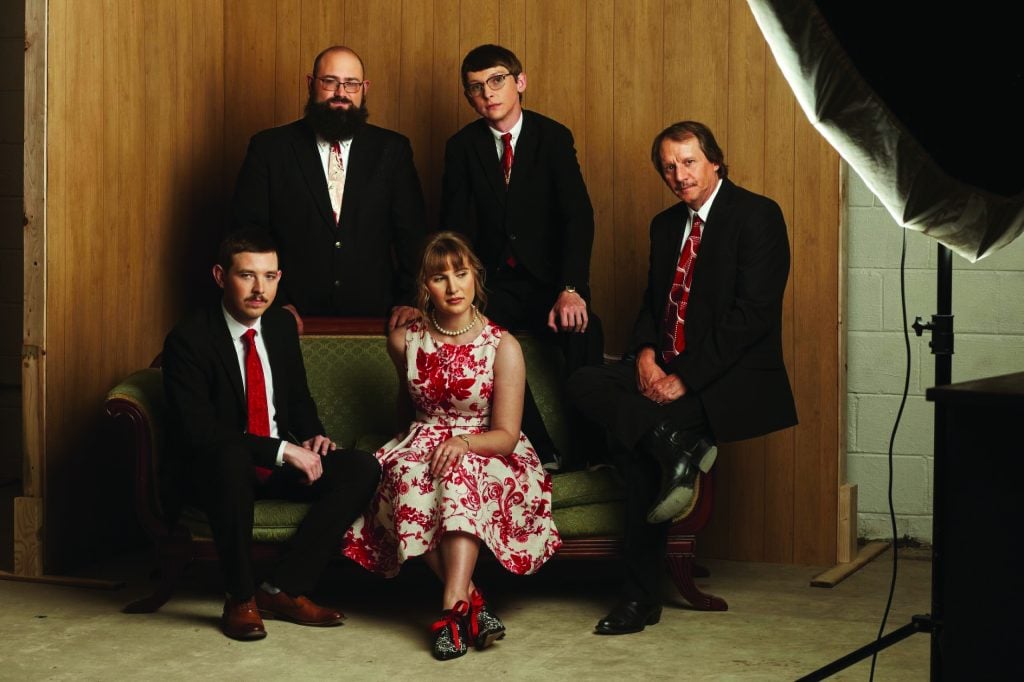
The Tennessee Bluegrass Band consists of Aynsley on fiddle, Lincoln Hensley on banjo, Tim Laughlin on mandolin and vocals, Tyler Griffith on bass and vocals, and Lincoln Mash on guitar and vocals. While she had never been in a leadership role in a band before, she has found it both rewarding and challenging. It forced her to grow in many industry-related ways, caused her fiddling to become more informed, and helped her to grow in her faith. On May 13th, 2022, the band released its first single of Tim Rayborn’s “I’m Warming up to an Old Flame” through a world premiere on SiriusXM. Given the enormous talent in the band, it’s no wonder they have received overwhelmingly positive support from their growing legion of fans. The Tennessee Bluegrass Band released their first album July 22, 2022. It’s packed with the band’s unique take on traditional bluegrass infused with joy, energy, and true passion for the music.
Before we wrapped up our interview, I asked Aynsley her philosophy about teaching fiddle. “When you learn fiddle, it’s very easy to get caught up in the big picture goal, whether it’s playing three tunes in a contest or trying to get through backup and a break in a bluegrass song. After my students get to a certain level of playing, I ask them not to only concentrate on the minutia (bow speed/pressure, double stops or not, gritty/smooth sound, etc). Instead, I like teaching students to not just rely on patterns and musical formulas to make music, but also to think about the song’s past (e.g. are you going for an ‘impression’ of a particular fiddler to lend a feeling of history to this break), and to listen carefully what the singer is singing about, and what feeling are you going to evoke through your backup.”
With so many talented musicians such as Aynsley Porchak coming along, us old geezers can now relax and lay back and know that bluegrass music will be in capable hands.
Wayne Erbsen is a musician, author, publisher, radio host and professor of bluegrass music at the University of North Carolina at Asheville. Find Wayne’s music instruction books at www.nativeground.com