Appalachian Music Program
West Virginia University
For bluegrass music fans, West Virginia represents the heartland of the deep and rich musical traditions of Appalachia. The old rural mountain lifestyle that first generation bluegrass singers remember fondly in their songs about the old log cabin and the homeplace have been passed down in the bluegrass music tradition in such a way that even modern players with no other attachment to the Appalachian region hold those images fondly in their hearts and minds.
Unfortunately, those who have grown up in the mountains of West Virginia have often been told that the only way that they are going to make it in this world is the leave the state and find gainful employment elsewhere. This trend has sometimes soured those who are native to the state to the traditions of their ancestors. The negative connotations that sometimes surround the term “hillbilly” have not helped. Travis Stimeling is working hard to change that with his Appalachian Music program at West Virginia University in Morgantown, West Virginia.
Stimeling, a native West Virginian who grew up playing bluegrass and is a professor of music history, started the program in 2014. Prior to that time he had been teaching at Millikin University in Illinois after graduating from the University of North Carolina with a doctorate in musicology. In 2013 he was hired by West Virginia University to be a professor in their history department. Travis said, “In 2014 I decided that we were going to start a band. The first semester I had a solid band of five players, one of whom had done some work with Larry Sparks and just so happened to be here getting a master’s in percussion. It just happened that there was some talent here. By the second semester, with the success of the first group, I had more than doubled the size of the class.”
Elaborating on the founding of his program, Travis said, “We have a world music center here at the university that has a long tradition of hosting international music of Africa, Indonesia, Japan…a lot of percussion stuff. I talked to the director of that center and told him that I’d like to get this bluegrass band going and asked, ‘What is the easiest way to make this happen as a class?’ He gave me a course number for Chamber Music in Ethnic Percussion. We rationalized that because a banjo has a drum head on it. We ran it like that as a pilot and then eventually turned it into a course called Appalachian Music Ensemble—Music 363. We then built that out into a minor. We’ve had the minor since 2018.”
Travis explained that students can play in the band by taking the one course, but if they want to also complete the minor degree they have to take a music theory class, one-on-one lessons, and a course on the history of Appalachian music. The Appalachian music minor is in the School of Music in the College of Creative Arts. Travis said, “We do have some students who are doing an Appalachian Studies minor and an Appalachian Music minor, but that is rare.”
Early in the program, students who wanted to take voice lessons or guitar lessons had to do so in the already established music department. But recently, Travis convinced the department to hire some adjunct teachers that would specifically teach bluegrass instruments. The university now has teachers who offer lessons in old-time fiddle, bluegrass fiddle, Dobro, and bluegrass banjo. Travis said, “We are hoping to expand that to also have a mandolin instructor.” Guitar and voice students still study with music department instructors.
In addition to the adjunct teachers, Travis also brings in guest instructors to work with the students. When selecting guest instructors, he likes to bring in native West Virginians who have done well in the music business. In the past he has brought in guests such as Ginny Hawker, Charlie McCoy, and Kathy Mattea. Travis said, “It is such a boon when someone like Kathy walks in and starts coaching the kids on how to play less and get more, or something like that. The kids love it and these successful people from West Virginia enjoy giving back.”
The students who tend to enroll in the Appalachian Music program come from a broad spectrum of the student body. Some are classical violinists who want to expand to play fiddle music, while others might be studying engineering. Travis said, “There have been a lot of engineering majors interested in this program. Strangely they almost all want to learn to play the banjo.”
Travis Stimeling runs this program in addition to his regular duties at the university. He said, “This is not part of my normal salary. I don’t actually get paid for it at all. This is a passion project for me.” When Travis initially approached the school about starting a bluegrass band, he said that they were receptive because they had never really done much to present the traditional music of the state. He said, “There was a recognition that even though WVU is one of two land grant schools in West Virginia, the school had never done great by traditional music. It placed classical music above everything else and thus had not served the people of the state in this particular fashion. So, I’ve had support all the way up to the president of the university in keeping this program going.”
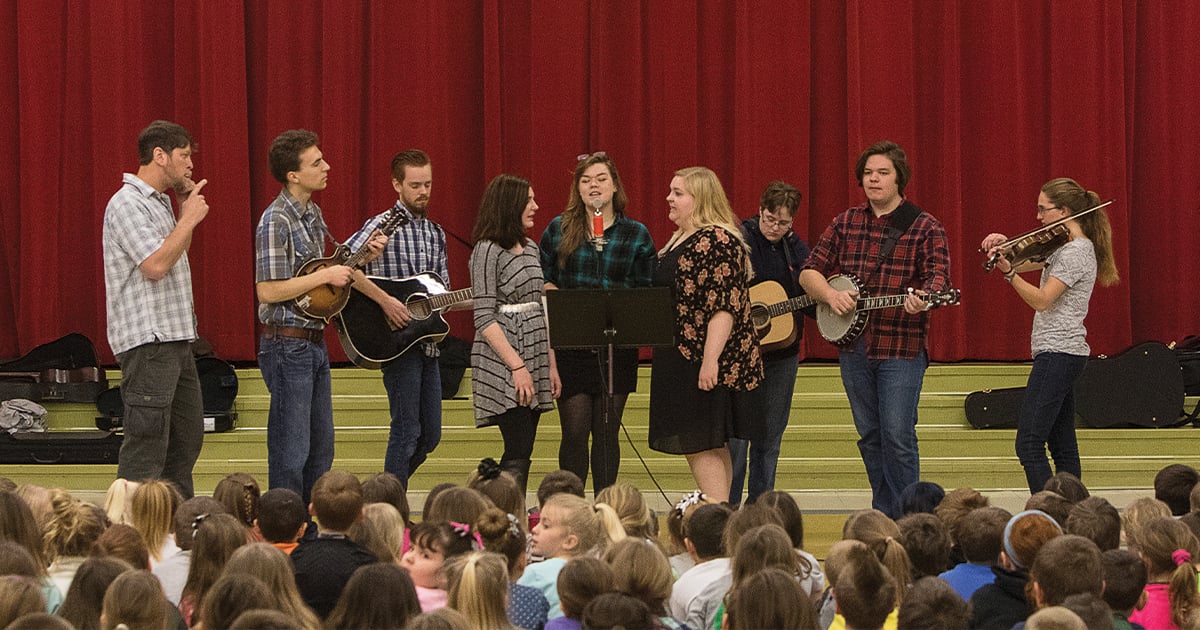
In addition to introducing college-aged students to the traditional music of the state, Travis also helps bring the music to residents all over the state. He said, “A big part of what we do is play at elementary and middle schools in rural areas. I grew up an hour south of here being told that the only way that you are going to be successful is to leave West Virginia and if you leave West Virginia, leave all of that hillbilly and redneck stuff behind. We go into the schools and teach the opposite. We go into places where the university doesn’t usually touch and we’ll play songs from the area. We choose regionally appropriate songwriters or select songs that deal with history from that place and we tell stories. At the end of it all, we tell those kids that where they come from is important and that it is worth holding onto. It is so important for us to do that.”
In addition to helping the kids at rural schools connect to West Virginia, Travis said that it also works in the other direction to help his student’s appreciation for the heritage of their state deepen. He said, “For my students to see how important it is for us to carry that tradition forward, that is the purpose of what we do here. We are not going to try and compete with ETSU. They have their thing and they are very good at it. If we can keep people here in the state of West Virginia playing this music, giving them a reason to stay and build community and then invest in those communities…that is where it is at. I see this music as a hub for reinvestment in a place that desperately needs it.”
Relating one story of his student’s new found musical inspiration, Travis said, “You can’t be in West Virginia without doing a lot of Hazel Dickens. All I had to do was play ‘West Virginia My Home’ for them and they said, ‘Who is this woman who sounds exactly like my great-grandmother? She is sassy!’ I said, ‘Yes, she is sassy, let’s go dig into some of her stuff.’ Every year I have at least one student who says, ‘I want to learn every song that Hazel wrote.’ I say, ‘OK, let’s do it!’ Then I can bring Ginny Hawker up from Elkins, who sang with Hazel for years. Hazel was one of her mentors. That connection keeps them excited.”
In addition to playing for school children, the students at WVU also play for community square dances and at local jam sessions. Travis said, “The jam session connection is important to what we do. We want experienced musicians playing with less experienced musicians because that is how it gets passed on. It is not about a formal curriculum and making it look like how we teach classical music. It is about how we teach bluegrass music…you learn in parking lots, or at the community center, by watching someone.”
Along those lines, the students not only circle up and jam amongst themselves, they are also required to attend at least one local jam session in the community per month. The students have to document that they were at the jam session and write a journal entry that explains what they learned musically by attending the jam and also what they learned about the culture and the community that supports it. Travis said, “We have a thriving jamming community here in Morgantown. There are open jams three nights per week. I worked with the people who host those jam sessions and asked if I could send my students there. They said, ‘Absolutely, we’d love to have them!’” One of those jams had been going a long time and attendance had been dwindling, but when the young college students started coming, the jams grew as some of the older folks decided that they need to show up for the young people.
Travis added, “At the end of four years I have students tell me, ‘I’m graduating and the thing that I’m going to miss most is my picker friends.’ They have become a family. That is where we are winning.”