Annie Savage
And the Free-Strings Curriculum
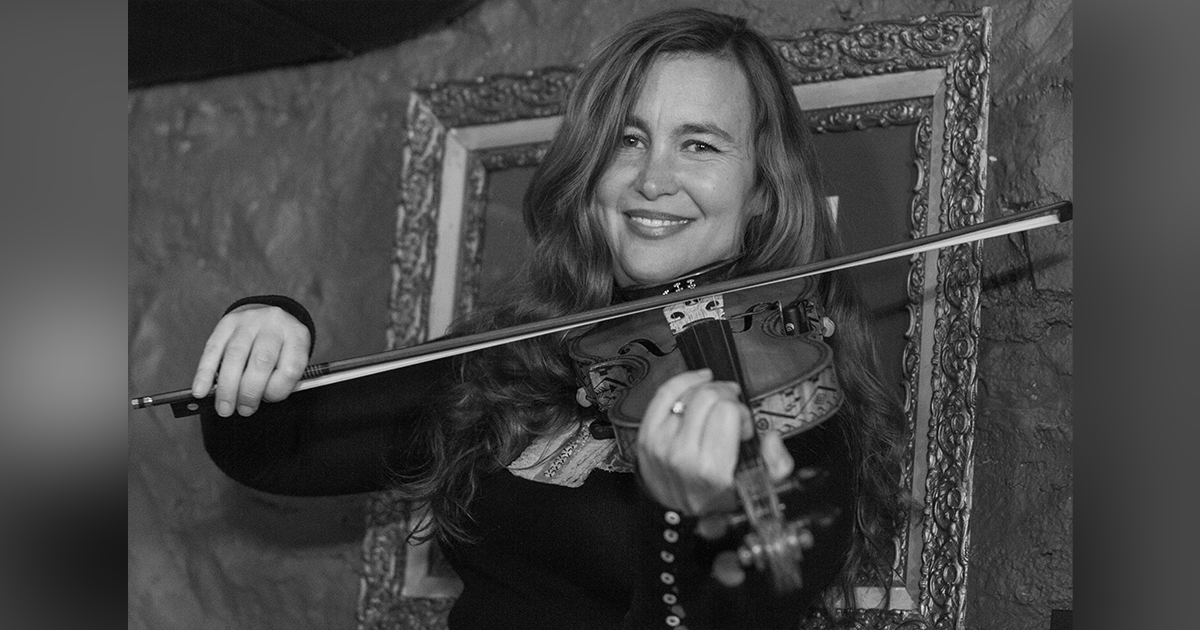
Several weeks ago I received a press release from Turnberry Records announcing their launch of a new “Education Division.” The release explained that the first launch of the new division was called “Free Strings—Join The Jam.” They stated that in initiating this curriculum they were partnering with fiddler Annie Savage, veteran performer and teacher, with over twenty years of experience teaching stringed music in public schools and festivals.
I have known Annie since jamming with her, and our mutual friend Kit Simon, at a bluegrass festival about twelve years ago in Pueblo, Colorado. After receiving the press release, I sent her an email asking if I could interview her about this curriculum. When she responded with an affirmative email, I noticed at the end of the message, after signing her name, she included a quote accredited to her that had appeared in No Depression magazine. It said, “She sees her mission as ‘total world domination through vibrating wooden boxes’…”. A wonderful goal!
In a nutshell, Annie has developed a first of its kind curriculum that will provide public and private school orchestra teachers all the materials (video lessons available on a variety of platforms and supporting notation) that they would need to teach their music students how to jam and improvise. The details of this curriculum will be the topic of this article.
A few days after receiving Annie’s response to my email, I was talking with Greg Cahill, who is well known for his Traditional American Music (TAM) program that brings bluegrass music to schools. I asked him if he had heard about Annie’s program. Greg said that he had talked with Annie about it and thought it was a great idea. While Greg’s program exposes school children to bluegrass music, Annie’s facilitates them learning how to play the music. When I mentioned the “world domination” quote to Greg, he laughed and said that if there was anyone who could accomplish that, it would be Annie Savage.
Annie’s Background
Annie Savage grew up playing bluegrass music in Iowa and Missouri. She began learning to play with the Suzuki method at the age of two. As a young fiddler she was mentored by Doc Nau of Mount Pleasant, Iowa and learned to be an improvisational player. She attended the Interlochen Arts Academy in Interlochen, Michigan and later pursued music at the undergraduate level at the Boston Conservatory at Berklee College of Music. She then earned a master’s degree in Music Education from the University of Colorado in Boulder while serving as the president of the Colorado Bluegrass Music Society. Since 2000 she has taught in public and private middle and high school orchestra programs in Iowa and Colorado. She is currently a PhD candidate in Music Education at the University of Iowa. As a performer, she is perhaps best known in the bluegrass world for her work with the band Jeff Scroggins and Colorado and her teaching band, The Savage Hearts.
Creating Educational Opportunities
In the July 2017 issue of Bluegrass Unlimited, Dan Boner wrote an article about Annie developing a new instructional book titled Join the Jam! A Method Of Jamming For Traditional String Players. In that article Dan stated, “Annie is among the growing group of music educators who embrace folk music not as classroom novelty, but as an essential tool for helping children to overcome performance anxiety and enjoy the learning process by making music with each other… Annie’s new instructional book, Join The Jam!: A Method Of
Jamming For Traditional String Players, provides a gateway for young
classical violinists to explore the world of community music making within a
classroom framework.”
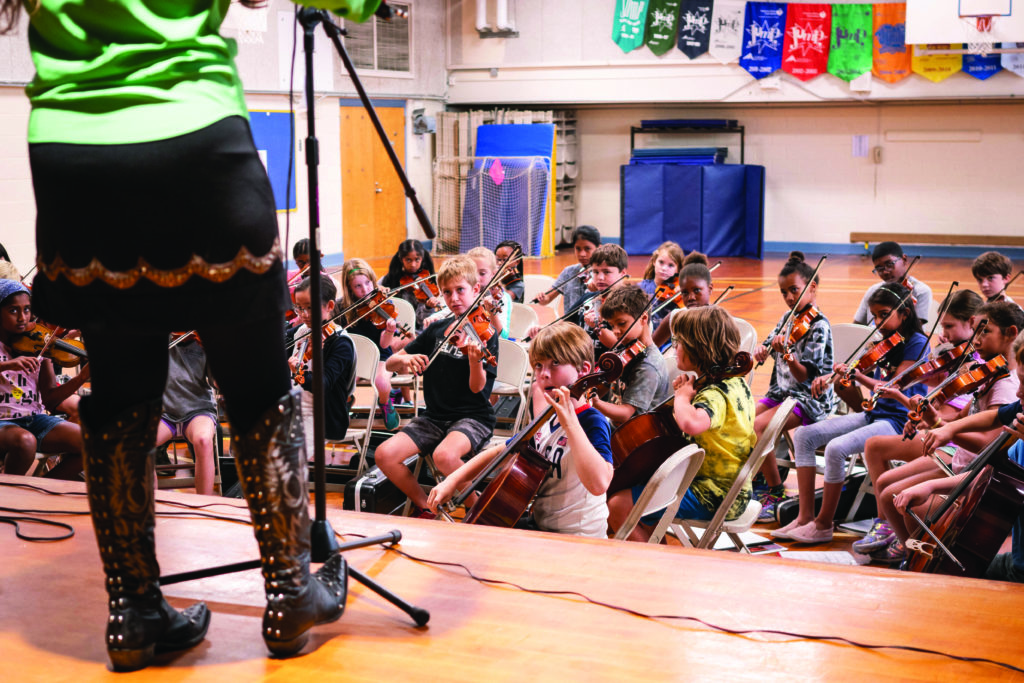
Annie’s book provided a presentation of folk music within a classical framework (standard music notation). The book also taught genre specific ideas and concepts such as “taking a break,” “providing back up” and learning “licks” that embellish and personalize the break. The book also presented blues scales and licks, useful in helping the student create their breaks. Additionally, the book allows students to make a variety of musical choices when creating their breaks—a method that gentle leads the student to learning how to improvise.
This brief re-cap of Annie’s book is meant to remind our readers about what we previously presented about her teaching experience and method and to say that she has now taken the concepts that she presented in her book and has expanded her program greatly through the Free-Strings curriculum. Not one to rest on past accomplishments, Annie has continued to develop new teaching methods, utilize new technologies, and expand the overall program so that it is easily available to the widest possible audience.
The Free-Strings Curriculum
In Turnberry’s press release, this new release is described as: “a comprehensive approach that takes students and educators who have a background in traditional string playing and gets them ‘off the page’ by teaching them the skills for improvisation and jamming that are needed for bluegrass, blues, roots, and popular music.” In the press release Annie Savage further describes the curriculum—“The Free-Strings is a comprehensive online curriculum for string players of all stripes based on the nexus between inclusivity, creative musicianship, and the skill set required for a lifetime in music. The IBMA Foundation grant that we received was used to create a special Bluegrass and Blues Module that is the first teacher training course of its kind. It is designed to train a classroom orchestra instructor to deliver the nuanced skill set and technique we enjoy in bluegrass bands, jams, and the music industry to public school students. Our grant helped us hire bluegrass giant Greg Blake, gifted young artist Iris Mae, and renowned bass player Blake Shaw in addition to using the technology prowess of Turnberry Records to create a beautiful and easy to use interface.”
In the interview that I conducted with Annie, she said, “Public school music is largely classical music that kids learn through reading notation. In my 23 year career in the classroom, I have specialized in creating easy to follow string instruction that leads students into a lifetime of playing. About ten years ago, I started out with what I called The Savage Fiddler Method. I was doing a lot of work with adult jammers who picked up playing by ear and jamming really fast and just loved playing. They often credited this kind of informal music making with giving them a new life in music. I started to wonder, ‘Why aren’t string orchestra teachers doing this?’ They work with strings! Strings are the core instrumentation in bluegrass, blues, rock, pop, and almost all the coolest forms of American music making. What are we missing here? And since, what I’ve learned when I talk to these teachers is…that most public school teachers didn’t learn how to play by ear and jam in formal music school let alone teach it. Additionally, these folks might have sixty people in a single class. So, it takes support from a person who has already done this work in the classroom to give them first, the initiative to teach American roots music and then more specifically, the practical knowledge of how to teach improvising and jamming in a way that can lead to the kinds of performances: concerts and contests- that drive public school music programs. The good news? It’s really easy for them to learn because they are great players to begin with.
“String teachers have graduated from music school where they got certified to teach ‘orchestra.’ So—along with reading notation—they need to know how to jam, play by ear, and understand basic chords. Colleges should teach this. If not colleges, then we need to get creative and connect the dots between the bluegrass and popular music industry and public schools. Music is a process that everybody can participate in regardless of age, race, or cultural background. I’ve been a ‘music for life’ kind of educator my entire career and the Free-Strings Method is all about that.”
When Turnberry Records approached Annie about being a recording artist, she instead suggested that they use the audio and video resources that they had to design an online curriculum that would allow for the average public school teacher, with very little experience teaching improvisation and jamming, to add to their curriculum a program that will allow them to start to add non-classical ensembles in public school orchestra programs. Turnberry was up to the challenge and the release process started about a year ago.
Annie said, “The string teachers are not used to pulling up lead sheets and the students are not used to playing over chords. They are not used to thinking about that language I call ‘chordal literacy.’ The curriculum is designed around this core skill. We teach ‘here are the chords, here is the melody, here is the variation, here is the harmony.’ Now, using all of those tools, here is how you make it your own and play with others. Overwhelming at first perhaps, but in the end it gives players access to every other kind of non-classical music there is.”
To initiate the curriculum, they received a grant through the IBMA Foundation and the first teaching module that was created was titled “Bluegrass and Blues.” Annie said, “A fundamental part of that for me was to reframe the story of bluegrass to include the blues. I worked with my friend Blake Shaw, who is a jazz bass player steeped in the blues. I also got Greg Blake on board and we flew out to Turnberry’s video studio and shot the Bluegrass and Blues lessons with the hope that public school teachers who might not be interested in bluegrass specifically would see the culturally varied experience that is the true story of bluegrass- extending from Monroe’s work with Arnold Schultz. In order to present bluegrass in public schools, it only makes sense to reflect the culture of as many kids as we can. It’s the right thing to do and frankly, it’s the truth. We later went on to record the World Fiddle and Jazz module.”
One of Annie’s goals in initiating this curriculum has been to motivate orchestra teachers to start non-classical ensembles and, in turn, inspire opportunities for traveling bands to not only perform for the schools, but have the school ensembles perform with the bands. Annie said, “We hope to bring in local performers, or bring in performers that are on the road and create an interface so that those bands would have an interactive curriculum. What I had seen as a performer was that I would walk into a public school and I would perform with the kids and share with them the history of bluegrass, but the really profound work is in teaching the kids to play along with the musicians.”
The concept is to have a local or traveling band have the school acquire the Free-Strings curriculum six or eight weeks prior to their performance at the school so that the kids can work with the material in class and then perform some of that material with the band when the band comes to perform at the school.
The Free-Strings Method is not only for public school orchestra programs. Annie said, “Bands can apply it to their in-school clinician work so they are performing with kids and not at kids, but also festivals can apply it to their education programming. Since it is online, it can be used by homeschool networks. Festivals can use it as a workshop or year-round jamming method”.
Another advantage of this online method is that kids can work with the curriculum while at school, but also from their home. Annie said, “It is the perfect mechanism for teaching by ear because you can watch it over and over, you can slow it down, and you can practice at home because every kid can access the program on their computer, phone, or tablet. Ironically, technology has created huge tools for teaching roots music by ear”.
Although the Free-Strings Curriculum is a by ear method, Annie also offers written music along with the video instruction. She said, “We notated everything for violin, viola, cello, and bass because I didn’t want there to be a barrier for those who are primarily sightreaders of music.” By providing the written notation in addition to the video lessons, Annie hopes to give the students (and teachers) who have learned how to play music by reading the sheet music something that is familiar to them with the hope that by also working with the video instruction they can learn how to transition away from sightreading and learn how to use their ear, improvise, and jam. She said, “Ultimately, I’m trying to remove the barriers to jamming. Because, in my experience, if they don’t do that while they are young, they can become resistant to it as they get older. The most difficult people that I work with are those who study notation and never improvise because they are too afraid to take risks. The single greatest barrier is that the students have been trained to read music from day one and they have all been trained to play music at the same time because you may have sixty kids in a class. So, to get them started, we notated everything. The idea is that those notation packs are like little method books. They have exercises and the chords are written out and they have arpeggios, so that kids start to realize when they are practicing their arpeggios, those are the chords! So, we are drawing a parallel between what they already know and what we want to teach them to do.
We are not reinventing the wheel. I grew up playing bluegrass and country. So, that is my first language. But as I went to music school, I realized that Mozart was an improviser and when he wrote these crazy breaks down that he was improvising and honestly, they look really complicated. Now I’m supposed to be teaching kids how to just memorize that? That is not even teaching them what made Mozart, Mozart. He was a master jammer, like Bill Monroe. He was skilled at playing the I-IV-V, but figuring out what you could do that wasn’t the I-IV-V. So, he just was doing what Janis Joplin, Miles Davis, Leadbelly, Bill Monroe…all these exciting dynamic improvisers did. And honestly, that is what people will pay money to see and hear.
“What I think that classical teachers don’t realize is that what they are teaching in classical music came from the same process that bluegrass players are using when they improvise a break. In its heyday, improvisation was the cornerstone of classical music performances. It seems to me that we should go back to the day when each of us becomes our own musician, rather than just memorizing what somebody else does. That is something that bluegrass players already know how to do, and it is very sophisticated.”
One of the concerns that classically trained musicians have is that they feel, or have been told, that “playing fiddle will ruin your classical violin technique.” Annie says, “That is just not true. Notes are notes. The way that you hold the instrument and the music that comes out of the instrument can, in many ways, be independent of each other. I focus on technique because that is an important part of being a secondary music teacher. These are kids that are playing All State and they want to play Vivaldi and go to music school. Who am I to keep them from doing that? I am just trying to unstick the egg from the frying pan. For the kids who are superstar classical players, what I found in my research is that jamming is a very strong tool in reducing anxiety because if they make a mistake they will have the facility to wiggle out of it. For the kids who would never go on to play in music school, which is 80 percent of the student body, there is only really ‘three chords and the truth’ anyway. So, it isn’t that difficult for them to be able to do.”
Another issue that arises in the minds of music educators is that when they think of improvisation, in their minds, that means jazz music. Annie addresses that concern by saying, “Even though I am a life-long jazz afficionado, that is a lot of chord changes for a third grade violinist. ‘Angeline the Baker’ is only two chords. So, you can go back and focus on a small number of chords changes and suddenly you are teaching the kids, ‘When you are on the I chord, you are home. When you go to the IV chord, you go to the grocery store. What do you do after you go to the store? You come back home.’ I teach this chordal literacy in terms of wanting the student to really own where they are going with the chords and how that works so that someday they can walk into a jam where someone is kicking off a bunch of songs that they have never heard and they can function in that situation. I think at the end of the day, my curriculum is a method for getting string players (violin, viola, cello) to think in terms of chords, which then opens up to improvisation and jamming.”
Annie continued, “All public schools want culturally relevant learning to be happening. They want to take kids in rural and urban settings alike, give them a violin and have that kid really own the violin. In my mind, creative teaching and jamming and improvisation is by itself culturally relevant because the way that the kid decides to play that break comes from their heart. I think that there is a very powerful place for bluegrass in the public schools in its relatively simple structure. But, I think that the bluegrass industry needs to reframe the narrative that they operate from in order to include women, in order to include people of color, in order to include the kinds of learners that are actually in the public schools.
“I want to go into the academy of classical music and show people how simple this is…it is not that complicated. My goal is to have a hand in changing the way that orchestra programs operate in America. I think that they have missed out on some cornerstones of American root and pop culture. They don’t need to look to Europe. Some of the best music in the world is American made. Do it here, do it on your terms. We don’t have to memorize Mozart today. You can be your own Mozart. My goal is music for all…music for life.”