
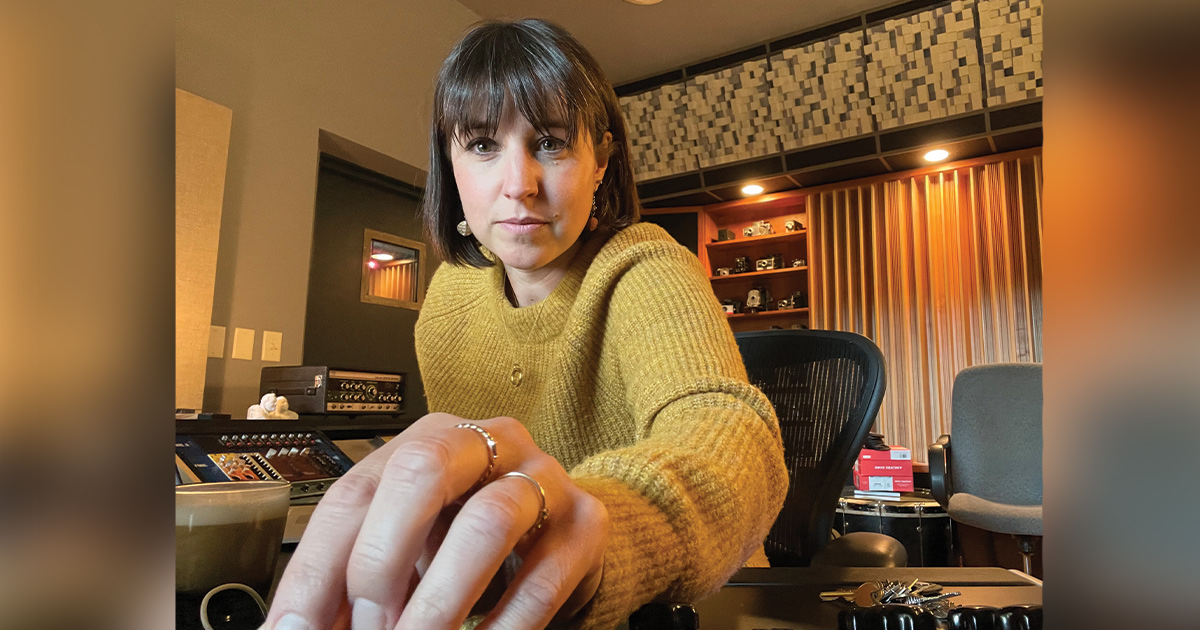
Anna Frick
Mastering: The Final Gut Check
Even if you have never been in a recording studio, you probably have a sense of the recording process at its most rudimentary level. Set out a microphone, play or sing into it and a machine records the sounds. Of course, there is much more to both the art and the science of recording, but—at the simplest level—most people understand the concept. Even the next step—mixing—is something that people can wrap their head around. You take each vocalist’s and instrumentalist’s tracks and you mix them together while adjusting the volume levels, EQ, compression, reverb, ambience, panning, pitch and other various signal processing components. Again, there is much more to mixing, but most people can grasp the basic idea.
After a project has been recorded and mixed, the next step is called “mastering.” This is a much more subtle and less-understood art. The mastering process is a bit more mysterious and the people who excel at this process are specialists and sometimes are even looked upon as “wizards” because what they do is less understood, even by experienced recording artists. The mastering engineers are the individuals who make the overall project a cohesive whole that is ready for consumer consumption. Mastering engineers know how to turn a great-sounding project coming out of the mixing process into a phenomenal-sounding project.
In an interview for the SoundGirls website, mastering engineer Anna Frick was asked how the mastering process differed from the recording process. She said, “Recording is like collecting all the pieces that are going to make the final product. It’s like when you’re cooking; you go for the high-quality ingredients because that basis affects the result. It’s forward-looking. Mixing is treating those ingredients with care and respect, but also with balance and precision. You don’t want to over work the dough, but it’s got to be mixed well, or it won’t bake. Mastering is like the final plating—the ingredients have come together to form something beautiful as well as tasty and satisfying. So mastering is looking backward at all the elements and making sure they all have been assembled well, then looking forward to the audience. It is the connecting point between the artist’s vision and the audience.”
In the interview for Bluegrass Unlimited, Anna made another analogy, this time to building. She said, “Recording is where you are collecting all of the lumber and making sure you have screws, nails and tools. Mixing is where you are putting it all together and it takes shape. Mastering becomes the quality check. It is where you are kicking the tires, you are polishing everything and making sure the screws and nuts and bolts are nice and tight and that the piece is functional and that it looks good so that when it goes out in the real world it is not going to fall apart and people are pleased with it.”
Until recent years, the audio engineering profession has been predominantly male. But that is changing. More and more women are sitting in the engineer’s chair in the studio and doing great work. Those in professional audio who specialize in mastering form a smaller slice of the audio engineering pie and thus there are even fewer women playing this important role. Anna is one of those women and in addition to mastering and restoring projects herself, she also spends time teaching others how to do it.
In the world of acoustic music, two of the most prominent individuals who have mastered projects over the past 35 years or so are David Glasser of Airshow Mastering and Bill Wolf of Wolf Productions. To learn her craft, Anna spent twelve years working for David Glasser at Airshow and is now out on her own. She was nominated for the International Bluegrass Music Association’s “Engineer of the Year” award in 2019 and won that award in 2021.
If the mastering engineer is “the connecting point between the artist’s vision and the audience,” Anna has been that connecting point for a number of very prominent bluegrass artists, including Billy Strings, Justin Moses, Alan Munde, Wood & Wire (a Grammy nominated album), Never Come Down, Jake Leg, Della Mae and more.
Background
When she was in high school, Anna Frick had a friend who wrote songs and sang. She wanted to have a recording of her friend’s music to take with her when she went to college. She took her friend into the studio and during the session guided her friend, much like what a producer would do—even though, at the time, she didn’t know anything about producing a recording. Anna said, “I took my friend into a studio in our hometown of Fort Collins, Colorado, and I just wanted a good recording of her songs, so I was giving her some direction and trying to facilitate a good recording. The engineer looked at me and said, ‘You know you kind of have a knack for this.’ I said, ‘I really am enjoying this.’ He told me that I could make a career out of it. That is not something that I ever considered. I knew nothing about the music industry or recording. But that experience got my mind turning about the possibilities and it set off this journey of figuring out what my place was going to be. I got a glimpse of what working in a studio was like from that project. At the time I did not know that there were audio engineering programs or music business programs in the collegiate world. But once I found that, I took to it like a fish to water.”
Right out of high school (1999) Anna went to college to study business at the recommendation of her parents. She said that they thought getting a business degree would be more stable than anything in the music industry. She said, “I studied business for about a year and a half and found that there wasn’t a lot of passion in my classmates. I wanted to be around people who were really intentional about what they wanted to do with their lives and have a lot of purpose. I kept searching and finally found the audio production program at the University of Colorado Denver.”
During her college years, Anna started by learning the basics of audio engineering such as signal flow, microphone design and console design. She said, “The first semester we were not even in the studio, it was just learning concepts. After learning basic concepts, the next iteration of the program was getting into the studio and getting hands-on with the gear and learning recording techniques. At that point we were recording to tape. The program had not made the transition to the digital realm. We learned everything from song concept, to all of the elements of recording, to mixing and then mastering and distribution. Simultaneously, I was also taking music business classes learning all about copyrights and how the business around it all works.”
Anna’s degree in college was balanced between audio engineering and music business. When she graduated (2003), her first job was working at a booking agency in Boulder, Colorado—a company she had interned with while in college. She worked that job for a couple of years and met her husband, Dustin Boyd, while working there. From there she worked at a publicity firm for a short time. After leaving the music industry and working as an admin assistant in the corporate world, she then returned to the world of audio by finding a job working in a recording studio for an audio book publishing company. She said, “That got me back into working hands-on with audio. That job made me remember why I started and reconnected me to what set me on this path to begin with—the studio atmosphere and working hands-on with the technical aspect of sound. I was editing audio books and doing production management.”
While Anna was working for the audio book publisher, Dustin had started working for Planet Bluegrass, which connected her with the bluegrass music scene. It was through connections at Planet Bluegrass that Anna found the job at Airshow. She said, “I ended up leaving a full-time salary job with benefits to go work part-time at Airshow because I saw the opportunity. Airshow was a world-class facility with world-class engineers. It was the opportunity of a lifetime.” The part-time job quickly turned into full-time work and it gave Anna the opportunity to get back into music production.
Working at Airshow
Anna started working at Airshow towards the end of 2009 and at the time she didn’t have a lot of experience with mastering. She said, “Full transparency, I’m not really sure that I even knew what mastering was and I think a lot of people don’t understand it. It is a ‘dark art’ as they say…all sorts of magic and wizardry. When I started as an assistant engineer I was quality checking all of the masters. That was me in a room with headphones on, listening really deeply to everything, and making sure that there were no errors. My ears were the last on any master before it went out to the world and got pressed into thousands of copies. So, I had to be really on my game and attentive in my listening. What that did was start to train my ears in a whole different way in terms of critical listening…in terms of what made a record ‘done’…in terms of the final polish.”

Anna started to take advantage of her working environment to hone her craft. She said, “I recognized that I was among these really incredibly seasoned engineers and they had very curated equipment. When I started at the Boulder office they had three mastering engineers and two mix engineers and I had the opportunity to get hands-on with this gear that most people don’t have the chance to even be in a room with. I had the opportunity to be with these engineers and in the room with this gear and I started to ask a lot of questions. I approached everything with a lot of curiosity.”
Like anyone who becomes a master at their craft, Anna started to put in serious time with her art. She said, “In the evenings after people would leave, I would go in and start recalling projects of the mastering engineers and listening to the mix and listening to the master and A-B the two of them. I’d look at the engineer’s recall sheets and all of their settings and ask myself why they made those decisions. ‘Why did they use that EQ over this other EQ?’ I started also learning the gear by listening to every parameter, notch-by-notch, and training my ear to understand the nuances of each piece of gear and what it was doing to the sound.
“Then I started to ask the engineers about why they had made their decisions about using certain gear and settings. I would ask what they were trying to achieve. I wanted to get inside their head so that I could tune my ear into what they were hearing. I then started to recreate their mastering without looking at their recalls. I tried to recreate their master without knowing what they had done. I then started doing practice mastering on my own and asking for their feedback.” At one point Anna had David Glasser listen to a project she had mastered and he said, “I think I like what you did better than what I did.” She said, “At that point, I thought ‘OK, I’m on the right track.’ I started gaining some confidence to the point where I could start taking on clients.” The kind of hard work and dedication that Anna has put into honing her craft is exactly what it takes in the business of mastering. This is an art that really cannot be taught through a series of logical steps. The rudiments of using the gear can be taught and the basic techniques can be taught, but after that it simply takes time with the headphones on. Critical thinking, experimentation and a desire to continually polish one’s skills and abilities is what is required to train one’s ears to the subtleties of mastering. Anna put in the extra hours and did the hard work.
Going Out On Her Own
When Anna first started taking on her own clients she said that she wanted to be transparent with every client and let them know that she was still in the learning process. She said, “I would ask clients to give me any feedback that they had and that I would not take it as a criticism. I told them that I was still trying to learn and said that if they were willing to go on the journey with me, I would be willing to work on the project. That allowed me to start to understand client relations and how to work with a client and not just for a client.”
When she is listening to a project, Anna asks herself “What should be grabbing me? Is it the lyrical content or instrumentation? In bluegrass there are so many high energy songs that exemplify the mastery of instruments. Is that what makes the song unique? If so, I’ll lean into that. If that is not coming across, why isn’t it coming across? Are the transients of the mandolin picking not cutting through the mix? Is the tone of the guitar not natural? Is there something that feels off? Are the vocals buried? It is really about asking the question ‘What makes the song unique?’ and ‘How is that possibly being obscured?’ Then I work to bring that out.”
Anna added, “Mastering is that final gut check. We all love music because it resonates with us on some level. Mastering is that gut check of saying, ‘Yes, this works. Yes, this has that emotional appeal.’ It is putting on that music lover’s hat and saying, ‘Yes, we did it, we got it there.’”
In addition to mastering recordings, Anna also does audio restoration work, was recently elected Vice Chair of the IBMA Board of Directors, is on the board of the Recording Academy and teaches classes at the University of Colorado Denver. Anna and her husband are also graduates of IBMA’s Leadership Bluegrass Program—Dustin in 2016 and Anna in 2017. To learn more about Anna, visit her website allysound.com.