

Allegheny Echoes Week
Teaches Bluegrass and Old Time Music in the Heart of the Mountains
Last year I had the chance to visit the long-running Allegheny Echoes Week, an acclaimed instructional camp that has featured bluegrass and old-time music workshops every June for 27 years. The gathering takes place at the Marlinton Motor Inn, outside the small town of Marlinton, West Virginia, in Pocahontas County, one of the most rural and beautiful mountain counties in the Appalachian chain.
Mike Bing, of the legendary West Virginia string band The Bing Brothers featuring Jake Krack, started the Allegheny Echoes music workshops 28 years ago with brother Dave Bing, Kirk Judd and Sherell Wigal. Bing, along with his brothers Tim and Dave Bing, grew up in Barboursville, located next door to Huntington, West Virginia. As an adult, however, he found work in Pocahontas County and has lived there ever since.
All of the Bing brothers spent a lot of time in Pocahontas County once they became roots music musicians, especially after they met and befriended the famous Hammons Family.
Living alongside the Williams River, the Hammons Family influenced generations of bluegrass and old-time musicians in West Virginia, the Appalachian region and around the world from the 1800s to the late 1900s. They would eventually become inductees into the West Virginia Music Hall of Fame in 2020.
The Bings treasured their time with the Hammons Family, and what they learned from that lineage about mountain music is still at the heart of the Allegheny Echoes Week decades later.
The 28th Allegheny Echoes Week will take place June 23-29, 2024. For music students of all talent levels who make the trek to the camp, the workshops include beginner, intermediate and advanced classes in old-time banjo, fiddle, guitar, mandolin, bass and vocals. On the bluegrass side of the ledger, there are classes on bluegrass guitar, fiddle, Dobro, banjo and the mandolin. The instructors are top-of-the-line musicians who are experts at workshop teaching.
Group classes during the week typically begin at 9 a.m. with individual instruction happening after lunch. The designated “Masters” of roots music are brought in during the week do showcases in the afternoons.
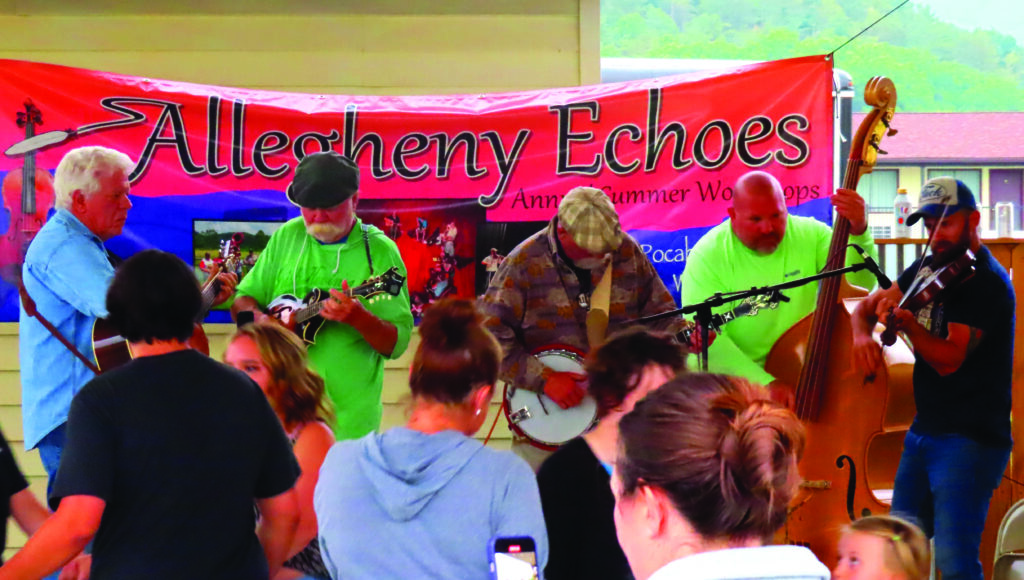
After dinner, the fun begins with a “Monster Jam” on Monday, a square dance Tuesday (powered by the live music of the camp staff and instructors), and the infamous “Bonfire and Wild Meat Dinner” on Wednesday.
As the week nears its end, a concert by all of the Allegheny Echoes students, accompanied by their instructors, takes place on Thursday at the beautiful and historic Pocahontas County Opera House in Marlinton. Then, on Friday, the instructors put together a special concert at the 1910-built theatre as well. Both concerts are open to the general public.
Allegheny Echoes co-founder Kirk Judd, who is a noted author and an accomplished poet, remembers those early days when he first got to know the Bing Brothers, and how the idea for this successful and unique week of roots music instruction bubbled to the surface years later.
“Mike Bing and I like to say that we graduated from different high schools together in Huntington,” said Judd. “I played basketball for the high school in West Huntington and Mike played on the Barboursville team and we were rivals on the basketball court. After high school, I went to college at Transylvania University in Lexington, Kentucky, and Mike went to Marshall University in Huntington. After one year, I transferred back home and went to Marshall as well, which happened right before the Vietnam War riots at the university and the infamous plane crash that killed most of the Marshall football team in November of 1970. I pledged to a fraternity at Transylvania and when I came back to Marshall, I went over to the Kappa Alpha fraternity house there and found out that Mike had also pledged that same fraternity.”
Reunited at the frat house, Judd and Bing began to hang out together once again. While Bing had yet to take up the mandolin, Judd soon met his brothers Tim and Dave, who had already started their musical journey.
After Bing graduated, and after Judd dropped out of college to get married, the two did not see each other for years. One day, half a decade later, Judd decided to travel to Pocahontas County to do some fishing.
“I went to fish on the Williams River and standing there was Mike, who was also fishing on the Williams River,” said Judd. “I looked over and said, ‘Why, there’s Mike Bing,’ and I stopped the car and I found out that the Bings had been coming up to Pocahontas County forever to fish and to learn how to play music from the Hammons Family.”
Judd also experienced his own encounter with the now-famous Hammons Family during that same time period.
“I met the Hammons Family as well,” said Judd. “During early spring, when the state had begun to stock trout in the creeks and rivers, we drove by a house that had a sign on the front door that said, ‘Fish worms for sale.’ I knocked on the door and Sherman Hammons answered and said, ‘Can I help you?’ I said, ‘Yeah, I was wondering if you had any fish worms for sale.’ He said, ‘What? No.’ But then, he asked me if I liked to listen to music, and that is when he got out his banjo and fiddle. I just happened to have a bottle of Jack Daniels in the old Army pea coat that I had on, and we sat on the back stoop of that shack and he played that banjo and fiddle and told me many tales. I was fascinated by them. All of that generation of the Hammons Family were at a different level.”
The Hammons Family originally lived in Kentucky in the 19th century, but when they began to notice that the Civil War was about to stir up, they moved to Pocahontas County in the 1850s, finding then-virgin forest there where they basically lived a pioneer life away from the tumult of so-called civilization.
Music was a big part of the Hammons Family experience. Edden Hammons, for instance, who was Sherman Hammons’s uncle, lived from 1875 to 1955. He recorded 52 fiddle tunes in 1947. Those recordings, however, would not be released in album form until the 1980s, when they instantly became a treasure trove of sound, documenting a fiddle tradition that began long before the phonograph was invented.
“The family still used Elizabethan words and phrases,” said Judd. “For instance, instead of saying the word ‘near,’ they would use the word ‘nigh.’ They still spoke in that brogue accent. They just talked differently, and you could tell that it was pure and from way back in time. Sherman would also sing familiar old ballads with verses that I had never heard before. These tunes were handed down by the Hammons Family when they had no radio and no television nor had much in the way of outside influences. So, many of the versions of the tunes they were playing were almost straight from the British Isles.”
Eventually, folklorists and song catchers like Alan Jabbour and others would seek out Sherman and other Hammons Family members and do field recordings of their music, trying to capture their history and style.
The Bing Brothers also became friends with Sherman Hammons, his fiddling brother Burl and the rest of the Hammons Family. They enjoyed hanging out and learning everything they could from the troupe by playing with them late into the night.
Many years later, the idea was hatched to create what would become Allegheny Echoes. The vision behind the concept was to set aside a week where folks could come and learn how to be better bluegrass and old-time musicians in a picturesque mountain environment while taking instruction from top-of-the-line roots musicians. The difference between other music instructional camps and Allegheny Echoes Week would be that the latter would honor the legacy of the Hammons Family at its core.
As Judd stated above, the founders of Allegheny Echoes Week were himself, Mike Bing, Dave Bing and Sherrell Wigal. Wigal and her writing partner Judd would take care of the creative writing side of the camp while the two Bing Brothers handled the music side of the endeavor. Musician John Blizzard joined the leadership group in their second year. In the mid-1990s, Allegheny Echoes Week was registered as a non-profit organization and they began to move forward with their dream.
Twenty-seven years later, I left my room and quietly walked around the grounds of the Marlinton Motor Inn, which is a big two-story hotel that sits by itself a few miles outside of town where it is surrounded by mountains.
Many of the instructional classes are held beneath multiple event tents standing on the grassy lawns around the hotel. Far from any urban noises, the instructors and their students go about their musical courses and mentorship in a natural and wonderful atmosphere.
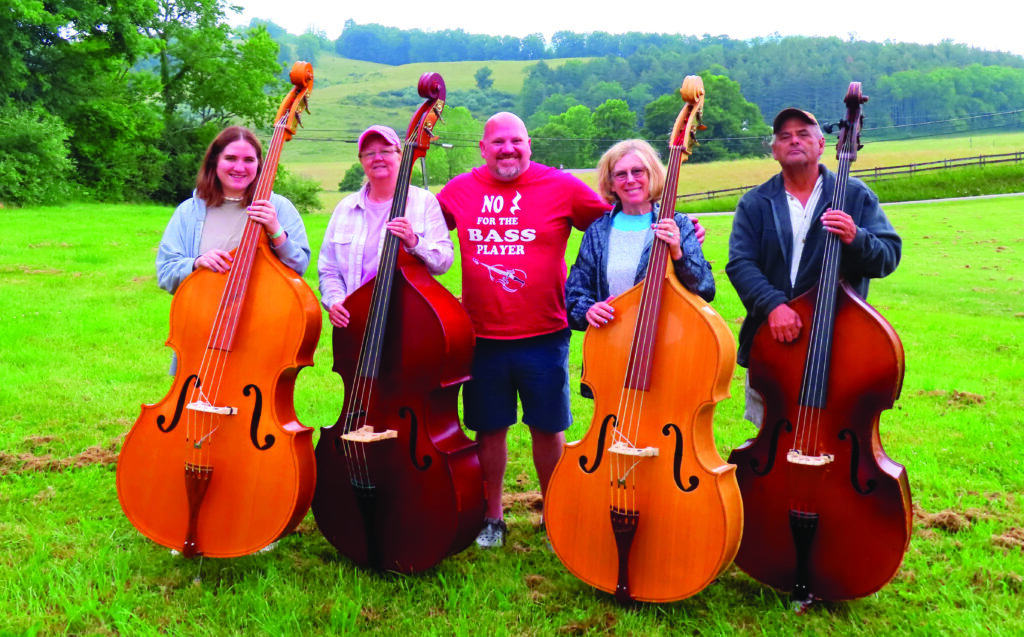
In one tent, with a mountain view rising up in the near distance at all times, Tim Corbett teaches his bass class, making sure all of the students are on the same page as they work on songs together. Occasionally, Corbett will play recordings on his phone to show them how various famous bluegrass and old-time musicians would play the same tune in different ways.
Every day, after exploring the surrounding countryside, I tried to make sure that I was back at the Marlinton Motor Inn to catch the Master’s Program concerts that were presented in the late afternoon.
Jerry O’Sullivan performed one of the most mesmerizing Masters showcases that I witnessed. O’Sullivan plays the uillean pipes, performing both Celtic music as well as the music of the Hammons Family.
A decade ago, the Bing Brothers played a concert in New York City, and that is when they met O’Sullivan in a very serendipitous way. “After the concert, they put us up in a hotel that was 50 feet from an Irish pub,” said Mike Bing. “After we get done performing, we say that we’re going to The Golden Harp. After we get there, this guy walks in, and we didn’t know who he was at that point, and he walks up to us and says, ‘You boys wouldn’t know a Hammons tune, would you?’ It was so out of the blue, because he lives in White Plains, New York. He sat right down with his pipe and I bet we played two hours of Hammons Family tunes together.”
When O’Sullivan takes the stage at Allegheny Echoes, he is joined by Tim Bing on the banjo and Jake Krack on the fiddle and that same vibe is recreated in the cool mountain air.
At the upcoming 2024 Allegheny Echoes Week, the musicians scheduled to perform at these special Masters presentations will include IBMA Female Vocalist of the Year Amanda Smith, the acclaimed Greenbrier County, West Virginia band Mud Hole Control, and West Virginia banjo great Richard Hefner. Hefner is famous for leading the 1970s-era band The Black Mountain Bluegrass Boys.
After the instructors concert concludes on Friday night, Allegheny Echoes co-founder Mike Bing is finally ready to relax and talk about yet another successful week. Bing is especially proud of the fact that many young kids participated in the Allegheny Echoes classes, which help to bring new generations of musicians into the bluegrass and old-time music fold.
“This year, we were able to give out 70 scholarships to our students, and after the passing of the great musician Dwight Diller, we have been able to create a new scholarship in his honor,” said Bing. “When he passed away recently, the message was given out that, ‘In lieu of flowers, please donate to Allegheny Echoes Week program,’ and so, we put his name on the new scholarship. Dwight was a friend of Sherman Hammons and he kept up with the really old style of playing music, and he was well-known for that up and down the East Coast. These days, one of our former students named Stephen Casto is now an instructor, and that full circle is great to see.”
As for Bing’s story on how he met the Hammons Family, the true tale also revolves around the sale of worms. “My Dad would come up here to fish and Sherman sold fish worms, yet he didn’t even know that Sherman played music,” said Bing. “Sherman would go up and down the river in his truck and sell red worms. And, if Sherman could get a drink, he’d happily get one from you, and my old man was good about giving out drinks. But, for the first 15 years that my family knew him, we didn’t know he played music. Then, after my brothers and I started playing music, we’d start learning the background of this tune and that tune and that is when we found out that the Hammons were well known. Then, through Sherman, we met his brother Burl, the fiddle player, and Maggie, who sang quite a bit.”
Bing never met Edden Hammons, of course, but he has gone out to the head of the Cranberry River where Edden lived. “The head of the Cranberry River is still in the middle of nowhere and it is all National Forest land now,” said Bing. “It’s nice up there, and you can see where that high lonesome sound came from, which comes from somebody that lives in the middle of nowhere.”
With the aforementioned wild game cookouts that are cooked and shared at every Allegheny Echoes Week, the purpose of the tradition is to give folks who may live in an urban environment a chance to experience what life is like in the more rural areas of America. “We get a lot of students from the cities. And when you do things like that, they are very impressed with the things that we do all of the time here in the mountains,” said Bing. “They enjoy seeing deer hams cooked under hot coals, and trying bear meat, and sometimes even moose and elk meat that is brought in. Then, we also welcome Tom Wescott from the eastern shore of Virginia every year, who helps to set up the camp and who also brings in fresh clams and oysters for our feast. Tom lives on the Chesapeake Bay and we met him when he came to Allegheny Echoes as a student many years ago. So, it all works together, and it all enhances their stay in Pocahontas County.”
For the first seven years, Allegheny Echoes was held at the Snowshoe Ski Resort located about 25 miles away. But, eventually the choice was made to bring it to the Marlinton Motor Inn and keep the festivities closer to where the Hammons Family lived, and to use the superb Pocahontas County Opera House as the main venue for the concerts.
That decision has been reinforced by the cooperation of Rob Butcher, who runs the Marlinton Motor Inn. Butcher loves mountain music, enjoys listening to the late-night jams, and he has done his best to make his rural hotel a perfect fit for Allegheny Echoes.
“Rob was into the music to begin with, as he has a nephew that plays and a brother that is deep into bluegrass,” said Bing. “As for Allegheny Echoes Week, Rob can’t do enough for us, and he really puts himself out there to make sure everything goes well.”
Bing is retired from his day job now, and he is looking ahead, trying to make sure that not only Allegheny Echoes continues after he is gone, but that it stays true to the original intent.
“We are working on all of that now,” said Bing. “Running an event like this can wear you out, and I’m talking to some younger folks about eventually taking it over. I believe that Allegheny Echoes has to be run from Pocahontas County. In my mind, to keep that main flavor of this event going forward, it has to be run from here. That is important. Everyone knows what to do now to make this week happen. All I can say is that I’m not a crusader, in that I believe that if this music survives, it will survive because this music is good enough to survive, and not because of some program that you are trying to put on people.”
There is still time to register for the 2024 Allegheny Echoes Week. More information can be found at alleghenyechoes.com and by calling 304-799-7121.