
Aleyas Mandolins
A Gem From Coal Country’s Deep Heart
Photo by Callie Thomas
In today’s hyper-competitive custom luthier marketplace, excellence is only the price of admission for new mandolin builders. For an emerging luthier, getting noticed under the blinding luminescence of top-tier builders like Heiden, Kimble, Ellis, McClanahan and more means building instruments early in your career that bear up under critical scrutiny. The Tyler White mandolin Bluegrass Unlimited reviewed in our December 2021 issue is a great example of a new builder excelling in all phases of mandolin design, construction and finish.
Enter Lee Chapman of Charleston, West Virginia, who builds mandolins and other instruments under the Aleyas Instruments marque. Chapman sent BU a conventional A-5 f-hole model mandolin to review, and here, Chapman hits that pro-level build bullseye spot on. The LA-5 model he sent has volume, power and projection that should make it perfect for loud gigs or big festival jams. But beyond that, it’s airy and delicate in the right ways, subtly encouraging better playing by letting the mandolinist hear how their attack and left-hand pressure dramatically affects the timbre of each note. Pay attention to what you’re doing here, and the Aleyas mandolin brings home the bacon.
“I have been building guitars and mandolins for almost 15 years now, with the last three years full-time. The serial number for that (review) mandolin is 076-50, which means (it’s) the 76th total instruments built with that being the 50th mandolin,” Chapman tells Bluegrass Unlimited. He adds, “There are several players that own and play mandolins I have built that you may know. Zachary Alvis with Chosen Road, Johnny Staats, Darrell Scott, Andy Statman, and many other smaller bands with great mandolin players that aren’t that well-known yet.”
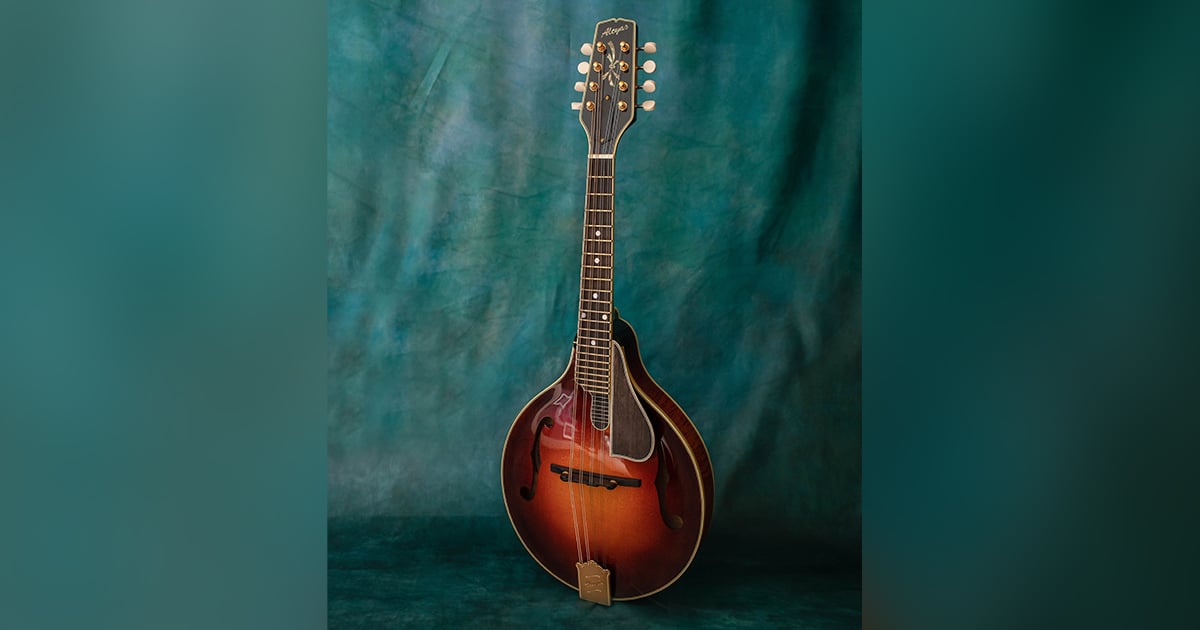
Some products reviewed here have been a tad underwhelming. But Chapman’s lovely LA-5, fitted with gold EVO frets, gold tuners and an engraved gold-plated James tailpiece, was a delight from the moment the case was opened, revealing a deft, artistic reddish to gold sunburst and exquisite chatoyance in the figured maple back. The full build list includes a West Virginia red spruce top with parallel tone bars, red maple back, sides and neck, ebony headstock overlay with mother-of-pearl (MOP) and abalone inlay, ebony radiused fingerboard, custom-built ebony bridge and pickguard, triple-bound body, headstock and side-bound fingerboard with a bone nut and EVO fret wire, a James engraved tailpiece, Waverly tuners, and an oil varnish finish.
The top wood is exquisite, narrow-grained red spruce with tons of silking. Chapman does a nicely executed modern headstock inlay that’s quite attractive and distinctive. The finish work was excellent, with only a few imperfections on the edges of the f-holes, an area devilishly difficult to get perfectly right. And aside from its beauty and high build quality, it passed the most important test of all; I didn’t want to stop playing it.
That’s due, in part, to its excellent playability over those 22 frets. It almost needed the bridge raised a bit due to a bit of string rattle. The nut and saddle slots are properly done. Not quite to the level of a pro setup, but this is better than many new instruments. The fretwork is well done, with no trace of extending fret tangs, and the fully bound neck has a nice rounded shoulder profile that makes it feel like it’s been played for years. Unlike a majority of modern mandolin builds, Chapman employs a full ‘Florida’ fretboard extension. The full-length extension may not be for everyone, as it can induce some pick noise. That’s why so many mandolins have had a “floridaectomy” or the builder has chosen to employ a shorter extension. But if you favor the original Loar look and design, then this is perfect.
Chapman installed a beautiful faux tortoiseshell endpin, a welcome change from the boring ebony bits usually used. One personal peeve is I wish mandolin builders would install a strap button on A-style instruments, because that’s probably the first thing the buyer will do. But most builders prefer to leave that decision to the client.
When it comes to the all-important issue of sound, the Aleyas LA-5 generated noticeably clear, loud fundamentals, making it very punchy and powerful all along the neck. One major trick to building a truly great mandolin is how the luthier manages the complex set of multiple overtones created by a paired string instrument. Too thin, and the mandolin sound breaks up, too thick and you get none of that lovely high harmonic shimmer and bloom we equate with the best of the best mandolins, modern and vintage. Chapman’s mandolin was truly hard to put down, with its clear shimmering highs and punchy mids. There’s plenty of bark here already, and that will obviously improve the longer and harder the instrument is played.
Chapman reports that his average price per custom build is $8,900 for the LF-5 and $6,800 for the LA-5 model, with an upcharge for the lovely blue Calton case this mandolin was shipped in. He’s backordered only about 6-8 months, a rarity for a builder of this quality. For more info, email Lee Chapman in Charleston, WV at [email protected]