
After 50 Years, the Most Famous Bass in Bluegrass Changes Hands
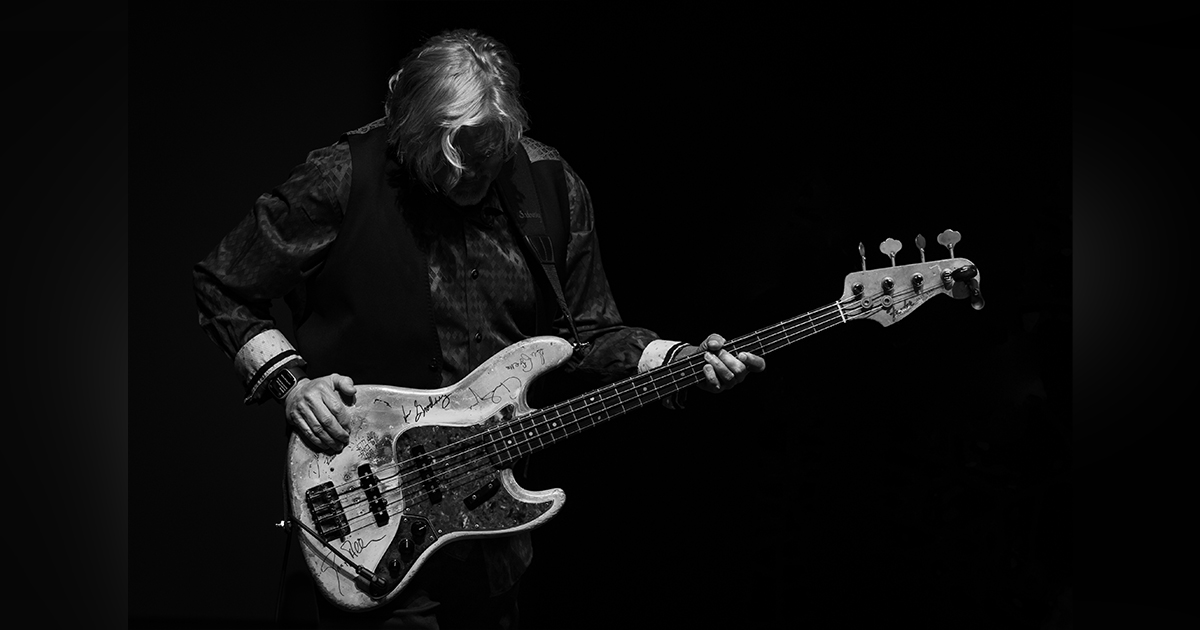
In 1975, John Cowan, the newest member and lead vocalist of New Grass Revival, a band that would come to forever alter people’s perception of an entire genre of American music, walked into the Doo Wop Shop in Louisville, Kentucky, picked up a 1962 Olympic White Fender Jazz bass and immediately fell in love with the butter-colored instrument with “the thinnest neck on a Fender Jazz bass that I’d ever held.” When he asked how much they wanted for it, they said “a whopping $225!” (Nearly $1,400 in today’s dollars.) I didn’t have that kind of cash,” said Cowan. “But I did own a plexiglass Dan Armstrong bass. Thank goodness they agreed to trade ‘em straight up!” John left the Doo Wop Shop with the ’62 Fender, immediately named him “Whitey,” and commenced a love affair that would last for half a century.
If nothing else, Whitey the bass may have tried to address the age-old question, “If a tree falls in the forest and no one is around, does it make a sound?” If those trees happened to be alder, maple, and rosewood, the answer, in Cowan’s hands, appears to be a resounding yes. Through two iterations of the virtuosic, genre-bending New Grass Revival, Cowan and Whitey toured the world, from Tokyo to Telluride, on the way to enshrinement in the Bluegrass Hall of Fame in 2020. NGR spent three years as Leon Russell’s band, from 1978 to 1980, in an era when Billboard Magazine named Russell “the Top Concert Attraction in the World.”
Cowan and Whitey were there with Emmylou Harris in Dodger Stadium and Nanci Griffith in Ireland, and there again, when New Grass Revival—a bluegrass band—cracked the U.S. Top 40 pop charts. There was NGR’s incendiary last show, opening for the Grateful Dead and Bonnie Raitt on New Year’s Eve in Oakland in 1989, when Jerry Garcia called Cowan “a monster” as he was leaving the stage. Alison Krauss. Vince Gill. Chris Hillman. Steve Winwood. Little Feat. Garth Brooks. Michael McDonald…. Compiling a list of performers with whom Cowan and Whitey have shared their thump and towering vocals over the past fifty years, including the past eighteen years with the Doobie Brothers, may require an algorithm not yet invented. Nor is there any real way to measure Whitey’s value in supporting Cowan through years of addiction and recovery. (Cowan’s been sober for thirty-five years this September.)
In all that time, there’ve been exactly two moments when Whitey was no longer in Cowan’s possession. Once, in 2008, when the need to feed his four kids made it necessary to put Whitey up for consignment with his friend George Gruhn at Gruhn Guitars. “The first thing George said was, ‘Are you sure?’” Whitey sat there with “barely any nibbles” until Cowan, “both deflated and relieved,” went and brought Whitey back home.
The other time came in 1978, in the first of three years that New Grass Revival was Leon Russell’s band. After a blistering show at the Illinois State Fair, Whitey was stolen right off the stage. “At first, I imagined that one of us (Sam Bush, Curtis Burch, or Courtney Johnson) had taken it and put it away. After some quick inquiries, we realized that someone had actually stolen Whitey while we were packing up. I was devastated and heartbroken.”
“Through luck or spirit or my late dad watching over me,” the State Fair called a few days later, while the band was in California, to say that the person who’d stolen Cowan’s bass had been found. “We told the police that if he’d just return it, we wouldn’t press charges since he was just seventeen years old.”
Just as Moby Dick, the mythic white whale, grew to become a nearly hieroglyphic canvas of marks, nicks, cuts, and battle scars, Whitey, after five decades on the road, took on its own distinctive evidence as a mythical road warrior. Cowan himself, out of reverence and reflection for both his beloved bass and his years on the road, began asking artists he admired to grace Whitey’s body with their signatures, among them Greg Allman, Garry Tallent (E-Street Band), Billy Gibbons and Dusty Hill (ZZ Top), Kenny Gradney (Little Feat), Chris Squire (Yes), and Gordon Stoker of the Jordanaires. Like Willie Nelson’s “Trigger”, or Stevie Ray Vaughan’s “Number One,” there would be no mistaking this bass anywhere. Because of Whitey’s iconic appearance and New Grass Revival’s enduring legacy, it’s been called “the most famous bass in bluegrass.”
But the nine-pound bass slung around Cowan’s neck for five decades began to exact an unrelenting physical toll. In March of 2025, after fifteen years of progressive neck issues, Cowan, now 71, underwent surgery that left him unable to play Whitey for any extended length of time without creating numbness in his hands. “I couldn’t do it,” said Cowan, acknowledging a dispiriting reality of time. Then an idea hit him. Cowan and Whitey were about to improvise one final encore.
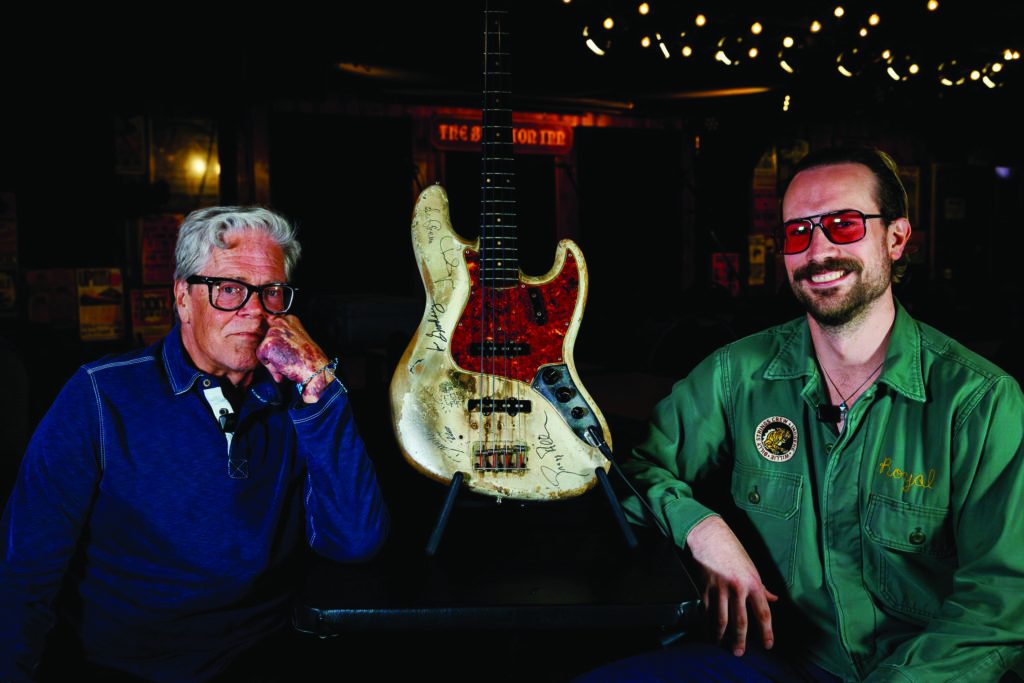
Photo by Madison Thorn
Rather than slide his bass under his bed, “gathering dust because I couldn’t play it,” Cowan considered a way to extend Whitey’s musical life, ultimately having the inspiration to entrust his much loved “ol’ piece of wood” to a friend and extraordinary bassist, Royal Massat of the Billy Strings Band, allowing Whitey to thump and churn for decades to come. “Royal was my choice,” said Cowan, “because of his ability, his age, and mostly, his deep appreciation for what Whitey and I accomplished in bluegrass music.” Massat, 33, was blown away by Cowan’s gesture.
“This is easily the most famous bass in bluegrass,” Royal said in an online post announcing the news. “I’ve been listening to this bass my whole life. We had New Grass Revival CDs when I was a kid, so I probably first heard it when I was five or six. There’s no other bass I can think of with this kind of pedigree.” After hanging out with Cowan and weighing his generous proposal, Massat took Whitey home. “I plugged it in, and I just started weeping.”
Cowan had only two stipulations before making Royal the official steward of the instrument he’s played and held for fifty years: “That, A, you never sell it. And, B, whenever you get to the age that you find somebody else that you want to pass it on to, that you do that.” Massat called it a responsibility that he was more than ready to take on. “I will honor that with my life.”
In his first act as caretaker, Massat had one stipulation of his own for John, a small tweak he wanted to make to the ancient instrument: He grabbed a Sharpie and asked Cowan to lay his own signature on Whitey, adding it forever to the other greats.
Love the bass, the man and the story!