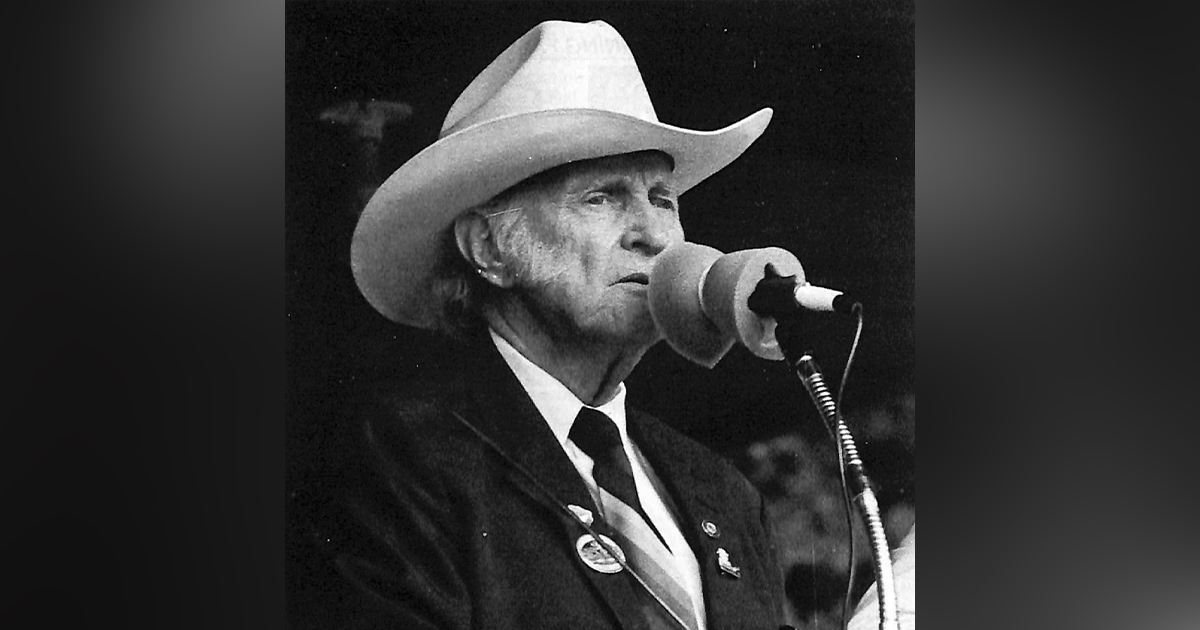
A Writer’s Quarter-Century of Hearing & Chronicling Bill Monroe
Twenty-five years passed between the first time I saw Bill Monroe play and the day I covered his funeral. In the interim, I had many chances to hear him perform, to meet and interview him, and to study his music. After I became a journalist, I also wrote many articles about Monroe, as well as sections of a handful of books.
Along the way I encountered William Smith Monroe (1911-1996) as a musician, a man, and the founder of bluegrass. Monroe was a tall, attention-commanding figure whose singing, mandolin playing, and songwriting changed the way people heard and played music.
Writers including Neil V. Rosenberg, Jim Rooney, and Tom Ewing had more direct contact with Monroe, but I did spend a good bit of time around him and got to know him. For a 1989 profile published in the highly regarded Journal of Country Music, I wrote:
“He’s a laconic, eyes-averted interview subject who can startle you with a direct, blue-eyed gaze and almost mystical theories of life and music. And he’s a tradition-based player who loves to come up with a new change for the music.”
My encounters with Monroe’s wizardry began one September night in 1971, when my North Carolina music partner Steve Runkle and I made our way to the Grand Ole Opry, not long after moving into an apartment at the other end of Broadway. We sat in the Ryman Auditorium’s stage-right balcony and had great sight lines of Monroe and a band that included fill-in fiddler Buddy Spicher. As unattached teenagers, we also had our eyes on two attractive young women who happened to sit a few rows ahead of us for the show.
Since the mid-’60s, Steve and I had been followers of Monroe, Flatt & Scruggs and the Stanley Brothers. We decided we could talk music with the two “girls” we had spotted. As it turned out, they were sisters. In fact, they were the great pickers and singers Sharon and Cheryl White, already members of a band with their dad Buck and mother Pat, called the Down Home Folks. Not only that, Sharon was also dating Monroe’s banjo player of this period, Jack Hicks.
It didn’t take long for us to abandon the plan of impressing the future stars of the Whites with our in-depth knowledge of Monroe and bluegrass music, though they were nice about it.
Catching the Early Bird
The next month, on Oct. 13, the Ryman Auditorium also played host to the first performance of the Opry series known as Early Bird Bluegrass concerts, which kicked off Country Music Week. With band members including Kenny Baker and Joe Stuart, Bill Monroe and the Blue Grass Boys headlined a show for the ages.
The lineup included Lester Flatt, Mac Wiseman, Ralph Stanley, Jimmy Martin, Don Reno and Red Smiley, and Monroe’s son, James. (Smiley was to die less than three months later, on Jan. 2, 1972. Sadly, all the other stars except James Monroe have also since died.)
Stanley appeared with a Clinch Mountain Boys lineup that included future Country Music Hall of Fame members Keith Whitley and Ricky Skaggs. The crowd was knocked out by the act’s harmonized performance of the Carter Family’s “Will You Miss Me When I’m Gone,” with a skinny Whitley rendering the robust low part that responds to the chorus.
Monroe had just turned 60 on Sept. 13, 1971, and continued to inspire and attract both long-time bluegrass fans and those attracted by the bustling festival scene that had sprung up in the mid-’60s. Country-music jukeboxes still included tunes such as his current single “Goin’ Up Caney” and “Tallahassee.”
At the conclusion of his Opry performances, Monroe would often turn up at shows around Nashville, including the Ernest Tubb Midnite Jamboree, a broadcast that first emanated from Tubb’s Commerce Street store in 1951. The Jamboree continued into the 1970s at 417 Broad, and in a recent revival. I remember the excitement of arriving early to get a standing-room-only spot near the great Blue Grass Boys at the famous record store.
Showing Texas Hippies How it was Done
By 1974, I was a performing musician myself and spent a couple of years working in the “progressive-country” haven of Austin, Texas. My dates with the Lone Star honky-tonker Alvin Crow and star vocalist Marcia Ball took me to the center of that scene, the Armadillo World Headquarters. That was the Fillmore-West-style venue where Monroe and band played in November 1974.
I will never forget the buck-dancing moves Monroe produced when he saw the Austin audience members doing what we called the “hippie hop,” basically yahooing, bouncing up and down waving their arms to the music. Monroe responded with the real deal—dance steps he learned in his native Kentucky and later employed as a member of a touring troupe from Chicago’s WLS National Barn Dance.
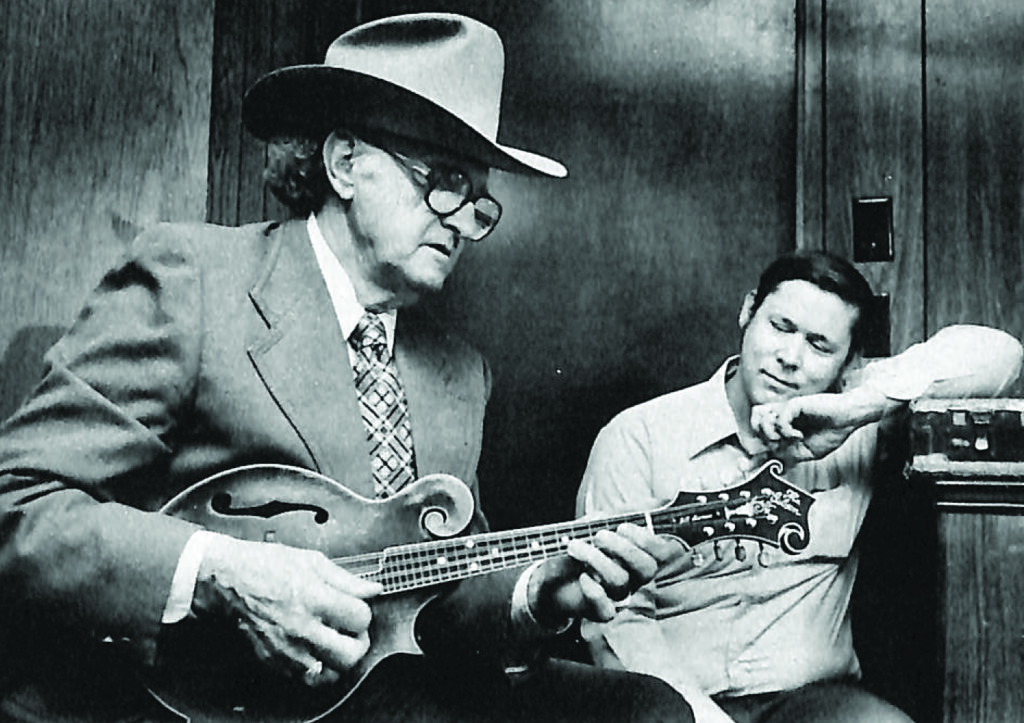
The 1970s and early 1980s found me on the road as a musician based in Nashville. I heard Monroe as often as possible, and he sometimes worked the same “showcase” venues as some of my acts, such as the Exit/in in Nashville and the Great Midwestern Music Hall in Louisville. In November 1982, I was there when Monroe played a Nashville benefit to defray expenses for cancer treatment for Sam Bush, saying he was glad to turn up for “Sammy.”
By 1983, I left full-time work as a musician and set out on what people thought was an unlikely career for me: journalism. Even before I was hired as a full-time Tennessean music writer in 1985, I started covering every bluegrass story I could. September 1985 brought me face to face with Monroe for a Tennessean interview on his current MCA album, Bill Monroe and the Stars of the Bluegrass Hall of Fame, as well as his upcoming Bean Blossom festival in southern Indiana. I showed up nervous at his Dickerson Road office, bringing a package of the sugary rolls someone had told me that Monroe enjoyed for breakfast.
“Those’ll be good,” he said.
“They’d have been real good with some coffee,” he added, straight-faced.
Monroe was 74 that day, a year older than I am now, and I was awed just to be there, but determined to remain professional. It was my first direct exposure to his captivating stories about bluegrass, where it had come from, and its most important elements. The musical tradition he started had “made more friends” than any other style, he often mentioned.
As we settled into the unfrilly surroundings of his mobile-home office, with a wall clock shaped like a mandolin, Monroe described the virtues of the guest stars on the record. They included Mac Wiseman, Jim & Jesse, the Osborne Brothers and Ralph Stanley. “Yeah, he can really put the feeling in it, Ralph can,” Monroe said about the singing of the younger Stanley Brother.
Some of his answers were a little unexpected, as though he were pulling my leg. “Charlie Poole was a good fiddler,” he said, answering a question about North Carolina musician Poole, who played the banjo.
As I followed that first meeting with a succession of interviews, some themes would become familiar. Bluegrass was a clean, decent music that people could bring their family to without worrying about rough talk or bad behavior, he said. All the players on the record had “hung right in there” and done a lot for bluegrass music, I learned. However, Monroe also offered points of historic significance. One was the way his tenor harmony singing evolved after he and brother Charlie broke up their duo in 1938.
“Me and my brother worked together a long time,” he said. “But when bluegrass started, mine and his singing was put aside, and I went with a different style of tenor singing from what I sang with Charlie. So that helped out in the way of bluegrass music having everything of its own.”
Born in 1911, Monroe summoned up memories of times that in 2025 are more than a century past, as when he talked about his gospel number “Let the Gates Swing Wide.” “That goes way on back to my early days there in Kentucky, when I was a young boy, awful young, I’d say 8, 9, 10 years old,” he said. “When we’d go to church, you know, we’d go in a road wagon with two mules, and my father and mother’d sit up in the spring seat and I’d stand behind ‘em.”
A Famous Instrument Restored
In November 1985, an unidentified miscreant smashed two of Monroe’s mandolins at his cabin north of Nashville. “The break-in and vandalism at Monroe’s house were only one of a series of incidents in which $10,000 in cash and valuables were stolen from his bus, obscenities were spray-painted on his car, and his Bluegrass Hall of Fame and Museum was robbed,” I wrote in a February 1986 story about the repair of his trademark 1923 F-5 mandolin by the Gibson Guitar Company. “The crimes remain unsolved.” Gibson presented the repaired mandolin to Monroe in a ceremony at its Massman Drive headquarters.
“Bluegrass fans all over the world are thrilled with this mandolin here and they were waiting for me to get it back,” Monroe said on February 25, 1986. The mandolin, restored by craftsman Charlie Derringer from pieces and splinters, sounded good, he said. After the event he grew a little more specific about the sound of the refurbished F-5. “It’ll come out,” he told me, in a musician’s description of the way an instrument can sound better the more they it’s played. “I’ll have to say this is the greatest day of all right here,” Monroe said as he packed up the mandolin to leave.
In September 1986, Monroe showed up in Owensboro, Kentucky, for the IBMA World of Bluegrass trade show, the first of many such conventions. In a tent show that recalled Monroe’s history of such venues, he and the Blue Grass Boys entertained with a typically diverse set of numbers that included the classic “Toy Heart” and the gospel favorite “A Beautiful Life.” “A boy about 14 years old requested ‘A Beautiful Life,’” said Monroe, who often played songs that audience members asked for. “So that’ll be the tune.” The band even offered up “Foggy Mountain Breakdown,” written, of course, by Monroe’s one-time rival Earl Scruggs.
Sowing Bluegrass on Fertile Ground
On October 9, 1986, Monroe made another appearance at the Early Bird Bluegrass concert series he started in 1971. “Let’s you and me do one,” Ralph Stanley said to Monroe on the show. “How about that ‘Can’t You Hear Me Callin’?”
In addition to knocking out the classic he first recorded with Mac Wiseman, Monroe took time that day to greet Deanie Richardson, who was just 14. More recently she’s been the fiddler for the all-star Sister Sadie band as well as a two-time IBMA Fiddle Player of the Year. In talking with Richardson, Monroe demonstrated his long-held practice of encouraging talented young bluegrass musicians. In a famous example, he hired Sonny Osborne to play banjo in the Blue Grass Boys when Osborne was 14.
In the 1980s Monroe was showing up all over Nashville: buck-dancing at Charlie Daniels’s Volunteer Jam XII, dropping by the Station Inn, and giving weekend performances at the Grand Ole Opry at its more recent Opryland location. It was a good time to be a Bill Monroe fan. On New Year’s Eve 1985, as he stopped by the Station Inn, Monroe answered a couple of my questions about the mandolin-smashing incident. Monroe had little information to pass on about who had done it, but said for my January 3rd story that “a gang of them” had been at fault. “People will do anything nowadays,” he said. “They’ll do anything they can to hurt me.”
The great musician did volunteer that the crime had been an inside job. “They knew right where the house was and they knew just where the mandolin was kept,” Monroe said as we stood in the crowded tavern.
These stories are far from the only articles of mine that mentioned Monroe or detailed his live appearances in those years. In September 1987, I wrote about the part he played in the funeral of multi-instrumentalist Joe Stuart, one of his key sidemen: “Monroe sang the haunting spiritual ‘Wayfaring Stranger’ and—by Stuart’s posthumous request—‘John Henry.’” That was a bluegrass funeral for the ages.
In those days, music-beat partner Bob Oermann and I frequently wrote full obituaries for minor and major figures, including one for Stuart for which Monroe told me, “He had a good heart; he would do things for people. I’m sorry that we lost him—he was one of my best friends.”
Next month: Journalist Thomas Goldsmith recalls more encounters with Monroe, including witnessing a studio session, some informal picking, hearing Monroe’s downplaying of Flatt’s and Scruggs’s contribution to bluegrass, and his star-studded funeral.
Thomas Goldsmith, a native North Carolinian, has played and written about American music for more than 50 years. A past winner of IBMA’s writer of the year award, he edited The Bluegrass Reader and wrote Earl Scruggs and Foggy Mountain Breakdown: The Making of an American Classic, both for the University of Illinois Press. He can be reached at tommygoldsmith(at)gmail.com.