A Small Business With Big Impact
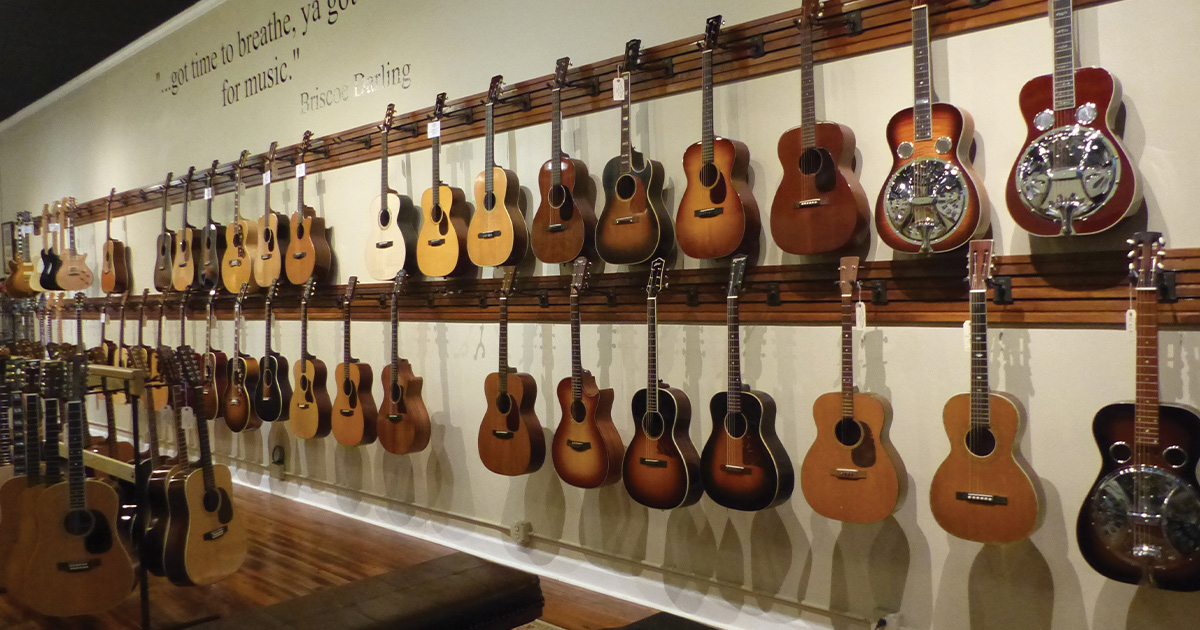
The old saying “good things come in small packages” rings true for Lowe Vintage Instrument Company in Burlington, North Carolina. The small store front located beside a photography studio and vintage vinyl record store in the historic downtown district appears neat, clean, and quiet from the outside, but it’s what’s on the inside that draws world-wide attention. The walls are lined with rare and unique vintage acoustic instrument such as pre-war Martin guitars, Gibson banjos and mandolins. Run by the father/son duo of Ed and Will Lowe, it is a haven of musical instrument history recognized by many in the bluegrass community.
Father, Ed, explained how he became involved in the vintage instrument business. “It all started when I got into banjo when I was 45 years old. It was the first instrument that I ever played. I got interested in the history of the banjo and finding the absolute best banjo you can find. That, of course, is a pre-war Gibson flat head original five-string, so the quest was on. My son (Will) became interested in guitar. It is a shared passion that he and I have. We would take mini-vacations in the summer. It was my wife’s idea. That started when he was in the fourth grade.”
Will shared, “My dad and I have always been very close. I’m so blessed to have such a wonderful dad. Ever since I was little whatever he was into, I wanted to do it, too. He was more than happy to share his passions with me. In his forties, he got into banjo and bluegrass music. I wanted to be involved. We were on our yearly summer trips when I was 12 years old and I told him that maybe I wanted to play guitar. He went to Sam Ash in Charlotte and got me a Martin D-1X. It was an entry-level guitar, but I was over the moon about it. He said, ‘Your mother’s going to kill me’ because he didn’t think I’d stick with it. When you’re a kid, you try out different hobbies, but I told him that I thought I really wanted to learn. He showed me three chords (G, C, D) which is all I think that he knew at the time. That was enough to get me going. If you’ve got three chords and a capo, you can play a lot of bluegrass songs.
After Dad showed me those first three chords from that point on, I was pretty much self-taught. I bought some instructional books. I wasn’t very well versed in theory or the nuts and bolts of music. I was more of a strummer and singer from the time I was 12 until I was 22. That was how I would describe myself as a musician.”
Ed noted, “When we got this shared interest in vintage banjos and guitars, we would plan our trips around going to places and looking for instruments.” Will continued, “A year or so later, Dad started getting into the pre-war Gibson banjos. If he’s going to do something, he’s going to do it right. He bought a couple of old Gibsons and that sort of got the ball rolling. After that, on our summer trips we’d go into guitar stores and pawn shops or anywhere we might run into a musical instrument.”
Daddy Lowe had an epiphany, “We started buying vintage instruments around 2004. It wasn’t long after that we realized if we wanted to keep buying vintage instruments, we’d have to sell some vintage instruments. One thing has just been a building block on top of another.”
Will heartily agreed, “We started accumulating this collection. It branched out. By the time I was 14, we had banjos, acoustic guitars, vintage electric guitars (Gibsons, Fenders). We realized after we had filled up the room over my parents’ garage with guitars and cases that if we wanted to keep buying more instruments, we needed occasionally to sell one so we set up a website in the early 2000s. We didn’t sell a lot, maybe one or two instruments per month. It was enough to sustain our hobby and be able to have the room and money to go find more stuff.”
The senior Lowe was already financially secure. “My full-time job pays the bills as I run the John-Boy & Billy Corporation which is syndicated morning radio for the last 30 years. I had the company that designed our website to design Will and me a little website. Just as a hobby, we would put our banjos and guitars up there and sell them to get money to buy more.”
Will elaborated, “We did that throughout my high school years as a hobby. Then I went college at NC State. In November 2012, I had a really bad car accident my senior year. I was in the hospital for 16 days and a wheel chair for six months laid up at home. I had so much free time on my hands. That’s when I started learning music more in depth. I took some lessons. I wanted to take music a little more seriously. Not with the intention of becoming a career path as it has become now, but I just wanted to be a better guitar player. I can’t read music, but now I do understand music theory. That’s when we hatched out the idea that maybe we would do this as a business full time after I got out of school.”
Ed stated, “As Will got older and was ready to graduate from college, I had the idea and just asked him, ‘Is this something you’d like to try to do and make a living at? I’m game because I’ve got a job that pays my bills. You can make more money using your degree, but it’s up to you. “Will was all in on the idea. “As soon as Dad floated that idea, I was totally on board. Who wouldn’t want to be around vintage instruments all the time? And getting to do it with my dad, it sounded amazing. That is when the plan was hatched.”
Dad elaborated, “In 2013, we looked around at a lot of places, but we ended up in Burlington. It’s where I’ve been my whole life. With the internet, it really doesn’t matter where you are. We ship instruments all over the world from here.”
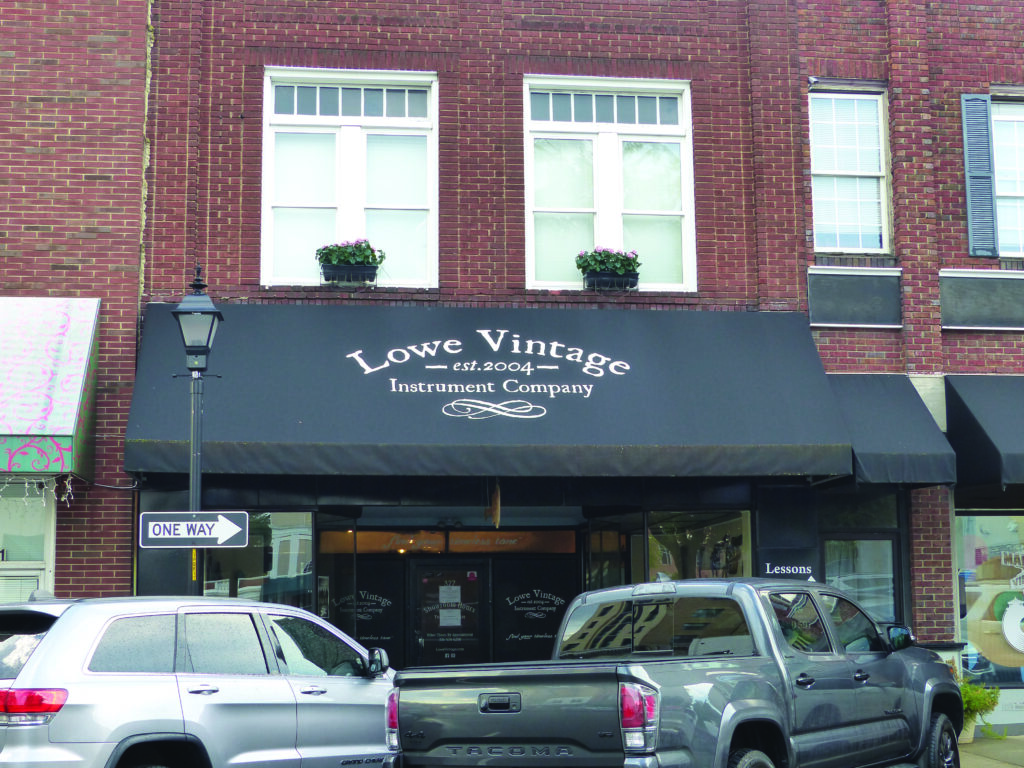
Will added, “The building was built in the early 1890s as a dry goods store. It is one of the older buildings still standing in downtown Burlington. It went through a variety of things when Dad was growing up. It had been a dress shop, but when we bought the building, it had been a photography studio and there was a little ice cream parlor out front. We could tell the building had great potential. We had no idea that the original hardwood floors were still in the building. We were very excited during the renovation project when we found those! We just got to work and started tearing down sub walls. We did all the work ourselves with some very good friends of ours, Donnie and Wendy Presley from Salisbury. The only things we didn’t do ourselves was replacing the heating and air system and the wiring. We ripped up layers of floor and found the original hardwood. We sanded and refinished them ourselves. Donnie built the beautiful counter and the wall at the back of the store. It took almost a year. There was no master plan. We just started doing things.”
The acoustics of the building are aesthetically pleasing to the ear and Will is so proud of that aspect of the building. “The acoustics of the room was a happy accident! It turned out so well and sounds fantastic for acoustic instruments. It’s a combination of the taller ceilings and the old hardwood floors. I always joke with folks ‘that room has definitely helped sell some instruments,’ You just sit down on that couch and it sounds so great.”
Ed had made connections in the music industry. “We had really close friends in Walter and Christy Carter (of Nashville’s Carter Vintage). We opened a year after they did. During that year, we would visit them and they gave us a lot insight of things to avoid and pitfalls. Ever since our first year, we have been recognized as one of the top 100 dealers in the world by NAMM. That’s nine years in a row that we have gotten that award!”
An appropriate time for the father/son business to open, Ed noted, “We spent eight months doing the renovations and we opened the day after Father’s Day in 2014.” Will echoed, “We just celebrated ten years. It’s been a quick ten and has been so much fun. I just feel blessed to get to spend so much time with my dad. To get to do it together is the part that makes it so special. If it wasn’t me and him, it wouldn’t be anywhere as near rewarding.”
How Ed became enamored with the banjo goes back to the radio show. “Johnny & Billy had an appearance in Nashville. Randy, the producer of the show, and I were killing some time and went down to Gruhn Guitars. I walked over to the banjos. Randy asked, ‘What in the world are you looking at banjos for?’ I told Randy, ‘You know, you can’t play a sad song on the banjo!’ Randy is a very thoughtful individual and he remembered that. For my next birthday, he bought me a used banjo, an old Harmony banjo. I figured if he thought enough about it to get it for me then by God, I was going to learn how to play it. I started taking lessons from a guy that came around the radio station. Then my wife gave me for my birthday the next year John Lawless’ Banjo Camp in Roanoke. I went up there and had a blast.”
Lawless interjected, “I may have first met Ed during one of our Roanoke Bluegrass Weekend instructional camps, maybe 25 years ago. But the first time he really registered was when he ordered a couple of sets of the Sammy Shelor fingerpicks from AcuTab back then. The order came in online from the John Boy & Billy Show, which really caught our attention. That same weekend was Sammy Shelor’s wedding to his first wife, and when I mentioned that we got an order from John Boy & Billy during the reception, he thought that was super cool. But I know Ed’s first love is quality vintage instruments, so he’s right where he is supposed to be.”
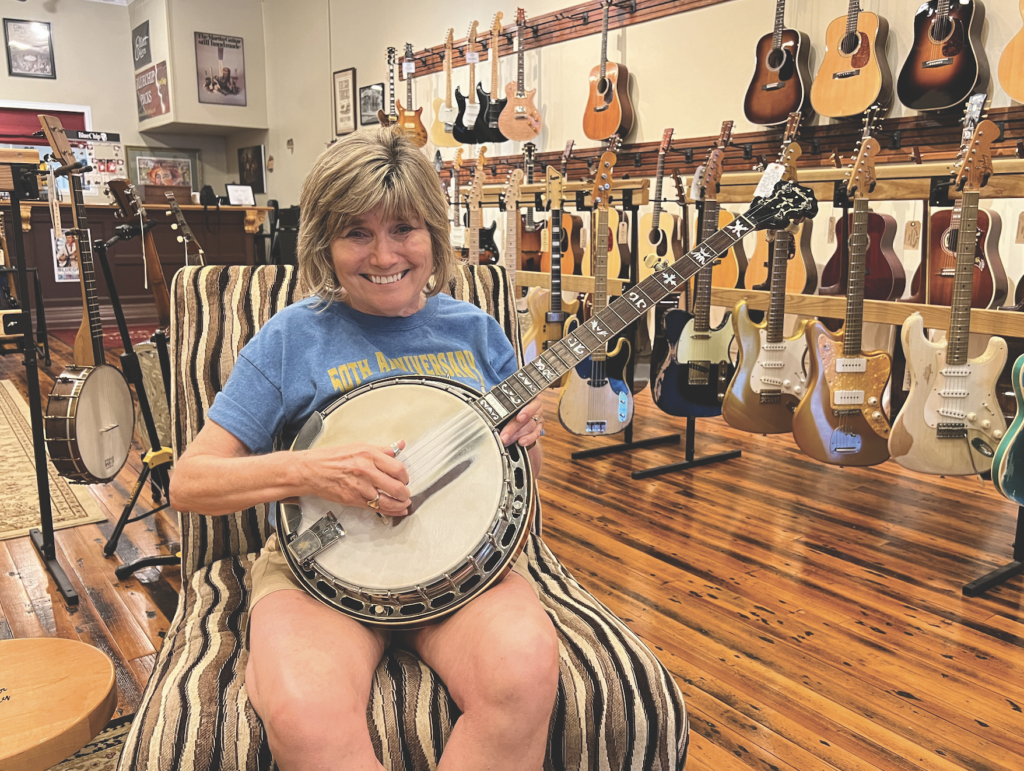
Ed continued, “I asked John if he knew of any teachers around Charlotte because at that time, I spent three days a week there with my job. Now I just go down for the day and come back. I had an apartment there. John said he knew a fellow there named Terry Baucom and gave me his number. I called up Terry the next week when I was in Charlotte. He came over the following week and Terry and I formed a lifelong friendship. He was just a great guy! I get teared up (talking about him). He’s one of the greatest guys that I ever knew.
“Terry would come over once a week and give me a banjo lesson, but more than anything we set around and talked about banjos and messed with banjos. We’d take them about apart. I’d buy them and he’d look at them. We just had a big ole time. That’s how my interest in banjos evolved.
“In 2005, I met Terry’s girlfriend at time, Cindy Norris. She was doing a little bluegrass show. My corporation (the John Boy & Billy Show) decided we would syndicate her bluegrass show and that’s how ‘Knee Deep in Bluegrass’ got started. I syndicated that from the outset, but turned it totally over to Cindy in 2019. She is a dear, dear friend.
“My corporation was the record label for Terry’s CDs. We did three or four. The second CD won the 2013 IBMA Recorded Event of the Year award for ‘What’ll I Do’ which was very exciting. I’ve sold a couple of Baucom’s banjos that Cindy brought in for his scholarship fund. We lost Terry way, way too soon. It was a cruel disease that took him and I’m glad that he didn’t have to suffer with it.”
Cindy Baucom is forever grateful. “I am a firm believer that if you follow your passion and stay the course, God puts the people in your path to help you fulfill your goals and calling. Too many things lined up perfectly for it to have been a coincidence that Ed Lowe played such a significant role in Terry and me achieving many of our dreams together.”
Ed’s banjo history branched out. “Because of the bluegrass world, I have made a tremendous amount of friendships. I was able to call Earl and Louise Scruggs personal friends of mine. One of the best transactions happened back around 2017. I owned the Granada that came out of Earl’s batch. It was 9584-1. Earl and Sonny Osborne had 2 and 3. It was a pleasure to own it for a period of time, but JD Crowe got a hold of it and played it and fell in love with it. He was interested in working out a deal. Through a mutual friend, we worked out a deal for JD to get that banjo. I could think of no person better to have banjo 9584-1 and Earl and Sonny having 2 and 3. That’s kind of like the trifecta with all three of them having Granadas all out of the same batch: 1, 2, and 3. That was very satisfying to do that. It’s extremely satisfying because I have JD’s last flathead that was in Jim Mills’ book, his 1938 RB-75. It’s in the case up front.
“We’ve had a Loar mandolin. I let Sierra Hull play it for a few years. That put some good chops in it. After we got it back, we ended up selling it a couple of years ago. I’ve had most of the big names in bluegrass in here at one time or another. Not that they all came in and bought something, but they’re aware of the store and have come in for jam sessions and other things. If I’ve got something they want, they know that they can get it from me.”
Ed has another son, but he has taken a different route in music. “My younger son is Sam. He moved to Brooklyn. Sam went to Carolina on a Morehead Scholarship, graduated with all A’s and got a full scholarship to Stanford for grad school. He got his masters in computer science. Will says he is the genius of the family. Sam started on drums because he didn’t want to play the same thing as his brother. There are seven years between them. He also plays guitar and is into recording. He has a nice little recording studio. He and a couple buddies started a company that is internet-based and does website development for the music industry. He’s having a big time doing that.”
Ed laughs when asked if he’s ever played in a band. “Lord, no, I’ve played in some of your finer closets! I’ve always done it for self-satisfaction.” He praised Will and their work together. “My son’s specialty is guitars. It’s just something my son and I do. He’s a musician. He plays guitar and bass. He plays bass in the group, Jive Mother Mary. They recently relocated to Nashville. Will is splitting his time between here and Nashville now.”
His son expounded on his own musical career. “Up until about three years ago, I was playing guitar in cover bands. I ended up taking a gig on bass for Casey Noel at a festival in Crossville, Tennessee. She’s a country singer from Greensboro that lives in Nashville now. That was my first gig on bass. I really started to enjoy it. In October 2023, I got a full time position that moved me out to Nashville playing in an original rock-n-roll band, but we also do side work.”
The 34-year-old bachelor originally planned to travel between Burlington and Nashville every other week to work at the vintage instrument store and perform with his Music City-based band. “It’s become where that doesn’t always hold true. There may be two weeks were we’re really busy. It depends on where and when the gigs are. The great thing is that Dad is so supportive. He loves the fact that I am doing it. With technology today, it’s easy to work (remotely). I’m available to FaceTime with customers. I’m very familiar with our inventory so Dad can call me so I can answer questions and talk with folks who come in the store. We make technology work while he does the day-to-day operations.”
“We’ve had some amazing instruments come in. We sold a Feb 1923 Loar F-5 that was a fantastic mandolin. We’ve had many, many pre-war Martins over the years, but two that really stick out in my mind would be a 1939 D-18 that we recently sold. It was a really special guitar that sounded amazing. The other was a 1942 D-28 Herringbone that is still the benchmark in my mind when I’m listening to a vintage Martin. That’s the one that I compare all others against.
“We’ve had lots of pre-war Gibson banjos, original five-strings or conversions. Right now, we’ve got a 1920 Gibson F-4 mandolin and a 1920 A-model mandolin. We’ve got a 2004 F-5 Fern. We’ve been really lucky to have had a lot of really special instruments come through the store mainly because there’s really not another store in North Carolina that does what we do. There are lots of great instrument stores in the state, but if you want to find a place where you can walk in and see a 1926 PB-6 flathead banjo or a pre-war Dreadnought Martin. You’d have to go to Nashville. That’s about the closest place. We get a lot of folks that drive from different parts of the state for that reason.”
Will is responsible for authenticating the guitars. “I’ve got 20 years’ experience handling vintage Martins. When we first opened, a luthier named David Shepherd worked with us for about four years. At the start of the business, he helped us with the authentication process. I learned an incredible amount from him. He has been in the business since the 70s. Now when guitars come in, I am primarily the one that authenticates them. Dad handles the banjos. We split the mandolins. We both have our areas of expertise. Between the two of us, we’re able to tell about them.”
Being a musician, is it hard to let these classic instruments go? Will confessed, “The fact that a lot of them are so expensive makes it a little easier on a self-employed business owner/musician’s salary. I can’t afford to keep some of the really special stuff that comes in. With that said, I have bought myself many a guitar from myself and I tend to give myself really good deals, too. I have definitely had plenty that have come through that I’ve hung on to. Like with the 1939 D-18, on one hand I was really happy to sell it and make the money. The man that bought it was just over-the-moon about it and couldn’t have been more excited. There was also a part of me that was really sad to see it walk out the door. You’re definitely always sad to see them go, particularly the ones that are really special. It’s a combination of both.
“We purchase things out right and do a lot of consignment sales as well. One thing we pride ourselves on is honesty. We try to give customers all the information in terms of what we can give them selling it out right compared to what we can sell it on consignment so they can make an informed decision and know how to proceed. I will always tell the seller, ‘This is where I think I could price your guitar on my wall. Here’s what I could pay you if you just want to sell it today.’ Oftentimes, I steer people towards consignment, especially on the more expensive guitars because it will put more money in their pocket. We will get you more money if you’re willing to wait and consign the instrument. I always want to work with the customer and get them as much money as I can, but some people just want to sell it and be done with it.”
Lowe Vintage Instrument has built a great business reputation. “One thing about the vintage guitar business that we’ve found as hobbyists is that it’s definitely a business where you meet a lot of shady characters who want to try and take advantage of the situation. We’ve always tried to set ourselves apart with honesty and integrity, making sure that we treat people right. One example, I had a little old lady come in with a 1930s Gibson with maple back and sides. It is exceptionally rare. She said, ‘I just bought this for $10 in an estate sale and I was hoping I could get $100. I said, ‘Ma’am, that guitar is worth about $6,000.’ We ended up buying it from her and she was more than happy to walk out with a check that was many times more than $100. We try to treat people right. That’s the right way to do things. It’s served us well, not only as repeat business, but people referring folks to us.”
Regarding sales, Will stressed, “Guitars, by far, are our bread and butter. We sell more of them than anything. Followed by banjos and mandolins, which are sort of tied. There’s just a whole lot more guitar players out there.”
The father/son business runs about 50/50 with online and in store sales. “I get a lot of folks that will make a special trip and drive in from VA, TN, NC, and SC to buy things in the store. We also do a good online business and ship items all over the world. We’ve shipped guitars to Australia, Japan, and Tel Aviv, Israel. Even the in-store sales most of them start on the website with people browsing the inventory. For online customers, if you can’t come into the store, you have a 72-hour approval period. We don’t charge a restocking fee. We give a full refund and we just ask the customer to pick up shipping costs. If you get an instrument delivered to your house, we give you three days to spend some time with it and make sure that you love it. If for any reason someone wants to send something back, we accommodate that. It gives people some peace of mind when they’re spending a bunch of money on an instrument. There are other vintage stores that do that. A lot of places give you 48 hours. We give you that third day. Especially in the wintertime, it is best to let the instrument acclimate. You should wait 24 hours to unbox it and make a final decision. I’ve found that the vast amount of instruments once they go out, they don’t tend to come back. It’s very rare for an instrument to come back. Our best customers are repeat customers. We’ve got folks that have bought dozens of instruments from us over the years. They refer their friends. We do a lot of social media, but our best advertising is really just word-of-mouth.”
Satisfied customer, musician, and collector Tom Isenhour of Salisbury, shared, “(It is) a great vintage store and really nice folks to deal with. They have the love and passion and plenty of knowledge in dealing with most any stringed instruments, new or vintage. They even sold my daughter’s Taylor Swift Taylor guitar for me. They have all the new accessories you need for your instruments. It’s always worth a visit when in the Burlington area.”
Tony Williamson, another patron, added, “Ed Lowe not only knows his stuff, but he does it for the love of the instruments and the players. This is a rare thing in a world where most dealers are out for profit above all else.”
Looking to the future, Ed admitted, “I’m quite satisfied with what we’ve got. We’re extremely comfortable doing what we do. It’s not a matter of where Will and I want to grow it where we’ve got employees. My wife can come in when I need it. Beth is always available. Will handles the website and social media. We’re content here. It’s a pretty good situation.”
Will affirmed. “We don’t really have any plans for expansion. We’re really happy with our location. It’s such a nice central part of the state and easy to get to off the interstate (40). We hope to be there for a very long time.”
Will concluded, “We love meeting new customers and talking to folks who are passionate about these old instruments. We hope folks that are not familiar with us will come in and check us out.”
Lowe Vintage Instrument Company is located at 327 South Main Street, Burlington, North Carolina. Regular showroom hours are Tuesday-Friday, 10:30-5:30 and other times by appointment. To contact Lowe Vintage Instruments about buying or selling musical instruments, call: 336-524-6250, visit their website: lowevintage.com or email: [email protected].