
A Martin Lost & Found
It’s every picker’s nightmare scenario: having a treasured instrument stolen. That happened to me back in 1972. My basement-level Chicago apartment was broken into while I was away from home, and when I returned, I immediately discovered that my 1947 Martin D-18 guitar was missing (along with some valued audio equipment). I called the police, but they never showed up, and since I didn’t know the guitar’s full serial number—I remembered only that it began with 100—there wasn’t much to report anyway.
I had purchased that Martin from a San Francisco music shop in 1964, paying about $300 for it. At the time, I was a finger-picking “folkie” who hadn’t yet been exposed to any bluegrass, but a friend had solemnly advised me that Martins were the only guitars worth owning, and I took him at his word.
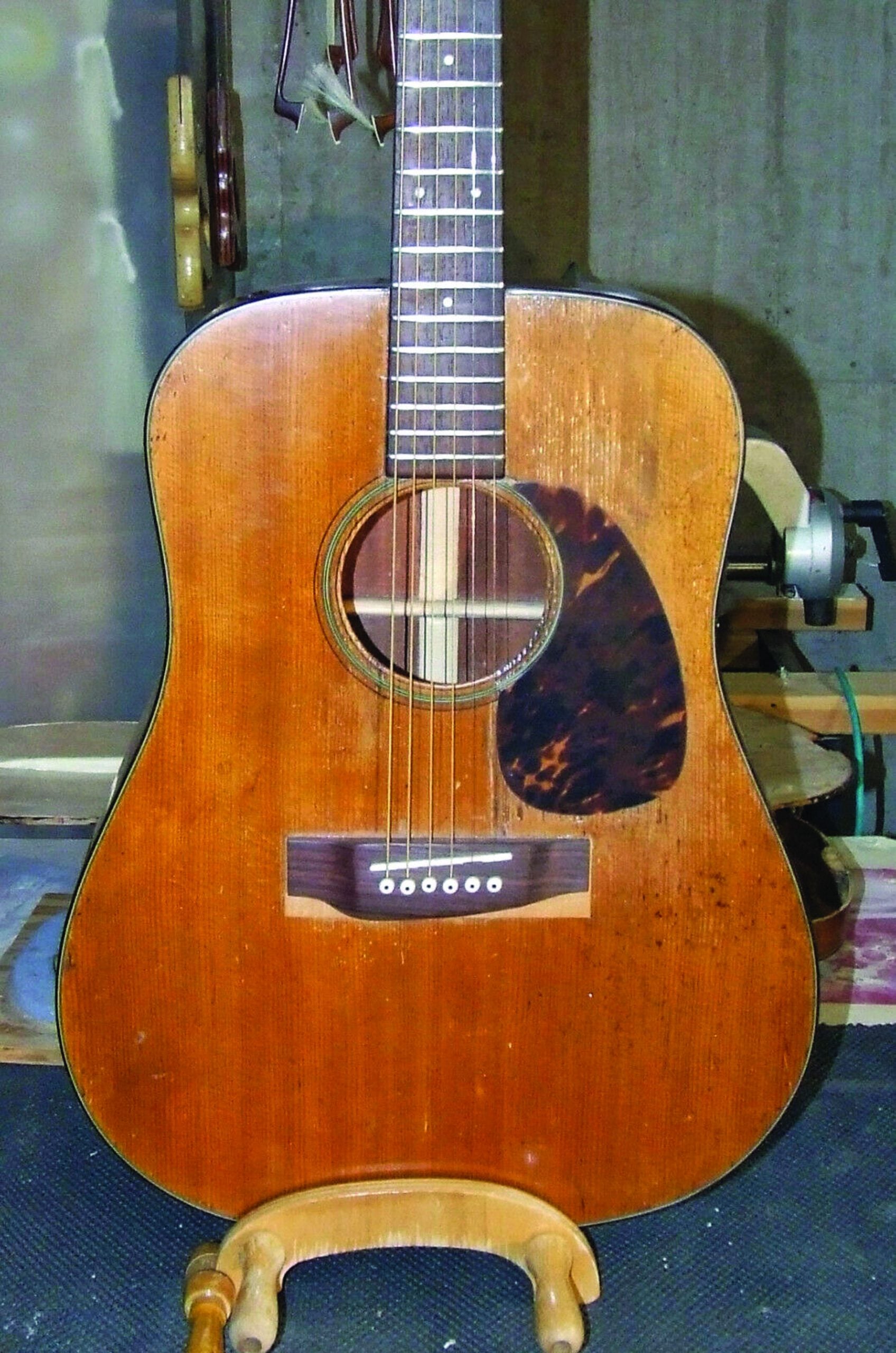
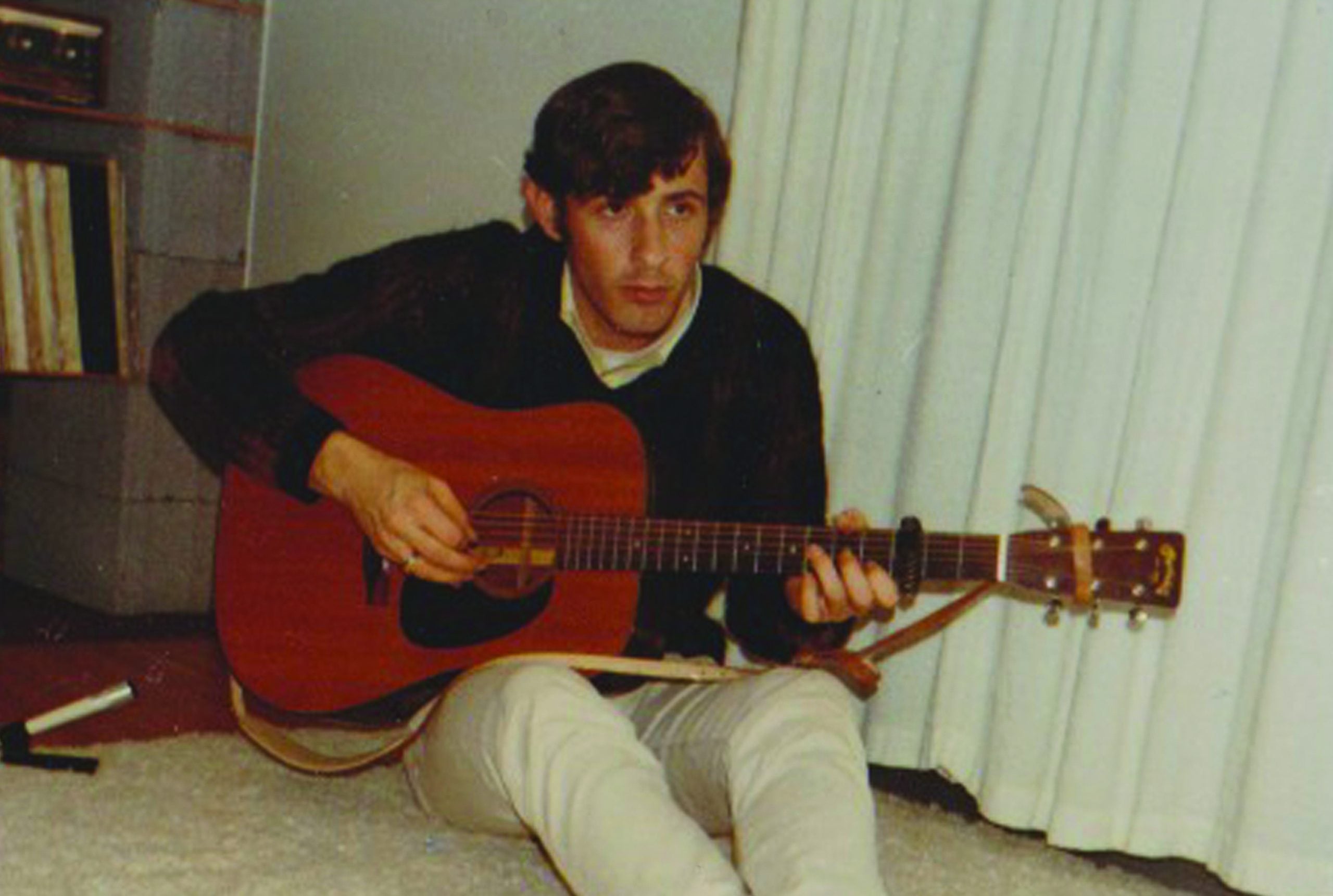
When I moved to North Carolina in 1965, the guitar went with me, of course, and I was introduced to bluegrass soon thereafter. But it eventually became clear that the instrument’s action was too high; the neck had been set up for heavy-gauge strings, not at all conducive to flatpicking. So, in 1969 I drove the guitar to the C. F. Martin factory in Nazareth, Pennsylvania for an overhaul. It was returned to me in great condition, and I used it during my stint with the Mole Hill Highlanders string band in 1969-70. It even made its way onto a couple of Union Grove vinyl records at that time. With that short but rewarding musical history, I had developed a strong emotional attachment to my D-18, so losing it was a gut-wrenching experience.
Shortly after the theft, it occurred to me that the Martin Company might have a record of the repair, in which case the guitar’s serial number would have been recorded. Unfortunately, when I called Martin, I was told that they had no documentation available, so I was left with no way of tracing the instrument.
Years passed, but the memory of that guitar’s wonderful sound stayed with me. Finally, on a whim in 2019, I emailed Martin, inquiring whether they might be able to locate any evidence of the 1969 repair. To my surprise, they did. They also had my address of record at the time, and—most important—they provided me with the guitar’s serial number: 100385.
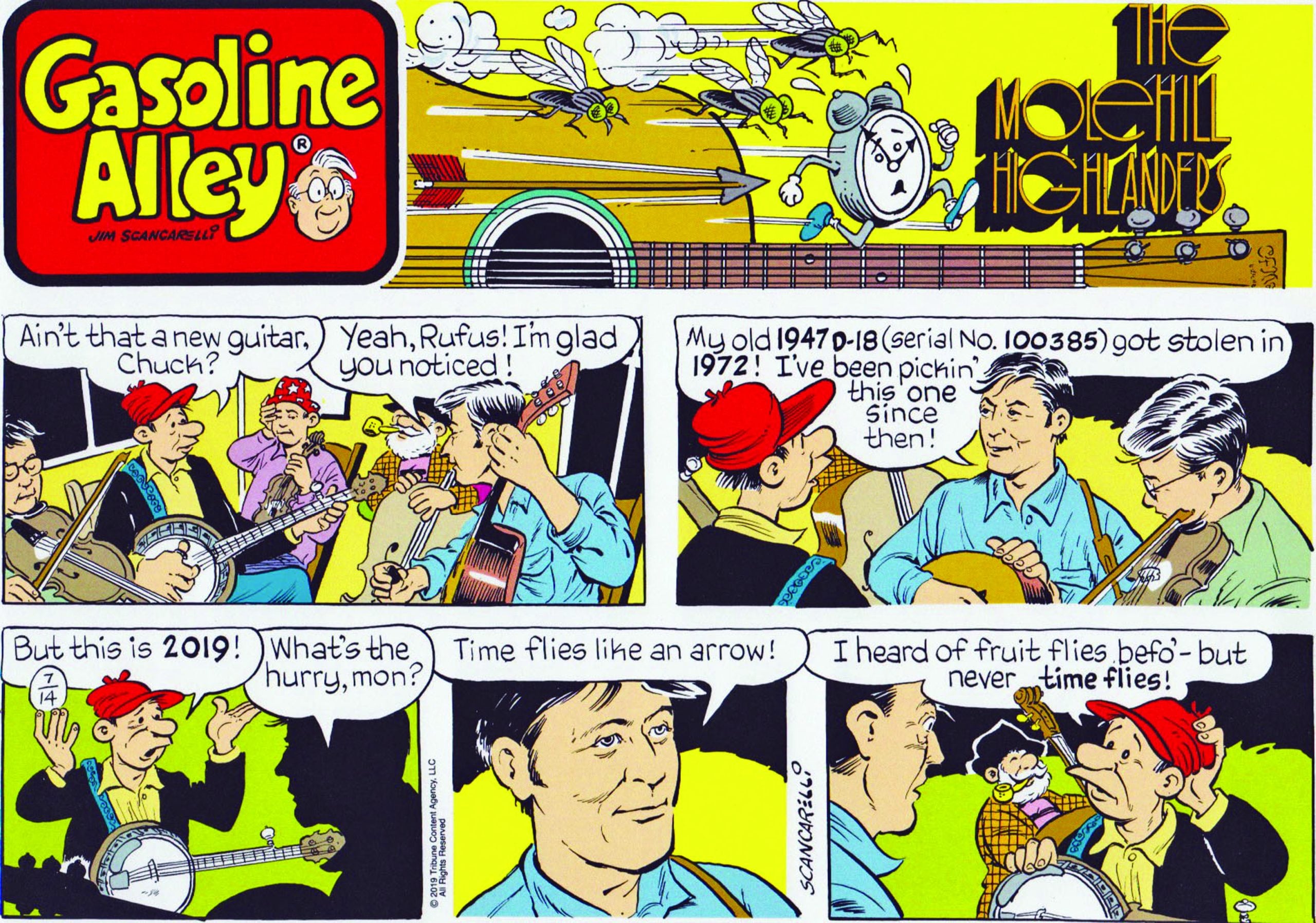
Equipped with that information, I contacted a number of vintage instrument shops around the country, and I placed an ad in Bluegrass Unlimited. My former Mole Hill Highlanders bandmate Jim Scancarelli, author of the comic strip Gasoline Alley, devoted an entire Sunday strip to my stolen Martin (see Figure 1); it ran on July 14, 2019. But all these efforts were to no avail. The guitar had vanished, and I never expected to hear of it again.
From time to time, I Googled “Martin 100385,” but nothing ever turned up. On July 1, 2021, however, I ran a Google search, and the very first “hit” was labeled “1947 Martin D-18 Guitar | eBay.” With my heart racing, I clicked on the Google link. The guitar listed on eBay was undeniably mine, or had once been, as was clear from the ad’s header: “For sale is my 1947 Martin D-18 serial # 100385. This is one of 775 made in 1947.”
The description, unusually long but quite informative, began as follows:
I bought this guitar in 1973 while I was the manager and string instrument repair technician at Music City in Madison, WI. For the first 23 or so years of this guitars life, it must have provided its owner/s with real satisfaction. It was played a lot and reasonably well cared for. The person that I bought it from shall remain un-named (but he was a well-known R & R guitar player in the late 60’s to mid 1970’s.) He had absolutely NO respect for this wonderful guitar and almost destroyed it. The original back was Honduras Mahogany and the owner smashed it. He later replaced the smashed back with a piece of Masonite that he glued on with epoxy. He once again attempted to smash the Masonite back but he only succeeded in cracking the sides, breaking the neck at the [heel] and pulling the bridge off along with some of the top under the bridge.
The eBay seller, a self-described “violin/guitar maker/repairman” went on to catalog various repairs that he had made, which had brought the horribly abused instrument back to life, even if not to its former state. Nonetheless, the sight of my old guitar in eBay photos, plus the seller’s declaration that it was “very solid,” encouraged me to try to reclaim it.
Unfortunately, the eBay auction had ended six weeks earlier. eBay does not reveal the identities of buyers, but in this case the buyer had decided not to keep the guitar. He’s a “lefty”, and had considered converting it for his own use, but ultimately decided that he didn’t have the time to take on that project. So, he put it up for resale on another website that turned up in a subsequent Google search, thus enabling me to identify him as George Schneider, and to contact him. By that point, George had already sold the guitar, but when I described my previous ownership, and my interest in a possible purchase, he promised to contact his buyer. Time went by without any news, until—some three weeks later—I received an email: “Guess what!? I heard back from him!!!…We just had a phone call. It went well. I’m gonna text him some of your earlier emails so he can get a feel for the situation, and he told me he’d be reaching out to you!”
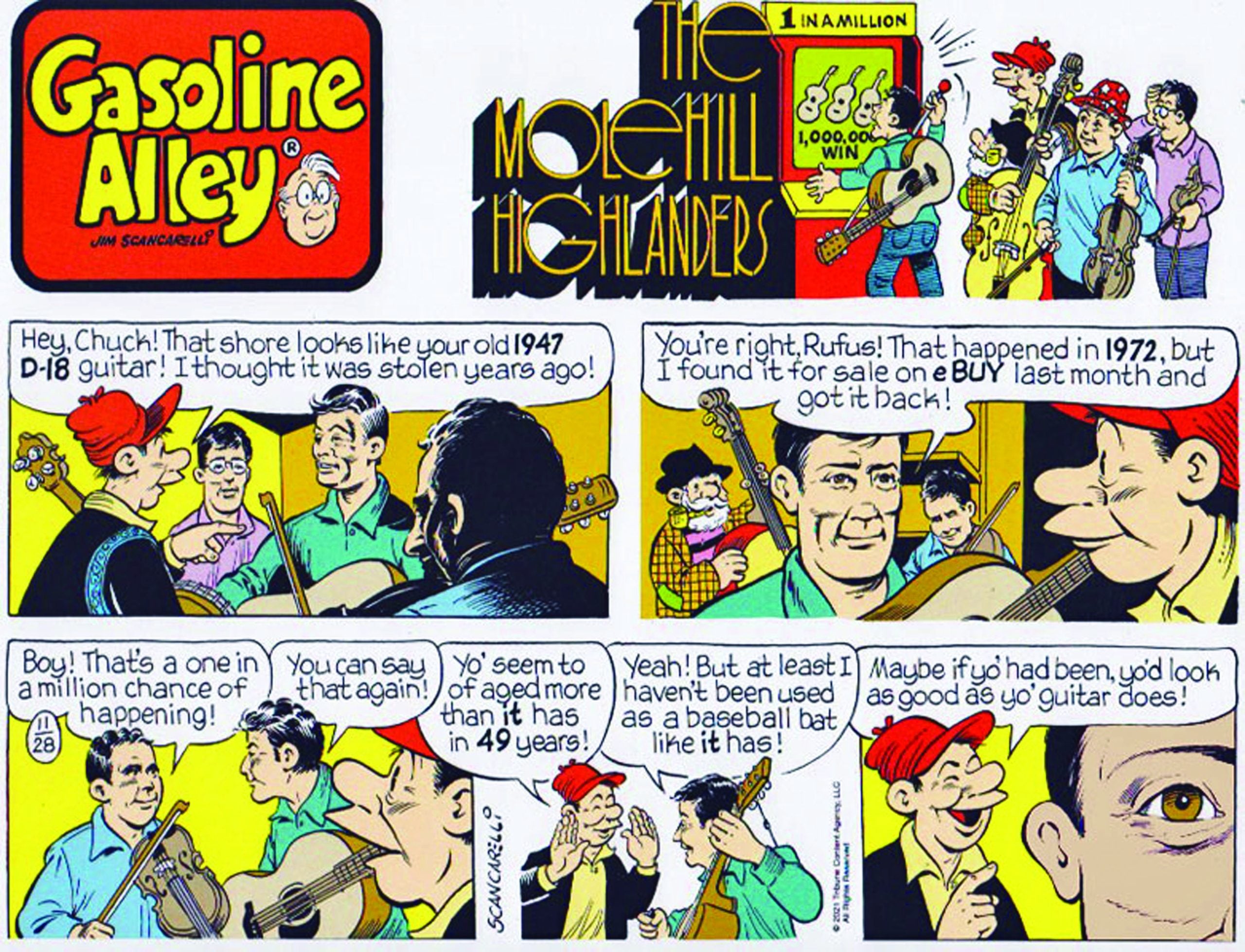
And that very day, Mike M. in Texas did indeed reach out to me. Mike is a professional musician who has lost several guitars to thefts, so he was especially sympathetic to my situation. He generously offered to sell me the guitar for exactly the price he had paid for it (considerably more than my original purchase price, of course, but I had no complaint). Two weeks later, it was back in my hands for the first time in 49 years. Once again, Jim Scancarelli memorialized the event (see Figure 2).
The sound was very impressive, all the more so given what the guitar had been through. It was powerful and balanced, with lots of sustain, and each string was clear with a very sweet tone all the way up the neck. I was, of course, exhilarated to have recovered my old Martin, but memories of its former appearance persisted, and I began to wonder whether any of the jarring cosmetics, resulting from the rock ‘n’ roller’s damage to it, could be repaired without compromising its sonic qualities. An answer to that question required an expert’s opinion, but finding the right person proved to be a challenge. Several luthiers turned down the project. Fortunately, through a friend I was introduced to Neil Kendrick.
Located in Central Kentucky, Neil Kendrick is a world-class luthier and an authorized Martin repairman. He is a modest man who does no advertising. His hand-built guitars are powerful-sounding, and visual works of art (Josh Williams can be seen playing one of them with Rhonda Vincent in some YouTube videos). When I arrived at Neil’s shop with my D-18, he examined it thoroughly for over an hour before promising to contact me later on with a full written evaluation and an estimate for any proposed work.

Within a few days I received an email from Neil detailing his analysis. It turned out that the guitar needed a lot more than cosmetic repairs, and I immediately endorsed Neil’s plan. The previously-replaced back was perfectly flat, whereas it should have been curved slightly, so Neil made an appropriate new one from Honduran mahogany that he had on hand. The neck angle was incorrect, as was the bridge, and those issues were addressed. A massively oversized bridge plate was exchanged for a smaller one, thereby opening up a dead sound area on the guitar’s top. A previous patch below the bridge was replaced with a stronger one that better matched the surrounding wood. Mounds of old epoxy were removed from the interior, and damaged braces were repaired. Moreover, the guitar’s overall appearance was greatly improved. When I went to pick it up, Neil handed me an instrument that closely resembled what it had looked like at the time it was stolen, and which had essentially been returned it to its 1947 factory specs. And the sound, which had already been impressive when I first recovered the guitar, was noticeably better as a result of Neil’s craftsmanship (I didn’t have to rely entirely on my auditory memory, since I had the Union Grove recordings to use as a reference.).
Some mysteries remain. I don’t know who stole the guitar, and I’ve been unable to identify the rock ‘n’ roll musician who smashed it up (perhaps as part of a stage act) and sold the resulting pieces to a knowledgeable music shop manager in Madison, Wisconsin. But thanks to Google and some very helpful people, the 1947 Martin D-18, s/n #100385, having survived and recovered from a previous abusive relationship, is now back in the possession of its rightful owner after an absence of nearly five decades, demonstrating that if you live long enough and remain patient, good things can happen.