A “Hidden Legend” Steps into the Spotlight
The Arnold Shultz Fund is launched in honor of influential western Kentucky musician
In July 2020, the IBMA Foundation established the Arnold Shultz Fund to support activities increasing participation of people of color in bluegrass music. Arnold Shultz (1886–1931) was an African American musician from western Kentucky who had a profound influence on Bill Monroe’s music and the development of bluegrass music. Back in 2017, Rhiannon Giddens, in a keynote address at the IBMA Business Conference in Raleigh, had challenged the bluegrass music community to “tear down those artificial divisions and let bluegrass and string band music be the welcoming place that it has, and can be, and, in more and more places.”
The idea for the fund grew out of an online conversation among alumni of IBMA’s Leadership Bluegrass program. In less than two months the Shultz Fund had raised more than $31,000, thanks to the enthusiastic support of the bluegrass community—including a major unsolicited gift from banjo player/comedian Steve Martin. A group of Denver, Colorado-based musicians organized a June 26 live-streamed concert with a portion of proceeds donated to the Arnold Shultz Fund. Band members included Andy Hall and Chris Pandolfi (The Infamous Stringdusters), Paul Hoffman (Greensky Bluegrass), Greg Garrison (Leftover Salmon), and flatpicking champion Tyler Grant.
Arnold Shultz Fund co-chairs Richard S. Brown, DMD and Neil V. Rosenberg are in the process of appointing an advisory committee which will make decisions about how donations to the fund will be used. Examples might include scholarships (college, workshops, camps, individual instruction, or Leadership Bluegrass); awards; projects; or programs. Look for 2021 program priorities and application details at bluegrassfoundation.org after the first of the year.
Dr. Brown is a nationally known Cambridge, Massachusetts-based mandolinist in the Bill Monroe style, a member of the IBMA Foundation’s board of directors, and an African American. Dr. Rosenberg is a noted bluegrass historian, author, banjoist, and Bluegrass Hall of Fame member who taught Folklore from 1968-2004 at Memorial University of Newfoundland in St. John’s, Atlantic Canada’s largest university. Two more members have been appointed to the committee: Dr. Erika Brady, a professor in the Department of Folklore and Anthropology at Western Kentucky University, and Trisha Tubbs, former director of SoftResources LLC in the Seattle area, the 2011-19 facilitator of the Leadership Bluegrass program, producer of the IBMA Momentum Awards show, and a longtime member of the Wintergrass production team. Tubbs is originally from Hawaii.
“We have to see where bluegrass music can go, where it hasn’t gone before,” Dr. Rosenberg said, “by paying attention to people who are sometimes seen as on the fringe or outsiders. The Arnold Shultz Fund seeks to welcome people of color into bluegrass. As a musician I’ve always appreciated the progressive nature of this music. It’s never the same. Here’s an important opportunity for us to develop, to take new directions.”
“Arnold Shultz is long overdue for recognition because of his influence on bluegrass music,” Dr. Brown said. “Arnold played with Bill Monroe’s fiddling uncle Pen Vandiver as a guitarist. Shultz was also a sought-after fiddler and later hired Bill to play guitar for him at dances. Bill Monroe told me about Arnold Shultz and their dance gigs more than 50 years ago, when I was in my twenties. The stories would always end with Bill saying, ‘Now, isn’t that something?’ Yes, it’s time to take Arnold Shultz, one of our hidden legends, out of obscurity and into the mainstream.”
Bill Monroe’s first paying gig as a 12-year-old musician was when one of his first musical heroes, Arnold Shultz, hired him to play guitar for a local dance. In Robert Cantwell’s book, Bluegrass Breakdown: The Making of the Old Southern Sound (University of Illinois Press, 2003), Monroe is quoted as saying, “There’s things in my music, you know, that come from Arnold Shultz—runs that I use a lot in my music, I don’t say that I make them the same way that he could make them ’cause he was powerful with it. In following a fiddle piece or a breakdown, he used a pick and he could just run from one chord to another the prettiest you’ve ever heard…. Then he could play blues and I wanted some blues in my music too, you see.”
After learning from local musicians and a few who were traveling through, Shultz became a road musician himself. It’s likely that he heard and played with a variety of musicians who worked on the steamboat lines that cruised the Mississippi from St. Paul to New Orleans and the Ohio River from Cairo to Pittsburgh, docking at Evansville, Louisville, Cincinnati and Owensboro, Kentucky—the latter only a few miles from where he grew up. During his travels between 1919 and 1922, Shultz heard musicians like Jelly Roll Morton, Louis Armstrong and any number of Dixieland jazz, blues and ragtime musicians from St. Louis, Louisville, Cincinnati, and New Orleans.
In her chapter about Shultz in the anthology, Hidden in the Mix: The African American Presence in Country Music (Duke University Press, 2013), Erika Brady quotes an interview folklorist William E. Lightfoot did with Shultz’s nephew, Malcolm Walker. “He traveled a whole lot. He would leave and we wouldn’t know where he was. He didn’t write or anything. But, somehow or another, we’d all be around the house there and the first thing you knew, you’d hear that guitar. And you knew it the minute you heard it.” Arnold would be in the area for a while, and then he’d take off for months at a time.
“He’d play as he walked away,” Lightfoot asked, “and wander off?” “That’s right; that’s the way he was,” Walker reported. “He’d just kind of ease on away.”
“Whatever his sources,” Lightfoot wrote in articles for the Oxford University Press and the African American National Biography, “Shultz assimilated the music of the 1920s—popular (both old standards and contemporary), blues, rags, religious music, old-time fiddle tunes and breakdowns, and jazz—as well as several instrumental techniques: flat-picking, finger style, and the open-tuned slide method on the guitar and both long-bow and short-bow fiddling styles. He became, in other words, a textbook example of a ‘musicianer,’ one who specializes in a wide variety of instrumental styles.”
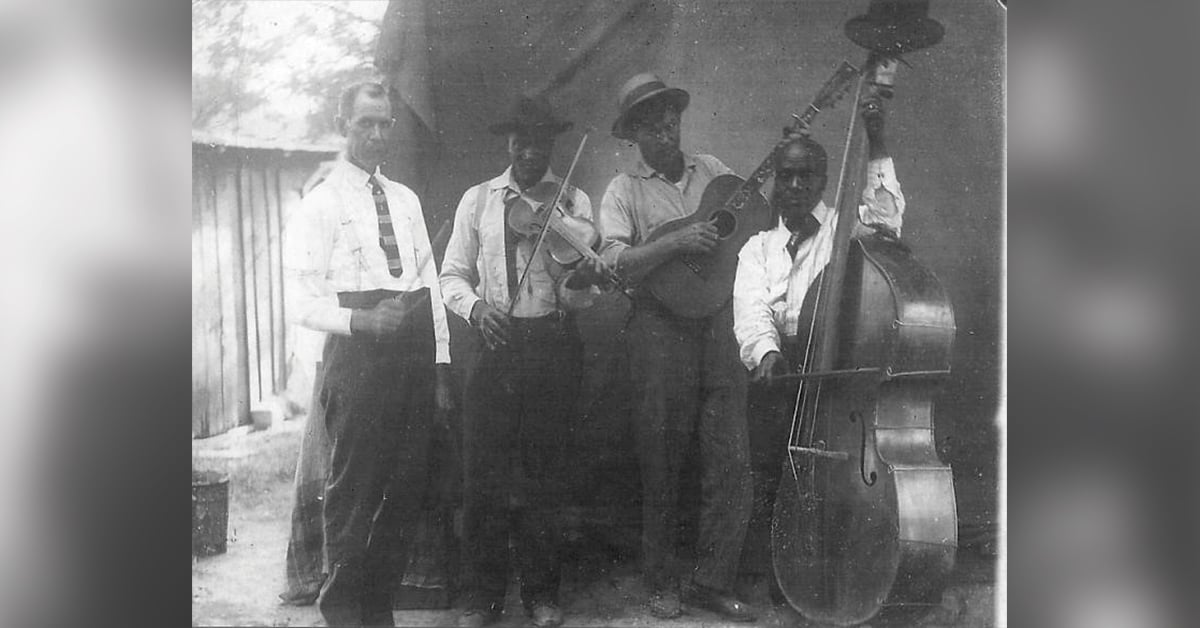
Born in February of 1886 in the Cromwell precinct of Kentucky’s Ohio County near Rosine, Arnold was the eldest son of David and Elizabeth Shultz. His dad was a former slave, and his mom was just 16 years old. According to the 1900 census, Arnold could read and write at age 14 and was working in the Oho County mines with his father. He picked up the guitar from an uncle and by the age of 25 was playing for square dances in a family band with his cousins, Ella (later Griffin) on fiddle, Luther on bass, and Hardin on banjo. Various family members would fill in over the years. There were 12 children in Ella Griffin’s family, and Arnold had several brothers and sisters.
He was never recorded, but thanks to the research of Lightfoot, Keith Lawrence, Charles Wolfe and Wendell Allen, who Erika Brady credits, we know that Arnold was a multi-instrumentalist, proficient on banjo, piano, and mandolin, as well as guitar. Bill Monroe’s oldest brother, Birch, remembered Shultz as playing a “good, old-time fiddle” in a 1980 article by Lawrence for the Messenger-Inquirer in Owensboro, Kentucky.
Along with music and coal mining, Arnold worked as a deck hand on riverboats, traveling from the Ohio River in Kentucky down the Mississippi to New Orleans. By the late teens and early 1920s he was performing in hillbilly and Dixieland bands with both Black and white musicians, including a lead guitar job with a group headed by Forest “Boots” Fought, a 20-year-old drummer from McHenry, Kentucky. They played dances and some rather sketchy bars. In an interview with Lawrence, Faught remembered a place on the Green River that was built high on a bluff with a railing around it: “It wasn’t nothing to see people sailing over that railing into the river.” Faught had a five-piece band, and Arnold was the only Black musician. “Back then we would go to play for a dance and somebody would say, ‘Hey, you’ve got a colored fiddler. We don’t want that.’ I’d say, ‘‘The reason I’ve got the man is because he’s a good musician. The color doesn’t mean anything. You don’t hear color. You hear music.’”
Arnold was a showman. He knew how to draw a crowd and keep their attention. Based upon a 1979 interview with fiddler Tex Atchison, William Lightfoot wrote: “As he got older, Shultz began to spend more time in the region, wandering around like a minstrel with his huge guitar attached to his shoulders with a rope. He played at street corners, railroad crossings, company stores, family gatherings, taverns and roadhouses, house parties, square dances (both Black and white), and churches. Atchison, the fiddler with the Prairie Ramblers [stars of Chicago’s National Barn Dance in the 1930s] has said that when he was a young boy in Rosine his mother would give him a dime for the movies, which he would in turn give to Shultz to play him a tune. Shultz, who carried his guitar on his back, would execute a kind of twisting motion with his hips that brought the guitar around into playing position in one fluid move. Shultz’s fiddling also impressed Atchison: ‘I picked up that [swing] stuff from Arnold Shultz, hearing him play that stuff. When I got to playing with the Prairie Ramblers, that would come back to me…. Arnold Shultz was 50 years ahead of his time.’”
On guitar, Atchison was mesmerized by Arnold’s ability to produce rhythm, melody, bass, and harmony by using just a thumb and a forefinger. He liked to use a lot of extra “passing” chords and runs. No one played a song with more than two or three chords in that part of the country before Arnold showed them how, according to Faught.
Faught told Lawrence that Shultz “was way ahead of his time on that guitar. It was just an old common flat-top guitar that probably didn’t cost over $20. It was a large guitar and I’m sure that it had a round sound hole and the old-time pegs that hung down under it. He had an old grass rope for a cord around his neck…. It’s a shame we didn’t have sound systems back then. In the noise of a dance hall, if you got 40 feet from a band, you couldn’t hear them. If Arnold had gotten on records, he would have been in a class by himself.”
Nolin Baize ran the Gold Nugget coal mine in Horton, Kentucky, from 1925 to 1926 and called square dances around the area. Baize, who worked with Arnold day and night, told Lawrence: “He was a guitar picker; I’ll tell you. He could come nearer to making it sound like a piano than anybody I ever heard. He knew a lot of chords on that thing and where to put them in. He just used his fingers too. He could play anything you could name. If he heard a record, he could sit down and play it in a little while. But I never heard him sing a lick.”
In 1927 Shultz was playing in the Horton area with clawhammer banjo player Clarence Wilson and fiddler Pendleton Vandiver (Bill Monroe’s “Uncle Pen”). Wilson’s daughter, Flossie Hines, told Lawrence she remembered hearing them play at a store in Rosine. “Oh, he was a guitar player. He could play music. He was something else. It’s a pity that anybody that could play like that had to die. When you heard anybody else play after him it was just like sawing [wood] or something. It just sounded awful.”
Shultz is credited by some researchers as an early influence on the development of Travis-style fingerpicked guitar. Guitarist Mose Rager taught Ike Everly (the father of the Everly Brothers), who then taught Merle Travis, who influenced Chet Atkins. Rager said he couldn’t remember ever seeing Arnold Shultz but that his music influenced him anyway. “Kennedy Jones, the man that taught me to play, learned a lot of chords from Arnold Shultz,” Rager said. “He knew Arnold very well. I used to hear him talk about him. The thumb-pick style was Jones’s innovation. Arnold played with his thumb and finger. He didn’t have no (thumb) pick.” Bill Monroe remembered the same thing, adding that Arnold Shultz would sometimes use the edge of his pocketknife to play slide guitar.
Shultz lived in a two-room house in Coal Bank Hollow near Horton, Kentucky. He never married. He was known to make home brew. Photos are rare. His cousin, Ellie, told Lawrence Arnold didn’t like to have his picture taken. “He said if he ever did any devilment, he could get away and nobody could find him,” she laughed. Shultz was a short man, a little overweight, and good looking. People commented on what a nice person he was. He always wore a black coat and a big black hat, and he hung it on the back of a cane back chair when he sat down to play the fiddle, according to Boots Faught.
Shultz performed with the (all-Black) Walter Taylor Band in the late 1920s, but by 1931 he was living with the family of a butcher named Beecher Carson in Butler County, playing music out of Morgantown, Kentucky. In April 1931 Arnold spent a week in Prentiss, Kentucky, with his relatives, leaving on a Saturday night with three other musicians to play for a dance in Morgantown. “That’s the night they said he got some poison in his whiskey,” Ellie Griffin told Lawrence in 1980. “Yes sir, I do think he was (murdered). He drank whiskey all the time before that and he never got sick over it. He drank that and he took sick and died. People were bragging on Arnold for playing better than the (other musicians) did. So they thought they’d fix Arnold and put him out of the way — and they did. He drank that whiskey and died.”
According to medical records, Arnold Shultz died at 45 of a mitral lesion in his heart. He was buried in an unmarked grave in a Black cemetery, now called the Bell Street Cemetery in Morgantown. The Great Depression was going on, and his relatives didn’t know about his death until after he was buried. The city of Morgantown erected a grave marker for Shultz on May 28,1994, with the month and year of his birth and death, a carving of a guitar in the stone, and the lines: “He was famous for his guitar picking” and “Dedicated to thumb picking and finger cording.”
Shultz was inducted into the National Thumb Pickers Hall of Fame in Drakesboro, Kentucky, in 1998 for his contributions to the Travis guitar style, but he has not yet been recognized for his contributions to western swing, bluegrass music, or (indirectly) rock ‘n’ roll – where Elvis Presley and Buddy Holly both credited Bill Monroe as a direct influence on their styles.
Almost 90 years after his death, fans and musicians in western Kentucky still remember Arnold Shultz’s wildly impressive and widely influential music. Those of us who study him wonder what he could have accomplished if he had lived longer than a short 45 years, and sadly wish for recordings that were never made. In Keith Lawrence’s 1980 article, Wendell Allen said: “Little did Arnold Shultz know that his guitar style and musical contribution to Bill and Charlie Monroe and others would one day be the object of intense research by writers, music scholars and historians from Washington, Nashville, New York, and other faraway places, seeking insight into the self-taught musical abilities of one Black man in the country villages of Ohio County.”
Bluegrass has not forgotten Arnold Shultz, and the IBMA Foundation is proud to honor his name with the creation of a new fund that has the potential to welcome a more racially diverse group of musicians and fans into our community. Some of us may have forgotten or never knew, but people of color were a part of the family from the beginning, according to Bill Monroe. And who wants to argue with Bill Monroe? Certainly not this writer.