A Guitar Lesson with Adam Granger
In early August, I accompanied my wife to Minneapolis, where she was planning to attend a family reunion. I remembered that Adam Granger lived in the area, so I decided to try to book a guitar lesson from him. Although I have been a flatpicker for many years, I have never been satisfied with my right-hand technique, and I thought that a face-to-face lesson with an expert might get me straightened out. Adam, of course, is well known as a guitarist, teacher, and performer; his book of tabbed fiddle tunes for the guitar (now in its third edition) is the bible for many flatpickers. I have been through multiple copies of that book, but my initial introduction to Adam’s music was through his ground-breaking record with Dudley Murphy titled Twin Picking (it was the first recording featuring two flatpicked guitars).
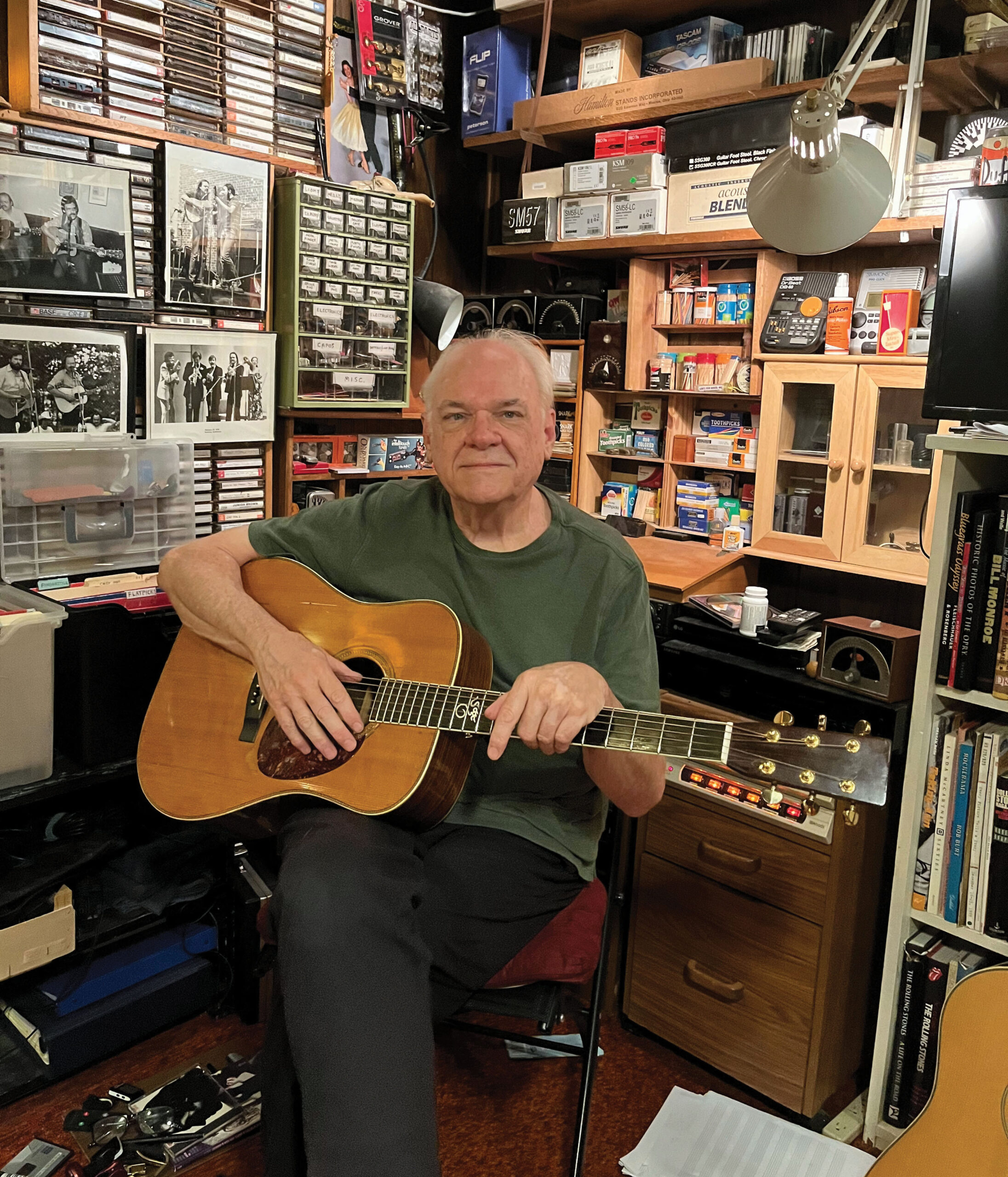
Hailing from Oklahoma, Adam started playing the guitar in 1961, and a few years later, he took up the banjo, with lessons from Alan Munde, with whom he has recently toured. He now focuses on the guitar and offers lessons two days a week from his home in St. Paul.
Through email, I arranged a one-hour session. I arrived at Adam’s house a few minutes before the appointed time (his website announces that he is “punctual”), where I was warmly greeted. For the first fifteen minutes, we just sat and talked. Adam is a very personable man, and he seems to enjoy getting to know his students a bit before getting down to business. Finally, turning to the music, he mentioned that he wanted to discuss rhythm playing. “I know you didn’t come here for that, but I think you’ll find it valuable” (I did).
We played through “Red-haired Boy,” and when Adam took the lead, my accompaniment consisted mainly of syncopated runs in a style that I had absorbed from Rodney Dillard’s guitar work on the classic album, The Dillards with Byron Berline – Pickin’ and Fiddlin’. When we finished, Adam said, “Let’s talk about context.” He remarked that with just two instruments, he favored a boom-chuck backup guitar rhythm, since the accompanist’s job is to cover both the downbeat and the upbeat. In a full bluegrass band, the bass and mandolin could do those two jobs, leaving the guitar player more freedom to innovate. So, we ran through the tune a second time, with Adam nodding approvingly. But he then pointed out that he could not hear the high string on my brush chords. Unwittingly, I had developed a bad habit of moving my right hand in a truncated arc, which resulted in the pick’s leaving my guitar’s strings before the brush stroke was fully completed. This is exactly the sort of thing that makes a discerning teacher so valuable: No solitary practice ever led me to notice the missing note.
Before addressing the topic of lead picking, Adam located several sheets of paper with exercises that he had written out, and we worked through some of them. “You don’t have to do them all every day, but if you spend just a few minutes on a couple of them, you will soon notice the difference.” We then played through “Billy in the Lowground,” which was a good choice for showcasing my failings as a flatpicker, although Adam kindly did not make that point. Instead, he proposed that I try the tune again – this time more slowly and softly – and the result was noticeably better. Most bluegrass musicians have heard the adage “If you want to play it fast, you need to be able to play it slowly,” and that was certainly borne out in the second iteration; moreover, playing softly seemed to improve the quality of the sound as well as its accuracy. Adam suggested that, for future practice, I should choose a fiddle tune and slow it down to the point at which I could play it perfectly, using a metronome. Then, speed up the metronome just five beats per minute. Wash, rinse, and repeat.
As the time wore on, Adam asked me if I could stay past 2pm (the official end of the lesson), and after I replied affirmatively, we continued for nearly an extra hour with more picking and conversation. As I was preparing to leave, I gave him a couple of articles that I had written for BU, and he, in turn, gave me a copy of the February 2025 magazine containing his humorous anecdotes about his time in Nashville. That piece made clear why he had been tapped to write skits for the long-running Public Radio show, A Prairie Home Companion.
Adam Granger is a man of many talents. He is an observant, encouraging, and patient teacher, and I recommend that you make an effort to meet with him if you find yourself in his area. His contact information is listed on his website, which can easily be found via a Google search.