A Direct Report From Ground Zero in the Thousand Year Storm
After Hurricane Helene Hit The Mountains, The IBMA Trust Fund and The Bluegrass Community Took Action
It is not every day that Chinook helicopters land in the mountains of Western North Carolina delivering much-needed supplies to a disaster zone, but that is what happened when Hurricane Helene struck the Nature Coast of Florida and then hit Georgia before trouncing Western North Carolina, Upstate South Carolina, East Tennessee and Southwest Virginia on September 27, 2024.
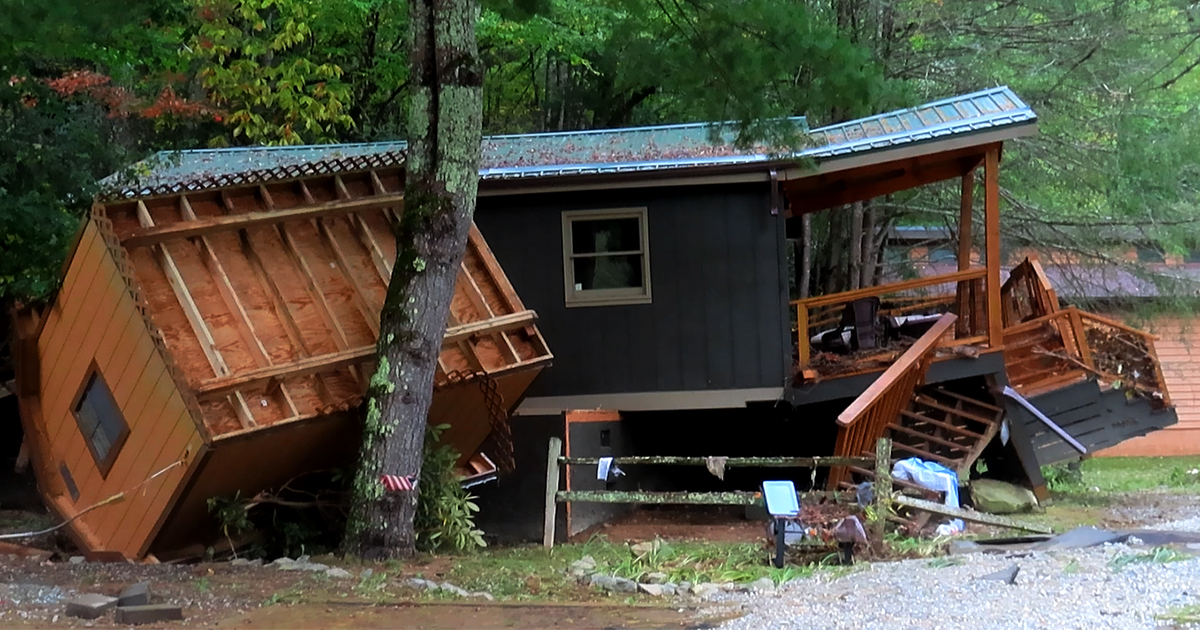
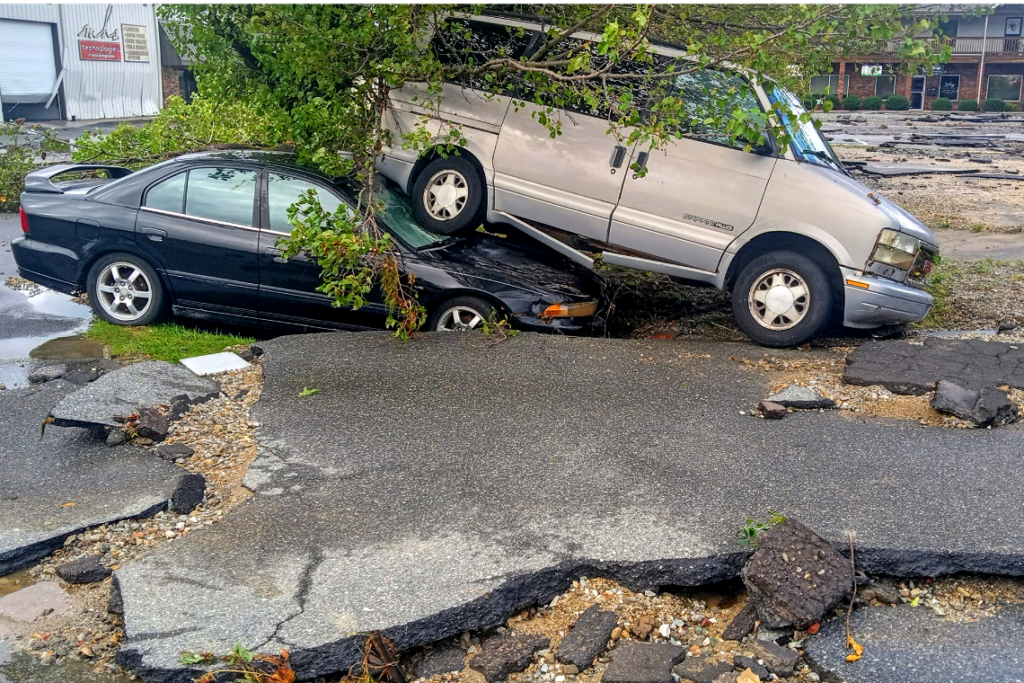
As it went about its business, the damage done to trees, houses, businesses, bridges, vehicles communications and people by Hurricane Helene was at an apocalyptic level in many cases, and it will still be a long while before the full extent of this story is told.
I live in Avery County, North Carolina, which was one of the hardest-hit areas. On the weather radar on Wednesday, September 25, the image looked like just one storm on the screen, with Hurricane Helene reaching category 4 status in the Gulf of Mexico and what looked like a smokestack of hard rain and winds flowing directly south to north out of the top of the storm. Ultimately, it was the south-to-north-moving Storm Number One that pulled Hurricane Helene up with it to our highest mountains east of the Rockies. The end result was nothing short of a 100-mile-wide bomb going off.
On Friday, September 27, Helene hit Avery County and all points listed above with ferocity. With the electricity out, I decided to try and relax and let it pass by. Soon, however, I was awakened to the sound of tree branches hitting my front door. When I looked up and out, all I could see were those branches and leaves, and when I opened the door, just a few feet from my place, I saw the big pine tree that was blown completely over, thankfully landing between myself and the chicken coop with no one hurt. That intense event was just a hint as to what was happening all around me.
Once the high winds died down a bit, I went outside to see the damage and that is when I knew we had entered a changed world. As I drove to the nearby town of Newland, after someone with a backhoe cleared a path through the landslide that had completely covered a section of Route 184, trees were down everywhere, the muddy water was still very much at a flood stage, and it looked like a war zone. When I turned the corner, electric lines were down all over the place and debris was omnipresent. When I drove into the heart of Newland proper, I not only got the full grasp of what damage had been done, I also instantly had a sinking feeling that folks further down in the nearby Toe River Valley and similar areas had to have taken an incredibly hard knock.
Hours later, there was a couple on the main street in Newland who had brought out their charcoal grill and were cooking food for anyone who needed a free meal. The Puerto Nuevo Restaurant did the same thing, cooking their food in front of their store. At the Dollar General store in Elk Creek, on the Avery County-Tennessee border, the man behind the cash register said that there was no way to communicate with his workers, not knowing their situation, so his family, friends and even a brother-in-law came to the store with him to help him open it up so folks could buy supplies.
Back in Newland, the Cranberry Street Café was not open for business, yet it had Starlink satellite Wi-Fi box up and running and they happily kept it on 24/7 with the password taped to the front door for all who wanted to get a message out to the outside world, or to check on others who lived nearby and possibly needed to be rescued.
As the news of the damage of Storm Helene began to filter out, it was soon obvious that folks were in trouble from Damascus, Virginia, to Canton, North Carolina, from Erwin, Tennessee, to Asheville.
I was surrounded by devastation, and when I became involved with local relief efforts and travelled around the region, the great destruction I witnessed was stunning, heartbreaking and dangerous. I’ve had so many friends here that have either lost their house to the storm or lost their business or vehicles or worse.
Another thing that I witnessed here in Western North Carolina was the way that mountain folks stood strong and stood together. In all of the areas mentioned above, the local residents worked as a team, whether they knew each other or not, in as unselfish of a way as I have ever seen before on such a large scale. It is not easy to live and make a living in the mountains to begin with, and I already knew that mountain folks were special and the connection was real, but this was different.
In the middle of this 100-mile-wide disaster zone, no one asked you for your political affiliation when pulling you out of the mud, no one asked what denomination you belonged to before feeding you.
In the first days of the disaster, a lot of us were wondering if the rest of the country was aware of what was happening here in the Storm Zone because we were completely cut off. When the electric, Wi-Fi and phone towers went out, all I had was an emergency radio to listen to, smartly given to me by my mother Glyn Halsey back in Ohio. That battery-driven radio, which could be hand-cranked to create power as well, became my only connection to the outside world.
On Saturday afternoon, one day after Storm Helene hit us, I picked up the live Grand Ole Opry broadcast at 650 on the AM dial and bluegrass star Larry Stephenson was onstage, about to perform. Suddenly, Stephenson mentioned Western North Carolina (WNC) in front of the crowd, letting us know outside of Nashville that he and everyone else in the audience were thinking about those in harm’s way, and that message meant a lot to those that heard it live, or heard about it later.
As it turns out, two of the musicians that were going to perform with Stephenson at the Opry that night lived in WNC and were either unable to communicate, or simply could not find a safe and passable route to Nashville.
All of the above is why this article is being written, as there were many folks connected to our bluegrass world that were caught up in the thick of it, or had friends and family in the disaster zone, or were simply motivated by their hearts and sense of humanity to step up and help.
Below are the experiences of bluegrass musicians that were connected in some way to the deadly storm known as Hurricane Helene.
When you read these interviews that I captured specifically for this article, remember that IBMA Week was happening at the same time in Raleigh, North Carolina, as when the storm invaded the High Country, and that the normal path from Raleigh to Nashville is I-40, which not only ran through the middle of the storm devastation in Black Mountain, Swannanoa and Asheville, the highway was destroyed near the Tennessee border.
Jason Burleson of Blue Highway grew up along the Toe River in Avery County, North Carolina, and even though he lives close by in Johnson City, Tennessee, he still has many family members and friends who reside in the small town of Minneapolis, which became one of the many ground zeroes of this naturally-occurring event.
“My grandparents and some other close kin are from Minneapolis, so I pretty much grew up there. We would travel there from our house in Buck Hill almost daily and I would fish Horse Creek and the Toe River. My cousin, Jeter Griffith, lives in Minneapolis and he’s the one that gave me my first banjo lessons when I was 11 years old.
“I was aware of all of the rain that came down before the actual hurricane moved north and I remember telling my wife Courtney that, ‘The real rain hasn’t even gotten here yet.’ The ground was already saturated, so I knew it would be bad, but no one could have imagined the devastation that happened.
“We had no way to contact any of our family members right after the storm arrived. Thankfully, none of my immediate family lives close to any rivers or creeks, so I wasn’t worried about them getting washed away. But, I knew they were without power and probably couldn’t get far because of the roads being washed out. It was a scary few days immediately after the storm hit, because there was just no way to check on people by the usual means.
“A lot of homes were destroyed in Minneapolis. We drove through there about a week after the storm happened and it was hard to believe the destruction. I just remember thinking ‘Well, all this can be built back again,’ so I tried to find some comfort in that.
“These mountain people are the best people in the world. They take care of each other and their neighbors. I already knew that, but I’m glad the world got a chance to see it. There’s a sense of community there that you rarely find anywhere else. I’m so proud to be from there and I want to personally thank everyone that volunteered their time and energy to help these people. I know they appreciate it.”
Brooke Aldridge, a member of the IBMA Award-winning husband and wife team known as Darin and Brooke Aldridge, also grew up along the Toe River in Avery County near the small towns of Plumtree and Spear, North Carolina.
“I was in Cherryville, where Darin and I live, and I had spoken with my mom that morning at about 9:30 a.m. and I asked her if the creek had gotten out of the path that it normally flows in, and she said that it was about to come up and over the top of its banks, and their house is located across that creek. Then, I tried to call her again at about 4 p.m. and I couldn’t get a hold of her. So, I tried to call my sister, who lives beside my parents, and no one answered because cell service was gone by that point. They do have a landline, but that was gone, too. I was in a panic. I just didn’t know what might be going on up there.
“We have lived through some floods there on Henson Creek and I knew that it was probably bad, but I did not know the extent of it, which I would eventually hear about when I finally did get to talk to my Mom again at about 8:30 p.m. that night. She was able to call me because her neighbors had a generator and Starlink connection. But even then, I could only talk with her for a few seconds because it was real spotty. She told me that they were OK, but she started crying and saying, ‘It’s all gone,’ and then the line cut out. At that point, my heart just sank, as all I could think about was, ‘What did she mean by that?’ I couldn’t get a hold of her again after that, and I just felt sick to my stomach.”
“We had just got home from the IBMA Week in Raleigh and I thought,’ Should we just go up there?’ But it was late at night and we didn’t really know anything about the conditions of the roads and it was two hours away. Eventually, I was able to call my older sister who lives in South Carolina where her husband is a fire chief and they had a signal at the fire station, and she got through to our Mom and that gave us some relief. Still, it was a very scary time.
“We had a friend that has a truck, so we all decided to bring some supplies to Avery County and we tried to go down into the Toe River Valley by Spanish Oak Road, but there were electric lines and trees down everywhere, so they sent us through Minneapolis where the authorities stopped us and asked us if we were locals or not. So, I had to describe where my parents lived on Henson Creek. So, when we drove in there, all I could think was, ‘She is right. It’s gone.’ It was like a war zone. We saw and heard all of the helicopters that were flying overhead and you could see how the flooded river had totally changed the landscape. It was something to behold, and I’ll never forget it. We were speechless as we drove in, really, and I was just sitting in the back and gasping at the sights that I was seeing for the first time.”
“When I got to my parent’s house, we all agreed that we had never seen a flood like this. And, we got word that our friend Dave Carver had died in the flood as well. Two simultaneous landslides buried Dave under his house, and his wife ran to the neighbors for help and they somehow saw him through a culvert that had washed down. One of the members of the Linville Central Rescue Squad (Bryon Towler) crawled through that culvert and stayed with him for 10 hours as they tried to dig to him out, keeping the falling mud off of him, but after they finally rescued him and took him to the hospital, he died of his internal injuries.
“While my parents weren’t hurt and their house is still there, my Mom still took it hard. Where my grandparents lived, in the house that she grew up in, it took a landslide as well. The family that lived in got out and were OK, but they lost all of their vehicles and their house. So, we walked up there and my Mom got very emotional when she saw it, and we did as well, because that house was where we spent all of our Christmas Eves as a kid, when 40 to 50 family members would be there, and that is where we spent a lot of Sundays, too. It was so sad to see that it was gone.”
Fiddle ace Aynsley Porchak not only teaches at East Tennessee State University (ETSU) in the Bluegrass, Old-Time and Roots Music Program, she is also a member of the Darren Nicholson Band. At one point, she lived in Erwin, Tennessee, along the Nolichucky River, which was one of the hardest hit areas, with the river reaching a devastating height of 30-plus feet above its banks.
“I was at the IBMA Week when the storm hit and I live in Gate City, Virginia, and wanted to drive home and I was hearing news from folks I know and they were like, ‘I don’t think you should be traveling right now. This is worse than just a regular storm.’ Then, I started seeing the videos of the flood and I’m like, ‘I know these areas.’ It was so sad to see these places I know so devastated.
“Avery Welter, my friend and our guitar player in the Darren Nicholson Band, he is also a First Responder and he was sent to Erwin to help with the emergencies, which were happening everywhere all at once, and he was telling me how bad it was. I was amazed by the videos that he was sending us in the band, and when we all saw those visuals, we knew that we had to help if we could do so. Then, ETSU basically gave us teachers and students time off to either get back on their feet from the damage of the storm, or to volunteer to help those out that were in need. I am a part of the Appalachian Studies department at the university, which focuses on field work and community involvement, and we were getting emails of organizations that were helping with the storm victims and I got involved with the United Way because they were distributing donations of food and toiletries, blankets and more. I like the idea of doing something tangible as I feel the best when I am doing something hands on.
“The Darren Nicholson Band began to get donations from folks outside of the disaster zone so we split the donations up and sent them to three counties, two in North Carolina and one in Tennessee, and I went into the stores and started buying generators and heaters to give to the people that needed them the most. Because our fans were so generous, one of my students and I went to the Home Depot store after band practice one day and bought four generators and loaded them up on her truck and then delivered them.
“Eventually, I went down into Erwin, where I used to live for a year, and it was horrifying. I saw these huge piles of brush and trees and limbs and it looked almost post-apocalyptic, and all I could think of was that there were so many houses that were not livable anymore. And, the one thing that I observed through all of it was how incredibly giving and unselfish the people of this mountain region are, because I saw first-hand people that may have lost everything and yet they would drop whatever they had going on to help their neighbor. This storm and this flood was a horrible thing to have happened, but one of the good things to come out of it was the solidarity of the Appalachian people, which was on full display.”
Eli Johnston of the band Authentic Unlimited lives on the North Carolina-Tennessee border near the part of I-40 that was destroyed.
“When the flood came through, it blocked a lot of our roads and came up over our driveway and messed it up really bad. At the time, I was leaving IBMA Week on that Friday after going to the IBMA Awards show the night before. Our band was heading out to Illinois and I saw what was happening on Facebook. I saw that the water had breached our dam here in Waterville, which is right up behind our house. Everyone was freaking out, thinking the dam was about to bust, so my wife was in the process of trying to get our boys out of our house. But, when she loaded the truck and tried to get out, she had to turn around at the bottom of our driveway because the water was too high. So, she went back up the hill to our neighbor’s house, and it was pretty scary.
“I called my wife back and they were all sitting at a Citgo gas station off of the interstate, waiting for her brother to pick them up and get them to Grassy Fork about 14 miles away where her family lives. That is when she heard over the scanners that Interstate 40 was failing and parts of it had fallen off into the river. Everyone at that point was saying, ‘Get out! Get out!” and they all jumped into their vehicles and headed uphill.
When we drove into Hartford on Sunday, there were road crews everywhere, and excavators and bulldozers all over the place, and they finally brought in the National Guard. There were also a bunch of helicopters flying everywhere for a couple weeks, and it looked and sounded like a war zone.
“It is amazing how folks here helped each other. These people here in the mountains roll their sleeves up and they work and help you out and don’t expect anything in return. And, the bluegrass community really came in here and offered up a lot of help. There was a guy that ran a bluegrass festival in Virginia that came to our church and brought a trailer and a bunch of grills and he cooked food for the homeless for about five straight days. People actually held a fundraiser out in Popular Bluff, Missouri, and sent a big check, and Doyle Lawson donated some money as well, and a whole bunch of people in the bluegrass community reached out, and it was amazing to see.”
That brings us to an amazing event that happened soon after the storm, when a group of bluegrass artists and those connected to the business stepped up with an impromptu benefit concert that raised tens of thousands of dollars for the IBMA Trust Fund that went directly to those in the genre that were in the storm zone.
Happening live on Facebook, the event was billed as the IBMA Trust Fund Livestream Benefit and it took place on October 3, just six days after Hurricane Helene hit the Blue Ridge and Great Smokey Mountains.
Because the live benefit happened so quickly after the disaster struck, it reminded many of the very special streaming concert that Marty Stuart, Brad Paisley and Vince Gill did at the audience-less Grand Ole Opry in the early dark days of the COVID pandemic.
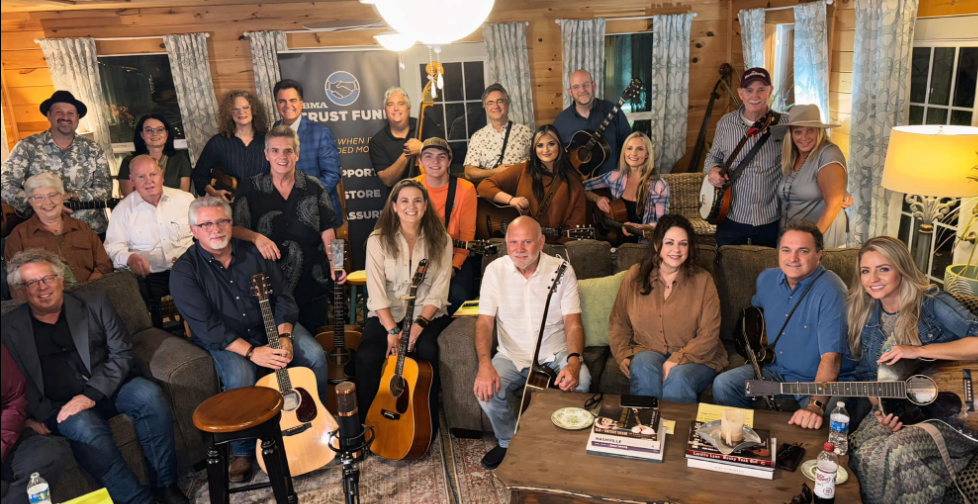
The IBMA Trust Fund Benefit took place at Rick Stanley and Donna Ulisse’s Wee Farm located outside of Nashville. In their small and crowded room, a full house of talented musicians convened with no setlist to work with, and yet these bluegrass artists stepped up in an impressive and historic way.
Along with Stanley and Ulisse, the performers who showed up on short notice included Becky Buller, Ronnie McCoury, Steve Thomas, Larry and Dreama Stephenson, Jaelee Roberts, Danny Roberts, Andrea Mullin Roberts, Rebecca Frazier, Mark Newton, Rebekah Speer, Stephen and Jana Mougin, IBMA Executive Director Ken White, IBMA Board Members Kristen Bearfield and Amy Beth Hale, Mickey Harris, and many more including the evening’s emcee Kyle Cantrell.
“We were at IBMA Week in Raleigh and my husband Rick said to me, ‘Donna, something is telling me that we need to leave here on Thursday.’ We already had our hotel booked for more nights and those rooms are not cheap, and when I said that we would lose all of that money, he said, ‘I just don’t think we should care about that, because we need to get out of here. Let’s follow my gut on this.’ Rick plans all of our trips and does all of the driving for the band, so he is always watching the Weather Channel, wanting to make sure we stay safe, and he had a feeling that this storm would be bad. I had a songwriting panel on that Thursday and I said, ‘Let me get through that and then we can get in our car and leave.’
“When we left Raleigh that day, our weather alarms soon went off about every ten minutes as we headed east and the map apps kept re-routing us. Eventually, the map app took us up through Wytheville, which added hours to our trip, and we saw a little bit of the damage as we drove through Virginia. It was one of the scariest trips that we have ever taken, as we couldn’t see through the solid sheets of rain and had to drive with our hazard lights on, following trucks on the highway at 30 miles an hour. It took us about 12 hours to get home.
“We still didn’t realize how bad the storm damage was, and then the next morning, I got up super early because I was worried about our friends everywhere, and I turned the TV on and what I saw was devastating. I was sitting on the floor in the middle of the room just crying. I called Doyle Lawson and I asked him if he got hit, and he said, ‘We got a little bit of damage, Donna, but nothing like Damascus (Virginia). I’m just so sad I can’t stand it.’ As I was sitting there I thought,’ I have to do something to help this situation.’
“As luck would have it, a few days later, I was supposed to check in and have dinner with Keith Barnacastle, who runs Turnberry Records, which is my label now, and when I got there, IBMA Executive Director Ken White was unexpectedly with Keith. So with Ken there, I said, ‘I think I want to so something to help with this storm, and I’m thinking about calling Jerry Salley and Larry Stephenson and with those two and me and Rick, we can broadcast something live on my Facebook page and see if people will donate.’ Ken said, ‘Well Donna, dream bigger.’
“It turned out to be one of those ‘God things’ as the next day, I was supposed to write songs with Jared Finck, who is also a videographer and would have the equipment needed to do a live stream, and Kyle Cantrell and his wife were supposed to have dinner with us that night as well, so he could be our emcee. Ken said, ‘Perfect. Let’s just do a show tomorrow evening then.’ So, we literally put together that IBMA Trust Fund Benefit in 24 hours.
“I just started calling all of my friends, and so many of them could make it and it was just a really fun time. There was a whole host of beautiful souls in that room. The songs that we were going to do weren’t even discussed, and no one wanted to do their latest single, which is what I loved about the evening the most. They weren’t there for any self-promotion, as it was all about those folks in those mountains that were getting hurt. Everybody sang those old songs, and in the room, it was easy to weep being around it all as everyone had so much real concern and love for the victims. It is amazing how many of our bluegrass brothers and sisters live within the path of that storm.
“After the stream was over, there was a lot of hugging in the room because I think most of the artists were moved just to be a part of it. And, though it was unplanned, it went better than anyone could have hoped for, although it also made me proud of the professionalism that exists in this amazing bluegrass community.”
The money raised that night all went to the right places. But, because the need is still great, look for another possible IBMA Trust Fund benefit concert to happen in January of 2025.
In the meantime, the folks at the IBMA want folks in need in the bluegrass world to swallow your pride and ask for help if you need help.
To watch this amazing benefit show, and to donate as well, please go to www.facebook.com/IBMATrustFund.