
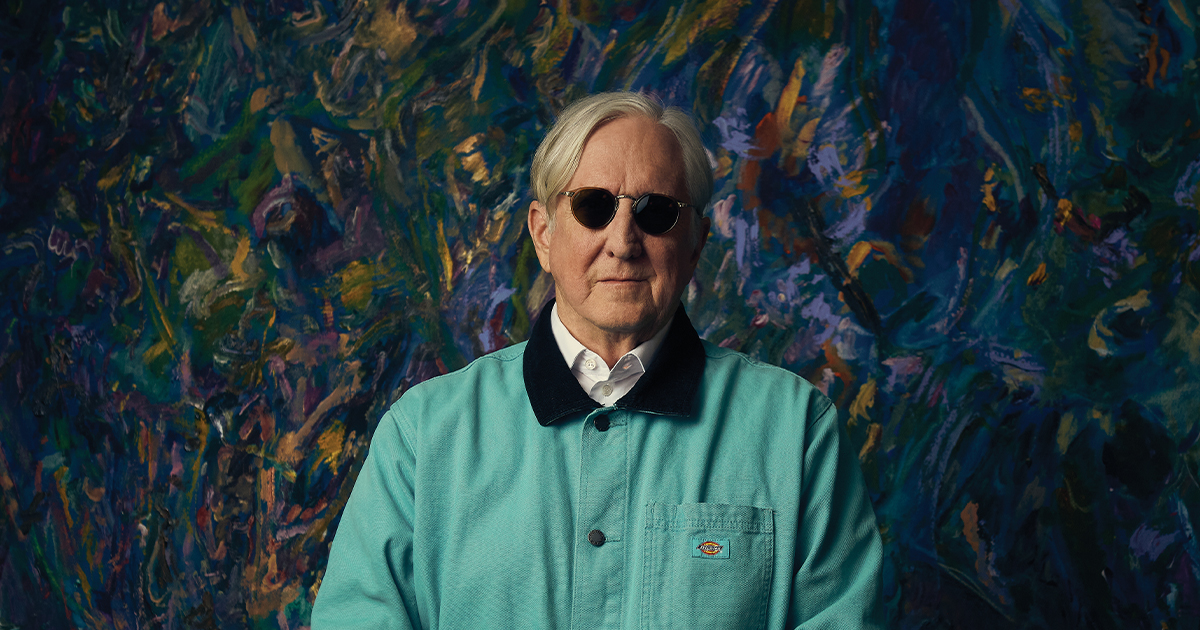
A Conversation with T Bone Burnett
The name T Bone Burnett may not be familiar to the general public, nor even to a sizable number of music fans, but he has had a remarkably influential presence in the country, blues, bluegrass, and rock music worlds for almost six decades. Born in 1948 in St. Louis, Missouri, and raised in Fort Worth, Texas, Burnett’s early ambition after graduating high school in 1965 was to write and produce songs following the styles of Burt Bacharach and Phil Spector, both innovative songwriters and record producers. He accomplished this goal and above and beyond: over the years, Burnett has written, recorded, and produced songs for both himself and those of an astounding roster of the stars and near-stars of American popular music, beginning in the 1960s and continuing into the 2020s.
Two years out of high school, in 1966, Burnett wrote and produced his first single and had a small success. During the 1970s, Burnett was a guitarist in Bob Dylan’s traveling band, The Rolling Thunder Revue, playing with musicians such as Bob Neuwirth, Steve Soles, and Dave Mansfield, among others. In this period, he also helped a number of young artists just starting out in the business by mentoring them and producing their records. He contributed original songs as well. In the 1980s, Burnett ventured out occasionally from behind the scenes and onto the stage to perform his own songs, and issued several albums, but his main work continued to be as writer, recorder, and producer of other musicians’ work.
In the 2000s, Burnett became involved in writing and producing scores for various theatrical and movie productions, notably the Grammy-winning soundtracks for a number of films, including O Brother Where Art Thou? (2000), Cold Mountain (2004), Walk the Line (2005) and Crazy Heart (2010), and the revival of Sam Shepard’s play Tooth of Crime (2008).
Beginning in 2006, T Bone began to tour consistently, playing his own songs, backed up by bands composed of the artists he had recorded and produced over the years. He has also released a half-dozen albums, recorded between 2006 and 2024. In April 2025, I had the pleasure of attending a concert given by T Bone at NYC’s Town Hall. The music consisted mainly of songs composed by T Bone himself, with T Bone interspersing the music with philosophical comments reflecting the wisdom he’s gained over the years. The show went on for two solid hours, and at seventy-seven years old, T Bone seemed to be just about getting his second wind.
T Bone Burnett has received multiple Grammys and Academy Awards, along with other critical awards, for his work in many venues. This short outline can only suggest the breadth of his life’s work. A complete assessment of Burnett’s musical accomplishments in television and film, as well as in his roles as songwriter, musical collaborator, and performer, belongs in a full biography of this artist. Throughout his many years of recording and producing music by other artists and making his own music, Burnett has consistently stayed close to his love for and belief in the “American music scene,” meaning the different musical styles and cultures which, for him, personify America’s “true democratic melting pot.”
The genesis of the following interview was my research for an article on the musician/artist Bob Neuwirth, who was a friend of Burnett’s for about fifty years. During our conversation, Burnett spoke enthusiastically about the current resurgence of American music as synthesized by a number of new, young, talented musicians with whom he has worked, and as a “prime example of music as a positive force.”
Conversation With T Bone Burnett October 2024
ELP: Do you find there is a big resurgence of American-styled music in the last few years?
TBB: Yeah! There is. It has been coming for a long time. For about twenty to thirty years, all the kids’ playlists were hip-hop. Now it’s all Zach Bryan and Tyler Childers, and Billy Strings. Hip-hop seems to have lost its energy in the last few years. One really brilliant artist after another is emerging in what I call the American music scene. There are extraordinary young artists like Billy Strings, Molly Tuttle, Sarah Jarosz, Sierra Hull, and Matthew “Charlie” Crockett. I think, if you want to know what’s good about the United States, listen to the music, because that’s where all different cultures, ethnicities, and nationalities have come and found harmony, and incorporated parts of each other’s cultures; it’s beautiful—it is the actual melting pot. And I think the more we can have that music as a gathering place, the better off we all are. It is also the place where we feel good about living in the United States, instead of feeling bad. There certainly is so much stuff going on, trying to make you feel bad about it: predatory capitalism, monopoly capitalism, and all that stuff… But this music is beautiful when the musicians are so good. Kids who have grown up with Doc Watson, Norman Blake, and all these extraordinary guitar players, Tony Rice. They’ve absorbed it by the time they are seven years old. Molly Tuttle is one of the best guitar players I’ve ever heard.
ELP: I just bought a CD of Sandy Bull. He doesn’t get much play these days.
TBB: He kind of retreated in the last thirty years of his life.
ELP: I was also thinking that no one seems to be playing the Blue Sky Boys.
TBB: Yes, but they have been absorbed and are part of this thing which is happening now. I love the Blue Sky Boys; Bill and Earl Bolick were fantastic. When we did the movie O Brother, Where Art Thou? people called it bluegrass music, but it wasn’t bluegrass music at all. Bluegrass music really started in 1965, in earnest. And the earliest you could place the first rumblings of bluegrass music was in the mid-1940s, when Earl Scruggs and Lester Flatt joined the Bill Monroe band [from December 1945 to 1948], and that was the first time that string-band line-up was set: mandolin, banjo, fiddle, string bass, and guitar. Before that, there were all sorts of different configurations, and it was never called “bluegrass.” It was formalized as bluegrass music by Ralph Rinzler in about 1965.
ELP: You mean he gave it a label?
TBB: Yes. There was a one-day festival in 1961, and it was called “The Blue Grass Festival.” It was two words. That was the first time it was used. Nothing happened afterwards until 1965, when there was a four-day bluegrass festival, and it was called “bluegrass.” That was the beginning of it, really. Bill Monroe’s band was called “The Blue Grass Boys,” and that was the inception of it.
ELP: I listened to Josh White records when I was growing up, and that was my introduction to folk music. Then, when I moved to Denver, Colorado, in 1978, after graduating from City College, one of my roommates was dating Jeanne Ritchie’s niece, Paula. So, I went to hear Jeanne Ritchie play a concert, and I also heard Doc Watson play a concert.
TBB: None of them would have called themselves “bluegrass.” Ralph Stanley wouldn’t call himself bluegrass, and neither would Patty Loveless. The Ritchie family and Doc Watson, and the Stanley Brothers, that was all “mountain music,” they called it; that was all Scots-Irish music. Appalachian music. As you know, the main two elements of American music are the Appalachian music and the Delta Blues music—music of the Mississippi Delta—and the hybrid of those two things. That’s what Bill Monroe hybridized, and that’s what Elvis Presley hybridized. It all grew out of that very fertile area between the two.
ELP: Did Rocket 88 come out of that?
TBB: Yeah, definitely. Which many people call the first rock n’roll song.
ELP: I have read that some people refer to Frankie Lane as an early rock n’ roller.
TBB: You can say that. That was the cowboy music, another part of the melting pot, as Hawaiian music or Native American music is. If you listen to the music of North Texas and Oklahoma, the Native American music sounds very much like bluegrass and very much like blues. (Sings a short example). And the Oklahoma Indian stomp-beat sounds are very much like the blues. Back then, everybody listened to everybody. There weren’t marketing categories that things were moved into.
At that time, I was triangulating between Fort Worth, Texas, New York City, and Los Angeles. I was going back and forth, meeting people and writing songs—trying to learn to write songs. About 1965, I graduated from R. L. Paschal High School in Fort Worth, Texas. I wanted to be Burt Bacharach. I never wanted to be a performer. I wanted to write songs for the movies and write songs for other people to sing. So, I would go up to New York, write something, and produce it; I wanted to be a record producer. I guess the two guiding lights for me when I was a kid were Bacharach and Phil Spector. And very quickly thereafter, George Martin. Those guys were the guys I aspired to be something like. I would produce the record and go out to Los Angeles or go up to New York and try to sell it to one of the companies. There weren’t any record companies down there that liked the kind of stuff I was doing.
ELP: Did they think it was too country?
TBB: No, down there, they would have considered it avant-garde. There was Duke-Peacockdown in Houston, and they mostly did rhythm n’ blues. There was some recording going on in Louisiana. There was Stan’s Record Shop, and he had a label and would put out stuff. There was a lot of rhythm n’ blues down there. Some country music, but by that time, most country music was coming out of Nashville.
ELP: Not Detroit at all?
TBB: No. And I wasn’t really interested in country music at that time, as it was being categorized and played on the radio and marketed in those days. I liked George Jones, but I was more interested in stuff from the twenties and thirties: Dock Boggs, another Appalachian musician. And The Stanley Brothers. Things like that…But also, The Beatles happened right then, and that was the only moment in my life where I was swept up by mass culture. I’ve always been interested in off-the-beaten-path stuff. The Beatles liked the same stuff I liked. They were part of the synthesis we were talking about a minute ago.
ELP: I saw The Beatles on Ed Sullivan, but I didn’t pay much attention to them until I heard their album, Rubber Soul.
TBB: That was a beautiful record. Rubber Soul (Released on December 3, 1965) and Revolver (Released on August 5, 1966) are my two favorite Beatles records. They were that beautiful synthesis of everything. Although looking back on it, before that, they made a beautiful rockabilly record: Everybody’s Trying to Be My Baby (1964). They loved Buddy Holly and Chuck Berry, like I did. We had the same taste, I think. Right now, I’m just beginning to mix a country/rockabilly/American music record with Ringo. I’ve written and produced it like I’ve always wanted to do… You know, The Beatles were the first rock n’ roll band. Before them, it was all front men with side men. And The Beatles were four front men.
ELP: You mean like Jerry Lee Lewis or Carl Perkins?
TBB: Or Elvis Presley and the Bill Black Combo. Buddy Holly and the Crickets. But there wasn’t a big rock n’ roll band before The Beatles.
ELP: I’ve never heard anyone point that out.
TBB: I don’t think people think about that very much. Every one of those guys wrote beautiful songs. They could sing great and play great.
ELP: Is that true for Chuck Berry?
TBB: What do you mean?
ELP: I mean, he could write and play, but he didn’t particularly have a band.
TBB: He had Johnnie Johnson playing piano for a while, but Chuck Berry was the front man. But he did go up to Chicago, and record with Willie Dixon and those cats.
ELP: I was wondering where you were in your career when you met Bob Neuwirth?
TBB: It was the year Janis Joplin died [Oct. 4, 1970]. I got a call from Albert Grossman, telling me The Full Tilt Boogie Band wanted to keep going after she died, and they needed a front man. He asked me if I would come up and meet the guys and see if I wanted to join the band as the new singer. I thought, “Those are way too big shoes for me to fill.” So, I didn’t do that. But, while I was there, my friend Stephen Bruton was staying in Bill Keith’s house in Woodstock. I was staying with him. The first night I got into town, there was a session in his living room; there were guitars, mandolins, and banjos sitting around, because Stephen was a great guitarist and a great banjo player as well. There were about five or six people there. The ones I can remember who were there were Stephen Bruton, Amos Garrett, Bobby Charles, Rick Danko, a couple of women, and Bobby Neuwirth.
We sat up all night long, playing music, and got incredibly drunk. Both Neuwirth and I fell asleep in the guest room, which had twin beds with a table between them. When I woke up, there was a half-drunk-half-full bottle of Tequila on the table between us. I looked up, and looking right through the bottle, I saw somebody was sleeping over there. Then Neuwirth looked up, and we saw each other right through the bottle. He picked up the bottle and took a frightening swig of it, and then he handed the bottle to me, and I had a sip of it because I was already feeling rocky anyway. And he said, “I didn’t see any bubbles.” And I thought, “This is a man after my own heart!” That evening and the next morning, we became fast friends. He was one of my most cherished relationships for however many years it was. Fifty years, almost.
ELP: As you got to know him, how and where did you encounter his painting?
TBB: We were so deep into the music for most of our lives, so I never knew that much about his painting until much later. I knew he was an artist. . . I really became familiar with his work, maybe ten, twenty years ago. A friend of ours had an empty loft over by the West Side Highway, around Thirteenth or Fourteenth Street. Bob went in there with a bunch of canvases, nailed them up to the wall, and started making paintings. I would go up there and see them hanging on the walls; they were beautiful paintings. I got taken by them and my wife, and I eventually bought a few. I’ve got them all around the house now, and so I continue to live with Bobby…
ELP: I think Bob must have been in and out of New York during 1959-60, and saw lots of different works and styles.
TBB: I think so. When we met, he had a much deeper experience of all of that—the Happenings, the Cambridge folk scene, the New York folk scene, all the music that was happening around Washington Square Park than anybody I knew. When I went down to Washington Square Park, in the sixties sometime, 1968 or so, it was a cacophony of all these different cultures and music. It was a really interesting place with a lot of perversity, which is the word people use today…That was also when concept art was beginning to rear its head. I thought of it as “con art.” The art I liked the most was by Cezanne. I also like Chagall and Matisse a lot; Rembrandt and Monet too…You know, that work reminded me of the Carter family. The music I loved. It had the same sort of feeling about it. And I think Neuwirth and I shared that sort of aesthetic.
ELP: Did Bob talk about particular painters he liked?
TBB: No, never. We never talked about that at all. We never talked about painting. We talked about art as a pursuit. Living the artist’s life. Being true. Not surrendering to the sirens of celebrity and mass culture success. Bob wouldn’t sign a contract. He wrote, “Oh Lord, won’t you buy me a Mercedes Benz?” on the back of an envelope in a bar, with Janis Joplin, but he wouldn’t sign a contract for it for a long time. Bob was hardcore; he was very true to his belief system.
ELP: Do you think that limited him in terms of a “career?”
TBB: See, the belief we shared was that artists don’t have a “career.” Careers are for lawyers and doctors and politicians, where there’s a ladder that you can climb. But in art, it’s either good or it’s not. And if it was good, I respected it, Bob respected it. And if it wasn’t good, it got nothing but scorn from us back in those days. I personally have since mellowed quite a bit. I try to be more gracious about things.
ELP: Talking about Bob’s critical career attitude, he did not exhibit with anyone. His music seemed to be his main thing.
TBB: I thought of him mainly as a songwriter. That seemed to be the core of his identity in the years I knew him. Much like his art, we would be sitting around, and he would start playing something, and he would sing some incredible song about Madonna’s bikini wax or something. It would be like a seven-minute-long song that he would just ad-lib.
And you would say, “Have you recorded that?” and he would say, “No. I just played it.” And he would never play it again. Or remember it. The whole thing would just be off-the-cuff. He had the ability to go right off the top of his head and keep going… And, he didn’t seem to worry about where it would end up. Now that Bob is gone, I don’t want his work to evaporate. That’s one of the reasons my wife and I bought his work, because it’s good, because he’s good.
ELP: You would think the overlap of artists and musicians would pique people’s interest, rather than in a hardcore drive to make a career.
TBB: That’s right. You know, I’ve never admitted to having a career. People will say to me, “You’ve had a really interesting career.” And I always respond with something like, “I don’t view what I’ve done as a career, but rather taking care of things right under my nose.”
ELP: I write poetry, and I’ve had people tell me, “Poetry doesn’t make money.” And I just think, “That’s good.”
TBB: Right. That’s not the point. You know, to judge music by the chart position and the amount of money it made is a crazy way to even think about music.
Excellent interview. Comprehensive and covering a broad swath of T Bone’s career. Delves into his background along with his current activities. Enjoyed the anecdotes of how Albert Grossman recruited him to replace Janis Joplin after her overdose, along with his lengthy relationship with Bob Neuwirth