Larry Rice and His 1959 F-5 Gibson Mandolin
This article provides an insight into Larry Prentis Rice and his mandolin, and contains anecdotal recollections about him from friends, family, and bandmates. As the oldest of the four Rice Brothers, and born into a musical family, Larry Rice wrote, played, recorded and produced memorable music. Born on April, 24, 1949 in Danville, Virginia, he passed away on May 13, 2006, at age 57, from complications due to mesothelioma, having worked at industrial power generating facilities. Rice recorded numerous originals songs, and those he learned as a child, adolescent, teen and adult. Themes of Larry’s originals songs were about current events, environmental catastrophes, vices and relationships.
Mike Boulware of Gainesville, Florida was instrumental in making arrangements to secure Larry’s F-5 mandolin, and to re-connect with old friends. Rice’s mandolin now resides in the Bluegrass Music Hall of Fame & Museum in Owensboro, Kentucky thanks to the efforts of Rice family members and friends.Carly Smith, curator from the Museum informs us, “We are truly honored to have Larry Rice’s mandolin on display at the Hall of Fame. It’s a beautiful instrument with an intricate inlay along the fretboard. We hope that bluegrass fans will make the journey to see all of the exhibits at the museum, including this mandolin which will be one of the first artifacts to greet visitors as they begin their tour.”
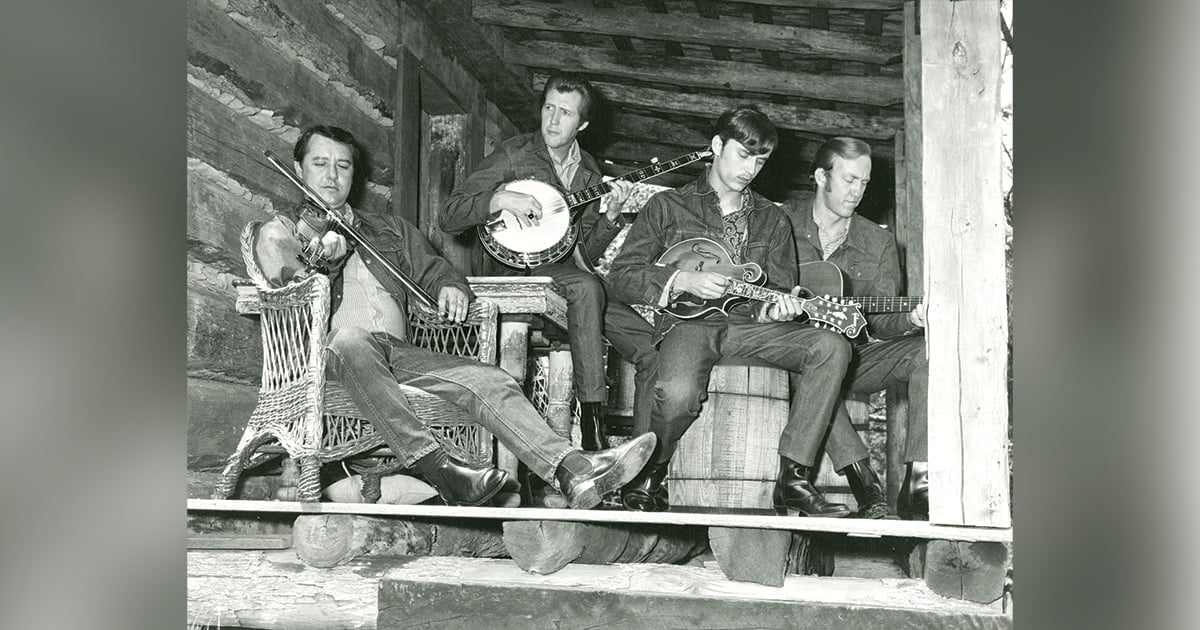
Rice had played in many top tier groups including but not limited to The Haphazards, The Golden State Boys, Aunt Dinah’s Quilting Party, The Kentucky Mountain Boys, J.D. Crowe and The New South, Dickey Betts and the Great American Music Show, The Tony Rice Unit, The Rice Brothers, Mark Johnson and Clawgrass, Rice, Rice, Hillman & Pederson, and various configurations of the Larry Rice Band. He enjoyed mentoring other players and gladly opened his case to play with beginners and professionals alike.
History of the Mandolin
Rice did a lot of work on his mandolin, which evolved into having a sound all its own, much of which was due to the modifications he and others carefully made. To the best of peoples’ knowledge, it was the only mandolin with which Larry recorded and played. The mandolin has traveled from California, to Kentucky, to Florida, to Washington, D.C., to Japan, Europe and back, and across the United States. It’s been played and recorded in Hollywood studios, Larry’s music room, numerous festival performances, jams across the country, studios, Rebel Records and at two benefit concerts in Tallahassee, Florida. (See discography at end of this article.)
Modifications To the Mandolin
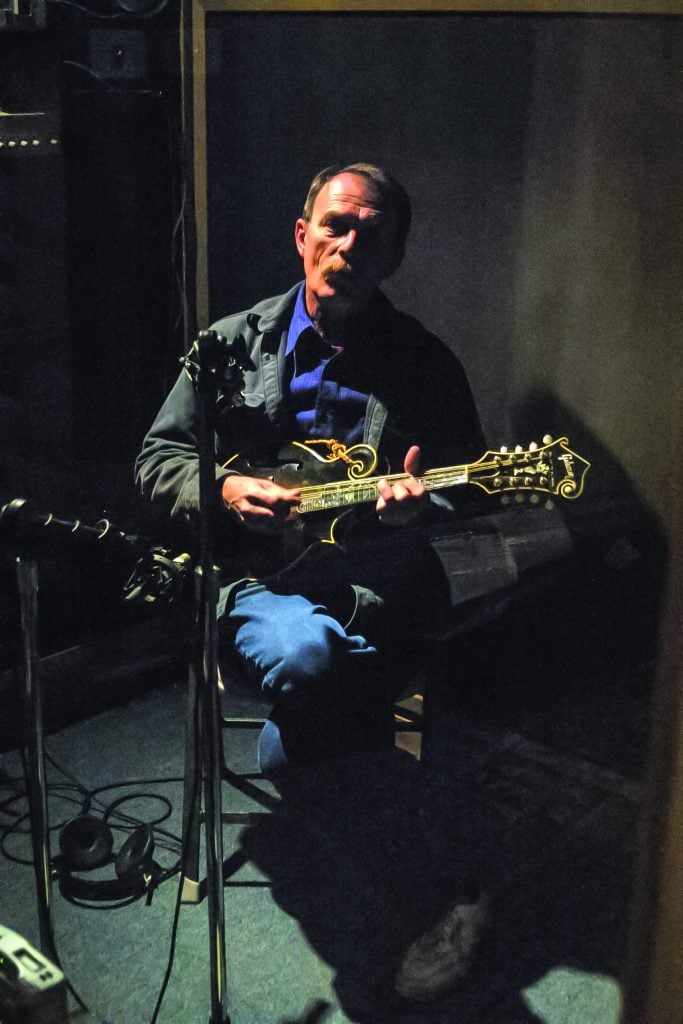
Larry believed that he could make his mandolin sound and look better by making modifications to it, as maintenance of its originality was never in his thoughts. Doyle Lawson quips, “Back then we weren’t so concerned about serial numbers; just a good mandolin.”
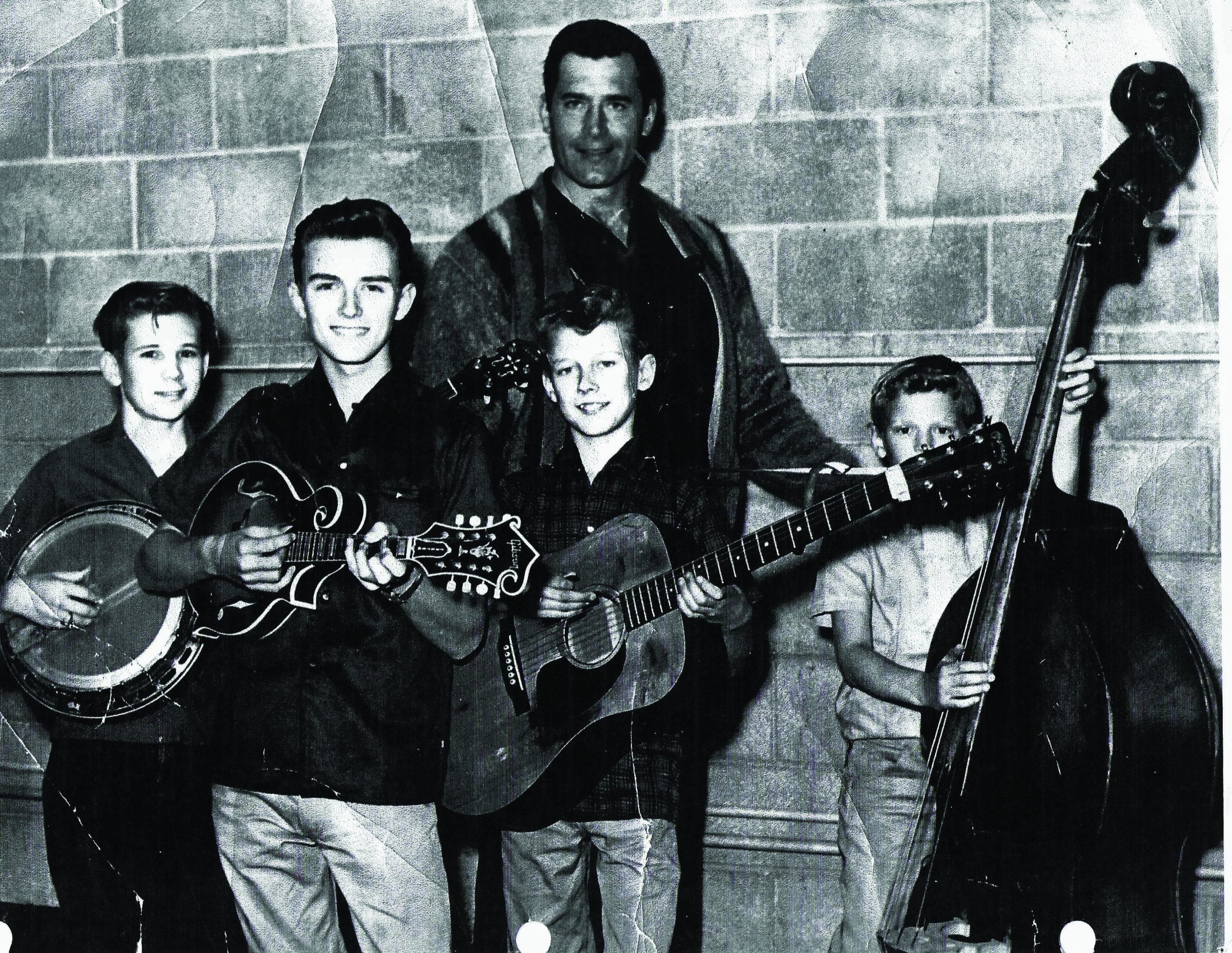
Ron Rice, Larry’s brother, knows well the history of his brother’s mandolin. “It was in 1961, that Dad purchased two 1959 Gibson F-5 mandolins (burst finish) from McCabe’s Music Store in Santa Monica, California, and gifted one to Larry, who was an early teen at the time. Larry played that mandolin in the Golden State Boys.”
Original condition—standard Gibson F-5 mandolin-burst finish.
First Modification—When playing Aunt Dinah’s Quilting Party, Larry removed the burst finish and changed it to a natural wood finish.
Second Modification—While in California he decided to have famed luthier R.L. Givens design and create a vine of life inlay on the fingerboard. Givens is a highly regarded luthier and craftsman who had done stints in Nashville and Idaho and parts in between. The inlay work is nothing short of the highest level of luthier artistry.
Third Modification—Larry also worked on the neck of the instrument by taking a pocket knife and sand paper to improve the feel of the neck. He put a Dr. Larry “P” (P for Prentis) Rice” label sticker on the peghead.
Fourth Modification—The mandolin went from a natural wood finish to a stained or darkened wood finish. Ron Rice jokes that, “He may have used shoe polish.”
Fifth Modification—Brother Wyatt Rice recalls “From as far as I can remember growing up, his mandolin had a dark finish on it. I always thought it looked cool. One day he called me up. I was still in Crystal River at the time. He knew I had been working on my own guitars and stuff and had done some repair work on Tony’s Herringbone. He had asked me if I could refinish the top, and sunburst it. I told him yeah, and I would order the correct lacquer to do it. Well, he couldn’t wait. I told him I just had clear lacquer. Next thing I knew he pulled up in the driveway with the mandolin, and had been to Publix, and bought food coloring. We took off the old finish, and Larry put on the food coloring the way he wanted it to look, then I sprayed it with clear lacquer. It actually turned out really good, and that’s the finish it still has on it today. He really liked the way it turned out. Larry’s mandolin has its own sound for sure. For the most part, it was his right hand that made it sound the way it does when he played it.We made many recordings in his music room. Larry always made it sound good no matter what microphone he used; you could always tell it was him.”
Sixth Modification—Mark Johnson recalls, “Larry would invite me over on weekends to play mandolin/clawhammer banjo tunes together. One day back then, he mentioned that he needed a strap for his mandolin and as a “thank you” to him, I made one out of leather boot laces that stayed with that mandolin to this day. I also gave him the rattlesnake rattle to place in his mandolin …to “keep the cigarette ashes loose and stirred up.”
Remembrances
Mickey Abraham, “Larry’s contributions to the bluegrass canon are significant and long lasting.”
Scott Anderson, “Iremember the first time that I met Larry. I believe it was Shannon Slaughter who called me and told me Larry was having a jam at his house and wanted to invite me. I got there early, as every good banjo player should, and I got to talk to Larry just a little bit before everyone else arrived. I was intimidated a little bit and in awe as I’m getting to meet this guy who I had listened to on records for so long. And it turned out he was just a nice guy.
“After a little while everyone showed up, we started playing a few tunes and the sheer power of Larry’s voice and of his mandolin playing really floored me. I was playing banjo and he had no problem at all being heard above me and the other seven or so musicians were there while he was playing or singing. His voice was so clear and strong it just cut through everything. In the afternoon after Larry’s funeral, I went over to Mark Johnson‘s house several of our other picking friends. Larry’s instruments were there at Mark’s house and I got to play Larry’s mandolin for about three hours that day. I could not then, and never will, come close to matching the powerful sounds that Larry brought out of that box, but I was very honored to get to remember him in that way on that day. That memory is something I will always cherish.”
Mike Boulware, “The great Don Everly once said something like ‘it’s like cars, either you grow up in a Ford household, or a Chevy household’…same with instruments, either you grew up in a Martin house, or a Gibson house.” Fortunately for all of us mandolin players, with few exceptions, are always in a Gibson house. The Rice family was one such. I first heard Larry playing many years ago, in the early years of what I call the Folk Scare, when people were returning to the roots of popular music, including bluegrass. The Rice family has produced some of the finest players ever.When I first saw the mandolin again, the very recognizable vine inlay on the fingerboard and Larry’s strap brought back all the times I’d heard him play.
“Many don’t know that Larry Rice was the mandolin player on Richard Betts’ 1974 tour supporting the album Highway Call. The backstage pass for their show at the Opry is still prominent on the case, as well as a bumper sticker from the Bottom Dollar Boys (Larry’s Tallahassee band).
“Inside the case, the picks, and Black Diamond strings, made it very personal, a glimpse into a life now over. I believe that instruments retain some of the “mojo” that the previous owner has lovingly applied through years of playing. There is some evidence via the world of physics to support that. So, how does an instrument become iconic? It gets played by an iconic player! In Mr. Monroe’s case, he played a few different Gibson models early on, until he finally got the Loar F-5 that defined his tone. When a particular tone/sound becomes the definition of that genre, you’re iconic, baby.”
Cindy Baucom, “I have enjoyed featuring Larry Rice cuts on the radio since the early 1980’s. He was incredibly talented as a musician, singer and songwriter. It was an honor to get to introduce him on stage at MerleFest when Rice, Rice, Hillman & Pedersen played there together. An even bigger honor came when he joined me for an interview for “Knee-Deep In Bluegrass.” His uncle, Dobroist Frank Poindexter, later told me it was the last interview Larry ever did.”
Terry Baucom, “I spent a lot of time with Larry when he invited me to join a west coast tour with The Larry Rice Band. We were a tight band and the crowds went wild and Larry sold a lot of albums! It was so fun. Sometimes we would get so tickled on stage about little things, that we’d nearly have to stop playing. I really don’t know a lot about his mandolin…other than, in his hands, it was a monster! That was an awesome time, and he was a really great dude.”
Pamela Davis, (Larry’s daughter) “I remember when I was young my Dad went into his cherished music room, and he practiced day and night, and he wrote in private. He would work all day and often practice at night. We respected his wishes for privacy. He played so fast I thought he would bust a string. There was a section worn off on the mandolin and he left it that way. Dad used to make funny commercials with his mandolin. He used to lovingly pick on me, especially my eyebrows. He would tune his mandolin by ear. I used to go into the music room, just to listen to Uncle Ronnie, and Wyatt and Frank and Keith Tew. It was so nice for people to come over and play with my Dad. I loved that. Dad had great wisdom. He taught me so much. I would have never picked out another Dad.”
Denny Gies, “I have listened to and admired Larry’s music for years. I got to see and hear his mandolin as it was on its way to Owensboro. It certainly does have Larry’s mojo; it is one powerful instrument.”
Michael Godwin, “The Rice family’s music has touched my soul and influenced my personal musical journey. Their rich tone production is second to none in the acoustic world. They perform with cutting edge technical ability while embracing contemporary and provocative harmony. Musical spirit and sound raises the hair on my neck and has often caused me to weep. Larry’s unique and insightful approach to songwriting is both lyrically brilliant and musically solid. Their music is transcendent and will forever be the fabric of my musical soul and motivation.”
Mark Johnson, “I first met Larry back in 1981 in Crystal River, Florida. We worked together at the Florida Power Energy Complex. He was a welder on the travel crew and I worked in the Health Physics Dept (Radiation Safety). We would work long hours together along with Larry’s brother Ron Rice and their father, Herb Rice, both pipefitters.
“The world lost Larry Rice to eternity back in May of 2006. After the funeral, Larry’s loving and loyal wife Linda asked me to keep his mandolin at my home in Dunnellon, Florida, for safekeeping. And that was where Larry’s mandolin remained, in my home, for the next ten years. Whenever my close friend Emory Lester would be in town for one of our tours or music festivals, I would pull it out and let him play it just to try and keep the instrument loose and musical. Emory was so honored to do so. Emory said it was the player that made the mandolin special. Larry could get the best sound out of that instrument that was unique to him and his music. Larry Rice was loyal to that one instrument his whole career and it was loyal to him. Larry was also loyal to his friends too. Every so often, I would take it out of storage to just hold that mandolin and reminisce about Larry and the powerful impact he had on the American Bluegrass/Newgrass genre and to also relive all the good times we had together and to thank him. I miss my ole’ friend.”
Clay Jones, “Larry was the first person I ever worked with professionally. He was the best artist I’ve ever worked for! He and all the Rice family have always been like family to me. On our first tour we went to California to play Grass Valley festival. When we weren’t playing or doing workshops, we went to Reno and played roulette. We had the best of times together. For an 18-year-old kid, he always treated me like an equal and was always more than kind.”
Lee Kotick,“I first met Larry in the late 80’s, having been invited by Mark Johnson to a jam in Larry’s music room in Crystal River, Florida. I had been taking guitar lessons from Wyatt. Thereafter we became friends and played many gigs together. Larry would often guest on the Tallahassee Bottom Dollar Boys television show. One notable gig was the National Square Dance championship in Daytona Beach. When we played at the Tillman’s Pickers Paradise Park in South Georgia, Larry appeared frail and ill. I shared Larry’s medical records with a neighbor who was an oncologist. He saw Larry the following Monday and confirmed the diagnosis of mesothelioma.
“With many musicians and friends, we produced the Larry Rice benefit concert (Legends and Locals For Larry) in Tallahassee at The Moon and raised funds to assist with his medical procedures and bills. Larry was a very brave man through his bout with cancer. His medical team enjoyed working with him and provided tomotherapy to shrink his tumors. While bass fishing one evening, I recall Larry telling me, ‘I’m not afraid to die. I just want my family to be alright.’ Those are words that are forever etched in my memory, like his metronomic mandolin chop.” Larry died in the arms of family members in Crystal River, Florida.
Doyle Lawson provided insight into the early years of these two second generation bluegrass stars. “In 1968, Larry came from California, and I didn’t know who he was. I went back to guitar, and Larry stayed with mandolin and his approach was different; he had his own style. We were all influenced by different people. He was a good guy, fun to be around, quiet, and he was solid. We had a great vocal inverted harmony blend, since we were all about the best overall sound. We were also versatile in harmony types.
“We rehearsed daily and Larry brought some west coast music to rehearsals. We didn’t want to be a cover band, as the pioneers were still performing. Larry was a tremendous asset to gather new material to set us apart. We cared about the songs.Larry’s mandolin was a cannon, and sometimes I would play it. I knew how good it sounded. It was exceptionally loud and had good tone. Larry is an unsung hero; he had a lot of input into the Kentucky Mountain Boys sound and material. I used to call him “Jose,” but I don’t know why. We did several reunion shows and it was like we never stopped picking together.”
Frank Poindexter,“First and foremost, I miss Larry being in my life and how much he meant to me. I became his uncle at two months old! My birth date was two months earlier in February 1949 and Larry born in April. Regardless of where we were geographically, we were always close by. From our earlier teenage days down in Florida playing gigs all the way to reaching our 57th birthday in 2006.
“I treasure every note and every chord I’ve enjoyed from that 1959 Gibson F-5. The many travels we shared from Asia to Europe, the many recording projects from Hurricanes & Daydreams to Clouds over Carolina and the Rice Brother records and show dates, will go down as my favorite and most treasurable life’s memories for me.”
Linda Hill Rice, (Larry’s wife)“I’m so happy that Larry’s mandolin is going to the Museum. Larry would have been so proud.”
Louise Rice (9/2012), “Larry loved his bluegrass music and never gave up on it. He had a good life, but he got sick and I miss him very much.
Ron Rice, “I think of and miss my brothers every single day, for Larry and Tony left us way too soon. We were all just kids in southern California playing music together and having a lot of fun doing so. We played gigs at Disneyland, Knott’s Berry Farm and a lot of folk music gigs such as The Ice House, The Troubadour and The Ash Grove where many famous bluegrass groups played including The Dillards, The Stonemans, The Country Boys and many others.
“To the best of my knowledge, in 1968 Red Allen left the Kentucky Mountain Boys. Doyle Lawson went from playing mandolin to guitar because Larry could only play mandolin, and Doyle could play both guitar and mandolin. I remember when Larry returned from a tour in Japan, around 1976, and had brought back a Pentax 35mm camera. All four Rice brothers have been avid photographers, and Larry was an inspiration. One of Larry’s favorite pastimes after a gig in southern California was to play ski ball at a nearby amusement park. Tony and I went on rides, but Larry was immersed in ski ball and has was quite good at it.”
Tony Rice (9/2012), “Larry was always my hero and he got to hang out with Clarence White, Chris Hillman and Herb Pederson. I envied that.”
Sammy Shelor, “Igrew up under the tutelage of the Rice family. At age twenty two, Larry saw something in me and my banjo playing, and he gave me an opportunity to record with my heroes, Tony, Wyatt, and Larry. I was a nervous young man set among his heroes, but after that it was easy. I remember when we recorded ‘I Cried Again,’ and I played banjo on most of his projects. I have so much regard for Larry, particularly his creativity. His songwriting had a certain flair that was hard to define. He was quiet, reserved, and his personality came out in his mandolin playing and song writing. We got to travel a lot of places in the U.S. and in Japan and Europe.”
Benjamin Srock, “If I had to sum it up, I would say the purity of the sound combined with lyrics of everyday people.”