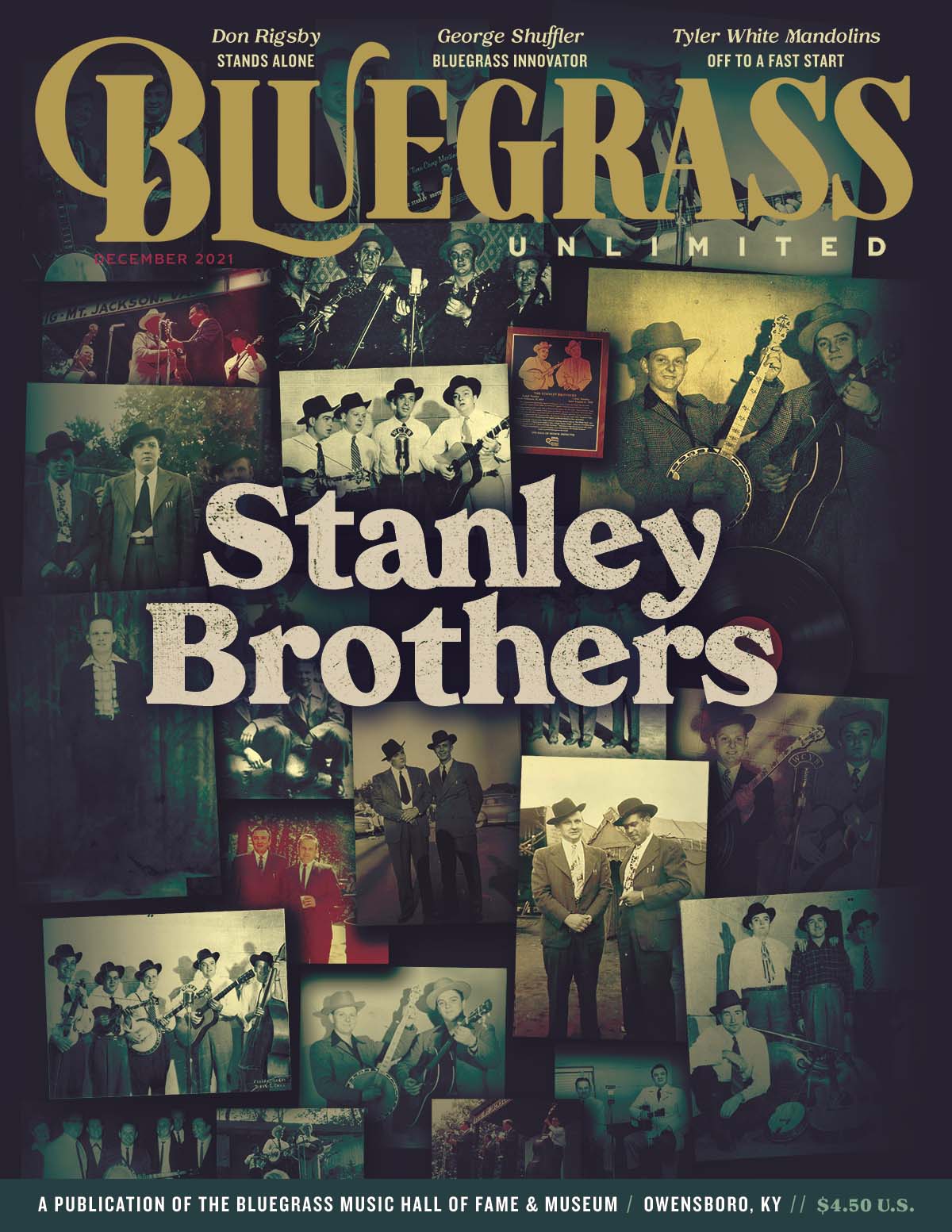
75 Years & Counting
The year 2020 was proclaimed by many as the 75th anniversary of the birth of bluegrass, a time that celebrated when the stars aligned in 1945 to provide Bill Monroe with an all-star cast of pickers and singers in his Blue Grass Boys band. At the top of the list were smooth Tennessee-born vocalist and rhythm guitarist Lester Flatt and a dazzling North Carolina banjo picker by the name of Earl Scruggs. Also in the mix were Florida swing fiddler Chubby Wise and bass players Howard Watts and Birch Monroe (Bill’s brother). It was this grouping of Bill Monroe’s outfit that was most-often emulated in the 1940s and ‘50s when up-and-coming bands wanted to adopt what became known as the bluegrass sound.
Bluegrass historian Neil Rosenberg observed that until another band copied Monroe’s performance style, it was purely one man, one band, performing his/its unique style of music. It wasn’t until another group, the Stanley Brothers, began emulating Monroe’s music that it moved from being one man’s style to a genre of music. For years, the first direct evidence of that copying was the 1948 release of a Stanley Brothers disc on the Rich-R-Tone label. One side of the 78-rpm record featured one of the group’s members, Pee Wee Lambert, playing the mandolin and singing lead on a song Monroe had been featuring on the Grand Old Opry, “Molly and Tenbrooks.” A defining feature of the performance showcased Ralph Stanley playing three-finger style banjo, on record, for the first time.
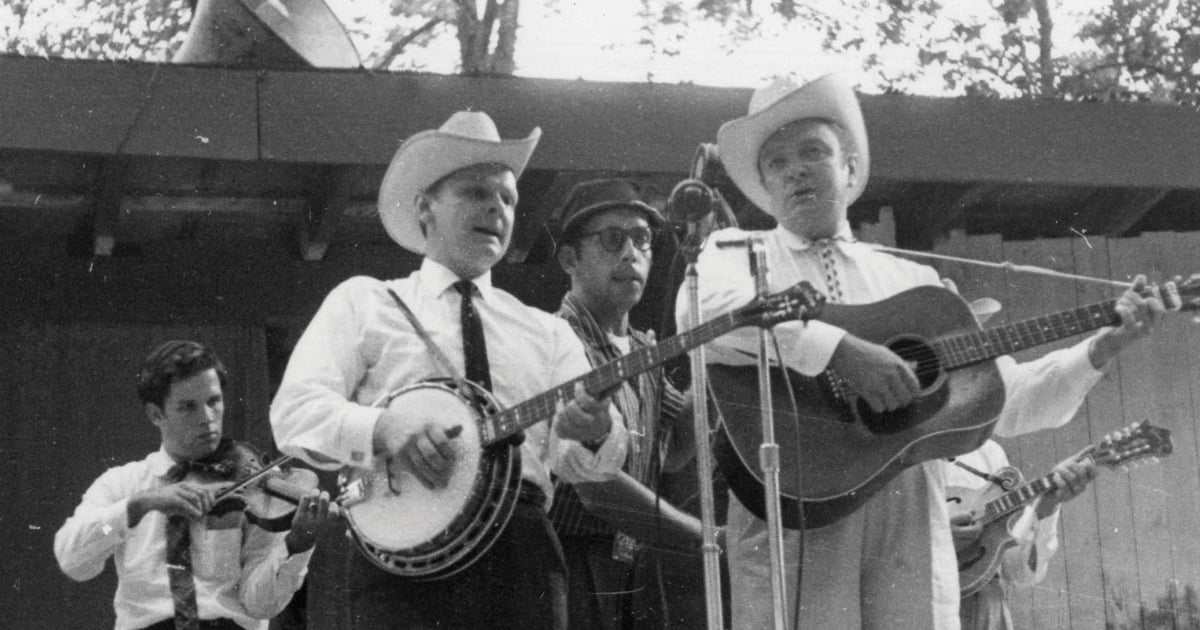
Although Monroe and his band started it all, the Stanley Brothers helped cement the foundations of early bluegrass. Carter Stanley was a gifted songwriter who added scores of songs to the bluegrass repertoire. He was also a soulful singer and a consummate master of ceremonies. Ralph Stanley developed into one of the most instantly-recognizable voices in country music as well as a unique stylist on the banjo. Together, Carter and Ralph Stanley fronted one of the few groups that survived the music’s incubation period (which included the near decimating effects of rock ‘n’ roll). Today, the Stanley Brothers are revered as part of the bluegrass founding trinity that also includes Bill Monroe and the duo of Flatt & Scruggs.
The Stanley Brothers enjoyed a twenty-year career, from 1946 to 1966. Following Carter Stanley’s untimely passing in December 1966, Ralph Stanley forged ahead with a successful fifty-year solo career. Upon Ralph Stanley’s passing at age 89 in 2016, the baton was passed to Ralph Stanley II, who continues to lead the Clinch Mountain Boys to the present day.
In The Beginning
The genesis of Stanley music dates back to 1946 when Carter Stanley led the way into the world of music as a profession. Shortly after the close of World War II, he found employment with Roy Sykes and the Blue Ridge Mountain Boys. The group was headquartered out of Norton, Virginia, and appeared there daily on radio station WNVA, a tiny 250-watt station. Carter noted of his time with Sykes that he was “doing ok, getting along fine, had no trouble at all.” This was about to change. Ralph Stanley was discharged from military service on October 16, 1946. He was met by his father, Lee Stanley, at the bus station in St. Paul, Virginia. Still in uniform, he was taken by Lee to WNVA where he sang with Carter during Roy Sykes’ afternoon radio program. He performed on a personal appearance with the group later that evening. Most likely at Carter’s urging, Ralph was soon a member of the Blue Ridge Mountain Boys. Sykes said later that he was holding a spot for the younger Stanley.
Ralph’s enthusiasm for the Blue Ridge Mountain Boys was short-lived. Part of his disenchantment stemmed, no doubt, from the fact that Sykes would, at times, switch from fiddle to banjo and, when doing so, would grab Ralph’s banjo, leaving him empty-handed. After about three weeks of this, Ralph had had enough and presented Carter with two options: one, they could break away and form their own group, or two, Carter could continue to play with Sykes and Ralph would make use of the money available from the G. I. Bill and train to become a veterinarian.
Sykes was not pleased with Carter and Ralph’s decision to go it on their own, especially in light of the fact that they took the group’s mandolin player, Pee Wee Lambert, with them. Overnight, the ranks of the Blue Ridge Mountain Boys were gone. Sykes’ words to the Stanleys were, “You do, and you’re through.” Carter took it as a challenge, to “see if that was right or not. I figured I might as well learn it then as later ‘cause we did want to work for ourselves.”
Carter had been using Roy Sykes’ guitar up until this point but now that was clearly not an option. He remedied the situation by purchasing a Gibson Banner J45 guitar. [With the inscription of “Only a Gibson is good enough,” the line of Banner guitars was manufactured during World War II by a workforce that – contrary to company propaganda at the time and for many years later – consisted entirely of women.] To add insult to injury, the boys got a program on the same station in Norton that Sykes appeared on. An item from The Bill Boyd Ranch House News told that “Carter Stanley and His Clinch Mountain Boys’ two most popular songs are “Mother’s Only Sleeping” and “Are You Waiting Just For Me?” on WNVA, Norton (Va.), 9:30 a.m.”
This all took place in the early part of November 1946. Although Carter and Ralph’s stay as a team in Norton was rather brief and not all that profitable (they only worked one or two dates as the Stanley Brothers), the last two months of 1946 were somewhat of a whirlwind in terms of their professional and personal development. For starters, they went from being sidemen to bandleaders. Their first duties included securing a radio show of their own, fleshing out the band with additional sidemen, obtaining dependable transportation, and getting a new guitar for Carter. New personnel, in addition to Pee Wee Lambert, came in the form of a fiddle player from Vicco, Kentucky, by the name of Bobby Sumner. And then to top it all, Carter Stanley married Mary Magdalene Kiser on November 15, 1946.
The hits kept coming. On December 4, Carter and Ralph sent an application to the Library of Congress to copyright their first song, “Mother No Longer Awaits Me at Home.” Although the song was registered in both of their names, it’s likely that the lion’s share of the work was Carter’s. The somber lament of an errant son’s return to home, only to find that the aged mother he had neglected had died, was typical of many of the songs he would come to write. The theme of parental loss would appear in many of Carter’s songs.
“But now they’re both gone . . .”
Carter and Ralph’s parents separated in 1942 and Lee Stanley was largely absent from his sons’ lives for the next several years. Family members say that Carter never got over the trauma of his father’s departure from the family during his teen years. While both boys were affected in different ways, the loss resonated more with Carter; he idolized his father while Ralph was known to be more of a Mama’s boy. So, who was the object of his “dead parents” songs? Perhaps Carter was honoring the tradition of “mother songs” in country music. Perhaps he channeled the grief of his father’s abandonment through the time-honored theme of maternal loss.
Whatever feelings Carter may have had about Lee’s disappearance earlier, the elder Stanley seemed to be very much back in his sons’ lives after the War. He had gone from the impatient father who stamped his foot when his young boys’ attempts at learning music had distracted or irritated him, to being the one who showed up at concerts where Carter had been performing with Roy Sykes. He even facilitated the reunion of his sons when Ralph returned from service. And now that Carter and Ralph had struck out on their own, Lee was about to use his negotiating skills —no doubt acquired from his many years in the logging business — to advance his sons’ careers by moving them to a larger market: Bristol, Virginia/Tennessee.
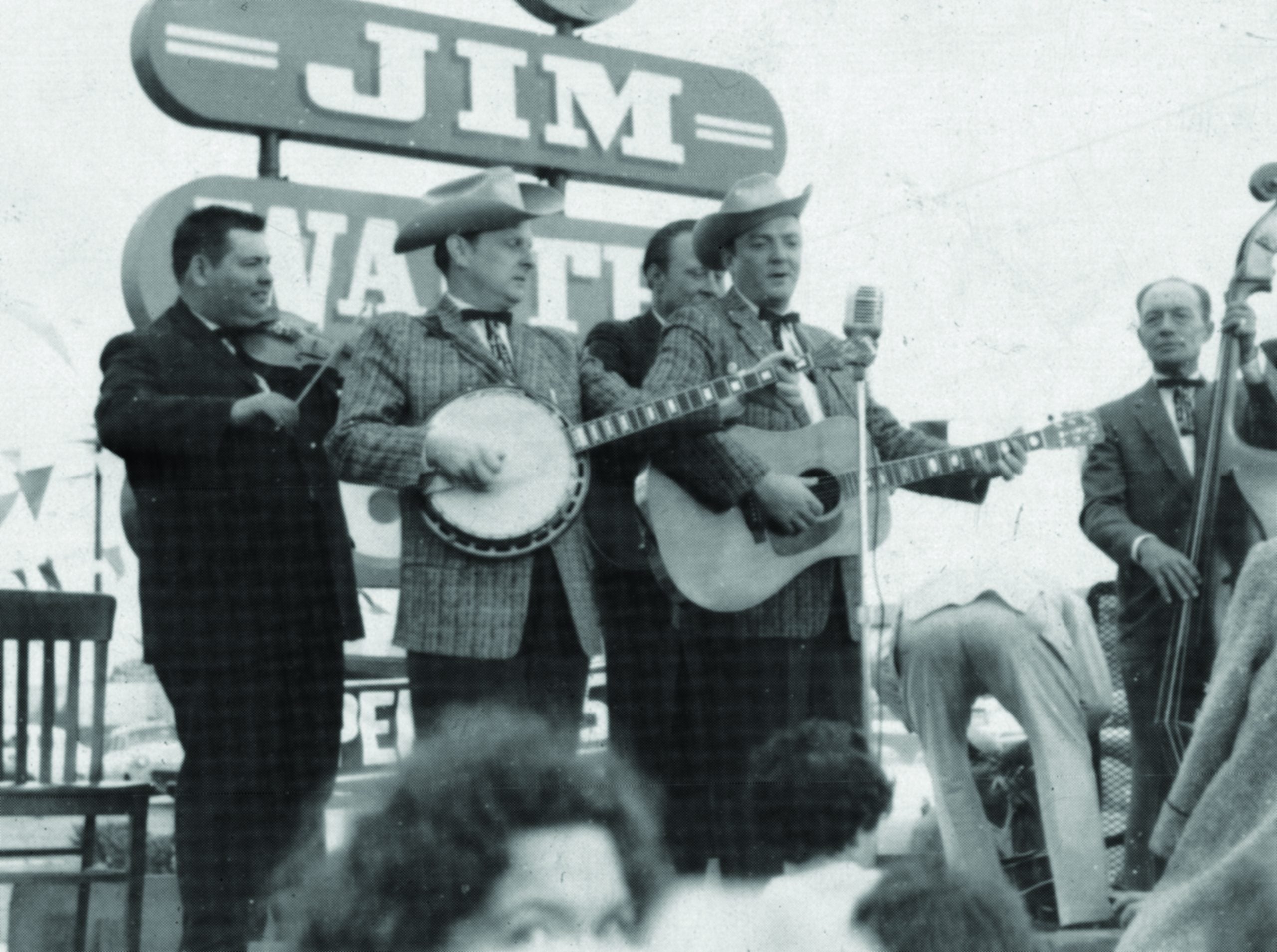
It seems that it’s only been in the last couple of decades that Bristol has come to be celebrated for the series of recording sessions that took place there in July and August of 1927. The Bristol Sessions, as they have come to be known; the Big Bang in Country Music that launched the careers of the Carter Family and Jimmie Rodgers. In 1946, these were probably footnotes at best in the city’s history . . . and some of the town’s more forward-thinking citizens of the day probably wished the events were forgotten altogether. But, hillbilly music persisted, mostly through the airwaves of radio station WOPI.
Americans endured the Great Depression of the 1930s and the shortages brought about to concentrate the nation’s resources to assure an Allied victory in World War II. The Depression was beaten, as were Germany and Japan, and for the first time in too many years, there was prosperity to be had. New businesses were being started every day and among these new enterprises were radio stations. Norton had launched WNVA back in March 1946 and Bristol would soon enter the fray as well.
Greener Pastures
Lee Stanley arranged an audition for his sons on the new radio station that was going on the air in Bristol, WCYB. The call letters stood for CitY of Bristol. An item in the trade music magazine Billboard noted: “Warren Wright, program director of WCYB, Bristol, Tenn., auditioned 35 rustic string bands before deciding on the three which the station has been using since it opened in December, 1946.” Out of all of the talent that auditioned, the Stanley Brothers were chosen for the midday program, Farm & Fun Time.
Initially the show ran from 12:30 to 1:30 every afternoon, Monday through Saturday. Among the tunes performed on their first broadcast, on the day after Christmas in 1946, was a solo by Ralph called “Six More Miles.” Though credited to Hank Williams, the group more than likely learned it from the singing of West Virginia vocalist Molly O’Day. The move to Bristol was somewhat of a gamble. The station was new and untested, as were the Stanley Brothers. But, it was a more powerful station; at 1,000 watts it had four times output of the station in Norton. The energy of Clinch Mountain Boys was not as easy to quantify, but they had determination and talent. They were on their way.
The Stanley Brothers’ first gig since moving to Bristol was in Belfast, Virginia, about 50 miles northeast of Bristol, but, perhaps more importantly, only about 15 miles from Lee Stanley’s home in Lebanon, Virginia. There’s not much in Belfast, not today anyway. The only structure of any size or age is the elementary school, which was built in 1939 and opened in 1940. An elevated stage that looks out into a multipurpose room served as the setting for the concert. Accounts of the show have changed over the years . . . from the band members (four of ‘em) earning $2.55 each (an audience of about 40 or 50 people) to playing for two packed houses. If the payout in Belfast had been meager, they made up for it the next night, Saturday night, with a show in a little hamlet situated near Appalachia, Virginia, between Big Stone Gap and Pennington Gap.
Fiddle player Bobby Sumner had a habit of coming for a while and going away for a while. His stay with the group in Bristol was brief, if he even went at all. By March, a new fiddler was in place, Leslie Keith. He was already acquainted with Carter and Ralph, having worked with them briefly in Roy Sykes’ group about the time Ralph was discharged from the Army. Leslie had since moved on to Newport News, Virginia, when he received a call from Lee Stanley. “Hello, is this Les? I’ll tell you what I want to talk with you about, Les. My boys has got a new show on a station over at Bristol — it’s a big station, 10,000 watter. [Actually, at the time it was only 1,000 watts.] We had a fiddler, a Kentucky boy named Bobby Sumner, but he says he’s not too willing to take a chance on this, that, and the other. I just wondered if you’d want to take his place.”
Stepping up to the plate, Carter called Leslie the next day. “You’re known all over this part of the world and you could help us build a show. As for pay, about the only thing I could offer you would be an equal split between me and you and Ralph and Pee Wee.” Carter’s time at bat didn’t last long; Lee took the phone from his son and upped the offer: “I’ll tell you, Les, you come and get with these boys and if you don’t make as much money as you think you ought to, why, I’ll make the difference up out of my own pocket.” Leslie boarded a bus and was in Bristol the next day in time for that Saturday’s Farm & Fun Time broadcast. An item in the March 22 issue of Billboard noted, curiously, that “Leslie Keith is now at WCYB, Bristol, Va., working with Carter Stanley and the Clinch Mountain Boys.” It was an interesting description given the fact that the group was being billed as the Stanley Brothers.
The group’s material came from a variety of sources. Carter recalled some of their songs as being popular hillbilly songs of the day such as “Tragic Romance” and “Filipino Baby” and “Monroe’s Columbia record numbers.” Ralph added “When I Lay My Burden Down,” “The Hills of Roan County,” “I Called and Nobody Answered,” “Going Around This World Baby Mine” and “things like that” to the list. Carter was just starting out as a songwriter. His first one was written not long before his discharge from the Army. “I was in Fort Myers, Florida, when the war was over so it would have been that year [1945] sometime. I was down there six months maybe or something like that. I named it and and everything . . . never did use it.” Still other songs were locally sourced. An item from the March 13, 1947, edition of the Dickenson Herald, Carter and Ralph’s hometown newspaper, reported that “Mrs. Agnes Vanover, of Clintwood, is happy to inform her friends and acquaintances that many of her songs and lyrics are being used on the Farm and Fun Time program by the Stanley Brothers over radio station WCYB in Bristol.”
By now, Carter had been working as a professional musician for about a year and things were finally starting to pay off. Although the Stanley Brothers were new, their entry into the entertainment industry couldn’t have occurred at a better time. After years of deprivation, people were hungry for live entertainment and the duo happened to be in exactly the right time with exactly the right product.
Farm & Fun Time
Jerry Williams was one of the on-air personalities who worked at WCYB when the station went on the air. His duties included reading the news, serving as a disc jockey, and hosting Farm & Fun Time. He noted that not only was the station big, but Farm & Fun Time was “the big show” in the area. Located at 690 on the AM dial, the signal had very little interference from other radio stations. As such, it was able to saturate not only the tri-cities area of Bristol, Johnson City, and Kingsport, but much of northeastern Tennessee and southwestern Virginia. Williams noted, “One thousand watts at 690 is sometimes bigger than five thousand or ten thousand or fifty thousand at other frequencies.”
A native of New York who was born Gerald Jacoby, he adopted the broadcast name of Jerry Williams to help give him a more radio-friendly persona. Fresh out of the Army and lacking any professional radio experience, he bluffed his way on to WCYB by listing a defunct radio station on his resume as part of his prior experience. How could anyone, Williams reasoned, check out his past work history at a station that no longer existed. The ploy worked and Williams found himself in Bristol in the early part of December of 1946, just before the station went on the air. He got to see the parade of talent that passed in and out of WCYB to audition for Farm & Fun Time. The New York native quickly lost his accent for the noontime program. He recalled the Stanley Brothers singing “real sad songs… sad hillbilly songs” like “Lonely Tombs.” Carter would dedicate them to the sick and shut-in listeners who were “not feeling well today.” Williams even went on the road with the Stanleys to personal appearances at schoolrooms “out in yonder land” where there was no electricity. He sang occasional solos like Merle Travis’ “So Round, So Firm, So Fully Packed” and “That’s How Much I Love You” and sold 8 x 10 photos for a quarter.
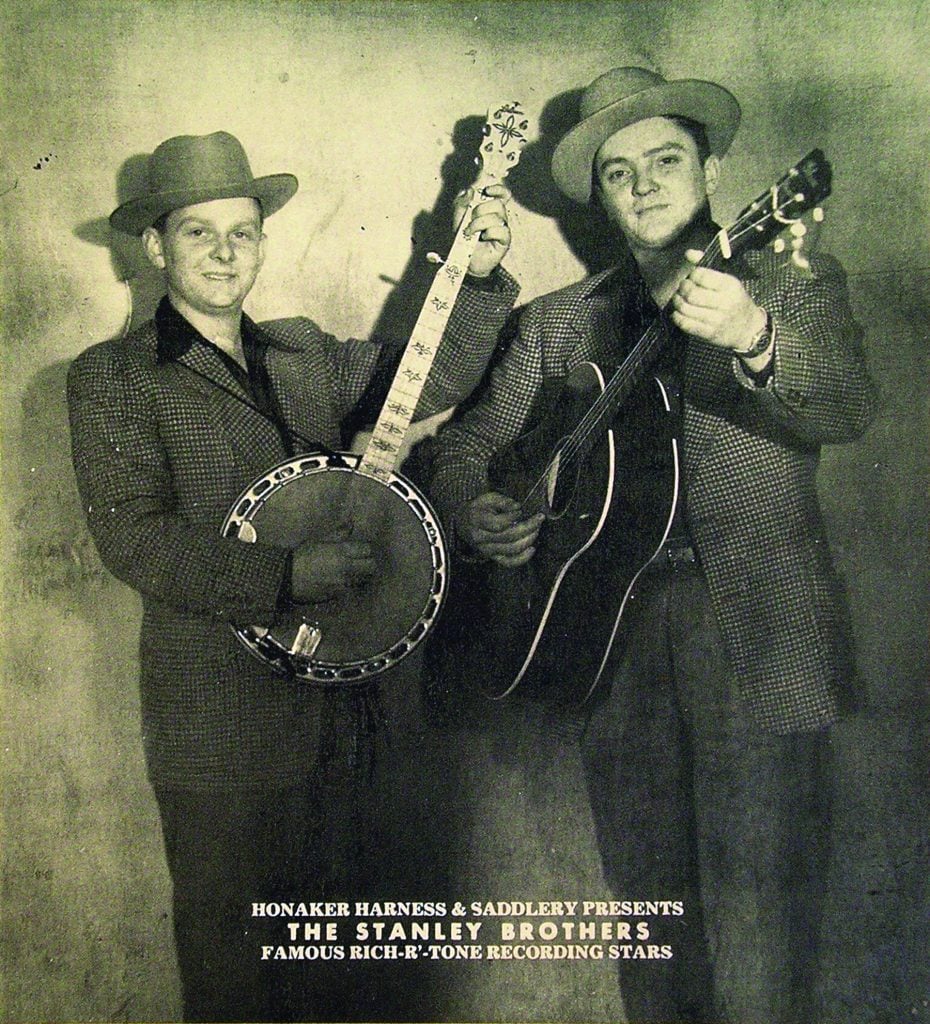
The Stanleys were selling, too. Most likely it was a little four-page song folio the band had made up. It was printed horizontally on an 8 ½ x 11 sheet of paper, which was then folded in half. The front offered “Greetings From the Stanley Brothers, Singers of Mountain Ballads.” Inside were two brief messages, one each from Carter and Ralph, as well as a photo of the duo; in all likelihood, their first publicity photo. The duo sported matching hats and houndstooth jackets. On the back were the lyrics to “Mother No Longer Awaits Me at Home,” which was credited to both Carter and Ralph.
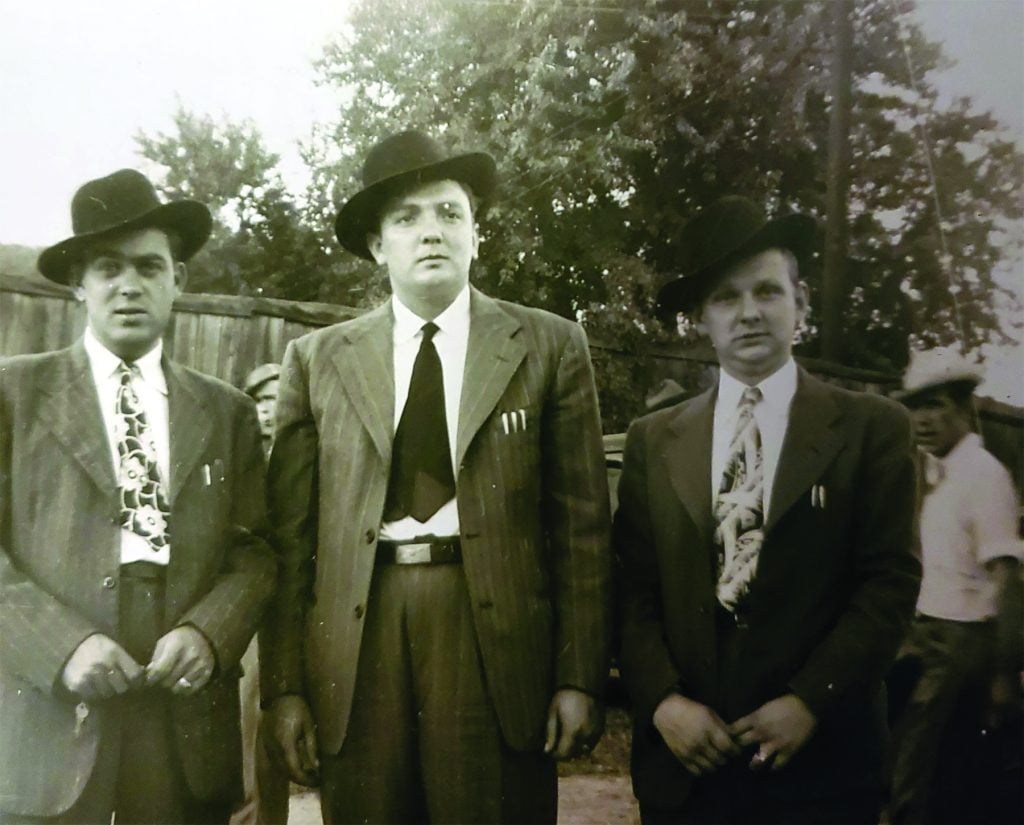
It was the exposure on WCYB that generated the demand for the Stanley Brothers throughout the region. Lee Stanley had handbills made up to advertise the show. Whenever he went out to promote or book a show, he would take a stack of handbills with him . . . “Listen to the Stanley Brothers on WCYB.” Although Lee did the booking for the group, his job couldn’t have been very hard. Carter recalled, “The show dates, they began to write to us, what we called ‘write-ins’, you know . . . so and so, maybe a member of a PTA or womans club or VFW, American Legion . . . different organizations, they would write, tell you, you know, they’d like to have you… so and so date, certain place and that’s the way it started.”
Four months after Carter and Mary tied the knot, Pee Wee and Hazel Holbrook were married, on March 25, 1947. In Bristol, the two couples shared close living quarters that were located next to each other. Hazel recalled, “We lived with this older lady; they lived on this side and we lived over here. Carter had wrote a song and him and Mary come in our part and Carter said, ‘Pee Wee, let me sing you this song.’ So, they sat down and Carter sung the song and Mary said, ‘Why I’ve heard that one before.’ And Carter said, ‘Now Pee Wee listen, I just wrote that song and she’s heard it before!’”
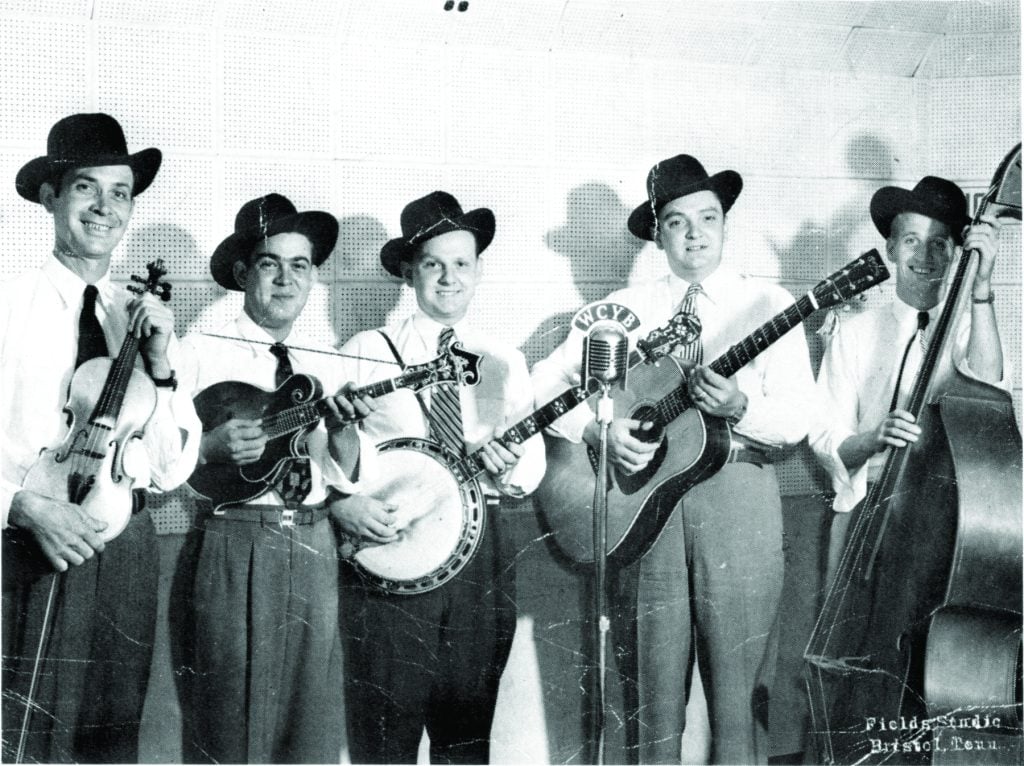
The Stanleys next recruited a bass player that Carter had worked with while in Roy Sykes’ group, Ray Lambert. For the first time, Carter and Ralph had a full five-piece band. Lambert played bass and did comedy, playing the part of the rube, Cousin Winesap, who was billed as the “nitwit of all nitwits.” It was a comedy bit Carter developed while working with Sykes.
Let’s Make a Record
Radio stations weren’t the only new enterprises popping up on the landscape. In the latter part of 1946, an entrepreneur from nearby Johnson City, Tennessee, started a new record label billed as “Favorite American Folk Music” by hillbilly and religious artists in the tri-state region. He called his new company Rich-R-Tone. By the middle of 1947 the label had a half dozen releases by regional artists such as Jim Hall, Buffalo Johnson, and the Mulkey Brothers.
Label head, Jim Stanton, claimed that it was the Stanley Brothers who approached him about recording for Rich-R-Tone, that they arrived at his office with a mail sack full of radio requests. He checked the dates and it was “every bit current mail for ‘Little Glass of Wine.’ I said, ‘Man, you mean you’re getting that many requests to sing that!?’ They said, ‘You can check ‘em.’ And they were legit.” Carter claimed that it was Stanton who sought them to record. “We was working in a town called Bristol at the time . . . and they came over there and told us they’d like to record us.” Regardless of who approached who, it was the five-piece band of Carter and Ralph, Pee Wee, Leslie, and Ray that made the group’s first recordings. There were no studios in the area in the middle and late 1940s, so radio stations doubled as recording facilities. Many of them were accustomed to broadcasting live music and, in the days before magnetic tape was commonplace, had machines that would etch music onto blank lacquer discs that could then be used as recording masters.
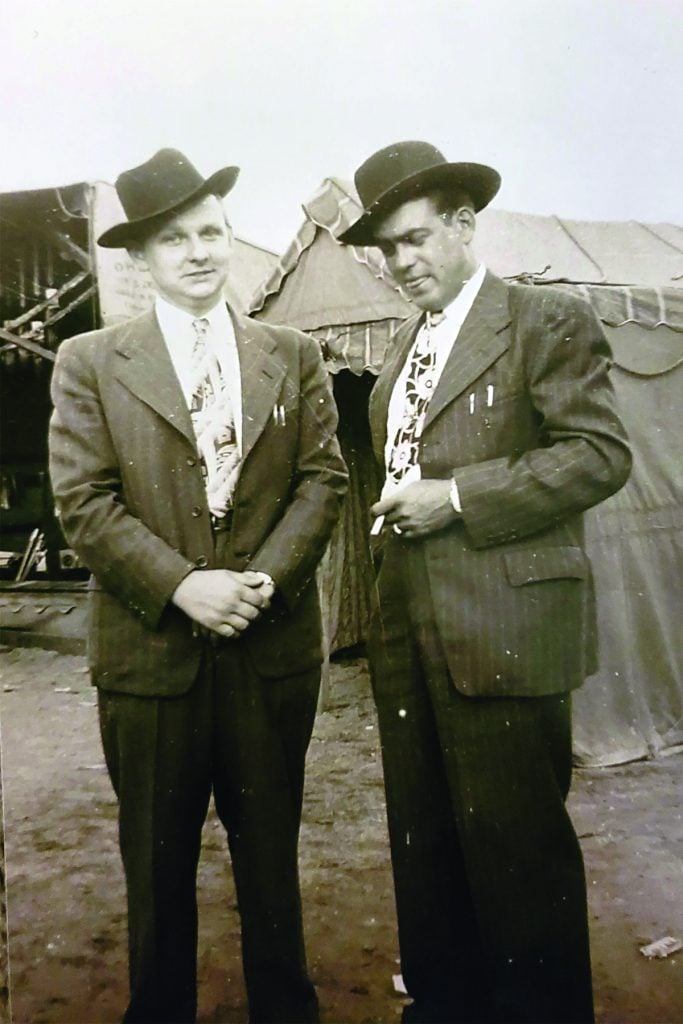
Such was the case when Carter and Ralph made their first recordings for Rich-R-Tone. Although the Stanleys were broadcasting daily from WCYB, Jim Stanton set up the session at a rival station, WOPI, because they had a good studio, good recording equipment, and a good engineer. Four songs were recorded at the session. Two were hymns performed in a style popularized by Bill Monroe several years earlier, quartet vocals augmented by sparse instrumental (rhythm guitar and mandolin) accompaniment. “Death is Only a Dream” and “I Can Tell You The Time.”
On radio and in personal appearances, Pee Wee Lambert was Carter’s singing partner. But on record, the first to be released by the Stanley Brothers, the emphasis was on Carter and Ralph. The boys featured two duet numbers: “The Girl Behind the Bar” and “Mother No Longer Awaits Me at Home.” Both songs were credited to Carter. The song that was attracting the most attention on their Farm & Fun Time broadcasts, “Little Glass of Wine,” was curiously absent from the session. Perhaps they were saving it for bigger and better things? In several respects, “The Girl Behind the Bar” was a knockoff of “Little Glass of Wine.” The tunes to the two songs were identical and were apparently lifted from a recently released Charlie Monroe disc on Victor called “No Depression,” and both songs dealt with ill-fated relationships that developed at a wayside tavern.
Hello Everybody Everywhere
On radio, the group was developing an entertaining program. Carter was a most genial master of ceremonies who greeted the listeners every day and introduced the songs. His style seemed to be rooted in that of Charlie Monroe, who in turn probably learned his craft from the Monroe Brothers emcee of the late 1930s, Byron Parker. Leslie Keith noted that Carter was “. . . getting good on those Lester Flatt licks on the guitar.” There was an opening theme song, a quick fiddle piece by Leslie Keith, a duet by Carter and Ralph, a solo by Pee Wee on a Bill Monroe selection, and a sacred quartet . . . mostly old-time numbers delivered with the drive of the Blue Grass Boys.
1947 was shaping up as a busy year for the group. Lee Stanley kept track of the bookings for the band. One section in his datebook showed a stretch of 90 appearances in a row, without a break. Carter noted, “We was really wanting a day off, just one day off would have been fine. We finally took it.” The abundance of work afforded the group the opportunity to trade up to a newer mode of transportation, a 1940 Buick Roadmaster. As Roy Sykes had done the previous year with his car, Carter and Ralph had their name painted on side: The Stanley Brothers and the Clinch Mountain Boys. They even used it as a prop for some of their publicity photos.
On or about September 11, 1947, WCYB increased from 1,000 to 5,000 watts. On the 19th, Farm & Fun Time was expanded from one hour to two; Mac Wiseman came on board and even resided at the same rooming house as Pee Wee and Hazel (and Carter and Mary?).
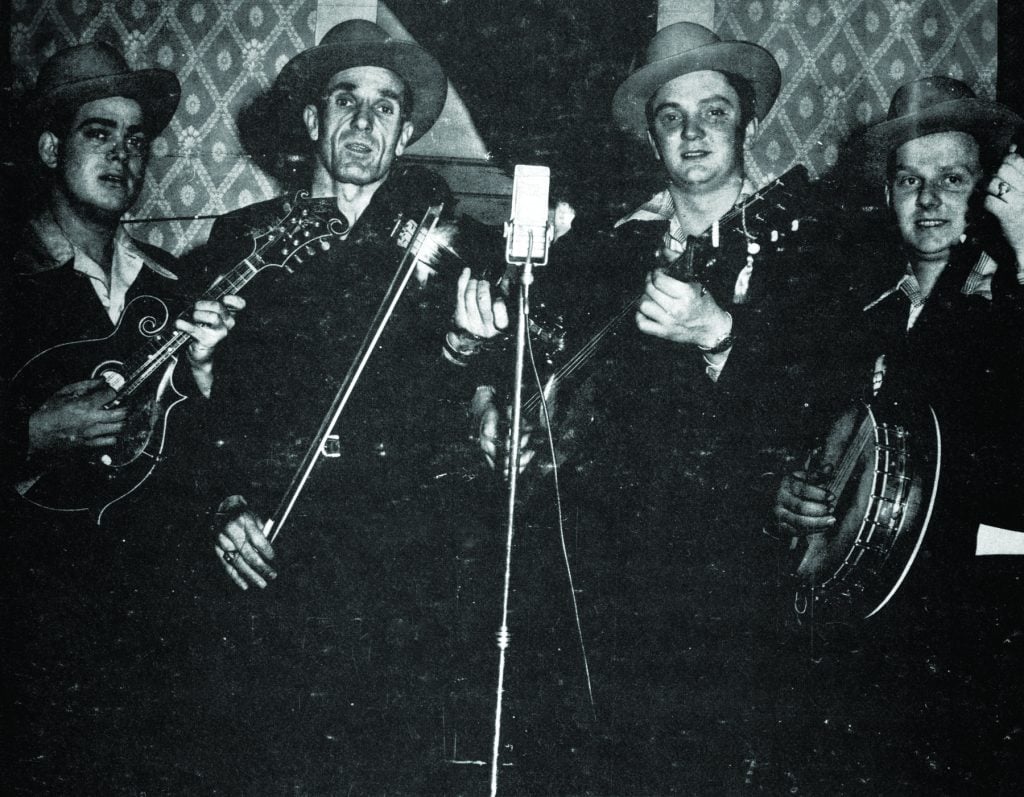
By the fall of 1947, the group had pretty much settled in at Bristol. Ralph rented a house and Lucy Stanley came to live in town for the fall and winter. Carter and Mary had been set up with their own quarters which now included three. The couple’s first child, Carter Lee, was born on September 29. This, no doubt, must have played a part in Lucy’s decision to be near her sons for autumn and winter. Carter probably didn’t have a lot of time to enjoy his new arrival. He was keeping busy with show dates, breaking in new musicians (fiddler Paul Prince joined up briefly to augment the work of Leslie Keith) and enjoying life as a recording artist; the group’s first Rich-R-Tone release had just appeared on the market.
By year’s end, the group issued their first song and picture folio. Brief biographies of Carter and Ralph were written by James A. Baker who was listed as “Agent for Stanley Bros.” His simple recap of their first year is probably a pretty good assessment: “At first the going was hard, but the boys were determined to go on. After a few personal appearances, they were received so highly by their audiences they just had to go on. In the past year, they have entertained thousands of their friends throughout the East . . . The Stanley brothers are grateful to their thousands of friends who, by ordering their books and attending their personal appearances, make possible their success.”
Going After That Bluegrass Sound
By the spring of 1948, the Stanley Brothers wanted a faster fiddler. While Leslie Keith was a masterful old-time fiddler and an excellent showman, Carter and Ralph wanted a fiddler who was more in line with the one Bill Monroe had in his band. Keith’s initial replacement was a North Carolina fiddler, Jim Shumate. He had worked with Monroe a few years earlier but now had a steady job at furniture store in Hickory. Shumate took a week’s vacation to fill in with the Stanleys. Up next was another North Carolina fiddler, and another Monroe alum, Art Wooten. He had the drive that the Stanley Brothers were looking for.
Wooten’s joining the Stanley Brothers coincided with another band joining the WCYB Farm & Fun Time cast: Lester Flatt, Earl Scruggs and the Foggy Mountain Boys. Lester and Earl had departed from Monroe’s group a few months earlier and shortly afterwards launched their new band. They played briefly in Danville, Virginia, and Hickory, North Carolina, before landing in Bristol. Tension developed right away between the Stanleys and Flatt and Scruggs. The source of friction was the Stanley Brothers’ repertoire, which contained a healthy share of numbers that were made popular by Bill Monroe. Lester Flatt reasoned that since he and Scruggs were working with Monroe when a lot of those same songs were made popular, if anybody had a right to sing them it was him, and not the Stanley Brothers.
The situation partly resolved itself when Carter and Ralph made a switch to a different radio station. Art Wooten had worked at WPTF in Raleigh, North Carolina, a few years earlier and suggested the station to the Stanley Brothers; he even helped negotiate the move for the band. On a Monday morning, August 2, 1948, the Stanley Brothers and the Clinch Mountain Boys began broadcasting on WPTF, a 50,000-watt station that had hosted the Monroe Brothers a decade earlier. The Stanleys’ program aired three days a week, at 6:00 am on Monday, Wednesday, and Friday. Their time slot competed with another popular country music group, the Blue Sky Boys. The rivalry was obviously friendly as Carter noted, “We worked some with ‘em in Raleigh.”
Ralph was less than enthusiastic about the group’s time in Ralph. “We didn’t stay very long though, maybe two months or something. We played personal appearances out of there . . . they didn’t turn out too well and we left real soon. We were supposed to play a school the next week, which we cancelled, we didn’t go. We got a letter from ‘em later on, a week or two later, that there was about eighteen hundred people turned out there that night. Then we said, ‘Well, maybe we made a mistake by leaving Raleigh’.”
Still, the time in Raleigh was not without benefit to their career. On September 30, a record shop in Williamson, West Virginia, placed a newspaper advertisement that read “It’s Here! ‘Molly and Tenbrook by the Stanley Bros. The Tune You’ve Waited For.” Their first “bluegrass” recording was on the market! Although Bill Monroe had recorded the tune before the Stanley Brothers did, his recording had yet to be released. Hazel Lambert noted that the Stanley recording – with Pee Wee playing mandolin and channeling Monroe’s vocals – “really made a bigger hit than Bill’s did. Oh god, they went around and around for a while . . . that was a bad subject.” With Art Wooten’s fast-paced fiddling and the inclusion of Ralph’s use of three-finger style banjo, it was clear who the Stanleys were trying to sound like.
To Us, That Would Have Been the Impossible
Word of the Stanley Brothers’ popularity on radio, personal appearances, and, to some extent, records eventually reached the head of Columbia Records country division, Art Satherley. Then a producer at one of the largest labels in the nation, Satherley oversaw the recording careers of notables such as Roy Acuff and Bill Monroe. Although he recorded a number of mainstream artists of the day, he had a fascination with the old-time nature of groups like the Stanley Brothers. He probably already knew that Columbia wouldn’t get rich off of Carter and Ralph’s music, but he felt there was artistic merit in it and if for no other reason, he wanted it on the label.
The Stanley Brothers had been pursued by one of the other major labels, RCA. They wanted Carter to come to Nashville to cement the deal. Carter told them he was too busy and that if they wanted to talk with him, they could come to Bristol. RCA was apparently unwilling to negotiate on Carter’s terms but Art Satherley was more than happy to fly into Raleigh to get a contract signed with the group. The Stanley Brothers picked him up the airport and escorted him to their hotel. Satherley’s resemblance to then-president Harry S. Truman, who was scheduled to be in Raleigh the same day stumping for re-election, allowed the Stanleys easy passage through several security checkpoints along the way.
Once at the hotel, Carter and Ralph, Pee Wee Lambert, and Art Wooten auditioned several selections for Art Satherley. Their performance was merely a formality as Satherley was already convinced he wanted the group. The contract was signed on October 14 and the Stanleys were given several hundred dollars in seed money to seal the deal. It would be months, however, before the band could schedule their first session for the label; a recording ban/strike imposed by the musicians union called a halt to all union sessions for most of 1948. Satherley was evidently laying groundwork for when the ban was lifted.
It was during this time the Stanley Brothers and Pee Wee Lambert perfected a trio sound that would be a hallmark of their Columbia recordings. Conventional trio vocals of the day consisted of a lead vocal, a tenor harmony above, and a baritone harmony below. Art Wooten suggested that they rearrange the harmonies by taking the baritone part and placing it above the tenor, thus creating what came to be termed a high baritone. Pee Wee sang that high part and it gave a lovely, haunting effect to a new canon of songs that Carter was crafting.
Carter’s earlier tension with Lester Flatt in Bristol had one positive outcome. He determined that he was not going to be known as someone who merely copied other people’s work and in the space of six months or so, Carter wrote at least six new songs: “The White Dove,” “A Vision of Mother,” “It’s Never Too Late,” “Be Ready to Go,” “Your Friends Will Follow,” and “You’re Drifting On.” Five of them were gospel, or had gospel overtones. Of these, two dealt with the subject of dying parents. The lone secular song, “It’s Never Too Late,” told of a romance gone bad where the singer (Carter) was hurt and left behind. Carter was writing good songs and his voice was developing what Bill Clifton later wrote, a “haunting quality.” He opined, “What sort of tragedy can there have been which gave so much pathos, such deep undertones of human emotion to the singing voice of Carter Stanley . . . [and] his ability for writing songs?”
Home Again
An item in the December 2, 1948, edition of the Dickenson Herald noted that “most everyone in this community is happy because the Stanley Bros. have come back to Bristol.” It was time for another go around on WCYB’s Farm & Fun Time program. Personnel changed from the time they left for North Carolina. Bobby Sumner returned to replace an exiting Art Wooten (who soon found a spot in the Foggy Mountain Boys) and a bass player from St. Paul, Virginia – Jay Hughes – signed on after having recently finished a stint with Jim and Jesse McReynolds. The new quintet posed for photos for a new song and picture folio and readied itself for an upcoming recording session with Columbia Records.
Such was the start of a musical legacy that has endured for three quarters of a century. Perhaps Stanley music’s greatest legacy is that it continues to inspire and influence others to this day, the most recent and visible example being genre-bending wonder-picker Billy Strings. Stanley music been recognized by the Library of Congress for its artistic merits and sphere of impact. The International Bluegrass Music Association enshrined the music’s earliest practitioners, the Stanley Brothers, by making them among the earliest entrants to that organization’s Hall of Fame. Membership in the Country Music Hall of Fame, long overdue, continues to elude them. But on a deeper, more personal level, Stanley music remains in the Heart’s Hall of Fame of the many faithful listeners who feel so deeply touched for having been exposed to it. More than fifty years ago, former Stanley Brothers Fan Club president Fay McGinnis wrote on the back of a record album that “. . . people must have sensed the human side of them. They must have seen more than just entertainers, because fans tastes often change, but friends remain loyal.” That same album contained a brief note from label owner Dick Freeland, who predicted that “. . . the music of the Stanley Brothers will live forever.” If the last seventy-five years are any indication, he just might be right.