

When Heroes Become Friends
Bob Minner Pays Tribute to Norman and Nancy Blake
Although Bob Minner has spent the majority of his musical life over the past thirty years performing as a member of country star Tim McGraw’s band, he is still a bluegrass flatpicker at heart. By the time he was twelve, Bob was studying the guitar playing of legends such as Doc Watson and Norman Blake. By the time he was fourteen, he was absorbing the styles of Tony Rice, Dan Crary, and Charles Sawtelle. Highlights of Bob’s high school years included opportunities to hang out at Jimmy Martin’s house and learn about bluegrass rhythm and jamming with Charles Sawtelle at a festival in Bob’s home state of Missouri.
At the age of nineteen, Bob entered the National Flatpicking Guitar Championship in Winfield, Kansas. He didn’t place that year, but he went back the next two years and placed third each year in the prestigious contest (1986 and 1987). Through a friend who had moved to Nashville, Bob met up-and-coming country artist Tim McGraw and by 1992 Bob was a member of McGraw’s band, a job that he maintains to this day.
Looking back on what drew him to flatpicking guitar music, Bob remembers, “When I was twelve, I got a Bentley acoustic guitar and went to a record store on the outskirts of St. Louis. I was looking through a bin and saw this record called Whiskey Before Breakfast by Norman Blake. I didn’t know who he was, but he was holding a cool looking old acoustic guitar and there was a sticker on the album that said it was ‘Norman Blake’s Guitar Album.’ I guess that is what made me buy it. I took it home and put it on my mom and dad’s console stereo and this huge guitar sound came out.” Bob was hooked and proceeded to learn all he could about flatpicking an acoustic guitar.
During the three decades Minner has been working with McGraw, he has taken the time to record a few solo albums and recently felt like it was time to start working on another. Bob said, “In February of 2021 I was visiting with George Gruhn. We live close and we sometimes have breakfast together on Saturdays. After breakfast this particular day, we went to his shop and were hanging out upstairs. I mentioned to George that I wanted to start a new project and one of the songs that I wanted to cover was the song that Norman and Nancy Blake had recorded called ‘Lonesome Jenny.’ I told George that Nancy had played cello on that recording, but I didn’t know any cello players. George’s response was, ‘Why don’t we call Norman and Nancy.’ Before I could respond to that, George was already dialing and then there was Norman’s voice on the speaker phone.”
Bob talked with Norman for a short while, telling Norman what a huge influence he had been and asked if he might be able to visit. He got Norman’s phone number. In March of 2021, Bob and Kenny Smith called Norman to wish him a happy 83rd birthday. Bob said, “Tony Rice had recently passed and left a huge void in the bluegrass guitar world. I started thinking about doing a Norman Blake tribute album. I looked around and realized that it had never been done. I wanted to give Norman his flowers while he was still living.” Minner adds, “Plus, I wanted to say ‘thank you’ to Norman and Nancy from that twelve-year-0ld kid that still lives inside of me.”
Bob then approached Adam Engelhardt of Engelhardt Music with the idea of putting out an album that would pay tribute to Norman Blake. Adam gave the go ahead and asked Bob to start selecting songs and piece together the musicians who would accompany him on the album. Bob had a big task in front of him. He said, “It is impossible to cover even a small portion of what Norman has done on one album. I wanted to include some of the songs like ‘Church Street Blues,’ ‘Ginseng Sullivan,’ and ‘Green Light On The Southern’ that were well-known. But I also wanted to include more obscure songs that I love like ‘Widow’s Creek,’ and ‘Lonesome Jenny.’” Minner, a fan of Nancy Blake’s mandolin playing, also wanted to include some of Nancy’s original material and thus included her compositions “Hangin’ Dog,” and “Year of the Locust.”
Regarding the artists he chose to accompany him on this recording—which is titled From Sulphur Springs to Rising Fawn: The Songs of Norman Blake—Bob said, “While I was selecting the songs I would hear in my head who I thought I would like to play and sing them. When I started to contact people, the prerequisite was that they had to be a big fan of Norman’s music, not just a big name in the business. I wanted them to be excited. Everyone that I contacted said ‘yes’ immediately.”
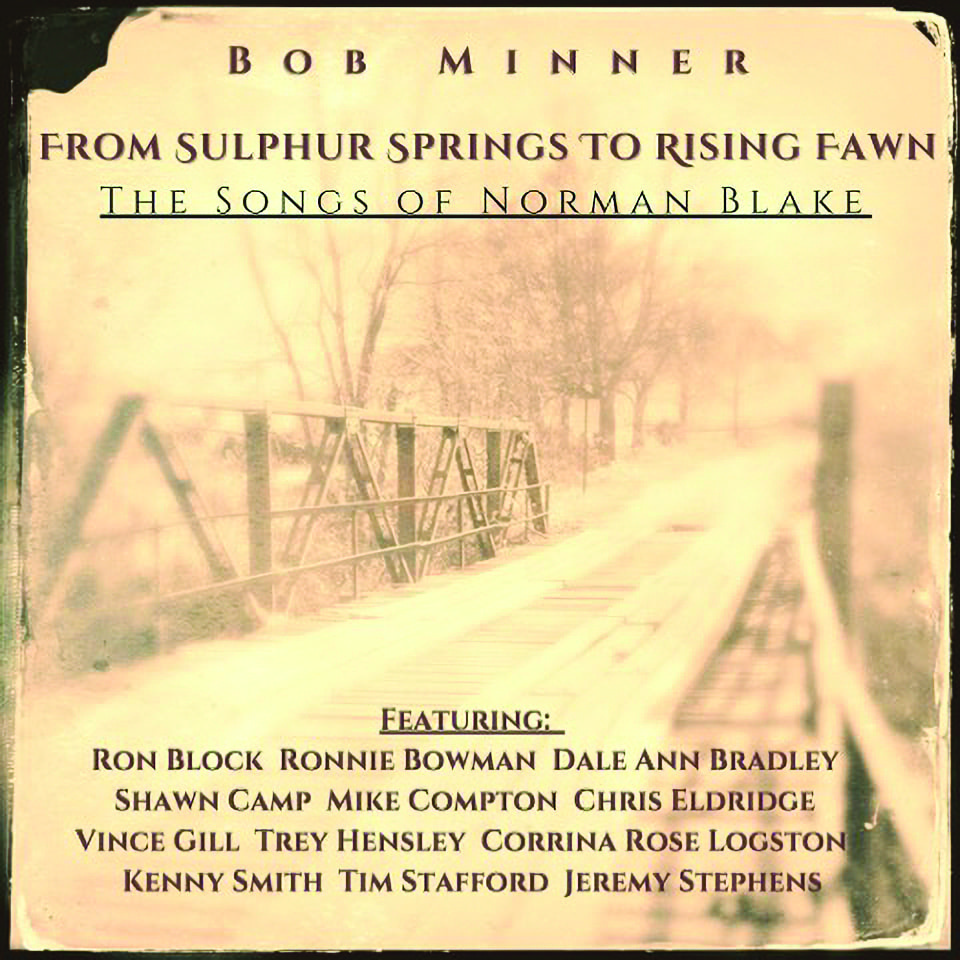
The artists who accompany Minner on this project include—Tim Stafford, Ron Block, Kenny Smith, Vince Gill, Jeremy Stephens and Corrina Rose Logston, Ronnie Bowman, Dale Ann Bradley, Mike Compton, Chris Eldridge, Shawn Camp, and Trey Hensley. As one might expect from this stellar list of singers and instrumentalists, what each produced for this recording is exceptional. Fifteen tracks appear on the album.
Minner’s goal on the production side of this album was to keep it small and intimate, as he feels Norman and Nancy had always done. To that end, the ensemble on each cut is sparse. On most cuts, you only hear two or three musicians and on the majority of the songs there is only one vocalist. The common theme is the guest artist playing and/or singing out front with Minner providing accompaniment.
There is a very laid-back feel to this recording, which is also very indicative of Norman and Nancy’s approach. Norman Blake’s songs tell stories and, like Blake, the artists on this recording know how to use their voice and instrument to tell those stories. Regarding Norman’s songwriting, Minner has this to say in the album’s liner notes, “His songs lyrically evoke images and stories of people, places, and experiences that are often quite removed from our modern society, yet still translate in a way that places us in their midst when we hear them. The writing is on par with Twain, Faulkner, or any other great American writer, only set to music that is also uniquely Norman Blake.”
Regarding the arrangement of each song, Minner said, “I wanted the collaborators to bring in what they wanted to do. I stayed out of their way. I wanted each artist to dictate the arrangement and present how they heard the song. I wanted the album to be intimate and conversational. I was surprised and pleased with what they all brought to the table…they killed it.”
Since Bob has never been one to toot his own horn, I’m going to do that for him. Bob Minner is a phenomenally talented musician. The tone, clarity, and fluidity he brings to his guitar and mandolin playing is superb. He expertly knows how to accomplish what all great musical accompanist achieve—he makes everyone he performs with sound better.
After the tracks were recorded, Minner brought them to Norman and Nancy Blake. He said, “My wife Ginger, George Gruhn and I went to Georgia and played the record for Norman, Nancy, and Joel McCormick. I brought some studio monitors and hooked them up to my phone. It was a great experience to play the album for them. They had nothing but praise. They were thankful and gave the album high marks. Both Norman and Nancy wrote heartfelt liner notes for the album.”
Bob added, “I wanted to include Norman throughout the process. I didn’t want him to find out about it after the fact. Out of respect for Norman and Nancy, I kept them informed regarding who was recording each song and making sure that we had the words right. They also had a say in the artwork. The cover photo is of a bridge that was in Rising Fawn, Georgia when Norman was growing up.”
The song that Chris Eldridge recorded for the album was Blake’s “Ridge Road Gravel.” The only time that Norman had ever recorded this song was in duo with Tony Rice. Since Eldridge had a close relationship with Rice, Minner felt this would be the song for Eldridge. When Blake discovered that this song would be on the album he told Minner, “You make sure that you dedicate this one to Tony from me.”
Overall, Minner feels like including Norman and Nancy Blake in the process made it a much richer experience for him. He said, “I think Norman and Nancy appreciated it and the project is better because of it. Plus, I can now call Norman and Nancy friends. When heroes become friends, that is a wonderful thing.”
One of Minner’s goals for this recording is that younger musicians who may not be familiar with Norman and Nancy Blake’s work will discover it through this album and “take a deeper dive” and discover the source. This is a phenomenal album and a wonderful listening experience. Everyone involved in this project are the cream of the crop in acoustic music and their work on the album reflects their expertise. This one is highly recommended.