
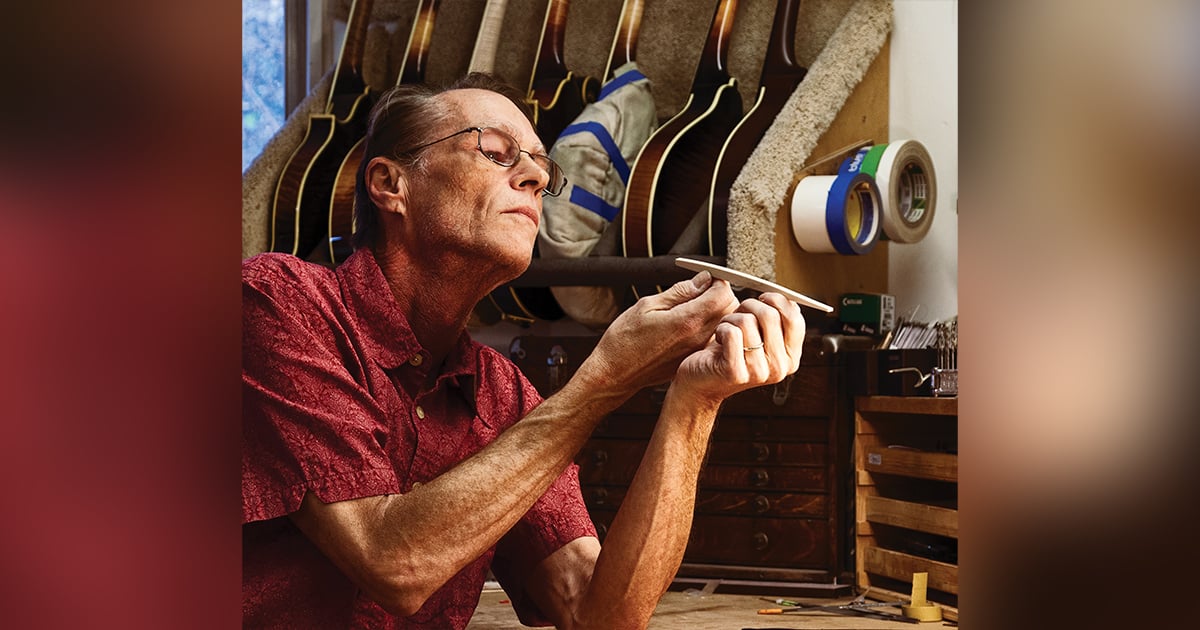
Tom Ellis and Pava Knezevic
Mandolin-Building’s Odd Couple
Together, Tom Ellis and Pava Knezevic have taken Ellis’s 40+ years of building mandolins and producing pearl inlays on a commercial scale—and their vastly different backgrounds—and created a partnership that clearly is more than the sum of its parts. Indeed, without encouragement from Pava, we might well have never seen Ellis return to building mandolins at all.
One trait in common that’s not odd is their shared passion for artistry and precision woodworking. Pava, in her teen years, dearly hoped to attend the art program at a state trade school, but it was far away from where her parents lived. She instead chose a carpentry school close by. After four years of trade school, Pava started work as a carpenter and hasn’t looked back since. “I worked with 37 men and they had never had a woman around. I had to plug my ears sometimes,” Pava recalls with a smile, adding, “I left because I wanted to work in a more balanced environment.”
Still, her time running lathes and other woodworking equipment had fed her inner artist, to a point. “I learned how to work with wood and it became a passion. I love being able to be precise with my woodwork, and building mandolins lets me do that,” she says. “I wanted to be able to focus on precision work. Building instruments is a bigger challenge and gave me a chance to grow.”
As civil unrest roiled her homeland in Europe, Pava and her family immigrated to the U.S. and settled in Austin, TX, where she found work at an area furniture manufacturer. After learning many finer aspects of wood shaping, joinery, finishing and more, she elected to move those skills to nearby Collings Guitars & Mandolins just outside of town. Starting with rudimentary sanding and finish work, she was promoted quickly to Collings’ new mandolin production department. She soon was building F-5s and other mandolins under Bill Collings’ ever-watchful eyes. “He was never critical, but he wanted it done the way he wanted it done,” she recalls of the late master luthier. “And he would show me how he wanted it done.”
Across town, Tom Ellis had abandoned mandolin building as a career for the most part after reinvigorating the handmade mandolin market when Ricky Skaggs ordered one of his first F-5s in the 1980s. But earning a luthier’s living is not for everyone. He’d built up his successful commercial business, Precision Pearl LLC, to where it was supplying inlay pieces by the thousands for Collings Guitars & Mandolins, Gibson, Taylor Guitars, and many smaller, independent builders. In a fortunate stroke of fate, when Pava tired of life at Collings, she moved to Precision Pearl in 2003, working as an associate on that side of the business. But just two years later, she challenged her boss with something startling: “We should build mandolins.” Tom agreed, and working together, they resumed production of Tom Ellis-branded mandolins, carefully rebuilding the level of craftsmanship and tonal excellence Ellis’s mandolins have always been know for.
Tom says emphatically that it was Pava, involved deeply from the start, that helped him rejuvenate the brand in 2005. “She is responsible for much of the hand crafting that goes into an Ellis mandolin. Pava does binding, glueing and sanding.” By 2012, Tom decided it was time Pava took her broad skillset and produce her own line of mandolins under her name using many of the tools and fixtures in his shop.
“I kind of showed her how and why I do what I do, but then I let her develop her own sound. I was hoping it (Pava) would be something different from an Ellis, but still really good. And I think it’s worked out,” Ellis explains. “The Pava has more of the Loar sound than Ellis. Her graduations are similar, but not identical to mine. I just felt like it was a good idea to let her go ahead with her own line, and it’s a good way to experiment, too.”
The pairing of two different builders also lets the combined operation offer a wider price range than Ellis could do on his own. “You don’t have to spend so much money for a Pava; even the high-end models where there’s a bit of a premium. It’s all in the finish. (Pava mandolins are not french polished, an expensive and time-consuming process). So the Pava mandolins are marketed as pro quality instruments, but in a more affordable price range,” Tom says.
The combined, cozy Elllis/Pava mandolin shop on Tom’s three-acre Texas property is very informal, a far cry from the almost clinical environment Pava experienced during her stay at Collings. Industrial machines appear placed randomly to an outsider, but are perfectly placed for use by the two master artisans and a small crew occupying the same production shop space at close quarters.
Over his 40-year journey seeking mandolin perfection, Tom Ellis has created an array of highly personal, unique jigs, tools, and molds. These tools for unlocking his imagination allow Tom to achieve the level of artistic and mechanical perfection in his instruments only a few other mandolin builders worldwide can equal.
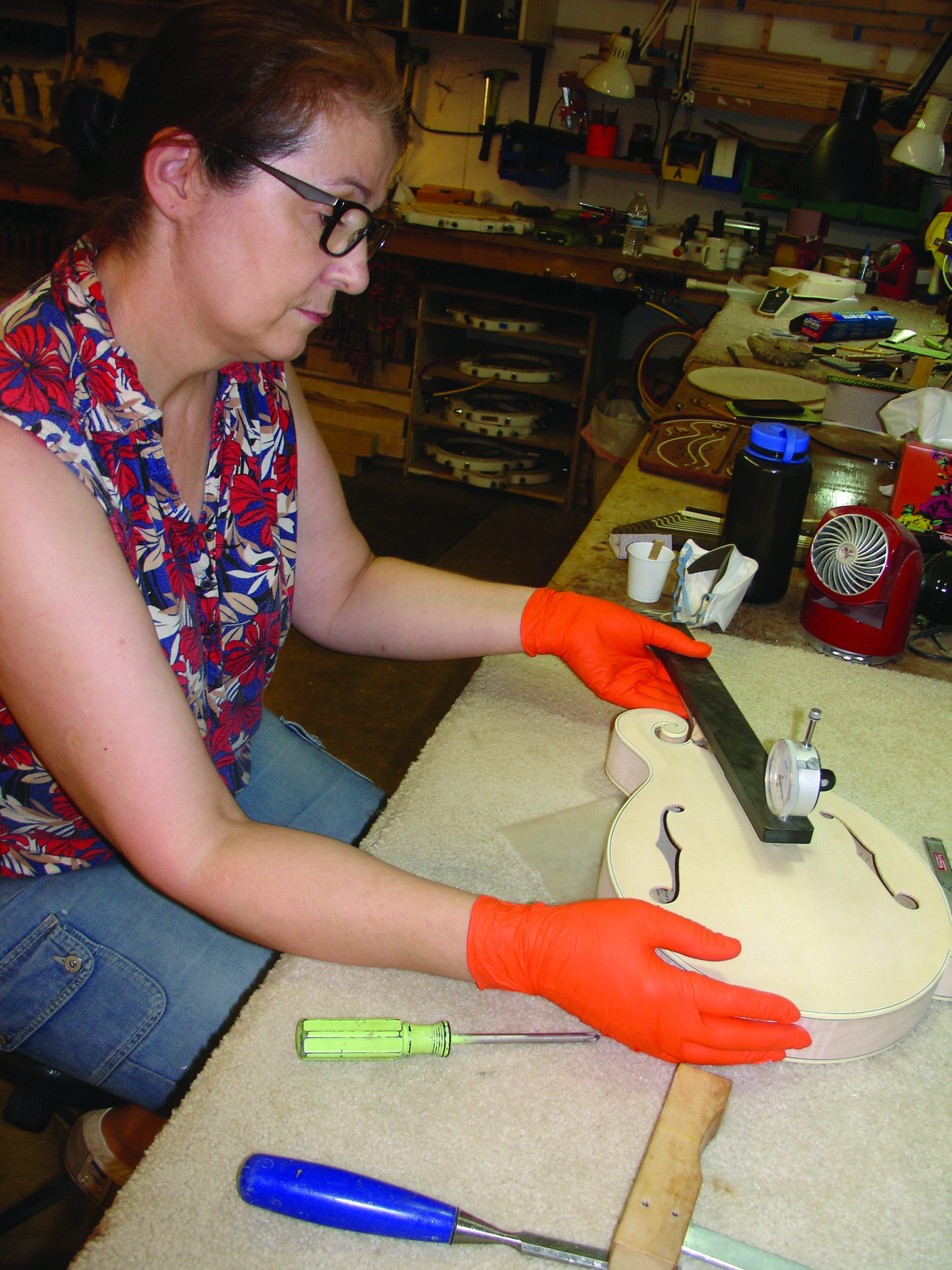
There’s Tom’s homemade top deflection gauge, which uses a bridge replica mounted to a jig with a pressure gauge under a bar supporting a large bag of sand to pressure the top and check its flexibility and overall strength during graduation and voicing. A unique binding bending jig to preform the exacting curves for the binding strips, lays on one table. That’s an especially daunting task for any luthier, especially when laying multiple lines of material around the fiendishly tight hairpins of the F5 scroll and the exactingly precise mitering to match binding ends perfectly at the instrument’s delicate points. But Tom’s handmade form makes the job far more predictable and practical. And beyond machine tools and precision jigs, much of what goes on here is still good old-fashioned precision hand work, like chiseling out the binding channel in the scrolls for a perfect match.
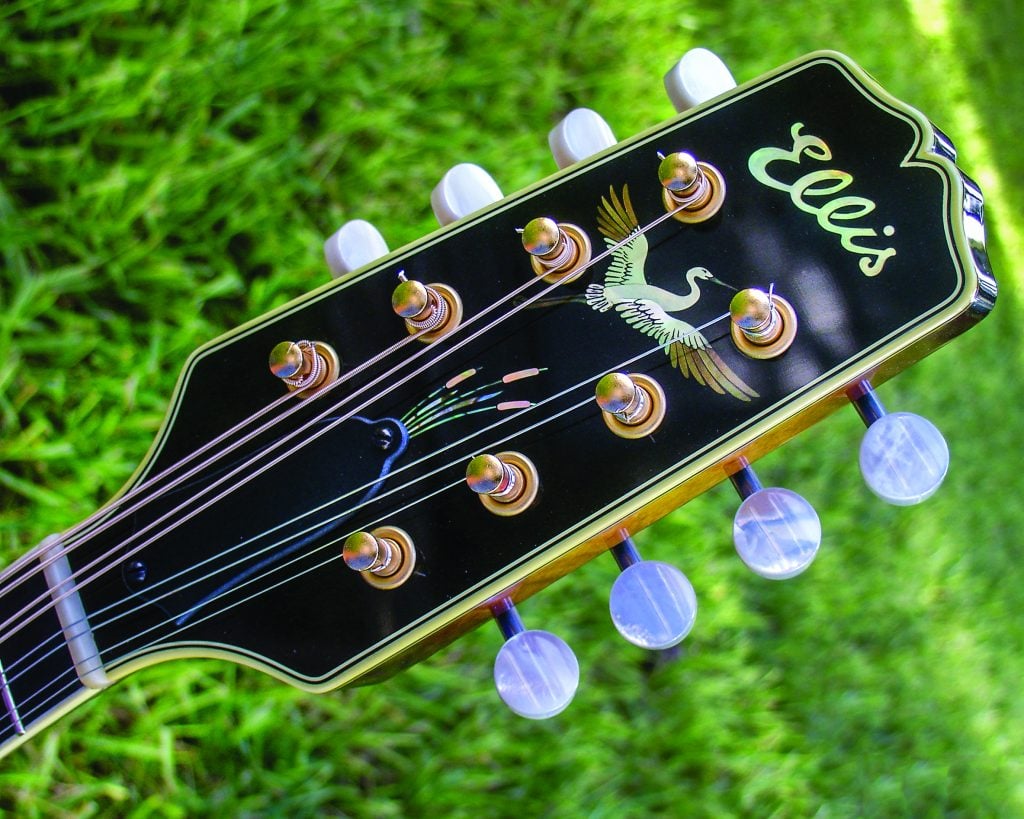
Tom’s intent at work, showing the almost stork-like concentration of the ornithologist he might have been. It’s his passion to stalk wetlands and wildlife preserves across North America to create stunning nature photography of hummingbirds and other avian subjects. It’s a theme he’s beginning to introduce to his instrument via some spectacular recent custom headstock inlays of birds.
Pava is calmer. She smiles more often. Married with two kids, she enjoys baking traditional Croatian cookies for special family holidays and sharing them with her friends and family. Her experiences—spending decades in furniture making, migrating from a distant land, language and culture to Austin’s laid-back atmosphere, then a stint for Collings Guitars & Mandolins, followed by her evolution at Ellis from inlay and finish work to full mandolin production—has given her an inner peace and sense of accomplishment, one senses.
Rounding out the team are Josh Luttrell, master finish expert who’s been working with Tom since he restarted mandolin production in 2005. Luttrell’s depth of experience working with stain and varnish is responsible for the flawless finishes, Tom notes. Cathy Creech is the business manager at Ellis Mandolins, Pava Mandolins, and Precision Pearl, contributing to everything from marketing to materials sourcing to orders and distribution. “She makes sure we have everything we need to continue making mandolins, and makes sure that our dealers and players can get their hands on them,” Tom adds. Mary Melena helps with wood processing and part-making, and is involved in all phases of neck production, fingerboards, pickguards and fret work. Jarod Allison assists both Tom and Pava with their builds. He also does in-house finish work for the Pava mandolins.
As one would expect, Pava and Ellis’s mandolin instrument lines are quite similar, with both builders offering F-5, A-5 and oval-hole A-4 models, with Ellis adding the increasingly popular two-point style pioneered in recent years by Mike Kemnitzer, Will Kimble and others.
Shaped by decades of customer demand, Ellis’ model line offers buyers a smooth progression of features and upgrades as it moves from the introductory Deluxe model to his top-of-the-line F5 Reserve (Tom and Pava don’t use the hyphen in their model numbers) features mandolins built from Tom’s private stock woods, representing the materials and precision craftsmanship Tom’s instruments are world famous for. The only model to feature the intricate Torch and Wire headstock inlay, the Reserve is also available with a Weldon Lister engraved James tailpiece.
Ellis fans may remember his Tradition model, which was Tom’s tribute to David Grisman’s 1922 Lloyd Loar-signed “Crusher” Gibson Master Model F-5 voicing, making this Ellis model closest in tone to the vaunted Loar sound F-5s. Tom says he has no plans for another run, but says he expects his forthcoming Sam Bush signature F5, co-designed with Bush, may fill that niche.
For more cost-conscious customers, the three mandolins in the Ellis “Special” category will generate the most interest. As Tom notes, even at this level the Special is an heirloom quality work of art. Built from the finest quality tone woods, the radiused fingerboard and speed neck put the focus of this instrument on playability. True to the more modern, expansive Ellis F5 tone, the Special sounds unquestionably richer, sweeter, and has more sustain than the typical Loar F-5 voice found in many contemporary instruments. Comprised of F-5, A-5 and oval-hole A-4 models, the Ellis Special mandolins all feature Waverly tuners and engraved James tailpieces. The Ellis Twin Point Special, he points out, bridges the gap between the F-5 design and the A-5 models with its distinct profile.
Unique to the line, the A4 Special is their only oval hole model. It projects a more vintage tone tone all its own, with a rounder, fuller sound many players prefer for Irish, classical, jazz and folk styles. And at his entry price-point, Ellis presents the A5 Deluxe, which features all of the same materials, specifications, and finishing as the A5 Special, but features silver hardware, nickel frets, and is double bound. Of course, as a small shop semi-custom builder, the Ellis crew offers multiple options across all models and trim ranges including different inlays, one-piece backs, upgraded tuners, personalized finish colors, and more.
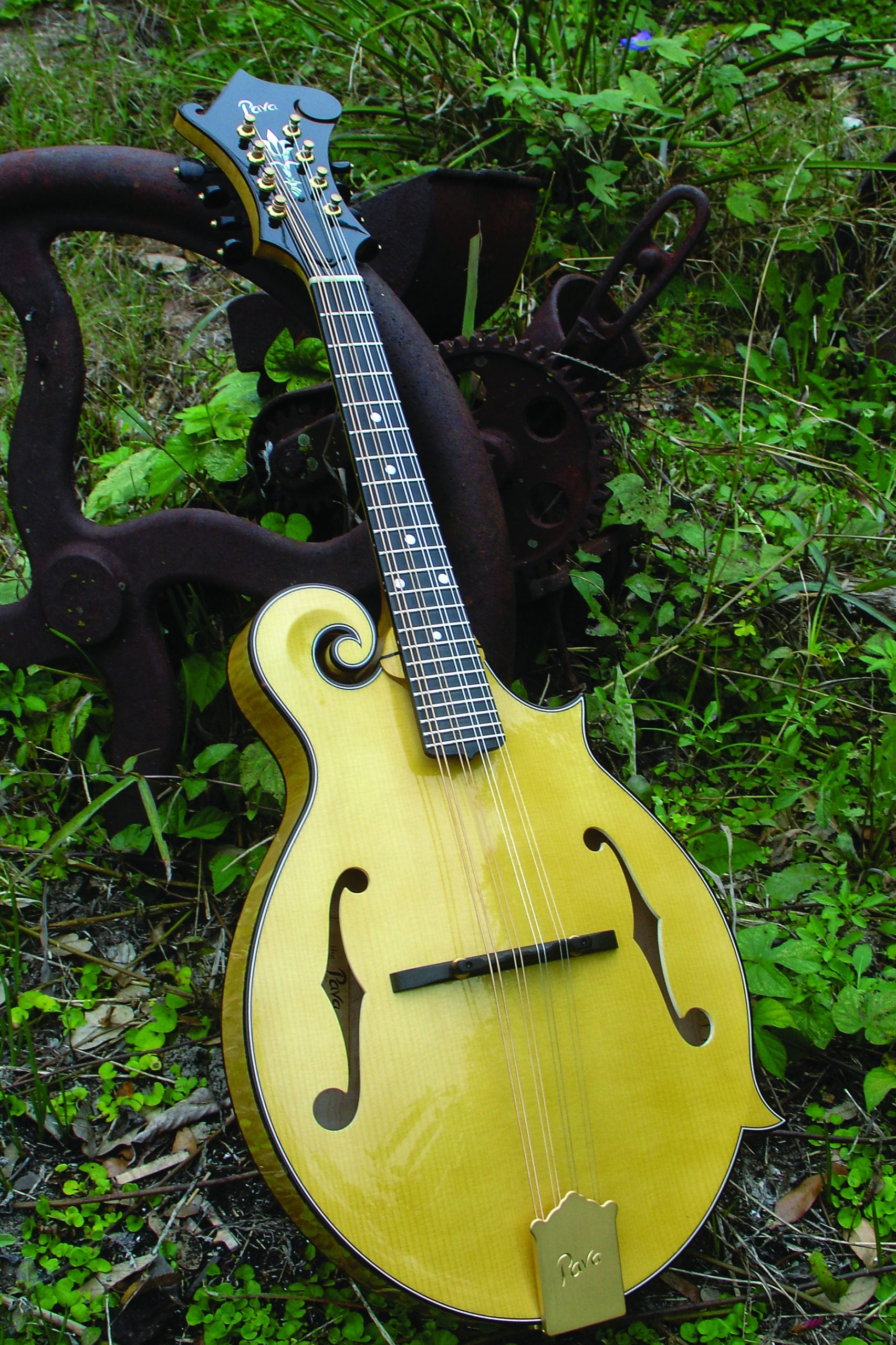
On Pava’s side of the production process, we find a smaller grouping of models and styles, given the other demands on Pava as she works on the Ellis instruments, as well. In my experience playing quite a few Pavas at IBMA, Winfield and elsewhere, Pava’s F5 models sound as good as they look, and are an excellent value in today’s unpredictable mandolin marketplace. Featuring Adirondack spruce tops and red maple backs and sides, Pava’s instruments generally have a very round and sweet tone, more open and approachable in some ways than a typical F-5, and markedly different from an Ellis mandolin.
“She does the voicing and carving of hers, and I do that for mine. I take on all the neck work, the shaping and sanding on the Ellis mandolins,” Tom explains.
The very first Pavas I played were about 10 years back at Winfield, and I commented to her at the time that her neck dimensions and nut width were noticeably smaller, almost as if they were intended more for women and smaller stature players. She’s beefed up her necks considerably since then, but they still retain a distinctly comfortable feel. They’re available in several trim levels and price points, but all models include a Bill James tailpiece, Gotoh tuners, with a satin finish on the base Pava models, upgraded to lacquer on her Player models, and varnish on her popular Pro models. Like its cousin the Ellis A4, Pava’s oval hole A4 mandolins have a slightly warmer more woody tone to them, which some players prefer.
After enduring two years of the global pandemic and counting, everyone in musical instrument manufacturing is struggling with supply chain issues, economic uncertainty, shipping concerns, and a fluctuating international market for high-end instruments. Through the storm, Pava and Tom have kept the doors open, added new models like the shellac/french polish finished Tradition, and fulfilled existing and incoming orders.
“It’s been a little rocky, but steady,” Ellis adds. “We were never really feeling in danger of going out of business once we saw signs of people spending a year off who were learning to play. But it’s definitely been quiet. I’ve made a few hires and Pava and I have been training them this first quarter, so we’re getting back into shape. We have a nice rack of mandolins we’re finishing. There’re quite a few in progress, and with the new hires, we should be able to increase production.”
Through the changes, Pava looks back, and talks movingly about her journey, especially as a prominent female luthier and role model to younger builders in the male-dominated arena. “Work hard and don’t be afraid. If you have a dream, you can make it happen even when you are one of the only women doing it,” she counsels younger women considering a life in luthiery. For herself, she’s happy with her husband of 36 years, Mladen, and kids Ana and Nikola. “I enjoy making stained glass. I took a class recently and I hope to keep learning. I also love just working, working with everyone in the shop, doing a lot of training.”
For Tom Ellis, retirement is in sight but he’s got projects to complete. For several years, he and Sam Bush have been collaborating on the design of the forthcoming Ellis Sam Bush signature model. It’s not ready just yet, but Ellis tells Bluegrass Unlimited he hopes to have the new model available soon.
But that’s just Tom Ellis being Tom Ellis. Always breaking down barriers and pushing the cutting edge of mandolin design and production. And there’s nothing odd about that at all, is there?