Arthur’s Music
Indy’s Bluegrass Heart
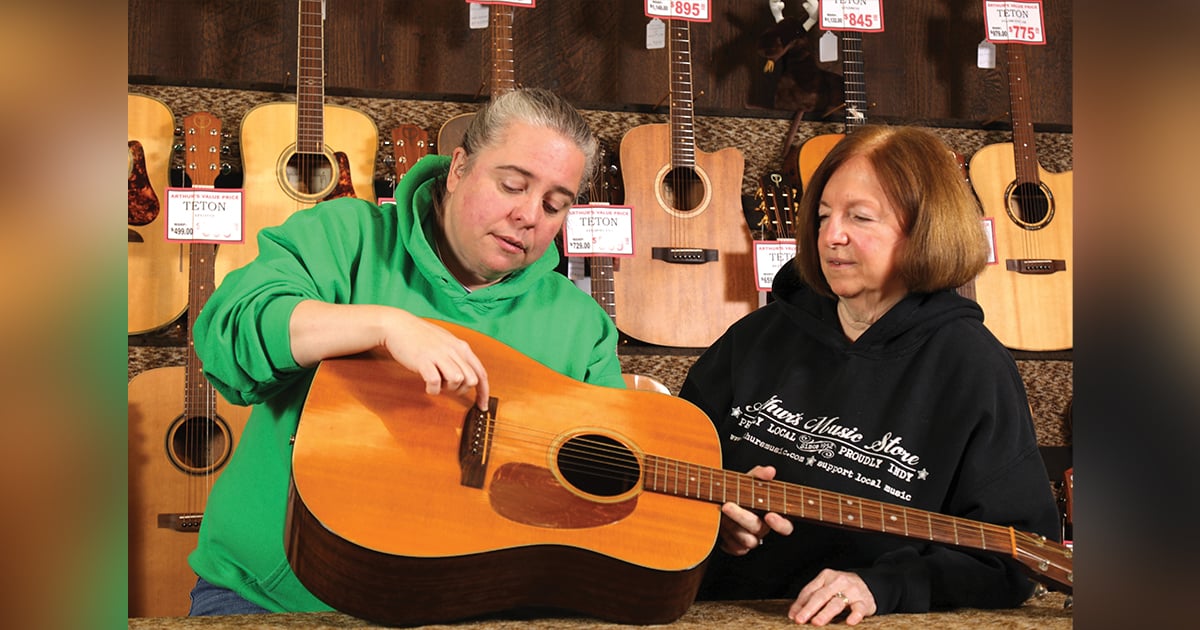
Walk into Arthur’s Music in southeast Indianapolis’ artsy Fountain Square neighborhood, and you’re immediately struck by how seriously this music store takes serving the area’s bluegrass customers. On an average day, a customer will find 30-50 banjos ranging from less expensive Deering Goodtime models to a vintage 1999 Gibson Earl Scruggs Signature model for sale. Martin guitars and more than a dozen mandolins line the display walls, along with a selection of resonator guitars, a fitting choice since Arthur’s has been teaching steel and pedal steel since the instrument’s invention. No other area store carries anywhere near that selection of bluegrass instruments.
In addition, Arthur’s, founded in 1952, holds regular in-house concerts from the likes of David Grier. Until the pandemic ended close gatherings, Arthur’s hosted an outdoor all-abilities bluegrass jam, Bluegrass in the Garden, that drew area bluegrass players of all ages and skills. Once the pandemic subsides, the store plans to resume the jam. They’re also a magnet for cool vintage gear from estate sales, like the Scruggs banjo for sale, and collectors thinning their herds. Blues-rock guitarist Joe Bonamassa has a close personal tie to the store, owning one of the exceedingly rare original Gibson Flying V guitars that turns out to have been sold originally by Arthur’s founder Amos Arthur. I walked in one day and found the 1942 Epiphone Triumph archtop that’s become my dream swing guitar.
Famous visitors to the store over the years, distinguished by signed publicity photos, have included Chet Atkins, Homer and Jethro, Ernest Tubb, Peter Paul & Mary, and even a young Michael Cleveland, who shopped at the store completely unrecognized the first time he walked in. One photo in their scrapbook shows Arthur’s employees receiving a Gibson two-point A-50 identical to Jethro’s mandolin now owned by Sam Bush, and a F-style mandolin that’s likely an F-12.
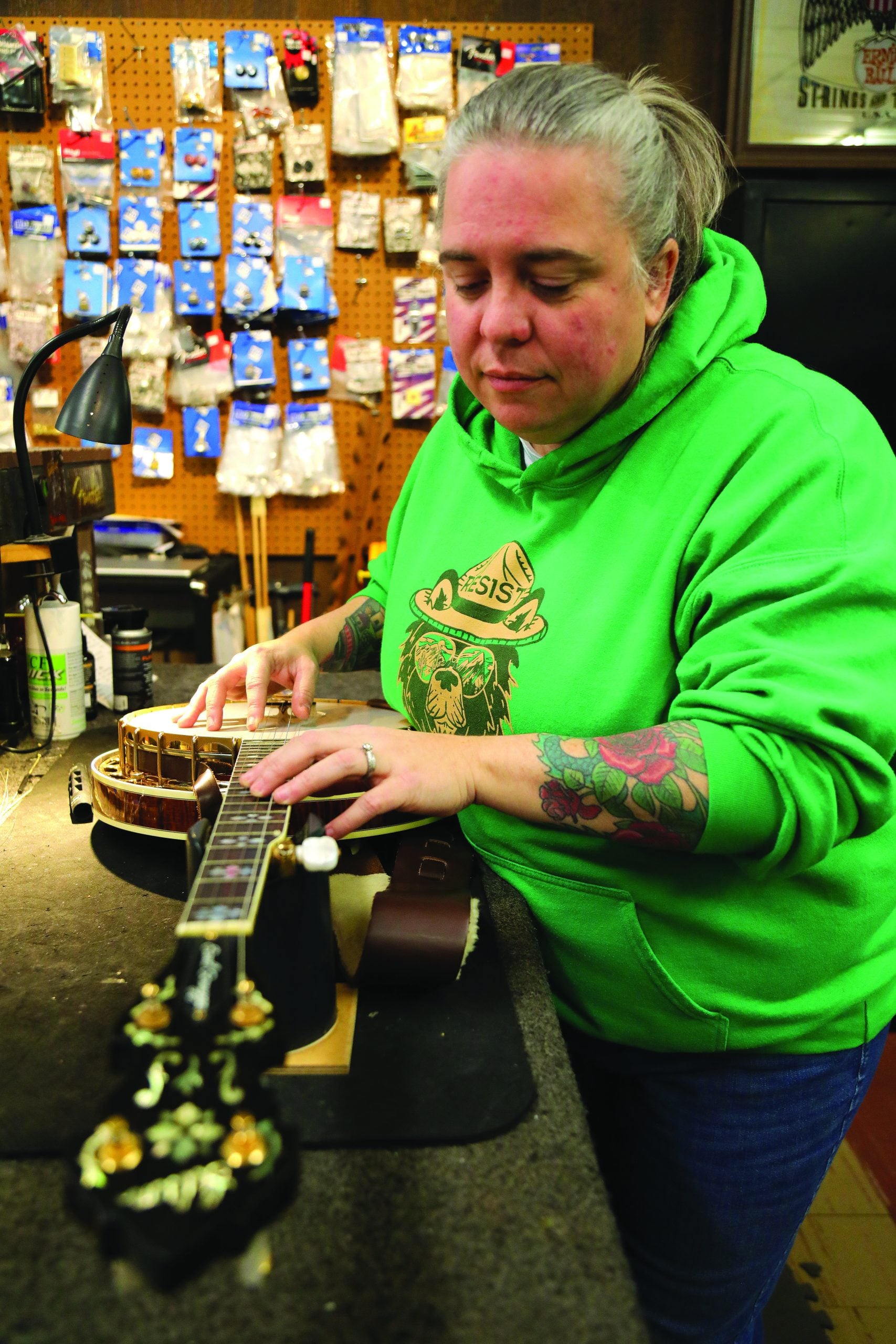
“Pretty much every musician, if they had a gig downtown or at the State Fairgrounds, would come in, says Arthur’s granddaughter Amy England, who operates the store with her mother, Linda Arthur Osborne, and serves as chief appraiser and head repair tech. Indeed, as the first music store in Indianapolis to seriously focus on stringed instruments instead of pianos or band instruments, Arthur’s influenced an entire generation of guitarists, banjo players, and other string musicians in the area. In 1963 when the Beatles made their debut tour of the States, they played the Indiana State Fair (which my older sister attended for $3!). Given the notoriously unreliable nature of their British Vox amps (which were even less reliable after they’d been rewired to use America’s 120 volt power grid), Amos was asked to provide backup amps, which were Fenders since Arthur’s was the region’s main Fender dealer. He witnessed the concert backstage, alert to any signs of amp problems for three of the Fab Four.
Bluegrass and acoustic stringed music runs to the very core of the Arthur family. Founder Amos met his future wife, Leola, at a music class he hosted. “It was a stringed instrument class in the late 1930s. They were not referring to it as bluegrass yet. She was taking mandolin lessons,” says Linda Osborne. “I think she played for awhile but switched to accordion and taught lessons as we were growing up.”
Husband Amos could play any instrument with strings, including banjo and mandolin. But his main focus was guitar, and Amos played rhythm guitar for local big bands from his late teens on. “Later on, he became fascinated with steel guitar. He taught himself to play, stocked steel guitars and gave lessons, and even invented some things for pedal steel. The rest of the city’s stores were all geared toward pianos and keyboards, but his focus was always stringed instruments. That’s one reason we’ve been here all these years” Osborne suggests, adding, “In the store, I always heard a lot of country and bluegrass music.” That legacy alone would solidify Arthur’s Music’s place in Indiana’s bluegrass history. But within the modern bluegrass retail store’s legacy, there’s a direct link to the reintroduction of a legendary bluegrass instrument —the Gibson RB-250.
As bluegrass bloomed in Indiana, driven by Bill Monroe’s annual Bean Blossom Music Park festival, customers started bringing in tenor banjos asking for a conversion to five-string or to retrofit an open-back with a resonator. Arthur’s employee Frank Beech stepped in and became one of the first artisans, along with Frank Neat, to build replica Gibson five-string necks and other banjo parts, retrofitting many tenors.
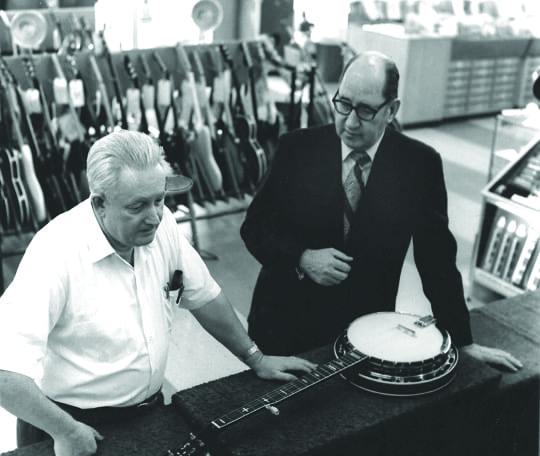
Always alert to a growing area of business, Arthur started a communication with Gibson executive Wilbur Marker and vice president of manufacturing Stanley Rendell about reintroducing a five-string banjo to their product lineup.
“The story about Grandpa (Amos) and the reintroduction to the RB-250 was that he saw the resurgence of bluegrass. It was coming back, but during the folk music boom everyone was using open-back banjos. And no one was getting back into building the more traditional bluegrass stuff. So he said to Wil (Marker), ‘Hey, you guys should think about doing some banjos again,” England explains.
Gibson had already been considering such a move, and it was additional motivation when one of their largest dealers made the request. The company replied to Arthur they were actually thinking about reintroducing bluegrass banjos to their line-up, and asked as a dealer, what did Arthur think the customers would want to see. “And that’s where (the RB-250 reintroduction) started,” England says.
Documenting the story is a letter to Arthur from Wilbur Marker, who had many jobs at Gibson Co., including head of product development and manager of customer relations. “In a few days, you will receive your first new model RB-250 in its new 623 case. Since you were instrumental (no pun intended) in starting Mr. Rendell and I off on the recent banjo development project, we felt you should have the first of the new dealer shipments…you can see this instrument is built to the famous 1927-28 Mastertone banjos. After you have had the opportunity to look the instrument over, we would certainly appreciate your comments,” Marker wrote.
Indeed, located deep within the store’s extensive records, Bluegrass Unlimited found a photo of Marker delivering the first production RB-250 to Arthur and banjo tech Frank Beech. The RB-250 banjo Arthur’s sold was serial number 923752, received on December 2, 1970, and sold to “Robert G” on January 21, 1971, according to the store’s handwritten sales records.
Marker retired after a long history with Gibson. “He was not our (sales) rep, but he did come in frequently all year. We’d meet him at NAMM show, which was not called that yet. My early memory of business life was going to Chicago for the (trade) show, and you’d walk into one of the hotel rooms and there’d be the Gibson room with two or three new instruments on the bed with Les Paul talking about them. And then there was the Gretsch room, with Chet Atkins demonstrating new models,” Osborne recalls fondly. After overseeing the RB-250 relaunch as vice president of manufacturing, Stanley Rendell later served as president of Gibson after the company had been acquired by CMI and legendary innovator Ted McCarty resigned. Rendell is credited with the company’s decline in musical instrument quality as he beefed up top thicknesses and braces as a way to reduce repair returns. Years later, George Gruhn acidly referred to Gibson’s instruments manufactured during this period as “stage props.”
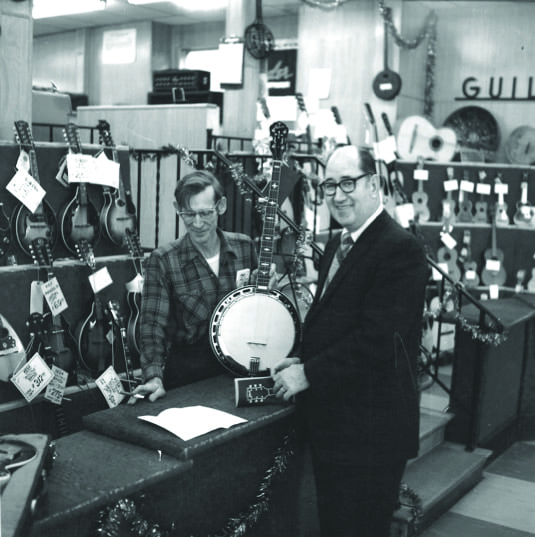
But the reintroduction of the RB-250, spurred by Arthur’s, succeeded, and led to the expansion of all bluegrass instrument manufacturing at the legendary brand. Today, Arthur’s Music remains a landmark in Indiana’s bluegrass community. After contacting a number of local bluegrass players about their experiences at the store, many came back with comments like “I learned to jam at Arthur’s bluegrass jam,” among other positive comments.
Asked about the store’s string-friendly business philosophy and its long-time support for bluegrass and other acoustic forms of music even through the rock and roll frenzy of the late 1960s and 1970s, Osborne explains, “It was deliberate. As I said, when Dad started the store, there was no one focused on stringed instruments in Indianapolis. They were all selling pianos and keyboards that were considered cultural. In the ‘60s, we were known as the store with the rock and roll instruments. (Arthur) was an early admirer of the Beatles, Elvis, all the popular music at that time.
“We still carried banjos and mandolins, even during the heyday of rock. Here in town, a lot of stores popped up selling rock and roll (gear), PAs, amps, electric guitars, and drums. So it was natural for us to ease back into what we were known for,” she explains, adding, “Our main thought process is always to sell what you know and can talk about. If we can’t talk about it, don’t know about it, or be able to repair it, that’s something we’re not going to carry. It’s why we don’t have recording gear and synthesizers. We do repairs and stock supplies, so we can give full service and support to the bluegrass community.”