
Jacob Jollif
Discipline, Hard Work, and High Standards
Written By Dale and Darcy Cahill
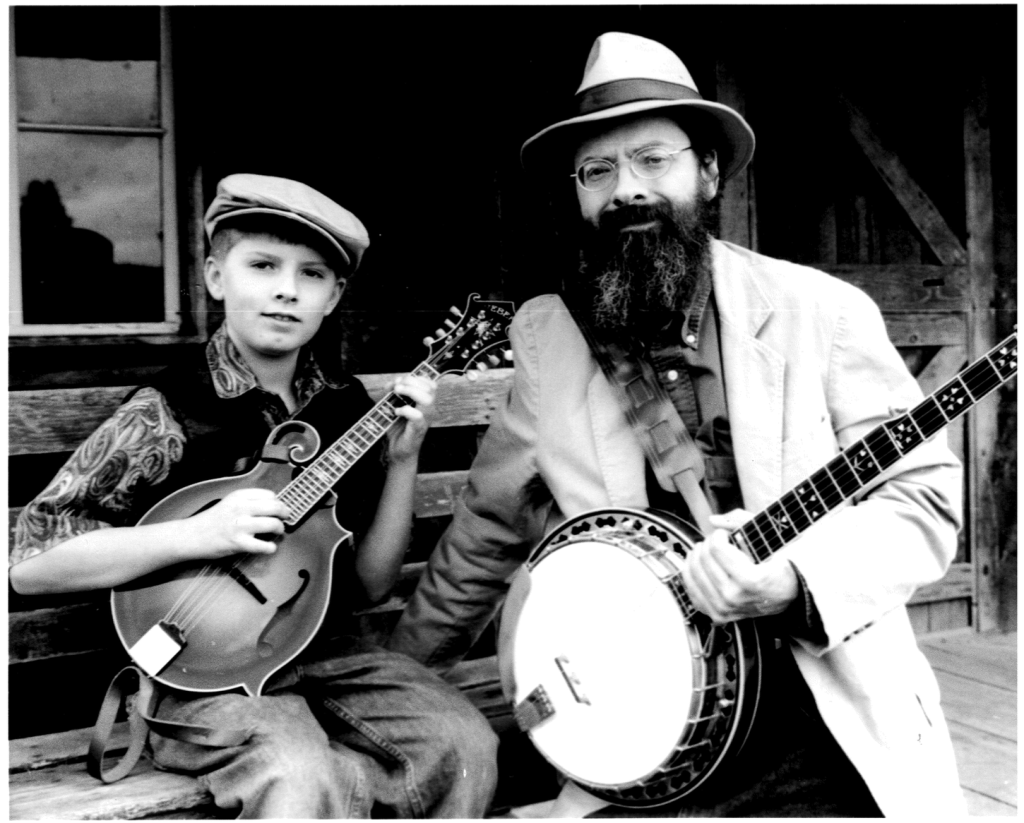
Jacob Jolliff’s bluegrass roots run deep. He picked up a mandolin at seven years old and attended his first bluegrass festival at age nine. Already an eager mandolin player, Jolliff surprised everyone by sitting in his lawn chair not for one or two sets but for the entire day of music. Riveted by what he saw and heard on stage, Jolliff’s musical commitment was complete. Now a 33-year-old with prestigious contest wins, a fully paid scholarship for mandolin at Berklee College of Music and years of touring with Joy Kills Sorrow and Yonder Mountain String Band, Jolliff composes his own instrumentals, sings and has found a way to play music true to his bluegrass upbringing and authentic in its expression.
Bill Jolliff, his multi-instrumentalist Dad, gave him his first lessons on the mandolin and gave him an education in bluegrass. Jacob said, “He showed me a lot of fiddle tunes. He gave me some good approaches for playing bluegrass tunes, ways for outlining the melody and embellishing it, and then showed me basic technique as well. But he pretty much stopped instructing me by the time I was 9 or 10 because mandolin was just one of the instruments he played and he felt like at that point that I had as much technique as he did. I don’t know if that was true, but he certainly got me going on the right path. A lot of the things he implemented are things I use with my students now.”
During middle school, Jolliff joined his dad’s bluegrass gospel band, Jacob Henry and Bill Jolliff, and they toured the Northwest playing for festivals, churches and Sunday morning gospel shows. During these tours Jolliff met and played with a long list of talented mandolin players and bluegrass stars including Ronnie McCoury, David Grisman, and Chris Thile. He took every opportunity he got to watch them play, ask them for advice, have a lesson and simply soak up their talents. Mostly self-taught at this point using resources like the Homespun instructional tapes, he had learned a lot by simple trial and error. So, these early encounters with high caliber bluegrass musicians like Thile made a huge impact on Jolliff’s playing and his desire to develop his right and left hand techniques.
By the time Jolliff was a senior in high school, he knew that he wanted to pursue a career in music so when he saw that The Berklee College of Music was holding auditions in Oregon, he signed up. The audition lasted 15 minutes followed by a 15-minute interview. For the audition he played a prepared Charlie Parker solo and then improvised a traditional fiddle tune with jazz inspired licks. He won a full four-year mandolin scholarship that day, the first one ever awarded. That summer before leaving for Boston he and some friends attended RockyGrass where Jolliff decided to participate in the mandolin contest. He won the competition and the Sam Bush signature Gibson mandolin. Next stop, Boston, Massachusetts.
Already excited to explore different genres of music, Jolliff found himself surrounded by like-minded musicians at Berklee who were equally eager to discover ways to expand their skills and musical imaginations. Jolliff studied under the late great mandolin master John McGann and while appreciative of the learning about jazz from McGann and his peers, he admits that he devoted most of his time at Berklee working on his technique. Jolliff says. “I was just obsessed with playing the mandolin and getting the right hand in shape……so I mostly just worked on sheer technique at Berklee. I just basically locked myself in the practice room for most of those years.”
Tony Trischka recalls the first time that he heard Jolliff play at Berklee. Trischka had just finished up a show there and as he walked backstage heard a group of students he describes as “burning it down” off to the side. He wandered over to check it out and there was Jolliff. His first thought was, “who are you?”
Over the next few years, Trischka got to know Jolliff as both a young man and a musician and recounts that Jolliff had an unparalleled work ethic. Trischka says that even Jolliff’s roommates couldn’t believe how much Jolliff practiced. More importantly though, Trischka realized that Jolliff’s bluegrass experience also set him aside from just about everyone he knew. Trischka says, “Who knows Red Allen’s ‘Hello City Limits’? Jacob Jolliff does!”
In 2008, during his sophomore year, Jolliff joined the New England based band Joy Kills Sorrow, a self-described “modern American string band.” All the players in Joy Kills Sorrow shared roots in acoustic bluegrass and folk but also brought with them experience in rock and roll, jazz, indie and blues. Jolliff explains, “In terms of Joy Kills Sorrow, I was really the drum set in that band. So, the first thing I would think about when we were arranging a tune is what the beat should be, like what my chop should sound like. And ‘chop’ not meaning like two and four in bluegrass, but what the mandolin drumbeat should be like. It just sort of evolved from that.”
Despite a rigorous practicing and touring schedule with Joy Kills Sorrow in the states, Canada, and Europe, by 2011 Jolliff found time to finish his Berklee degree in performance. Soon after, he entered the 2012 National Mandolin Championship in Winfield, Kansas and won. Jolliff then spent the next three years recording and touring with Joy Kills Sorrow right up until their final show on May 1, 2014, at Cambridge’s Lizard Lounge. As luck would have it, a few weeks before this final performance, Jolliff got a call from Yonder Mountain String Band who had just parted ways with their mandolinist. Jolliff fit right in with their notoriously independent blend of traditional bluegrass sounds and freewheeling improvisation.
It was during his years playing with Yonder Mountain String band that Jolliff’s vision of his own sound began to more fully emerge and by 2016 he developed a solo project, the Jacob Jolliff Band. The project included him and a rotating quartet of some of the most virtuosic and innovative young pickers around. Pickers that Jolliff says were equally good at playing as they were at listening. As Jolliff explains, they all have what he calls, “good ears.” Imagine Jolliff’s surprise then when that same year he received an email from renowned Australian mandolin luthier, Stephen Gilchrist, offering to build him a mandolin. Needless to say, Jolliff answered that email in the affirmative and he says that he loves it. He recalls, “the mandolin was completed and in my hands by November, 2017.”
In 2018, Jolliff left Yonder Mountain String Band and fully committed to touring with The Jacob Jolliff Band, the band we heard for the first time this summer at The Podunk Bluegrass Festival in Goshen, CT. While we had both known of Jolliff and his reputation as a wildly accomplished progressive mandolin player, we went to his set that Saturday night unprepared for what we saw and heard. We loved it! That night, Jacob’s band consisted of Stash Wyslouch on guitar and vocals, Myles Sloniker on bass and Bobby Hawk on fiddle. They fired up with a Jolliff original which made the traditionalist in the audience cringe but the second song a very traditional bluegrass tune with Jacob’s very bluegrassy vocals and Stash and Myles’ harmonies brought everyone back into the fold.
Widely known as a traditional bluegrass festival, we were happily surprised by the Podunk promoters’ decision to include the Jacob Jolliff Band in the 2021 line up. Rich James, Podunk promoter, said that he wasn’t initially convinced that this was the right headliner band for the festival. When contacted by Jolliff’s agent, he had some questions. The first was about Jolliff’s band itself. He had watched videos of the band and heard not only innovative breaks and melodies but a tight well practiced sound. When Jolliff’s agent explained that Jolliff’s band consisted of rotating high caliber musicians, James balked. He said that he didn’t want a loose jam band playing Podunk, no matter that they might have amazing chops. The agent explained that the impression of Jolliff’s band as a loosely configured group of high caliber musicians couldn’t be further from the truth.
In fact, Jolliff has never relented on his disciplined, daily practice routines and he runs his band with very high standards. When on tour, they have little down time, practicing tunes, fine tuning harmonies and solidifying what often seem like spontaneous flights into outer space. Jolliff says that his tours go like this, “driving, practicing, and playing. And occasionally eating.” While Jolliff’s musicians have lots of room to express themselves, especially on extended solos, their breaks are carefully crafted and seamlessly bounce from one to the other.
James took what some might say was a risk, but he is glad that he did. The positive feedback he received from most of the audience ensures that Jolliff will return to Podunk in the future. The bands mix of solid bluegrass, gospel, and sometimes freaky improvisational instrumental songs with free ranging solos makes it hard to categorize as a straight-ahead bluegrass band but every time you think he’s stayed too far from the pack they do a Bill Monroe cover with sweet 3-part harmony that makes you want to sit back in your chair and hear some more!
We enjoyed the set so much, that a few weeks later we caught another Jacob Jolliff Band show in Vermont at the Zenbarn in Waterbury Center, Vermont. This smaller and more intimate venue allowed us to focus on the band’s precision picking more clearly and on Jolliff’s voice as well as the harmonies he strikes with Wyslouch. Jolliff’s early dedication to the mandolin and to playing with his dad in the bluegrass gospel band set him up to be a better than fine bluegrass vocalist. Like many singers, Jolliff doesn’t always like the sound of his own voice, but he says that he does like hearing his bandmates play over and with his voice. He has also enjoyed expanding and fine tuning his harmonies with Stash and Myles.
The other bonus to hearing the band play in a more intimate setting was being able to clearly hear Jolliff’s original instrumentals. This musician is also a monster composer. His album Instrumentals, Vol. 1, puts him in league with Sam Bush and Chris Thile. He remains faithful to the bluegrass sound but does not allow the constraints of traditional bluegrass to inhibit his deeply personal musical expression. “Stingy with the Brisket,” his opening tune of the album, and “McGann Naps and Winfield” display the scope of his talents. When you add to that “Leila’s Waltz,” a tune he wrote for his late grandmother, you can understand that Jolliff is tough to pigeonhole as progressive or traditional. He has got it all.

When we finally got to sit down and talk with Jolliff in person, we met a person unaccustomed to describing his long list of accolades and accomplishments. He said he was honored and that he has been reading Bluegrass Unlimited since he was a little boy. He said he can’t wait to show the article to his dad. Instead of talking about himself, he focused the conversation on his music and those that have influenced him most, like McGann, Sam Bush and of course Bill Monroe. In an interview with Hermon Joyner from the magazine Mandolin Player Jacob said, “I’ve worked on jazz a lot and I’m always working on and trying to get better at it. I was really inspired by my teacher at Berklee, John McGann. He was just a brilliant player and I think he had the best jazz vocabulary on the mandolin, like his knowledge of harmony and navigating changes. He was so amazing at that, and he’s been a huge influence.”
Jacob’s right-hand technique is what distinguishes him from other players. His right hand moves in complicated rhythms that are sometimes too fast to see. For him, the right hand is where the music comes from. Jacob said, “It’s about the single most important thing about mandolin technique. Obviously, it’s only one-half of the technique, but at the same time, it’s what’s creating the sound. A lot of tone is in the left hand, too, but you’re definitely not going to be pulling good tone without a good right hand.”
At only 33 years old, there is still much more to come from Jolliff. At the core of what Jolliff strives for, is figuring out a way to make music on the mandolin that he really likes to listen to and that expresses his own voice. Add to that a bunch of equally accomplished musicians who believe in his mission, and it is worth keeping an eye on this fresh mandolinist who cuts no corners and has already devoted over half of his life to playing the mandolin. We can’t wait to see what he comes up with next!