Sonny Osborne
I Believe In Truth But Not In Spite
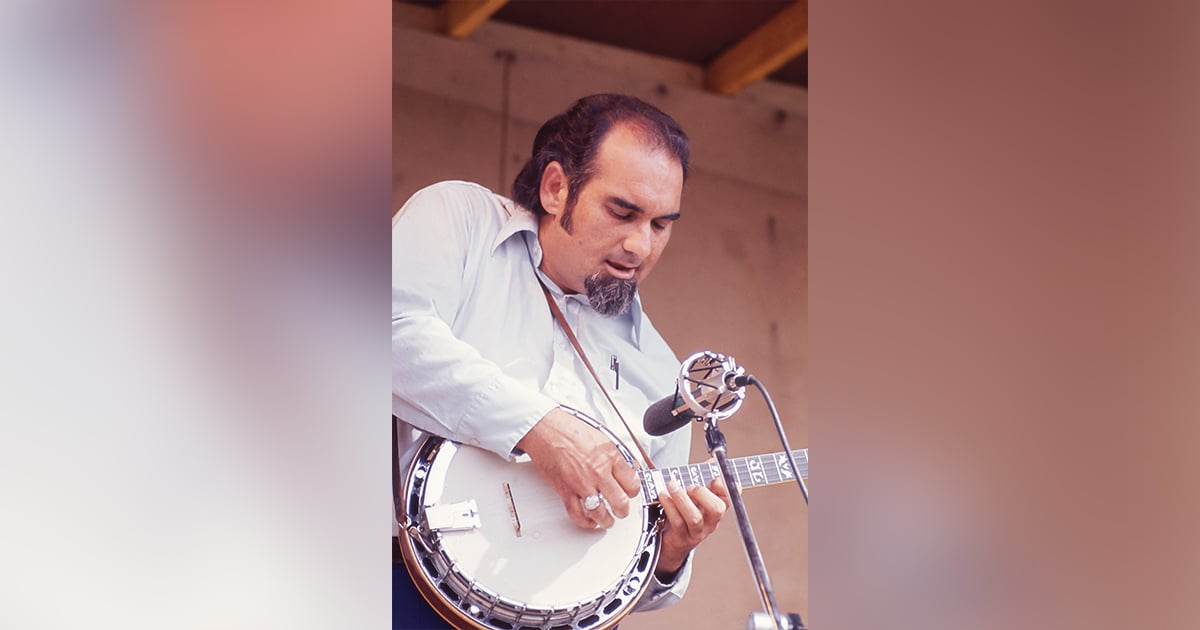
Photo by Doc Hamilton
Sonny Osborne started writing a monthly Banjo Newsletter column, “Keep On The Sonny Side” in October 1977 and, by my unofficial count, he wrote 36 columns. Sonny would talk the column onto a tape and then editor Hub Nitchie would transcribe it. (Which once led to the hilarious mistake of referring to “Randy Lynn Rag” as “Mandolin Rag.”) At the end of his second column, Sonny appended, “I sent off the first tape with enough to cover three or four issues, and what does Mr. Smart Nitchie do? He uses it all in the first column!…So now, while the other guys [in the band] are sleeping, I’m in the motel making a tape!”
Sonny had a casual brilliance with words and an amazing facility for language. He once described a Florida festival as being a “disaster” because “the weather raised its head and spat ugly words on the fairgrounds there.” He also had a wry and devilish sense of humor.
Sonny invited readers to ask him questions, saying anything was fair game, and subscribers answered in droves. And, as they soon found out, Sonny spoke his mind. He offered sweeping praise for what he liked (Tom McKinney’s capos), and criticism for what he found deficient in a product, an event, or a person’s playing. For instance, in answer to the question “Who is the best banjo player right now?” he named Bill Keith, Bobby Thompson, and Ben Eldridge, as best in the “chromatic style,” but then added “I don’t like Bobby Thompson’s tone because his banjo isn’t all that great and it seems to me that he doesn’t have it set up right.”
Even Earl Scruggs was not safe from Sonny’s uncensored opinion. In the July 1979 column, a reader wondered “where [Earl’s] music has gone and why it went that way.” After first offering a disclaimer to Earl Himself—“Mr. Scruggs, if you are reading this…what I’m about to say I feel is the truth, and that’s what I deal with”—Sonny said, “Earl Scruggs was the most perfect musician I have ever known.” He followed that by explaining, “I say WAS and that’s just what I meant to say—from about 1949 to 1957… Earl doesn’t play that way anymore.” Part of Sonny understood. “Maybe we all still want to hear him do super-human things with the banjo, and maybe he doesn’t want to do them anymore.” But another part of Sonny remembered the day in 1964 when Earl told him “he hadn’t been interested in the banjo in ten years.” Sonny said, “It broke my heart to hear him say that.”
However, if Sonny ever felt like he had misjudged someone, he would address that, too. For instance, in the June 1978 issue he said, “In past time I haven’t been too much of a Geoff Stelling fan.” He explained that was because, when he first met Geoff, Sonny thought Geoff had told him that Stelling banjos were better than the old RB-4’s “But, now,” Sonny says, “I wonder if I were not mistaken…If so, I do apologize openly here and now.” It takes a big person do that, especially in print, and Sonny was that big person.
Later, when Sonny came into “possession of a Stelling banjo” to “evaluate and give comment on,” he liked it well enough to say, “Look out for the boy [meaning Geoff]. He’s interested in building a better banjo and if he keeps at it, he most certainly will.” Eventually, Sonny would get Geoff to design a Stelling banjo to Sonny’s specifications, the SonFlower, and would say “For a new instrument, I believe it’s the best you can get.”
But we already knew that Sonny’s heart had been captured by an original, 1934, 5-string gold-plated, flat-head Granada (serial number 9584-2) because he told us all about it. After first poking gentle fun at a friend who had paid $6000 for an original 5-string RB-4—“Children, that’s a lot of loot to pay for a banjo”—Sonny found his “lifelong dream” banjo and paid “several thousand dollars more than I care to think about.” He would later say “you wouldn’t believe what I’ve been offered for this banjo…I’m not going to tell you, but it was well into the five-figure bracket…I guess if a person wants one bad enough and has the bread, no price is too high, not even $20,000. OOPS, I told you, didn’t I?”
In his fifth column, Sonny admitted to having his “first unpleasant experience” with a reader. Someone had written him a letter saying Bill Monroe was a “fair singer at best” and Lester Flatt “a weak singer at best.” That made Sonny’s blood boil. He raked the guy across the coals, telling him firmly that “If it weren’t for these men, the style of music we love…would be non-existent and publications such as this one…would not be here.” Oh, to be a friend of Sonny’s!
When a reader wrote in saying, “I seem to bug people with my opinions almost as much as you do. But I enjoy it,” Sonny replied, “To you, it may seem amusing that I almost always disagree with the general opinion, but to me, that’s more of a hang-up than not…If I must be controversial to be truthful I’ll do it. But that does not mean I will enjoy it…I believe in truth but not spite.”
Sonny would continue to write for Banjo Newsletter through April 1981, when he “left with no warning, no words of farewell.” I’m not sure what happened, but I cancelled my subscription for a while. (My bad!) Much later he would continue to entertain his legion of admirers in Bluegrass Today with his column “Ask Sonny Anything.”
For Sonny, writing for BNL was a “labor of love.” For us, the minions, to be treated to the wisdom of this sometimes-crusty bluegrass giant was a treasure beyond price. I’m not sure we realized it at the time. Fortunately, his words, like his music, will live on. Thanks, Sonny, for always being exactly who you were. We miss you.