The Story of a Stelling
On November 14, 1995, a Stelling Sunflower banjo—serial number 4356— began its journey from the Virginia factory to Gruhn Guitars in Nashville. Ten months later it was purchased by a banjo picker in Mill Valley, California who kept it for an indeterminate amount of time. At some point it came into the possession of my friend, whom I shall call “Rob” to protect his privacy.
I first met Rob through some other local bluegrass musicians around 2008, and for a while we played in a band together. Rob was a gregarious guy, and an excellent musician who taught me a lot about singing bluegrass harmony. But he also had some highly unorthodox ideas about “improving” the sounds of instruments that he had acquired. For example, Rob played a Seagull guitar, to whose interior he had glued a number of large spoons (the handles had been cut off). He explained that the shape of the spoon bowls helped reflect more sound out through the sound hole. I wasn’t able to confirm that hypothesis, but Rob’s was one of the heaviest acoustic guitars I ever held.
A multi-instrumentalist, Rob also owned a mandolin, fiddle, and banjo, although he never brought them to our practice sessions. After our band broke up, Rob came to my house periodically to jam, but he always played one of my instruments. Around 2015, he abruptly moved out of state, which unfortunately ended our musical get-togethers, but we occasionally kept in touch by phone. Suddenly, however, I was no longer able to contact him; his phone went unanswered. Eventually, I learned from one of Rob’s friends that he had relocated to a nursing home. Although I was then able to re-establish contact with him, communication from that point on was difficult and unsatisfactory, as he had no phone in his room, and the cordless device that nurses would take to him when I called seemed to produce a lot of static.
Through Rob’s friend, I inquired about his musical instruments, wondering whether he might want to sell any of them. At some point I had learned that Rob’s banjo was a Stelling Sunflower, which interested me greatly, and after a lot of consideration, he offered it to me for $1,000. His friend sent me some pictures of the instrument, but when I saw them my heart sank. The original Stelling neck was missing, replaced by an amateurish-looking substitute with virtually no ornamentation, and a peghead painted black. The resonator had a number of holes drilled through it. Suddenly a price of $1,000 no longer looked like a bargain.
I emailed Geoff Stelling, describing the instrument, and asking whether he might be able to restore it. Geoff didn’t know me from Adam’s house cat, so I had no idea how or whether he might respond. In his forthright reply, Geoff was understandably appalled: “I would not buy that banjo from your friend who did irreparable damage to the instrument by making all the modifications to it as you described. . . .I will not restore the banjo as you described it.” Accordingly, I declined Rob’s offer, thinking that the story had ended. But it hadn’t.
Three months later, I received word that Rob had died unexpectedly, and that he had wanted me to have his banjo. Rob’s friend shipped it to me, and a close examination revealed it to be in even worse condition than the photos had suggested. Not only did it have the damage described above, but the armrest was broken; the tuning pegs were a mishmash of guitar tuners along with a homemade wah-wah contraption; and the mutilated tailpiece had an American quarter coin epoxied onto it, for what purpose I could not imagine. When I removed the resonator, I discovered an array of toy cymbals, separated by felt washers and stacked on a bolt that passed through the resonator’s back. Apparently, this was Rob’s adaptation of his Seagull guitar experiment—an attempt to amplify the banjo’s volume. But who has ever encountered a Stelling banjo that was short on volume?
So, I was faced with the question of what to do with this instrument that Geoff Stelling had aptly described as “bastardized.” Acutely aware of Geoff’s prior refusal to touch it, I reached out to several other well-regarded luthiers, but despite their reputations for building high quality Gibson-replica necks, none would make one for a Stelling. Once again, I emailed Geoff, asking whether he might have any suggestions. He replied that he did not have “any suitable used necks or resonators to fix your sabotaged Sunflower,” but he did have a Stelling Whitestar banjo that he offered to sell me at a reasonable price. But there was a fly in the ointment. The Whitestar had a neck-crack repair which, although only cosmetic, was visible, and I was afraid that it would bother me. Therefore, I reluctantly declined Geoff’s offer.
Geoff responded right away, and I was completely bowled over by what he said: “No hard feelings about the Whitestar. If I had your parts, I could possibly come up with some ideas based on what there is left of that Sunflower. I probably won’t have time to make a new neck, but I might be able to resurrect something that would be a candidate for a new banjo. If you don’t give me that opportunity now, it may never happen again. If you want to proceed, I’ll take it on.” This time I did not decline his offer!
I shipped my inherited banjo “carcass” to the Stelling Banjo Works, and a few days later I received another email from Geoff:
“The resonator is not salvageable. I have a flange that would fit in good condition, a Golden Cross neck from about 1978-80 in salvageable condition, and a new resonator that was never completed for a Golden Cross of the same era that just needs finishing. It’s made out of black walnut with a cross inlaid in the back just like they were made in the years we were in San Diego. The wood will match the stained rim perfectly. Everything about this banjo will look like it was made originally as a Golden Cross from the 1978-80 period in California except the rim will say made in Afton, VA. A new head, bridge, and strings will also be needed.
To be perfectly honest about everything I am doing, I intend to make this into a respectable used Stelling Golden Cross with some used and or repaired parts, but it will be a genuine Stelling and a far cry above the piece of junk you inherited.”
Suddenly, the erstwhile Sunflower was about to gain new life as a Golden Cross. And the man who had originally refused to touch the former was becoming enthusiastic about making this happen. Geoff’s original response, which by his own admission was harsh, had mutated into a warm correspondence, fueled by growing enthusiasm for creating a phoenix out of its predecessor’s ashes. He wrote:
“I am anxious to play it, because it is being made out of parts that have had 40 years to age (neck and resonator) and a rim, tone ring, and tension hoop that were in the original Sunflower in 1995. The flange is also one that was made in California probably in the same time frame as the neck and resonator, so it’s all going together like a dream banjo. I am excited and I know you are too.”
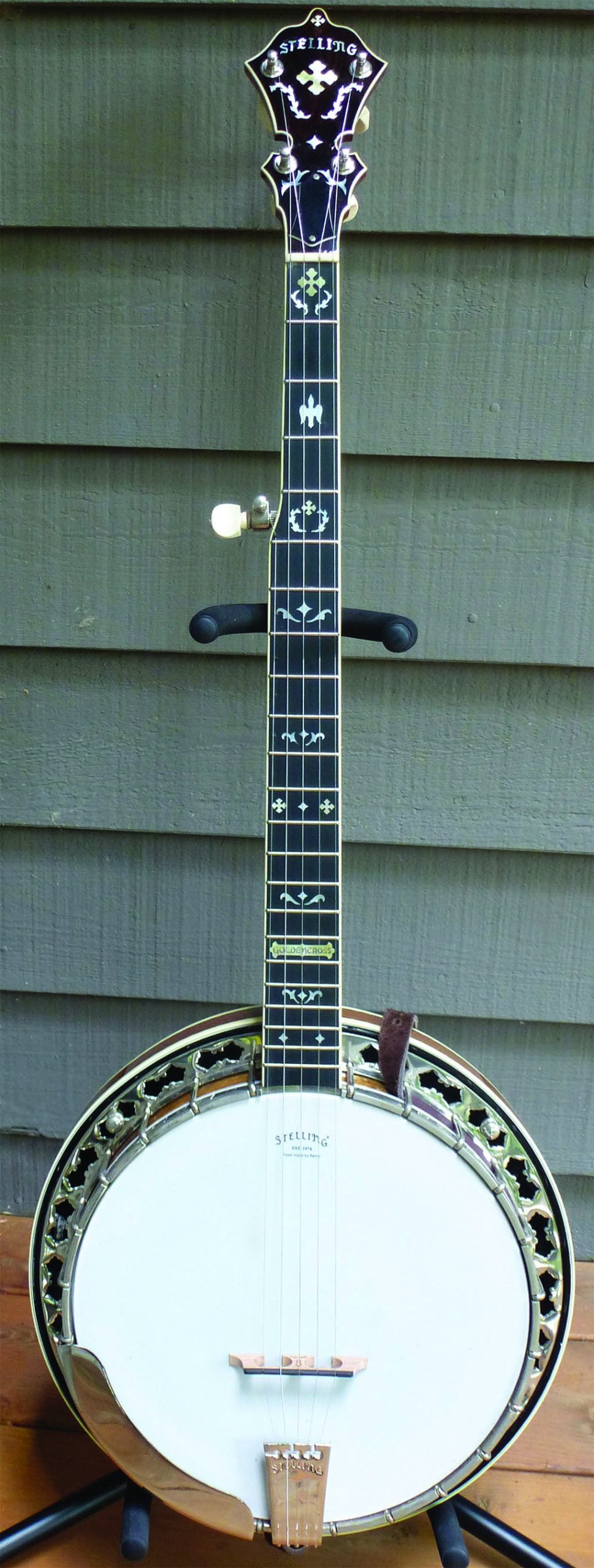
As the work progressed, Geoff kept in touch with me, sending me a few photos as he went along. I wasn’t sure how long the project would take—he had a lot of other jobs that also needed his attention—but a month earlier than he had originally predicted, Geoff sent me an email announcing that the “rebuilt Golden Cross is leaving the farm today.” Two days later it arrived on my doorstep.
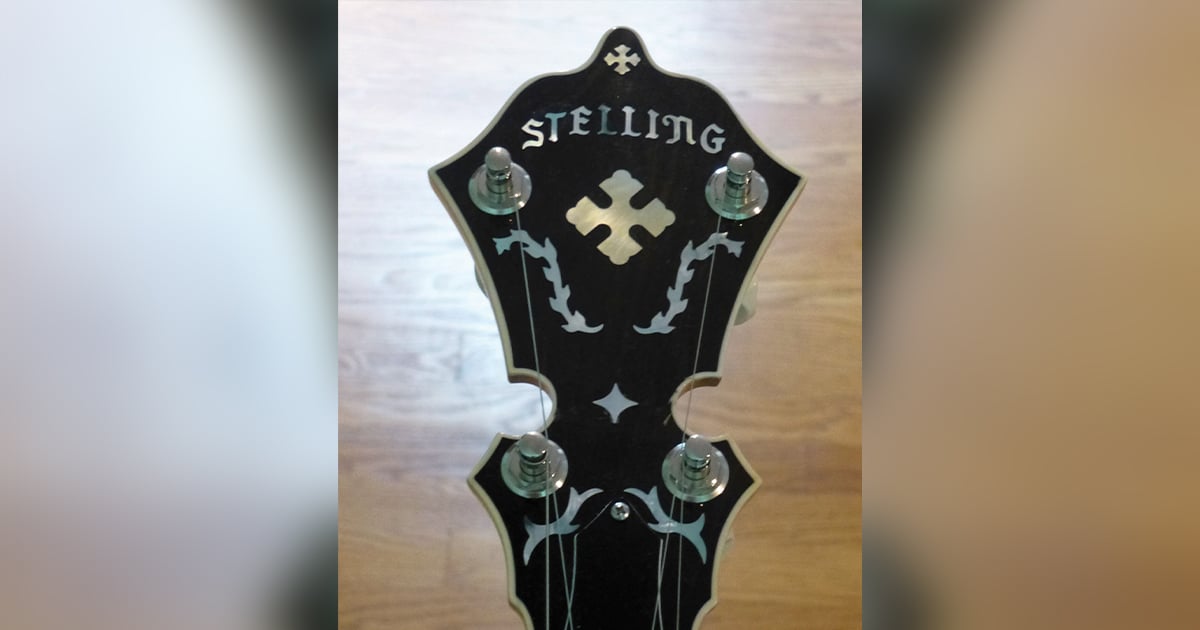
What I saw when I opened the case was not just a banjo, but also a stunning work of art. It looked like a brand-new instrument, and in many respects it was. The meticulous inlay work on the neck and on the back of the resonator was of museum-quality, and the walnut grain was absolutely beautiful. Perhaps most important, the distinctive Stelling sound was warm and crisp. I could not have been happier. Having not played much banjo over the past several years, I was a bit rusty, but I needed no further incentive to resume some diligent practice.
Although I have never met Geoff Stelling in person, our email correspondence has yielded a rewarding “cyber friendship.” Not only is Geoff a superb craftsman whose banjos are treasured by pickers all over the world; he is an extraordinarily modest and kind human being who cares deeply about the instruments that he builds (more than 7,000 to date)—he is attached to them as if they were his children. That, of course, explains Geoff’s initial outrage upon learning what had happened to Sunflower #4356, but it also explains the pride that he took in converting that Sunflower to Golden Cross #R4356. His final words to me on the topic were these:
“I am glad I changed my mind and that you are as happy as I am to have that new incarnation of the butchered Sunflower. The serial number R4356 will live on forever as a playable banjo that I and you are both proud of.”
I consider myself extremely fortunate to be able to tell this story, but I sometimes find myself wondering what Rob would have thought about it. It’s probably best that he will never know. Yet without Rob’s posthumous gift to me, and Geoff’s eventual willingness to rebuild it to his own impeccable standards, the old Sunflower’s remains might well have ended up in a dumpster. Instead, they served as the basis for a marvelous re-creation that once again can proudly display its craftsman’s name.