Bishline Banjos
Filling the Gap Between the Traditional and the Progressive
Photos by Mark Torrence
Although Tulsa, Oklahoma native Rob Bishline did not grow up listening to bluegrass music, the acoustic music of early 1970s performers like Jim Croce and Gordon Lightfoot did grab his ear. It wasn’t until about 1974, when he was 13 years old and heard “Dueling Banjos,” that he began his quest to discover that sound. His grandfather had a banjo uke, but that was not exactly the sound that he was hearing when he watched the Beverly Hillbillies or the Andy Griffith Show. He said that in that era it was a sound that he was even hearing on some TV commercials. He was very interested in finding out how he could produce it.
Rob knew that the sound he sought was coming from a banjo. He mowed lawns so that he could afford to buy a banjo that he spotted behind the counter at a local Service Merchandise store. Once he got the banjo in his hands, it still took a while before he was able to capture the sound he was seeking. In December 2001, Bishline told Banjo Newsletter “I bought a Mel Bay book and it was for chords in C tuning and I think it taught you how to hold a flatpick, but I just knew I was not getting it right.”
It wasn’t until Rob was looking through a copy of his father’s Popular Mechanics magazine and found an advertisement for a banjo instruction book that he finally zeroed in on his target. He said, “What was cool about it was that the book came with two 45 rpm records so that I could hear what I was supposed to sound like and that made all of the difference.” From this book Rob was able to learn songs like “Cripple Creek” and “Cumberland Gap” and create that sound.
From that time forward, Rob became a banjo fanatic. He would ride his bike to the record store and search for any album that featured the 5-string banjo. He even attached strings to a 2X4 and ran them over a banjo bridge so that he could practice his right-hand rolls in study hall at school. He said, “A lot of banjo players you talk to started by listening to Earl on the old Flatt & Scruggs albums—like the Foggy Mountain Banjo album—but the first album I found with Earl Scruggs on it was an Earl Scruggs Revue album and that stuff was just right up my alley because they were doing the Dylan tunes and stuff like that.”
Another album that Rob found at the record shop was Carl Jackson’s Banjo Player. Rob said, “That is a technical album, and that guy is a great player. That is the first stuff I started learning to play. I was slowing down the Earl Scruggs Revue and Carl Jackson albums.” When asked if he had heard of Carl Jackson or seen him play prior to buying the recording, he said, “No, I just saw an album at the store that had a banjo on it.”
Eventually, Rob found a banjo teacher, Bobby Anderson, at The Guitar House in Tulsa. When Bobby left the store, Rob started studying with his replacement Scotty Ward. By that time Rob had progressed to the point where he was good enough to sit in with Scotty’s band. By the time he was 17, Rob started teaching lessons himself at The Guitar House. After high school he did some touring with Pat Richardson as a duo and he also performed at Silver Dollar City in Branson, Missouri.
Rob’s interest in guitars and banjos extended beyond playing them—he also liked to “tinker” with them. The urge to tinker led him to move to Phoenix, Arizona in 1983 and enroll in the Roberto-Venn school of Luthiery.
Rob said, “The class there was a little over four months long and you built two guitars—an electric and an acoustic. They also allowed you to have a side project. Most guys would start another electric or acoustic guitar. I started building a banjo neck.”
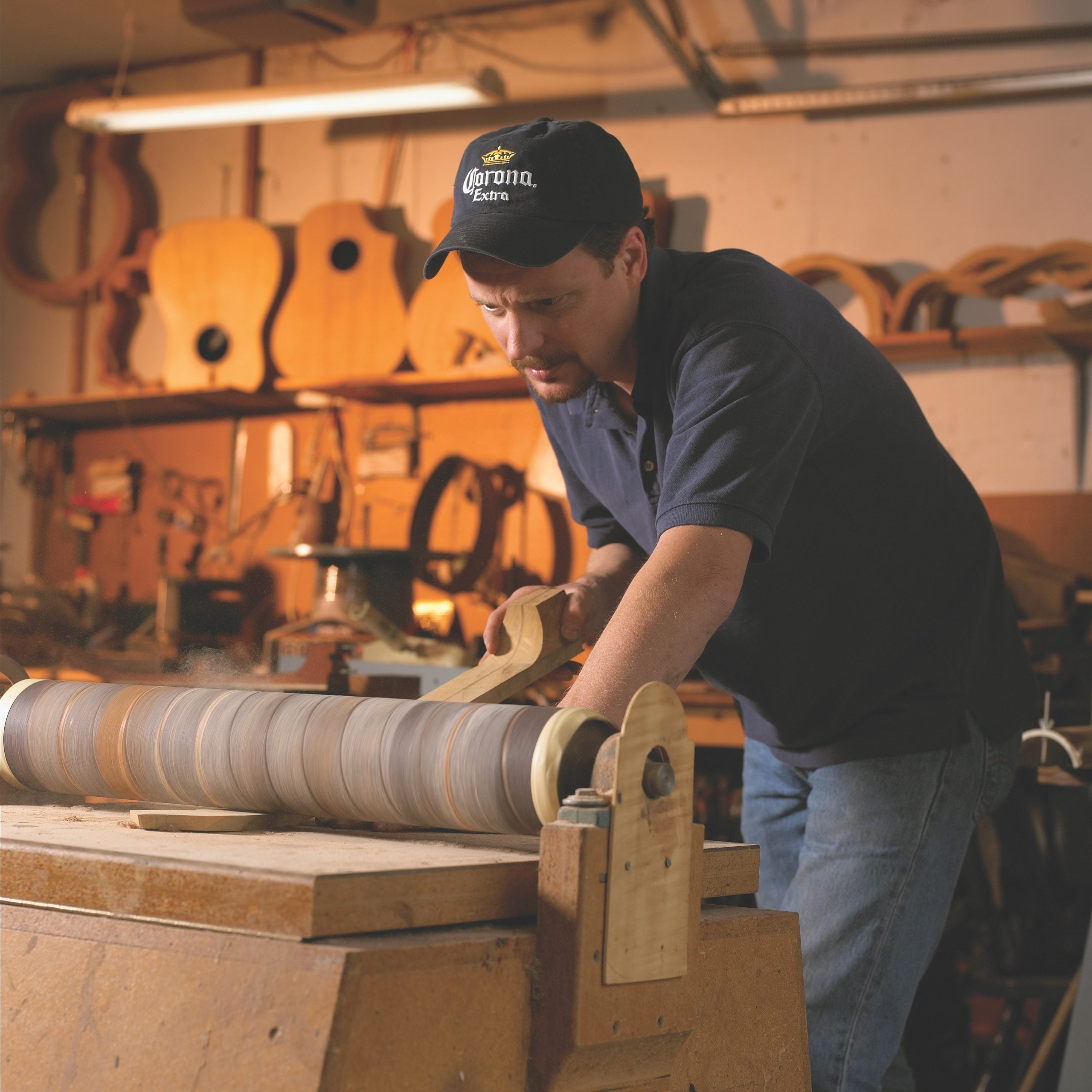
After returning to Tulsa, Rob started teaching again at The Guitar House and repairing guitars and banjos. He was interested in starting to build instruments, but the biggest drawback was tooling. He recalls, “The first thing I did was build a thickness sander. I went to the junk yard and got an old drive shaft off of a car and had it trimmed down and trued and made it into a crude thickness sander, and it worked.”
Bishline built his first banjo in the mid-to-late 1980s. He said, “At that point I had already built a few guitars. When I started building banjos, they were Mastertone copies. I’d build one and the store owner, Bob, would hang it out front and they started selling. I was probably selling about one banjo per month and along with teaching lessons and doing repair work it was a nice income.” He was also performing in various bands in the Tulsa area.
Rob continued to teach, perform, build, and repair at a moderate pace until a local businessman, Frank Davenport, bought several of his banjos in about 2003 and became interested in investing in Rob’s business. Together with another local investor, Andy Oatman, they formed a partnership. The investment and the business experience that Davenport and Oatman brought to the business helped the company grow significantly. The extra help also provided Rob with the time he needed to get creative and move away from making Gibson copy banjos.
Rob remembers, “We went to the NAMM (National Association of Music Merchants) show in Indianapolis in 2005 with six banjos and I ended up selling them all. Three of them went to Elderly Instruments in Lansing, Michigan. I also made many connections there that led to sales.”
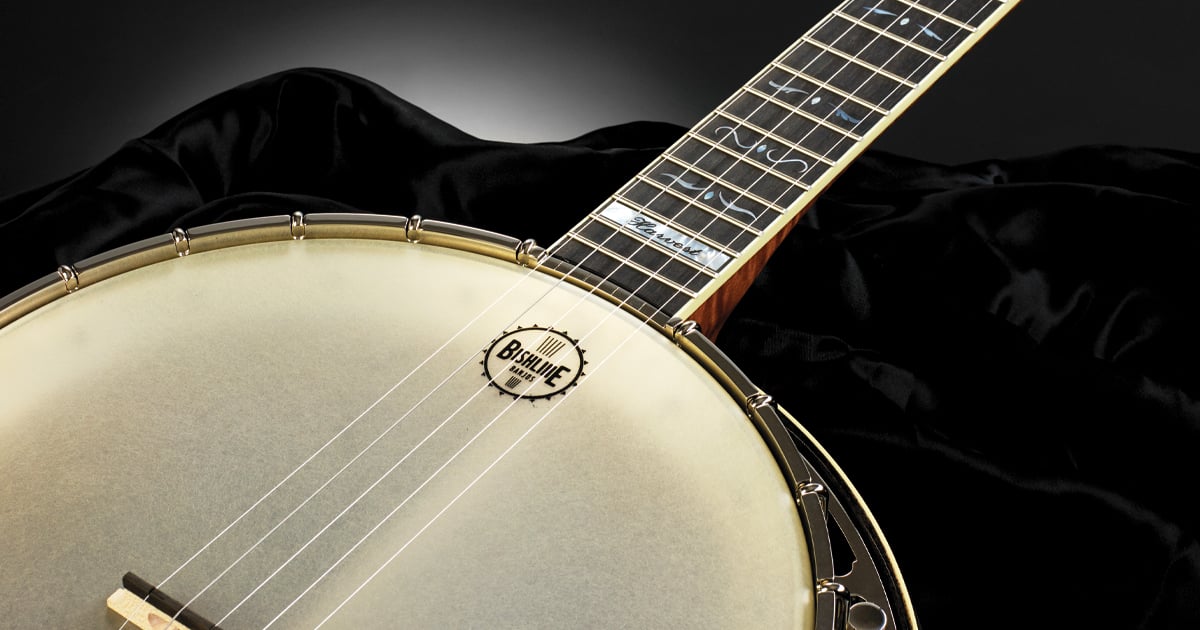
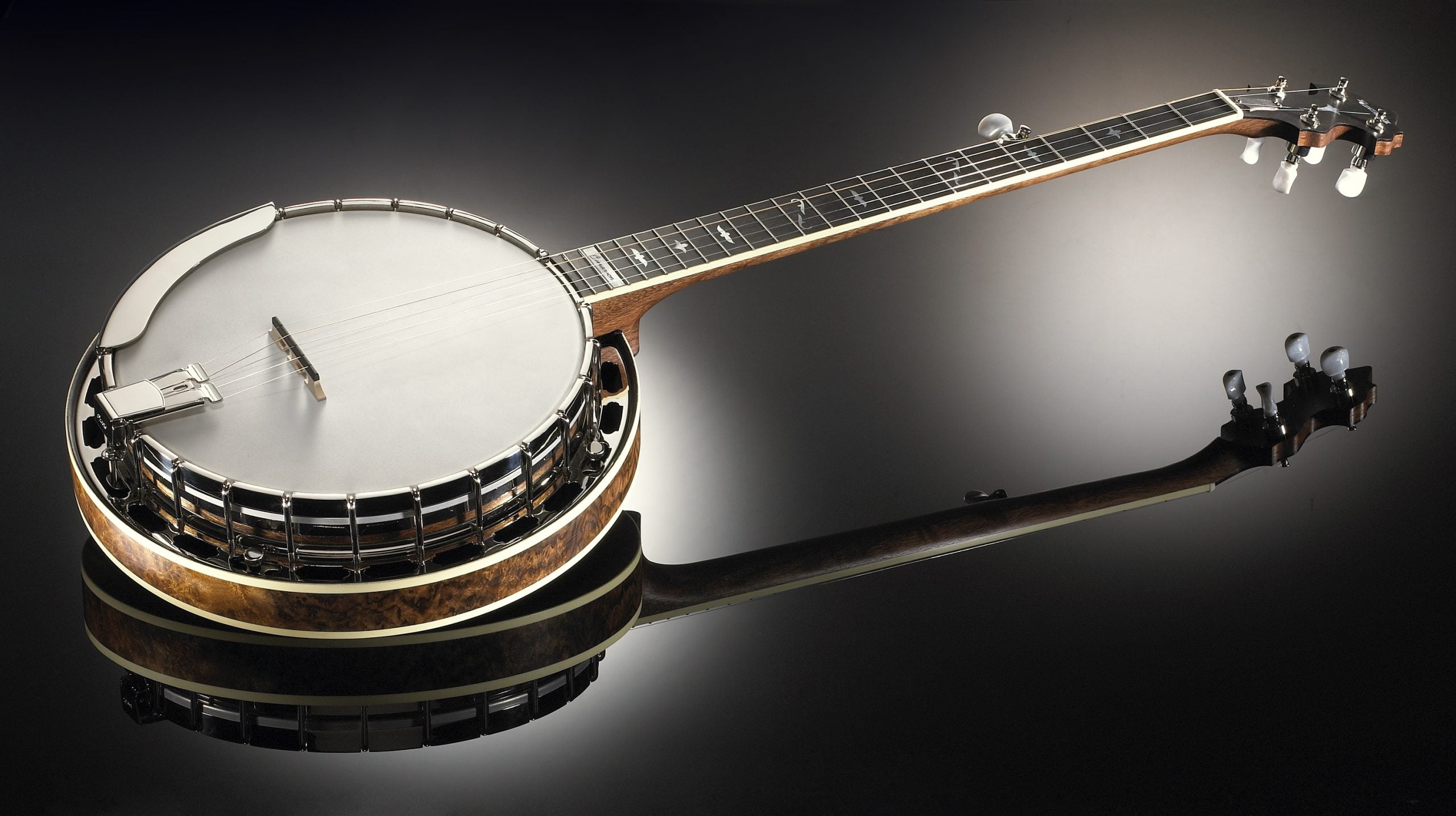
The first move away from building Mastertone copies was to use special grade woods—like cocobolo or burr walnut—and design his own inlays and appointments. Today, Bishline offers eleven standard models and four “Limited Series” models. The least expensive Bishline banjo is the Okie model, which is an open-back banjo with a mahogany neck, ebony fingerboard, Gotoh tuners, Dobson-style raw brass ring, two-ply maple rim, raw brass hardware, two-way truss rod, and hardshell case.
The lowest price resonator model is the Patriot, which features a burl walnut resonator, black binding, ebony fingerboard, a tone hoop ring, three-ply maple rim, nickel plated hardware, two-way truss rod and hardshell case. This banjo is in the $2100 range. Stepping up to the Cimarron model (add an additional $400), and you have the “bluegrass workhorse”—one of the most popular Bishline Banjo models. This banjo features a fancy burl walnut resonator, ivoroid binding, ebony fingerboard, Bishline tone ring, three-ply maple rim, nickel plated hardware, two-way truss rod, and hardshell case.
As the standard models progress in price, roughly adding $100 to $400 per step up, you move onto the Heirloom, the Harvest, the Danny Barnes, the Salty Dog, the Rosemary, the Midnight Moon, and end at the $3,895 Clermont, which is also a favorite for traditional bluegrass players.
The main differences that you will find between these models mostly has to do with the type of wood, the inlays, and the binding. The Danny Barnes model is the most unique, in terms of its parts, because it has a wooden rim/tone ring (which allows for high amplification without feedback). The most artistic model is the Midnight Moon with its black stained maple, koa binding, and constellation inlay. Modifications can easily be made to any model and include things like a wooden armrest; gold, engraved, blued, or powder-coated hardware; tunneled fifth string; modification of woods and binding material; archtop tone ring; and an ultra-light aluminum flange.
In the Limited Series, Bishline offers four models ranging from $4,995 for the Blonde Autumn model up to “please inquire” for the 10th Anniversary model (roughly $10,000). These models feature the Bishline “special reserve” ring and rim, plus more exotic and expensive woods, binding, hardware, and other appointments.
One of the stores that has carried Bishline banjos is Morgan Music in Lebanon, Missouri. The store’s manager, Alvin Deskins—a banjo player himself—said this about the banjos, “I like Bishline banjos because they are made in the United States and in the Midwest and because the Bishline banjos appeal to both the traditional and the progressive players. Their designs are unique, but are traditional enough that the traditional players will pick it up. At the same time, they are progressive enough that the progressive players also like them. Rob is bridging that gap. His banjos have a sound that the traditional players like, yet they are versatile enough to appeal to the progressive players.”
One of the more famous musicians who owns Bishline banjos is rock and roll artist Steve Miller. Rob said, “Back in about 2008 a guy I knew who drove the bus for the Steve Miller band called and asked if he could come by and get some work done on his banjo. I was at the shop and this big bus pulls up out front and Steve Miller walked into the shop. He is a wonderful guy who loves high end instruments. He has ordered two or three banjos and a Madera model (banjo/guitar) that I used to build.”
The Madera is an instrument that Rob designed that has a guitar body, but a five-string banjo neck. You can see Rob playing a Madera on the tune “Both Sides Now” on his website (under the Video tab, select Tabs and Tips and scroll down). The one he built for Steve Miller features Brazilian rosewood that Miller provided.
Rob is now the sole owner of the business after Andy Oatman’s passing in December 2019. In addition to spending time building, Rob also always maintained a teaching and performing schedule—although the pandemic has put that on hold. Rob said that he loves to teach banjo lessons as it provides him with a break from the work in the shop. If you’d like to view Rob playing and teaching tunes, go to that same Video tab (select Taps and Tips) on his website (bishlinebanjos.com). He provides some nice video lessons, with downloadable PDF tabs included.
If you are searching for a very nice banjo that will offer you a traditional sound, yet also allow you to explore more progressive banjo styles, check out the Bishline website and then give Rob Bishline a call.