Homespun Heroes
For Over 50 Years, Great Homespun Artists Have Taught Us How to Play Music
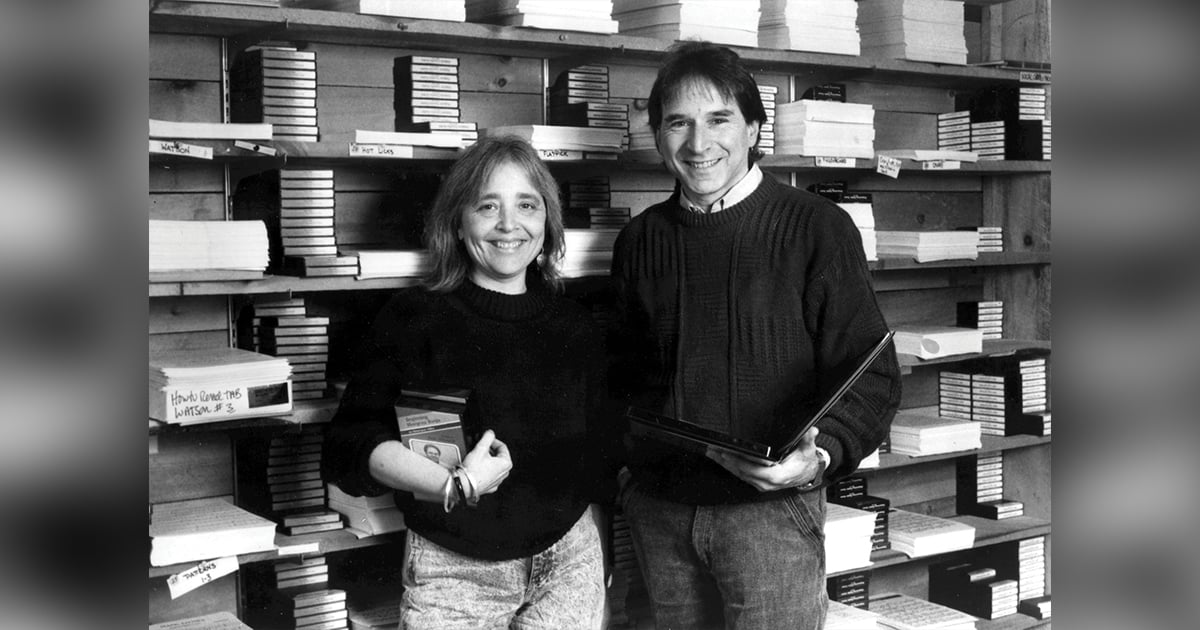
For many bluegrass musicians who have tried to improve their skills over the last 50 years or so, whether it is professional artists or campground pickers, the Homespun Music Instruction Company has played a part in their journey. There is most likely a Homespun DVD case lying around somewhere amongst the music gear of many bluegrass artists, sitting on the shelf of a TV stand or in a drawer somewhere or in a box in the attic. For years, the company was known as Homespun Tapes because their instructional VCR videos were the technology of the day until DVDs became the standard in the 1990s. Now, of course, Homespun instructional videos are downloaded and watched digitally on cell phones, tablets and smart TVs. No matter what form of technology is dominant in any given era, the heart of what makes the Homespun organization valuable to musical abecedarians of all levels are the original goals of the company: to connect the beginning, intermediate and advanced musicians with famous artists who are willing to share and explain their skills. At the heart of the Homespun story are the creators of the company, Happy and Jane Traum. Longtime residents of Woodstock, New York, the couple have created and mailed out instructional music products for over a half a century now. The love story surrounding Happy and Jane Traum centers on the folk music boom of the late 1950s and 1960s. It was a heady time for acoustic music with a lot of it centering on the Sunday afternoon get-togethers on Washington Square in Greenwich Village in New York City. After they met, Happy and Jane were married a year and a half later in 1960.
Happy Traum became a gigging musician at an early age. He loved to play not only folk music, but blues music as well, having been lucky enough to be taught by blues great Brownie McGhee. By the mid-1950s, Traum was performing throughout the Northeast. While exploring the trail of Happy’s career as found in the newspapers of the time, his name first appears in the Philadelphia Inquirer on May 3rd, 1959. In the short blurb, Happy and his musical partner Dick Weissman are performing a “folk concert” at the Benjamin Franklin Hotel. In an article about another performance by Happy and Weissman found in the Delaware County Daily Times from March 13, 1961, more is written about Weissman’s style, saying, “He represents the serious banjo school and has introduced a number of innovations in the art, such as triple thumbing.”
By 1962, at the height of the boom, Happy has joined the New World Singers along with Gil Turner and Bob Cohen. By the time the group performs in Chicago the next year, they appear in the Chicago Tribune newspaper on September 1st, 1963. In an ad for their concert at the famous Gate of the Horn club, located in the basement of the Rice Hotel and run by legendary music manager Albert Grossman and journalist Les Brown, the trio is shown in a professionally shot PR photo. Opening up the show are The Outsiders and Maxine Sellers. On the same page is the group’s competition for the week as the Smothers Brothers are opening a three-week run at Mister Kelly’s nightclub.
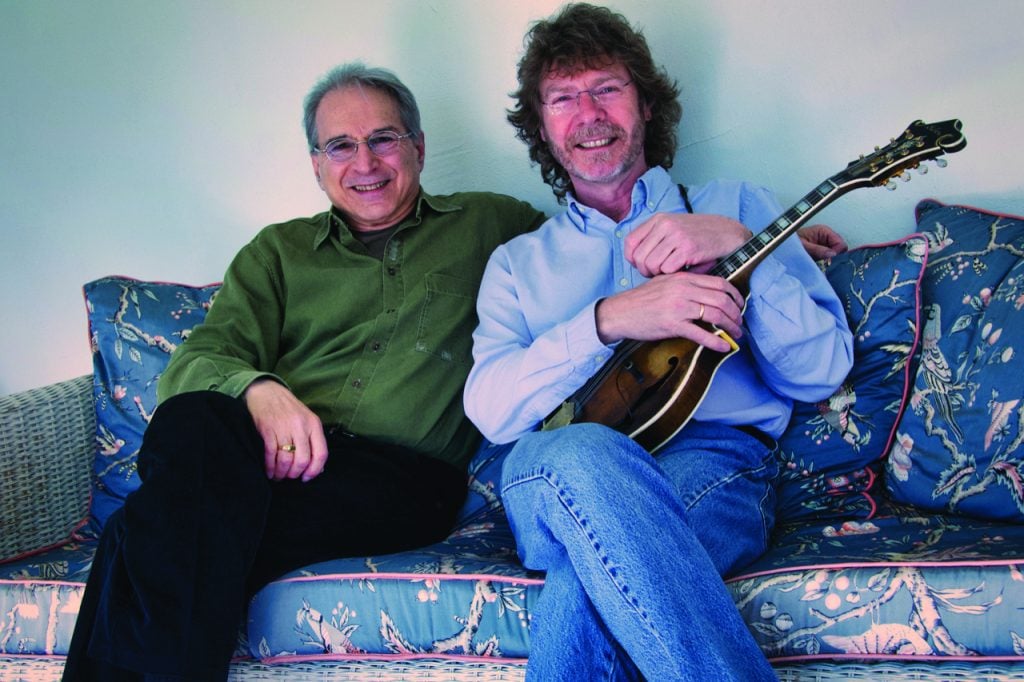
Earlier in Happy’s life, banjo great Eric Weissberg was in his high school class and that was when Happy became aware of the bluegrass genre. Weissberg would go on to record the very successful version of “Dueling Banjos” culled from the soundtrack of the movie Deliverance and also appeared on the ground-breaking album by Bob Dylan called “Blood On The Tracks.”
While Happy has never considered himself a bluegrass musician, he has always loved it and knew that he wanted to be a part of the scene.
“I remember going up to Eric’s apartment, where he lived with his parents, and he had these big reel-to-reel tapes and on them he recorded Flatt and Scruggs live off of the radio,” said Happy. “They were on WWVA and the Wheeling Jamboree, I think, on one of those southern radio stations that reached all of the way up to New York. Those tapes were my first introduction to bluegrass.”
Jane Traum took a different journey to the world of roots music.
“While I dabbled with the banjo and singing and that kind of thing, I don’t really play an instrument, but I do run the (Homespun) company,” said Jane. “I started out as an actress and studied and did several plays in New York. But, I turned myself over to developing Homespun and I am loving that part of my life. I’ve done it for about 55 years and I’ve loved every minute of it. It has been very challenging, but I feel like we are doing something really important as far as documenting this music that we both love and care about. We have met some incredible people and incredible musicians along the way.”
After making his mark during the folk boom, even recording with Bob Dylan in the early 1960s, Happy decided to create and sell audio-only instructional music lessons.
“I did a series of fingerpick guitar lessons and in those days it was on reel-to-reel tape, if you can believe that,” said Happy. “We would record it from a master copy and run them off on little five-inch reels. Then we’d pack them up in boxes and slap a label on them and send them off. Jane usually did all of that while I was on tour somewhere. Cassettes came in a couple of years later, so we had to add cassette machines to the lineup. It would be 20 years before we produced anything visual, which happened in the early 1980s when VHS tapes came in.”
While Homespun always featured instructional tapes for many styles of music, the bluegrass genre was a natural as the increase in the popularity of bluegrass festivals meant more people wanting to be able to jam in the campgrounds. The great melodic banjo player Bill Keith lived just a few houses down from Happy and Jane in Woodstock and he became one of the first bluegrass teachers for Homespun. Many great bluegrass musicians would follow.
In many cases, great artists do not always have the ability or patience to teach others their genius. But, as his new business began to flourish, Happy realized that he could interview various musicians in certain videos and successfully unveil wonderful instructional information from them. In another example, in the case of Bill Monroe’s first and only instructional video, Happy brought in the late and great John Hartford to interview the Father of Bluegrass.
There were many musicians, however, that were naturals when it came to sharing their art.
“Bill Keith and Kenny Kosek were the first two bluegrass-style people who taught for us, and then eight years later or so we started going to places like the Walnut Valley Festival in Winfield, Kansas, where we met Mark O’Connor and Merle Travis,” said Happy. “Eventually, we went down to Bowling Green, KY, to record Sam Bush. We also met Doc Watson at many of the same festivals we were playing together, and we did the only tapes ever made by his son Merle Watson. When I asked Merle to do lessons for us, he was still a little bit in the background since his father Doc was the big star. But, Merle was such a good picker and such a good guy that we went down to Deep Gap. NC and stayed at their house and recorded Merle with Doc backing him up on guitar. Then, we went down to MerleFest with our cameras and filmed a whole bunch of lessons with Doc as well. Doc and wife Rosa Lee were always appreciative that we featured Merle in our lessons. Having those two on our tapes was a great honor, but so were people like Jerry Douglas, Mark Schatz, Sam Bush, and Tony Rice.”
“Dr. Banjo” Pete Wernick was also an important of the Homespun story, according to the Traums. In addition to his great work as a member of groups like Hot Rize and Flexigrass, Wernick was a natural teacher and filmed excellent banjo lesson videos. But he also set about creating a set of influential lessons on how to be a part of a bluegrass jam, teaching jam etiquette as well as how to musically play with others.
With Homespun being over half a century old, Happy and Jane take a heartfelt view of the vitality they have captured on video of artists that are no longer with us. From Happy’s duet partner and brother Artie Traum to Monroe and Keith, from artists such as Dr. John, Chet Atkins and Etta Baker to John Hartford and Levon Helm, many in the Homespun family have left this world.
This phenomenon hit home recently with the sudden death of Tony Rice. One of the best and most influential artists in all of bluegrass, when news of Rice’s passing spread around the globe on social media, many posted his solo performance of “Church Street Blues” found on one of his numerous Homespun instructional videos.
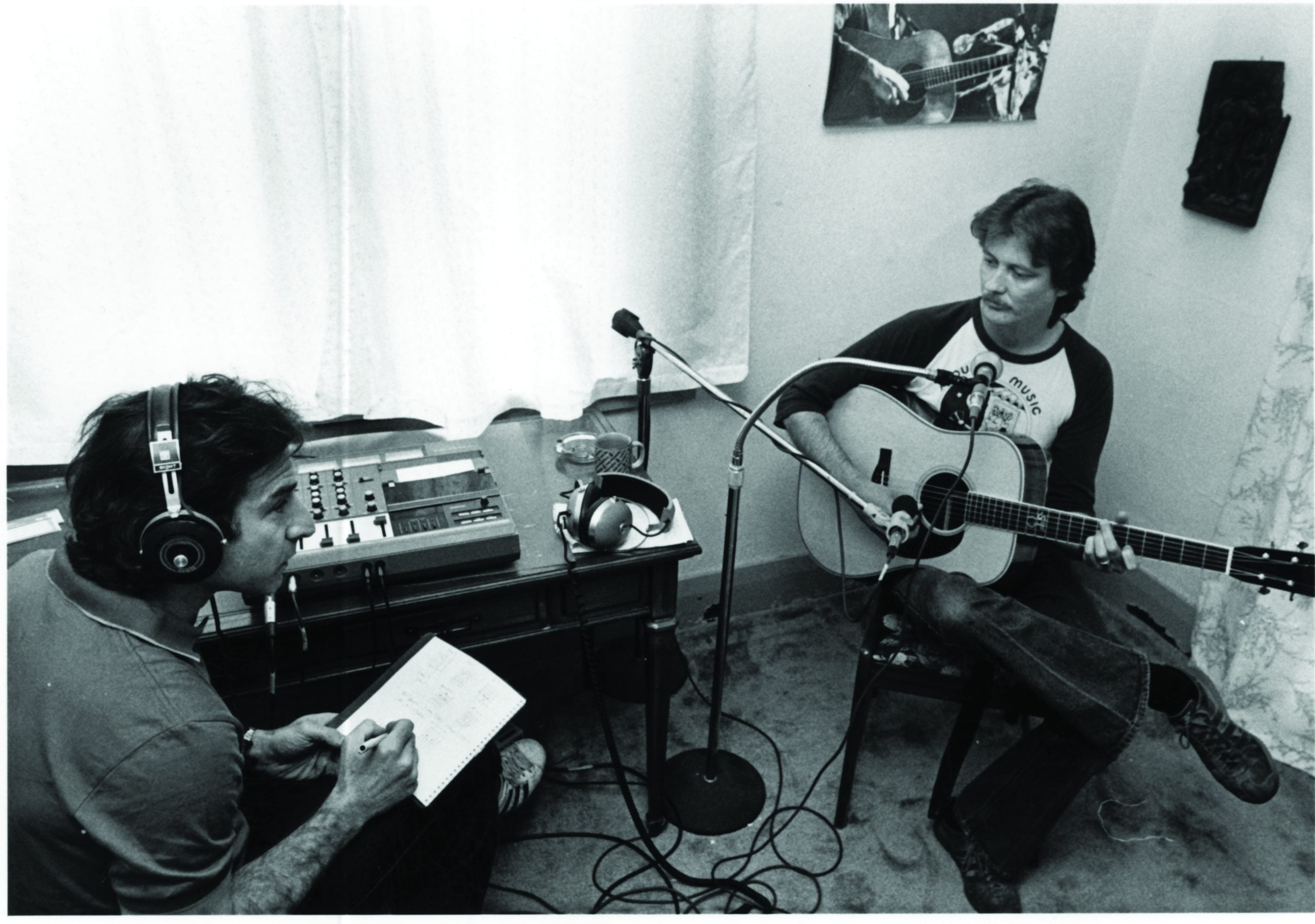
“We were very sad to hear of Tony’s passing and we knew him very well and I would talk to him on the phone periodically, although not so much in his last year,” said Happy. “He would call us every now and then and check in. We knew that he was ailing for a long time and had health issues, so we were aware of all of that so it wasn’t a total shock, but we were so sad. He was such a special person, both for music, because he really changed the way people heard the guitar as he was one of the great guitar players of all time, but he was also a very special guy. He was very loving and just a special person. He was very loyal to us. We miss him terribly and are very sad to lose him.”
In the beginning, Happy and Jane Traum were just thrilled to be able to offer lessons by their own heroes such as Pete Seeger, including gaining the rights to sell Seeger’s legendary instructional book on playing the banjo. But now, almost 60 years in, the Traums are as motivated as ever, taking full advantage of current digital technologies and seeking out young talent to make new instructional recordings. Their son Adam Traum has stepped up with excellent instructional videos and the roster is still expanding.
As for their time in the bluegrass world, Happy and Jane have loved every minute of being a part of this unique musical family. In 2007, both were given the IBMA Distinguished Achievement Award for their amazing efforts in furthering bluegrass music.
“I have a lot of fond memories and moments of being with the artists and the people that we have worked with as we have become very good friends with many of them,” said Jane. “People come and visit and stay with us, aside from the projects we have done together. Sharing our musical world with people and them sharing it with us, it is very thrilling to have your business weave in with people that you really care about. One of my very favorite moments was when the IBMA Week was still in Owensboro and we had just come out with Bill Monroe’s DVDs and he spent a lot of time with us at our booth. He hung out and talked and played and told jokes and it was really thrilling to be in his presence like that.”
Happy has also enjoyed his time deep in the heart of the bluegrass world.
“During all of the years that we exhibited at IBMA Week, we always had a booth right next to Bluegrass Unlimited Magazine and Pete and Kitsy Kuykendall,” said Happy. “We became good friends with them and remain so with Kitsy. It was so sad to lose Pete as he was a rare individual and we always loved spending time with them, including at MerleFest and other places. That was really special. It’s not just business for us.”
As for the future, “We have so much more to do,” said Jane, laughing.
“I think we are proud of what we have accomplished, but I also think we have just scratched the surface,” said Happy. “We just keep going, and we’ll keep going as long as we’re able to.”