Larry Perkins—The Best of Both Worlds
Reprinted from Bluegrass Unlimited Magazine
May 1991, Volume 25, Number 11
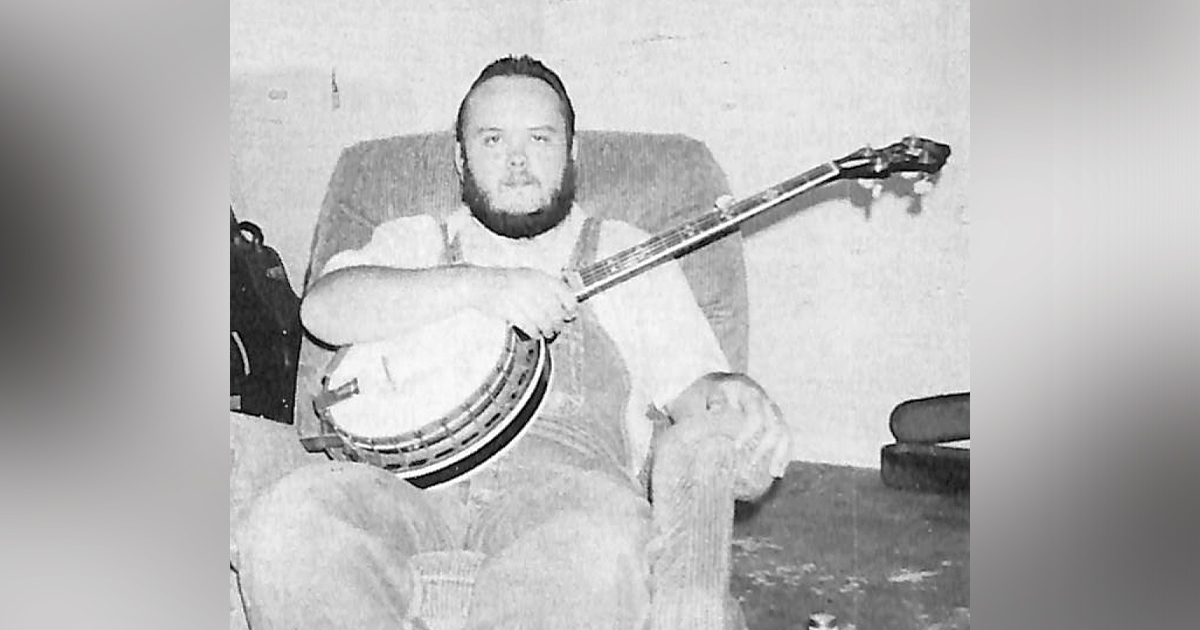
You’ve seen him selling instruments at a lot of bluegrass festivals, this friendly, soft-spoken, unassuming fellow with the beard and bib overalls. You’ve also seen and heard him playing banjo and finger-style guitar onstage with Curly Seckler and the Nashville Grass. His banjo style has been compared favorably to that of his close friend, the legendary Earl Scruggs. Raymond Fairchild, certainly not a man to bestow empty plaudits, says that “Larry Perkins is the closest man to Earl Scruggs, note for note, roll for roll, that’s ever lived—he picks the banjo now like Scruggs picked it in the ’50s.” And some have even speculated that Perkins (see BU, Notes & Queries, April, 1989) is one of Earl’s relatives!
The truth, as usual, lies somewhere in between. What is a bit surprising, especially for someone Larry’s age, is his phenomenal success, both as a musician and as a dealer in vintage and new bluegrass instruments—in such a short time.
Larry Freeze Perkins was born January 31, 1961, in Grant County, Indiana, near the Kentucky border. His parents are Larry and Jolene Freeze Perkins, now of Kannapolis, North Carolina, where they moved in the mid-1970s. There was music in both his parents’ families:
“Daddy was a guitar picker and drop-thumb banjo player. Almost everybody on his side of the family was a banjo player. My mother played piano. They farmed and later my dad worked for General Motors in Marion, Indiana,” Larry revealed.
Perkins has two siblings, an older brother and a younger sister. As a child, the first live music he heard was hymn singing in the local Methodist church. “I also heard my uncles and grandfather playing drop-thumb banjo and I guess the first recorded music I heard was the Carter Family and Roy Acuff. There was mostly just the old-time mountain music in the area where we lived. I had people that played all the way from Harlan, Monticello, Bowling Green, and Owensboro (Kentucky).”
So there was not much actual bluegrass music, as such, in Larry’s life when he was growing up. He recalls, “I never heard Bill Monroe. I can remember my dad talking about him, though. The first bluegrass that I heard myself was the Flatt & Scruggs Martha White television show. I guess I was attracted to their music right off, especially to Earl’s banjo picking, but I just saw them once or twice on TV. Really, it was way up in the late 70s before I had any access to records and tapes.”
Perkins was not destined to meet Earl Scruggs until 1979, but the two men would become good friends eventually.
Larry’s mother’s relatives were from Kannapolis, so it was only natural that the family relocated there “after Dad’s people died.” This Cabarrus County textile center of 36,000 population is the home base of Cannon Mills and the area has always enjoyed a healthy economic base. Later, when Perkins began dealing in vintage bluegrass instruments, he would find the Kannapolis area an excellent source of old guitars and banjos.
Once in North Carolina, the teen-aged Larry attended school and worked in construction, but his mind was on music most of the time. Following the example of his dad and other relatives, he played guitar and drop-thumb or clawhammer style banjo, but had no instruments of consequence: “I washed dishes one whole summer and was able to buy a homemade fretless banjo; it had a squirrel skin head, but no resonator. I had the banjo about two weeks when I played by myself one night at an old-time camp meeting called Camp Wesley,” Larry said. “A man named Banks Patterson was there. He and his brother were doing gospel music and invited me to play with them some. We played some churches around the China Grove, North Carolina, area.”
“Mother Maybelle Carter was one of the musicians that influenced me the most on the guitar,” he recalled. Perkins still had the three-finger Scruggs banjo style on his mind. “My Uncle Harlan was trying to learn three-finger style. I guess he was the one that inspired me the most to learn. A guy named Curt Ballard gave me my first picks.”
While attending church, Larry met a banjo player named Wade Garrett and his wife, who played guitar. “Wade owned an old Gibson Mastertone banjo and played with three fingers, but he played different than Scruggs. Wade’s actually got his own style and that was the first three-finger banjo picking that I was personally exposed to,” Perkins recalled.
Perkins was working at the Daily Independent, a Kannapolis newspaper, when he met Adael Shinn, who was also working there as a proofreader. They were later married and became the parents of a daughter, LeAnne. Adael is quite a accomplished vocalist and bass player in her own right and LeAnne is interested in playing the mandolin.
Sometime in this period, Larry began “tinkering” with old stringed instruments. “I kept a couple of Martin guitars and Gibson banjos around, more or less as a hobby. Then I hurt my back working for the Prison Department in 1985 and went into selling instruments full-time after that,” he recalled. “I was bedfast for a while and conducted business by telephone, acting as a middleman between the seller and the buyer.” Despite a major back operation, Perkins still isn’t able to perform heavy work, so the music business enables him to make a living doing something he enjoys. “I’ve been real fortunate in finding some nice old instruments,” he said. These include two prewar Martin D-45s, several original Herringbone D-28s, old D-18s and D-21s, as well as some original flathead Gibson Mastertones and several other types of sought-after vintage bluegrass instruments.
In 1987, Larry was offered the Gibson franchise. “Greg Rich, who is in charge of Gibson’s banjo production, encouraged me to get the franchise. I first met Greg through Earl. I had some work I needed done on my banjo and at the time Greg had just moved to Nashville and started working with Gibson. Earl told me that Greg was the finest craftsman anywhere and took me over to the plant to meet him. I was really impressed with what he did with my banjo,” Larry recalled.
With the re-designed Earl Scruggs model banjo and the reissued Granada and RB-3 banjos and the F-5L Loar model mandolin, “Things really took off,” Perkins said. Between January, 1989 and June, 1990, Larry sold $130,000 worth of new Gibson banjos alone, making him the largest volume dealer. He attributes his success to the quality of the new instruments: “The way I see the market now, demand for the prewar banjos other than the original flatheads has slowed down a lot. The new Gibson banjos are made to exact specification of the prewar models, including the original formula for the tone rings and a lot of folks feel that the new ones are better buys.”
Perkins opened a second store in Maggie Valley, North Carolina, in May, 1990, to augment his existing business in Kannapolis. The large building, which was formerly an upholstery shop, is located near Raymond Fairchild’s Maggie Valley Opry House. “Raymond had mentioned to me that the building was vacant,” Larry said, “and we both felt that the Maggie Valley area needed a music store; there’s really nothing closer than Asheville or Waynesville.”
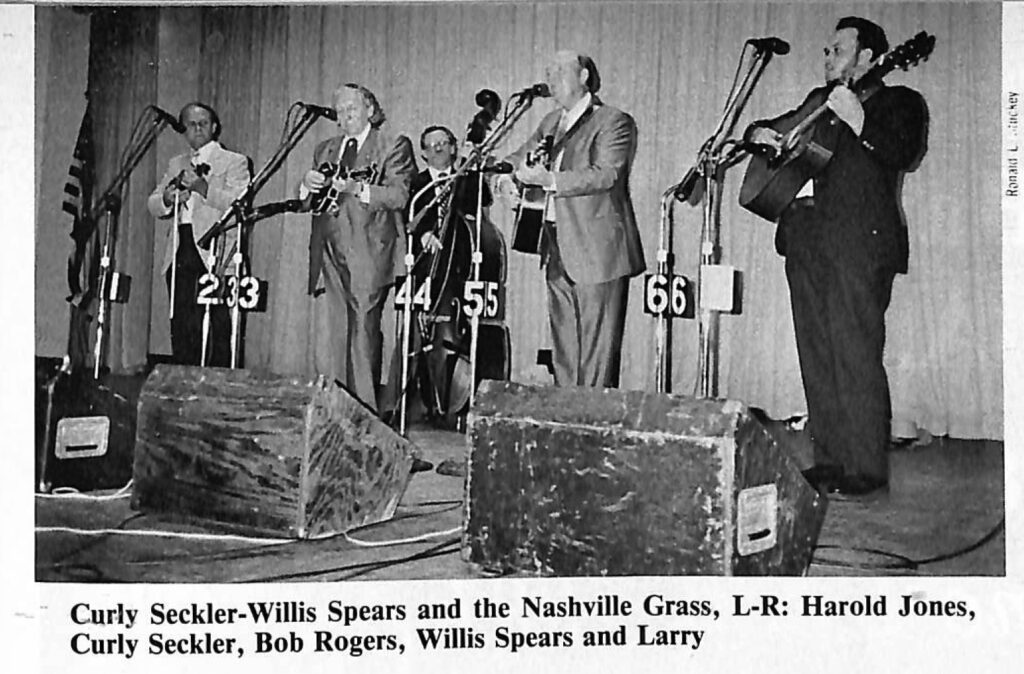
Larry became a member of Curly Seckler’s Nashville Grass in January, 1988 and played his first show with them at the Jekyll Island, Georgia, New Year’s Bluegrass festival. Shortly afterward he participated in a recording session with the Seckler band in Nashville, in which they waxed a “Tribute To Lester Flatt” (Rebel C-4301). Perkins also recorded in February, 1990, with Clarence Greene, mandolinist Dewey Farmer and Larry’s wife Adael, on a cassette project for Greene. Larry had met Farmer through guitarist Boyd Wagoner around 1979 and played with him informally, filling in some dates with Farmer’s and Harold Murphy’s Foggy Mountain Grass.
Much has been made of the similarity of Larry’s and Earl Scruggs’ banjo styles. Perkins described his first meeting with Scruggs: “Well, I first met him in 1979, in Winston-Salem, North Carolina, at the Carolina Street Scene. He was there with his sons. I talked with Earl some and bought one of his records and I just had a fit over it. We’ve been good friends ever since.”
Asked if he consciously tried to imitate Scruggs, Larry replied, “No, I really didn’t. I guess it’s just a coincidence, really. When I was starting out, I really hadn’t heard much of his picking, just maybe a couple of times when I was real young, on television and the Beverly Hillbillies thing. I played probably two or three years before I ever got one of Earl’s records. The main thing that influenced me was to try to play the tune of a song.”
Raymond Fairchild, who was present for this interview, volunteered, “I’ve asked Earl about Larry’s picking and he told me that Larry was the closest [to Scruggs] he’d ever heard.” So, Larry Perkins the instrument dealer and musician, enjoys the best of both worlds. And in the words of his close friend Raymond Fairchild, “When God made Larry, that was just another good thing He done.”