
Bobby Atkins—A Rededication to Bluegrass
Reprinted from Bluegrass Unlimited Magazine
August 1985, Volume 20, Number 2
Photographs, albums, and posters crowd the walls of the hand-built frame structure that once housed Bobby Atkins’ Stokes Recording Studio in Summerfield, ten miles northwest of Greensboro, North Carolina. Atkins’ career has included three stints with Bill Monroe, ten albums of his own, radio, movies, television, and leading bands that included such nascent stars as Tony Rice and Jimmy Arnold. That rich musical life, however, remains far from complete, for his family band, Bobby Atkins and the Countrymen, is just coming into its own as a fine bluegrass outfit.
Surrounded by the memorabilia of thirty years in bluegrass and country music, Atkins, heavy set, mustachioed over his grin, relaxes on a plain brown sofa. “When I get all up tight, I come out here and set down and look at all these pictures. I get all OK right here in a few minutes,” he says. “I’ve done bluegrass the whole time, but I’ve had to do others, too, many things. I can play blues. I can play classical. I can play bluegrass or country, because I’ve had to do that to make a living down through the years. Last year I decided I’m done with that. I’m getting back into bluegrass again.” That’s good news for Atkins possesses a distinctive, bluesy banjo style built on Reno and Scruggs. In top form he can bring sensitive expression to the slower numbers, tear down the fast ones, and provide exquisite backing that accentuates the singer’s words and emotions. The arduous task of regaining that ability affirmed Atkins’ rededication to the music. “I’ve got all that back now, but it took me a year to do it, because I sat in clubs and played this easy stuff. When it came to hard driving banjo, my first break would be fine, but [in] the next one my hand would give out. I squeeze that ball every day to keep my hands in shape, and then I practice every night as hard as I can. So I’ve got that good, hard banjo picking back.”
Picking came naturally to Atkins, born on May 22, 1933 at Shoals in musically rich northwestern North Carolina, His father fiddled and plunked clawhammer banjo, while his mother, adept at autoharp and the keyboard instruments, taught her son three chords on the guitar when he was five years old. By the time Atkins started school, his family had moved to Gold Hill, just a few miles from Curley Seckler’s hometown of China Grove.
He made friends with schoolmates who also liked to play music. In second grade Atkins, his brother Kemp, and three other children would be “down in the woods about all the time playing like we was on the Grand Ole Opry.” Teachers soon caught on and tried to encourage the kids’ interest by asking them to sing and play for their classmates. Atkins and company proved too shy to comply. Finally, the two guitarists and their back up singers performed “Working On A Building” as part of a school play.
“When we got through,” Atkins recalls, “the principal sent for us to come to his room. We were bashful and scared, too. We didn’t know but what he wanted to whip us or something. He wanted us to do a couple of numbers for his class. He gave us fifteen cents and a pack of chewing gum apiece.”
The hard work required of a sharecropper’s son caused Atkins to leave school after fourth grade, but he never gave up music. He stuck to the guitar until the exciting new music later named bluegrass filtered into his area. During the late 1940s Atkins saw Don Reno at the Madison Drive-In as one of Tommy Magness’ Tennessee Buddies. “He played the ‘Foggy Mountain Breakdown,’ and I like to had a fit. I knowed then that I’d pick a banjo, so I swapped an old watch I had for one. I got me three picks and I went to work on that roll. If I walked to the store or wherever, if I wasn’t working on the farm, I had that old banjo around my neck practicing.” Atkins immersed himself in as much bluegrass as the radio, records, and live performances could provide him.
In 1951 as a guitarist he joined the Rainbow Pals, a country group fronted by Hawaiian guitarist Joel Puckett. As Atkins learned from the bluegrass banjo pioneers, he got to play a few Monroe and Flatt & Scruggs tunes with the band. Atkins desired to play nothing but bluegrass. He left the Rainbow Pals after about a year, becoming a member of a part-time band that Carlton Haney had organized in Reidsville.
Haney arranged an on-stage audition with the Blue Grass Boys for Atkins in 1954 at Reidsville’s Broadway Theatre. Atkins recalls that the Father of Bluegrass Music seemed as big as a bear to his inexperienced eyes. After the young picker finished his pair of banjo tunes, Bill Monroe told the audience, “‘That’s better than I thought it was going to be,’ because he’d never heard me play. He told me he would send for me in two weeks, which he did.”
On an icy January day, Haney drove an excited young banjo man to Luverne, Alabama in his 1951 Cadillac. By evening Atkins’ euphoria had turned to despair while he tried to relax in a strange hotel room, so far from his close-knit family. Monroe recognized homesickness and after three days reluctantly gave Atkins bus fare back to North Carolina. Monroe did not give up on Atkins; he later used him as a replacement for Buck Trent during a swing through the Carolinas and Virginia.
Atkins, meanwhile, gained the personal and musical experience he needed working for Jim Eanes and Charlie Monroe during the mid 1950s. Twenty years later he paid homage to the elder Monroe with his album, “A Tribute to Charlie Monroe” (Old Homestead 90082). Atkins eventually joined the Flint Hill Playboys, led by Arnold Terry and Benny Jarrell.
In 1956, Atkins formed a partnership, which would last fifteen years with guitarist Joe Stone. Bobby Atkins, Joe Stone, and the Dixie Mountainaires became the house band of the Old Dominion Barn Dance on Richmond’s powerful WRVA. Although the group played bluegrass, their role required them to back a variety of leading country acts including Kitty Wells, Wanda Jackson, Archie Campbell, and Stonewall Jackson. The original lineup included Atkins on banjo, Stone as guitarist, Frank Buchanan picking mandolin, and Art McGhee, fiddler.
Atkins and Stone became west Texas bluegrass missionaries the following year. Al Perkins, an Odessa native now playing Dobro with Chris Hillman, remembers the 1950s as when western swing was all he could hear on the radio. Yet into this flat land of Bob Wills, hard water, and rattlesnakes went Atkins and Stone to play bluegrass for Happy Jack and Helen Williams. They broadcast two radio shows a day in Odessa and drove 65 miles to Big Springs for a live television program on Saturdays.
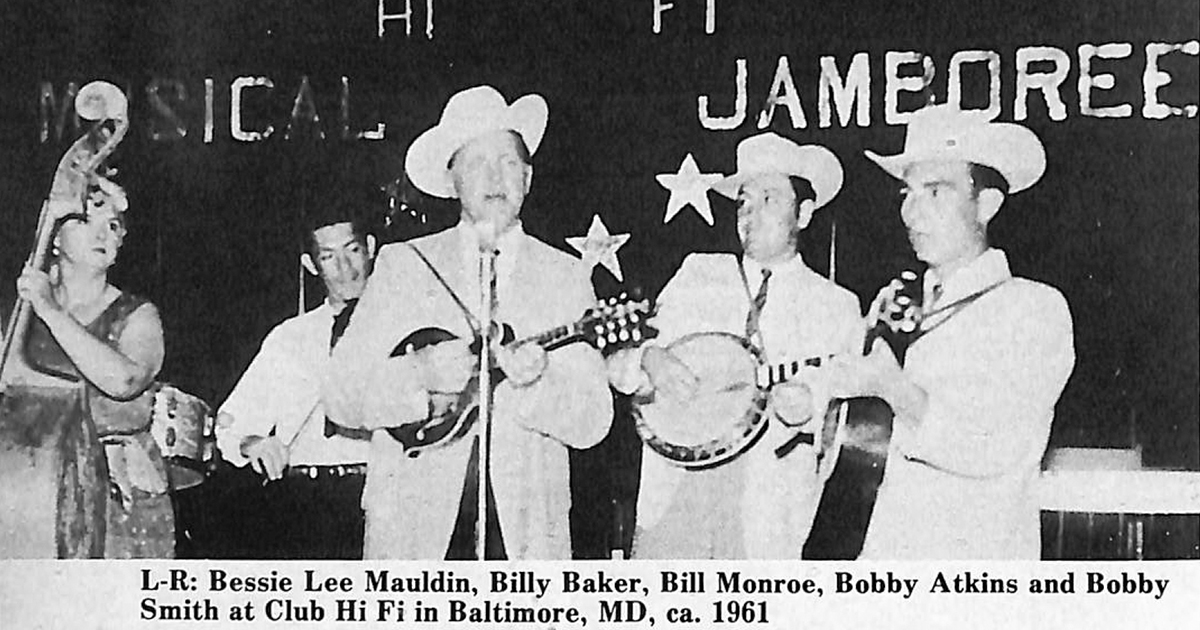
After a year or so a strike brought hard times for their sponsor. The pair returned east and continued working together. In 1961 Atkins left the partnership for eight months as a Blue Grass Boy. This last time with Bill Monroe took Atkins to the stage of the Grand Ole Opry some twenty years after he first imagined it. “We were going to do an album when I quit playing with him in Bluefield, West Virginia,” Atkins remarks wistfully. “We were going to do an album when I went back … I was going to do ‘John Hardy.’ I do wish I had done that.”
Atkins and Stone worked regularly in northwestern North Carolina throughout the 1960s. They played off radio stations WPAQ and WSYD, while opening for acts as distinguished as Flatt & Scruggs and Reno & Smiley. During his time with Stone, Atkins experimented with adding as many as three extra pegs to his banjo to use as tuning devices. “I had the things just to drop mine right quick to low C and then pull it right back up.” Atkins reports that Old Homestead Records, which has released several of his albums since 1977, receives occasional requests for a Stone and Atkins record “and I never can get Joe still long enough to do it.”
By 1968 the duo had limited their joint activities to three television appearances a week on WUBC in Greensboro. After one of those programs a 21-year-old songwriter and Dobro picker named Frank Poindexter approached Atkins. He had in tow his 18-year-old nephew, Tony Rice. The three formed a band, adding bass man Kemp Atkins, Marshall Honeycutt on snare drum, and two back up singers, Shirley Tucker and Rita Williams. They played together over a year. During that time they recorded sixteen tracks, most with Atkins on banjo and vocals, Poindexter on Dobro, and Rice handling both bass and guitar. Atkins or Poindexter composed more than half their selections. At the time they could find no one to release the material. Eventually, “The Old 50’s”/”D.J. Theme” appeared as Decca 38782. The B side, a blistering banjo workout, and fourteen other cuts surfaced a couple of years ago under the title “1968 Session” credited to Bobby Atkins, Frank Poindexter, and Tony Rice (Old Homestead OCHS 126). Recent bass and drum overdubs had been added to a couple of the songs. Rice contributed mostly rhythm work to the group, occasionally cutting loose on a Jimmy Martin tune on stage. “He’d sing once in a while, but he didn’t sing no where as much as he does now,” Atkins points out.
After Rice replaced Dan Crary in the Bluegrass Alliance, Poindexter and Atkins continued their association as Bobby Atkins, Frank Poindexter, and the Appalachian Music Makers. The outfit usually included Slim Martin and Kemp Atkins. During 1973 the Dobro player then dating his future wife in Monroe (what a fine name for a town), North Carolina, learned that a low budget movie was being filmed nearby. He took the producers a demo tape. As a result, the band recorded the soundtrack for The Preacherman. Two years later, the group not only handled the musical chores of the sequel, The Preacherman Meets the Widow Woman, but received cameo parts as well. Both films starred Albert Viola as a duplicitous minister engaged in the moonshine trade and less reputable goings on. Another sizzling Atkins instrumental, “Bob’s Special,” served as the traveling theme for the second motion picture. The same crew hired Atkins’ to do the music for a third outing, but legal wrangling over the rights to the story have so far prevented its shooting.
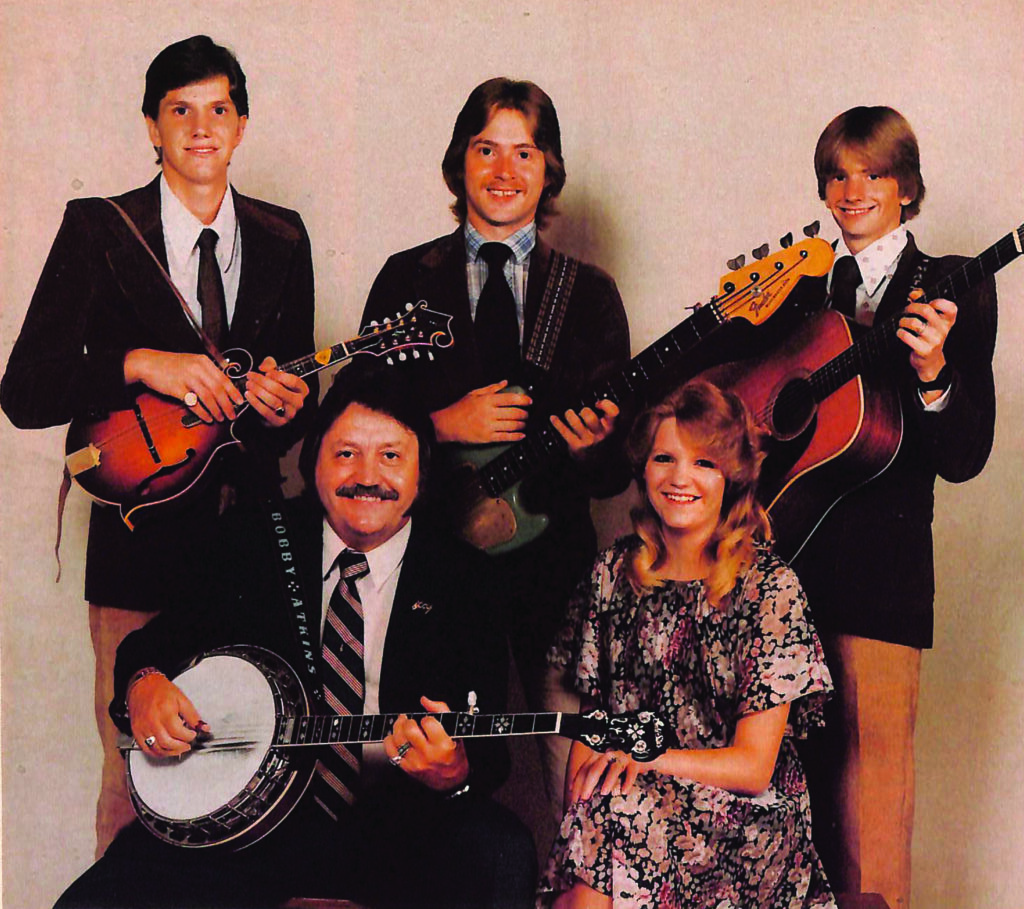
After Poindexter moved to Monroe in 1975, Atkins formed Bobby Atkins and the Countrymen. The original version contained Harvey Williams fiddling, Larry Moore on guitar, Tommy Randolph picking mandolin, and brother Kemp Atkins slapping bass. Atkins’ daughter Torey had begun singing with him on occasion during the 1970s.
Soon after forming the Countrymen, Atkins began to ease his sons into the band. He added Mark, then eleven years old, on mandolin in 1976. Two years later, Matt joined on guitar as a sixteen year old. A nephew, Tim, took care of the bass work for some time, before Torey’s husband, Kenny Duncan, replaced him last year.
With such a young lineup, Bobby Atkins and the Countrymen have experienced many growing pains. Despite problems with the mix and the harmonies, their most recent domestic release, “Ole Time Sundays” (Rich-R- Tone LP-8119), demonstrated that Atkins’ patience and his children’s dedication is beginning to pay off. The album contains, moreover, three gems written by Poindexter that deserve the attention of those hunting fresh material. Atkins promises that even further improvement will be found on “Back in the Good Old Days,” set for release soon by Cattle Records of West Germany. The group has two more albums in the can, one of them an instrumental album featuring bluegrass arrangements of standards, old breakdowns, and pop tunes.
Atkins has nurtured the Countrymen to be able to handle such diversity. “The band I’ve got with me now can play more of what I like to play than anybody I’ve ever had with me. I play all types of tunes on the banjo. I play ’em bluegrass and they can play all that stuff with me … what we’re really working at now is to try our best to have a different sound so that people do know us time they hear the first four bars, and to have it professional, and to play the tune in place of playing all around it. We work from an hour to four hours a night on that, because we intend to burn some festivals up this summer.”
Although Atkins possesses a strong country soul voice, he plans to give Torey and Kenny Duncan greater responsibility for the lead vocals, “so I can do some backing like I want to again. I love to sing, but I cannot back myself with a banjo like I should be backed and sing at the same time.”
Part of Atkins’ rededication to bluegrass involved the inauguration of the Bobby Atkins and the Countrymen Bluegrass Festival at the bluegrass park established by the late Lester Flatt in the shadow of Pilot Mountain near Pinnacle, North Carolina. The initial event on 22-24 June 1984 featured Don Reno, Jim Eanes and Tommy Jarrell.
In the score and ten of his professional career Bobby Atkins has served as sideman, band leader, songwriter, and record producer. He has, on the other hand, endured hardships unfamiliar to some younger musicians. While playing many kinds of music, his devotion to bluegrass remained. “Bluegrass music is to me something that you can’t fake. It comes from right here, your heart, your feelings, your soul. You’ve got to have that feeling.”