Opry Hosts 25th anniversary Celebration of O Brother, Where Art Thou?
In the same vein that “Man Bites Dog” is bigger news than “Dog Bites Man,” a soundtrack that eclipses its own blockbuster movie makes for better headlines. On February 28, a packed house at the Grand Ole Opry celebrated the 25th anniversary of O Brother, Where Art Thou? The impact of the movie’s music, however, did not surprise famed producer-writers Coen Brothers, who brought O Brother to the big screen; from the start, they told the actors, “This is more about the music than the movie.” They began their collaboration with T. Bone Burnett to produce the soundtrack for the music before filming began.
News of the pending soundtrack had national news coverage before the movie debuted, with references to performances by Emmylou Harris, Alison Krauss, and Gillian Welch. The soundtrack featured a number of bluegrass and gospel stalwarts as well—Ralph Stanley and the Stanley Brothers, John Hartford, Norman Blake, The Whites, the Fairfield Four, and the Cox Family.
The impact of O Brother on roots music cannot be understated. The 2001 album and the movie are credited with a rebirth of interest in old-time and bluegrass. The album, which went eight times platinum, was selected as Album of the Year at the Grammys, the International Bluegrass Music Association Awards, and Country Music Association Awards (only the second soundtrack to do so). It also earned a Grammy for Best Country Collaboration with Vocals for Dan Tyminski, Harley Allen, and Pat Enright; and Best Male Country Vocal Performance for Ralph Stanley for “O, Death.”
Other awards included IBMA’s Gospel Recorded Performance of the Year for Alison Krauss and Gillan Welch on “I’ll Fly Away” and CMA Single of the Year Award for “Man of Constant Sorrow.” It was also named the best-selling soundtrack of the decade by Billboard and Rhapsody magazines, made CMT’s list of 40 Great Albums in Country Music in 2006, and NPR’s list of “The Decade’s 50 Most Important Recordings” in 2010.
Dan Tyminski landed a key role as the singing voice of Ulysses Everett McGill when lead actor George Clooney decided he would stick to acting instead of singing. Tyminski acknowledged the role was life-changing. What started out as a one-time performance that would have netted Tyminski just over three hundred dollars ended up as a gig that, he says, “paid for my house and put my kids through school.” He jokes that his wife’s fantasy was his voice coming out of George Clooney.
For Tyminski, the opportunity to sing the Soggy Mountain Boys’ hit “Man of Constant Sorrow,” which played throughout the film, was icing on the cake. At the time he landed the role, he was already enjoying a successful career with Alison Krauss and Union Station.
Tyminski indicated that the impact was more far-reaching than merely personal. When asked by Bill Cody, during the after-show interview in Studio A, how life changed after O Brother, Tyminski said that, even with the success of Alison Krauss and Union Station, he couldn’t have imagined a project that so completely changed the demographics of bluegrass fans. Suddenly, he said, there was a diverse crowd asking, “Where can we find more music like this?” Festival attendance tripled, he added.
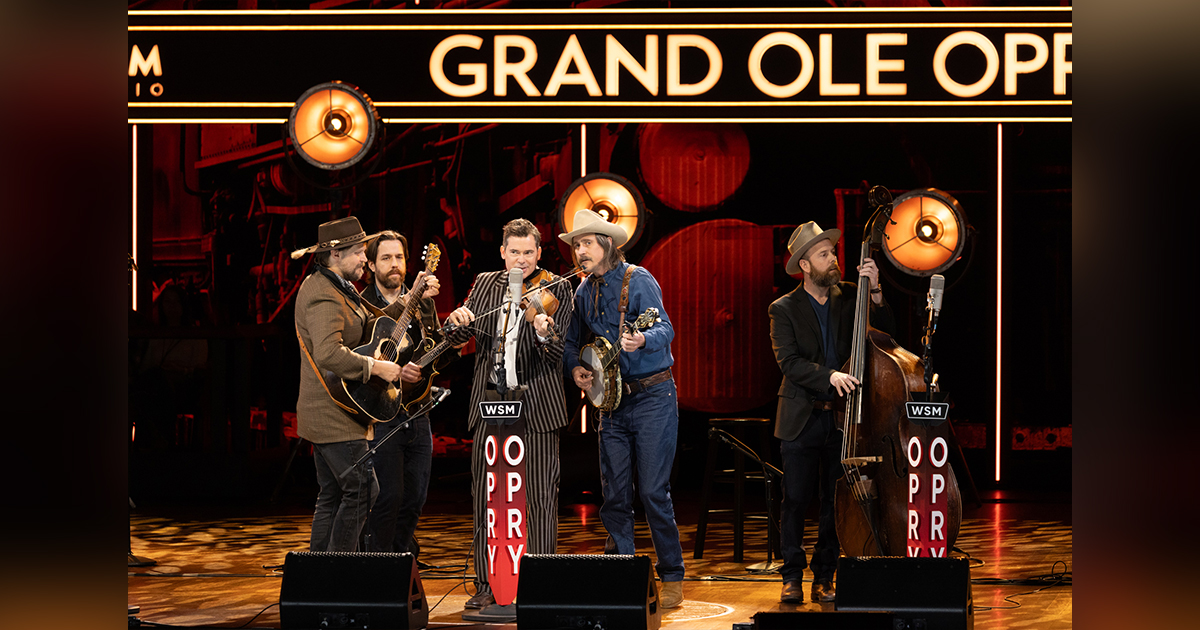
For the special anniversary celebration, the Opry gathered many of the performers from the original recordings and the film. The stellar house band was composed of Mike Compton on mandolin, Stuart Duncan on fiddle, Jerry Douglas on Dobro, and Dennis Crouch on fiddle, with Compton and Duncan frequently contributing background harmonies as well.
Alison Krauss, who made repeated appearances during the show, was joined by the Fairfield Four (“all five of them”) for a rousing opening of “Every Time I Feel the Spirit,” which they followed with an acapella version of “Po’ Lazarus.” Krauss also sang “Down to the River to Pray” with the Fisk Jubilee Singers, resulting in the first but not the last standing ovation of the evening. Krauss also received a gift from the Opry with a special note from Del McCoury.
Chris Hollo for The Grand Ole Opry
Joining Opry hosts Cody and Mike Terry, Old Crow Medicine Show frontman Ketch Secor shared emcee duties and served as music director for the night. The hosts reminded the sold-out crowd of the movie’s success, “sparking a Renaissance of roots music, honoring the music legacy and timeless sound of the American South.”
The performers not only included many of the original singers and musicians from the soundtrack, but also some of the rising stars in the genre. Sarah Jarosz sang “You Are My Sunshine” and joined Molly Tuttle on “I’ll Fly Away.” Tuttle also performed an acapella version of “Didn’t Leave Nobody but the Baby” with Harris and Krauss.
Following his three sold-out Nashville performances at Bridgestone Arena and the Ryman Auditorium, Billy Strings also appeared in the anniversary show lineup. He opened with “Wild Bill Jones,” and then joined Tyminski and the band for “O, Death,” prompting the emcee to comment that “somewhere up in heaven, Ralph Stanley is tuning in.”
Chris Thomas King, who played Tommy Johnson in the movie, performed a duet with Colin Linden of “Hard Time Killing Floor Blues,” from a scene filmed, he later revealed, on the Pondarosa ranch—with real crickets singing in the background. At the interview with Cody after the show, King talked about his own path to the role.
At the time he auditioned, he was wearing dreadlocks and playing electric blues, “skirting around the purists in the blues world.” The role of Tommy Johnson, he says, “was a crossroads that took me another way. I was an acoustic blues aficionado. I wanted to rock out.” After his role in O Brother, he was cast as a band leader in scenes from the biopic Ray.
After inhabiting the role of Johnson, he says that he faces “no boxes now. I can spread my wings; I’ve cultivated my audience,” and, he added, “Now I’ll take any hair I can get.” King suggested another possibility: “I didn’t get killed in the movie, so if they ever do a sequel…”
Following an intermission, the Peasall sisters, now adults, who provided the voices for the little Wharvey gals in the movie, introduced the Alaskan Sunnyside Sisters to perform “In the Highways.” Wearing cowgirl suits and boots, the young band members admitted they hadn’t seen the movie until they were hired by the Opry, adding, “But now we love that movie—and the music!”
After a film clip of the Soggy Bottom Boys “singing into the can,” Molly Tuttle returned to the stage to perform “I Am Weary (Let Me Rest)” with Compton and Duncan on harmony, followed by a reminder that the Grand Ole Opry had recently celebrated “100 years of singing into the can.”
Tim Blake Nelson, who played Delmar in the movie, also performed “In the Jailhouse Now.” The only major cast member to sing his own vocals, he even added the yodel. In the after-show interview, Nelson discussed his casting for the role. After reading the script, he said, “I would have been willing to do a day on that movie—a hallway part”; instead, he landed the role of Delmar, the character, he noted, with some of the best lines in the film.
He confirmed that a high-profile actor, one he referred to as “the biggest movie star in the world,” had pursued the role of Delmar, but would have necessitated adjusting the filming to give him equivalent screen time as Clooney. Nelson said the Coens instead chose to go with “a complete unknown,” adding, “Joel and Ethan [Coen] knew me and liked the odd look of my face.”
Next up, without waiting for the finale, was the song Cody called “the one everyone was waiting for”: “Man of Constant Sorrow” sung by Tyminski with Compton and Stuart.
Old Crow Medicine Show, who had performed “Big Rock Candy Mountain” in the first set, returned to play the rousing instrumental “Indian War Whoop,” evoking images of an unrepentant George (“Don’t Call Me Babyface”) Nelson being escorted out of town for a hanging.
The show ended on a note that might have merited an altar call. The Fairfield Four performed their acapella rendition of “That Lonesome Valley” from their gravedigger scene, followed by Opry members the Del McCoury Band singing “Get Down on Your Knees and Pray.”
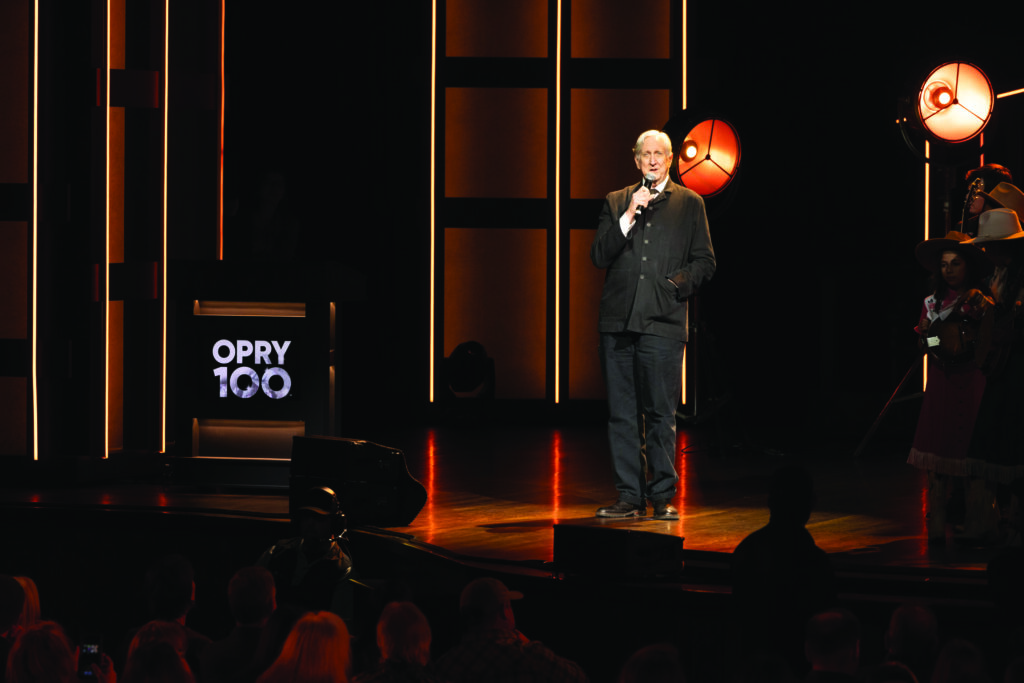
Before the grand finale, soundtrack producer T. Bone Burnett came to the stage, suggesting advanced tickets for O Brother’s 50th anniversary in 2051. He told the audience, “If you want to know what’s good about the USA, listen to our music. We’ve made harmony tonight.” He added special thanks to Denise Stiff for her instrumental role in creating the album.
As the show closed, the performers all returned to the stage, the show—like the movie—ending with “Angel Band.” The star-studded anniversary show fittingly celebrated the soundtrack that set in motion a renaissance in old-time and bluegrass music, cultivating a new generation of fans.