Preston Thompson Guitars
Modern Made Guitars With A Vintage Sound
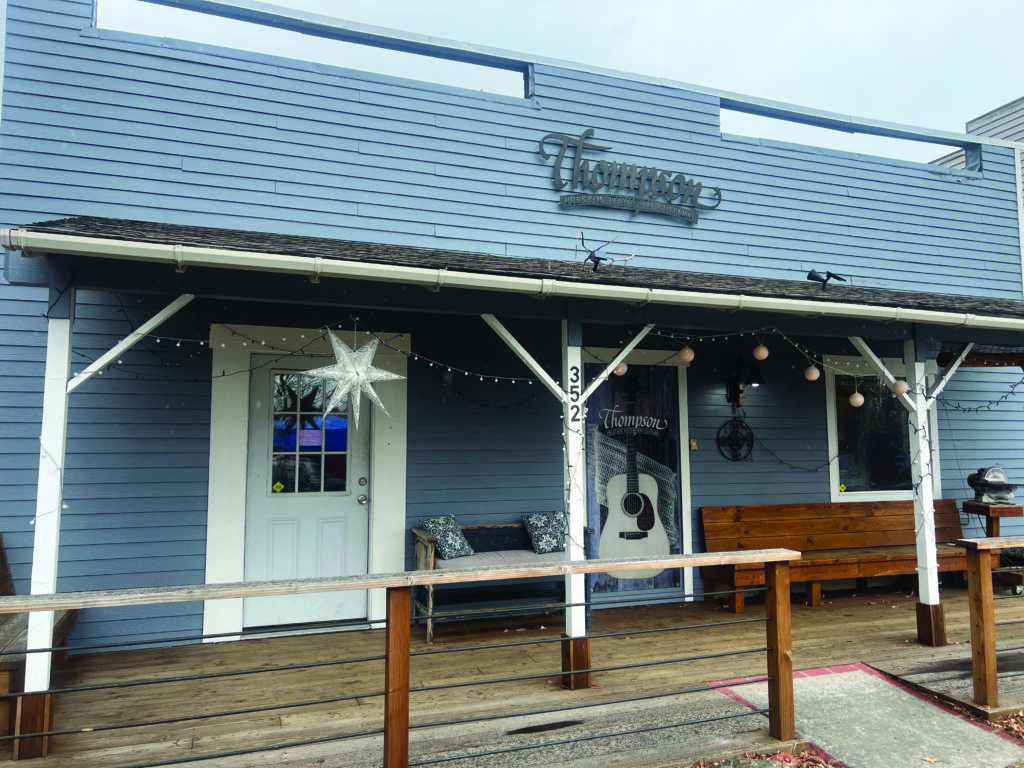
Preston Thompson had a love for guitars and a desire to replicate the tone of vintage pre-war instruments from the 1930s. That passion led him to study the art of lutherie, becoming an individual luthier in the late 1980s. Years later, in 2013, Preston started his own custom shop with partners Daniel Stewart and David Blakeslee in Sisters, Oregon—home of the Sisters Folk Festival. Though he passed away from complications with pancreatic cancer just six years later, in 2019 at the age of 62, Preston’s dream, his artistry, and his love for guitars continue to pulse through the veins of his talented, dedicated staff.
Christine Funk, Thompson Guitar’s General Manager, explained, “It’s a family-like shop that makes a little less than 100 (guitars) a year. When Preston opened the shop, his team built 10 guitars, then 30, 60, 90 over several years. The most we have made (in a year) is roughly 130. Our numbers went back down due to many custom orders and inlay work, which extends the build process.”
Their elite team includes nine employees and one apprentice: Gareth Jenkins – Voicer of Tops; Simon Haycraft – Inlay, Neck carving, sunbursts; Ryan Ediger – Lead Set-Up; Peter Daggatt – Master Finisher; Bud Bown – CNC, Necks, Rosettes, Tops; Olivia Elia – Body Building; Matt Behnke – Set-up; Storm Wolf – Tops/Backs/Finish; Mitch Tretheway – Set-up; and Ryan Rutherford – Apprentice in Set-up.
They have a varied list of musicians, including bluegrass and jamgrass players, beginning with the legendary Peter Rowan to Billy Strings and Molly Tuttle. Their roster also includes talented players like Chris Luquette, Tim May, Zach Top, Lindsay Lou, Joe Cicero, Jon Stickley, Kenny Feinstein, Chris Jacobs, Jordan Tice, Max Davies, Pete Kartsounes, Tom Knowlton, Erik Hill, James Kee, Cruz Contreras, Soraya Sullivan, Kyle Ledson, Eric Lindberg, Chris Jones and many others. They are always on the lookout for exceptional young players in up-and-coming bands who should contact Thompson Guitars to learn about their artist discounts.
Peter Daggatt, who has been the master finisher for over six years, shared that “I am especially proud that Billy Strings has several Thompson Dreadnoughts he plays on stage and a rosewood OM for writing songs. It has been a wild ride having Billy sharing our guitars with the world!”
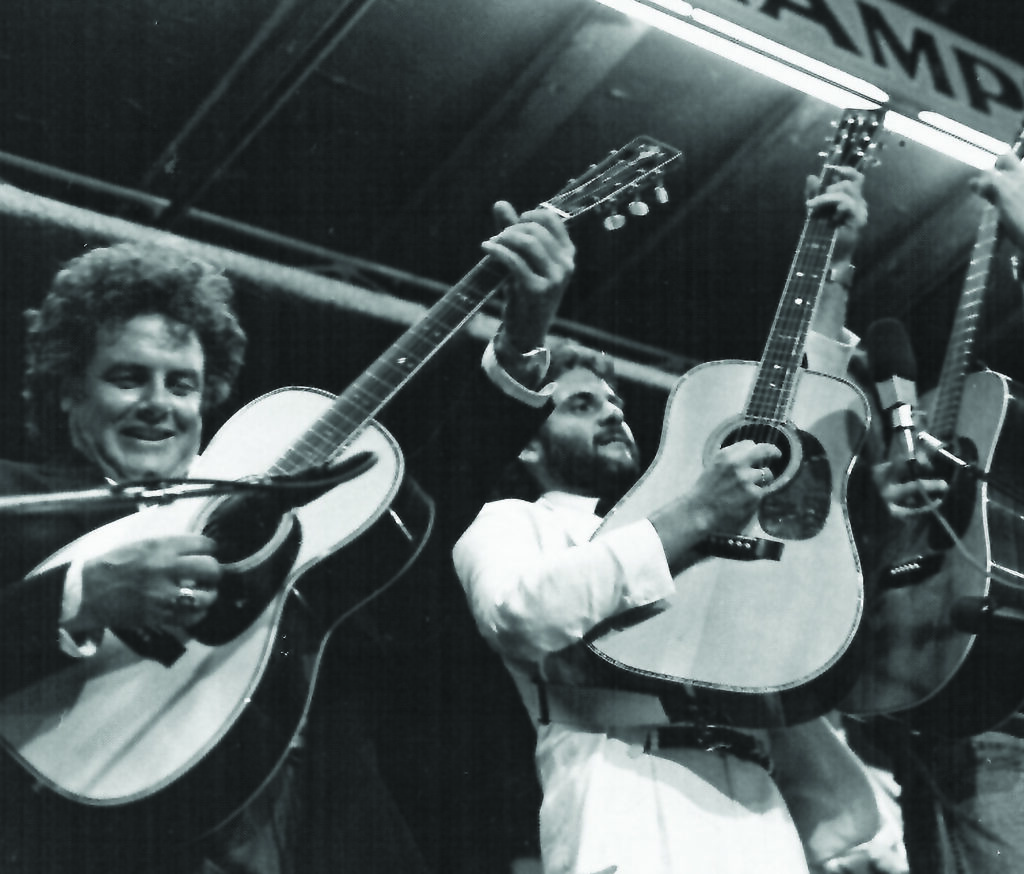
Peter Rowan weighed in with his personal history, “I was hanging out in Colorado with Charles Sawtelle, and Preston had made copies of some of Charles’ Martin guitars. One of the first ones he made was a triple O size guitar. I was really in love with that smaller size body. It was based on Charles’ triple O-45. We went to play in Winfield, Kansas, in the late 80s, and Preston was there with the guitar. I played it that night and loved it. I bought it, and I’m still using it. It’s a great guitar. It has pearl on the top. It is technically a triple O-42. Preston and I became friends, and Thompson Guitars has been very kind to me. Over the years, I endorsed him. He gave me one of his HD-28s.”
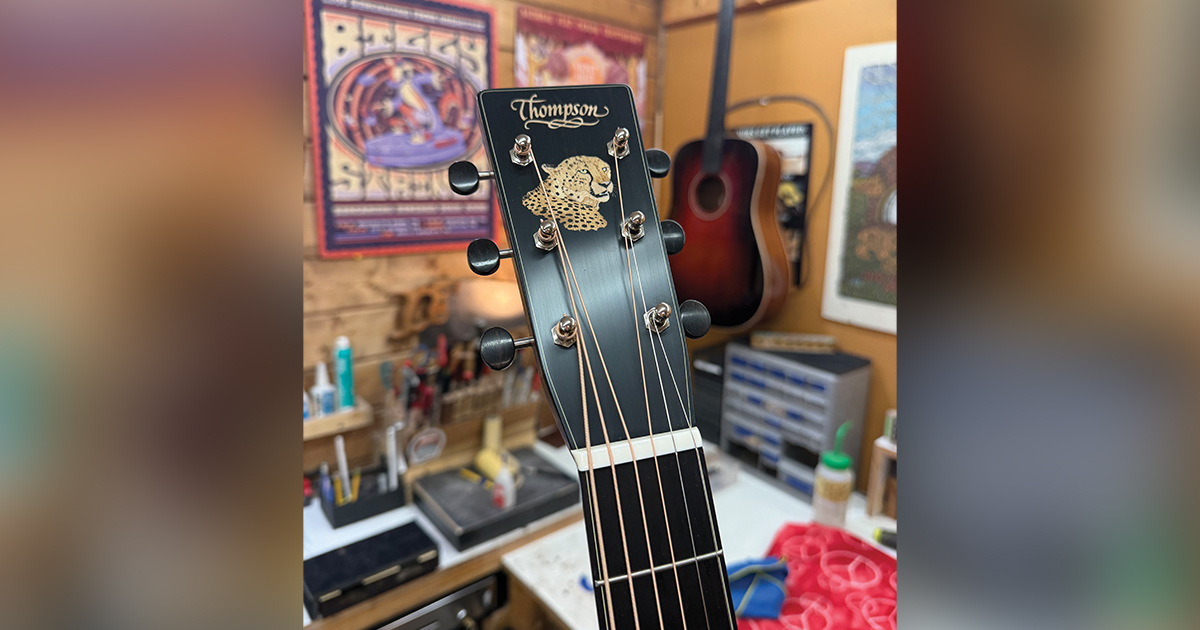
In 2023, Thompson collaborated with Peter to create his own 0000 rosewood signature model featuring a beautiful sunburst; only 15 of these special guitars will be built. The lotus flower, infinity knot, buffalo skull, and water inlays adorn the fingerboard and headstock, created out of bone, koa, pearl, and turquoise.
Rowan elaborated, “Thompson Guitars are very flexible and used all kinds of material for my guitar. They do a lot of custom work. I really support and appreciate their high level of quality. Preston was a tremendous innovator of the detailing. I played it when I received the Lifetime Achievement Award and on the IBMA stage with Wyatt Ellis and Molly Tuttle. I love that guitar. It works both as a finger picking guitar and a good solid bluegrass guitar. It has the ability to dig into the bass.”
To tell the full story of Thompson Guitars, one must begin with the history of its founder, Preston Thompson. As a young man, he studied lutherie under Charles Fox at the School of the Guitar Research & Design Center in Vermont, one of the first schools for guitar making in North America. His talent for building guitars was discovered by bluegrass virtuosos Charles Sawtelle and Peter Rowan in the 1980s. During his collaboration with Sawtelle, Preston began to gather measurements from Sawtelle’s collection of rare and famous pre-war vintage instruments.
Preston built a custom guitar for Sawtelle based on his studies. His detailed measurements of those vintage instruments are still used to this day to create guitars that are coveted for their superlative sound, the beauty of their materials, and the precision of their construction. As a devoted craftsman, he fostered a unique outlook and focused drive, building a lighter, livelier guitar.
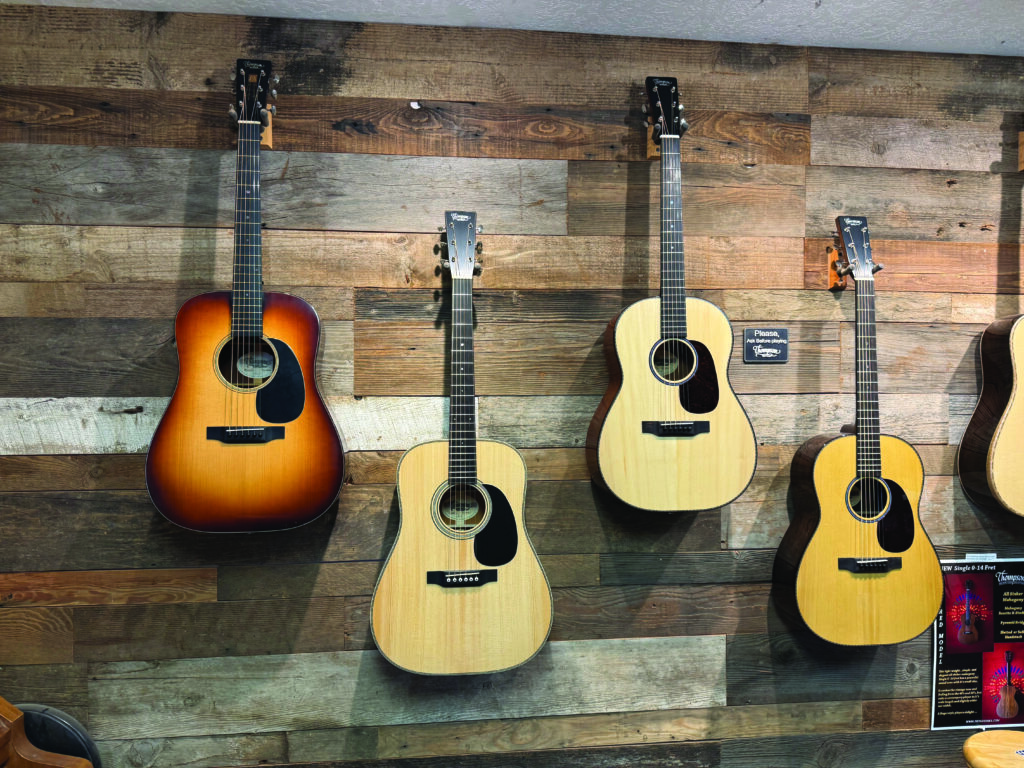
Thompson guitars have nine different models, from a Parlor to a 0000, and work heavily on custom builds that can include any type of inlay design desired, from rattlesnakes to trout and original torch patterns designed by Haycraft. They recently added a new model to the list called the DMC—a classical body shape. Think a variation of Willie Nelson’s Trigger with a deeper body and advanced X bracing pattern.
The 0000, which Preston originally named the T-1, was the first guitar body shape drawn and built by Preston while he was a student under Fox. Many of the first Thompson Guitars were 0000s and are known for their bigger 16” lower bout guitar tone and excellent balance. Most of our models can be either 12 fret or 14 fret and are made in both long and short scale. The back and side tone wood selections include Mahogany (various species), East Indian Rosewood, Madagascar Rosewood and Brazilian Rosewood (other rosewood options also available)
The finest grade Adirondack Spruce tops are standard, but other soundboards may be substituted, including Lutz, Sitka, and Redwood. They offer a rare find of Alaskan Barge Sitka; these Sitka tops were harvested after the wood used for the barge was submerged in saltwater for decades. This unique wood has been cured to a beautiful tone and appearance, some with a distinct blue-gray color.
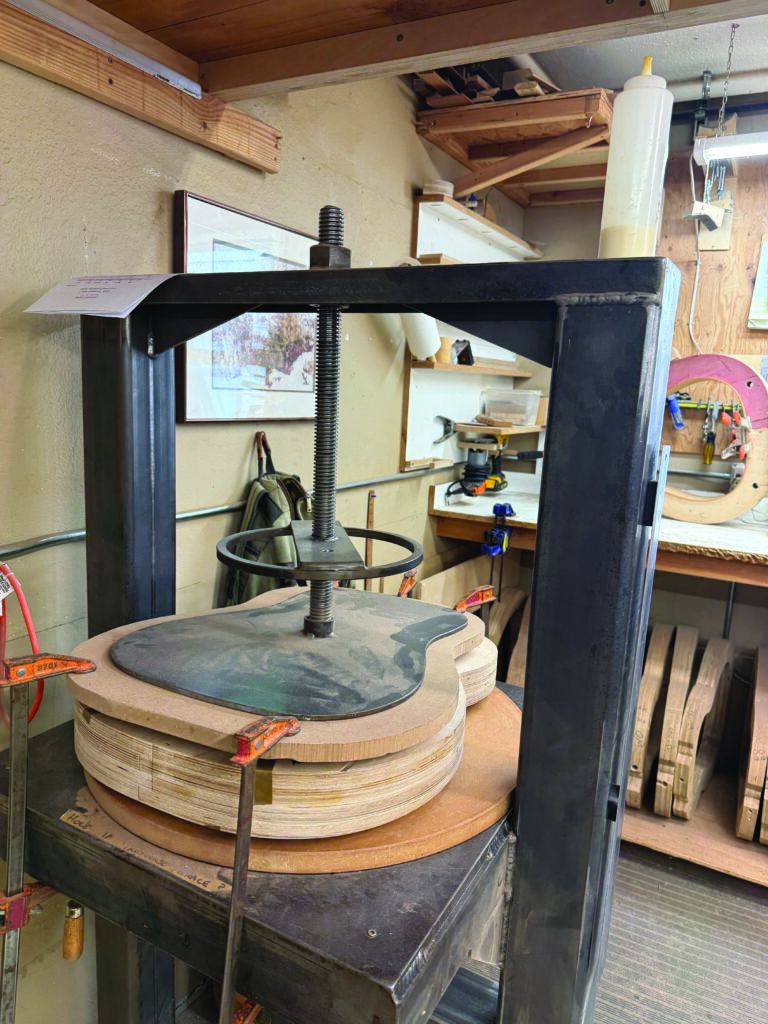
Each employee is extremely passionate about creating guitars based on Preston’s designs. They don’t streamline their handiwork. They recognize that every piece of wood is unique, from the small pieces for tone bars to the larger pieces that make the bodies. Every part of the instrument reacts differently, and the human touch is what Preston wanted fully present in all his work. His goal was to achieve what he found in those pre-war style guitars that he had studied so intently in his youth.
Gareth Jenkins’ craftsmanship has been an integral part of the Thompson sound and helped build their reputation over the years. He shared this sentiment, “Having been there in the beginning and sharing the dream of this business and building these kinds of instruments, for me, that’s a big part of it. It’s not a factory. We take great pride in what we do. I think it shows at the end.”
Haycraft, originally from the UK, and the main designer and inlay specialist, shared the uniqueness of Thompson Guitars, “It’s something when you pick up an article that has been crafted. You will feel it. It may even be imperfect, which machines won’t give you that. Imperfection can be perfection. Every person is different, and likewise, every guitar and piece of wood have their own personalities. Honoring the tradition, you’re going to see and hear something different every time, always pushing the bar of beauty and quality. It is a mixture of art and science.”
Employees, Bown and Elia, are both musicians and owners of Thompson guitars. They discussed their work in the building process of a guitar. Bud shared, “Typically, we stick to our roles, which contain a whole bunch of little paths within them. I bounce around between the CNC to mill parts, and right now, I’m putting necks together, gluing in truss rods, and putting braces on the tops. Our roles change from time to time. The more consistent you can be in your role, the better you are.”
Olivia builds the body, which involves bending sides, sanding sides, putting them together, and progressing to binding. It’s a pretty big task wrapped into one. Olivia detailed the timeline, “There are so many hands that touch it, but my part takes maybe ten hours (per guitar), and I work on around three to five at a time.”
Funk explained, “We estimate seven to nine months to go through our process to build a guitar, and probably 70% of our guitar builds are custom orders.”
Finisher Daggatt described his job, “It’s basically taking the raw wood, bodies and necks, and finishing them over multiple weeks, then handing them over to the set up crew. It goes through four coats. We start by staining our mahogany guitars. We rub an oil-based pore filler into the guitars to give them a head start on being flat. From there, we seal them and make sure everything is looking perfect and clean. We scrape out the binding and start the spray process, which is four coats in a spray day. The next day, we sand it as flat as we can without burning through and do it again. We do it again and again and again until everything is all nice and flat. From there, it’s just a final hand sand all the way up to 1200 to 3000 really fine grit. Then buff them on the buffing wheel and get them ready for the setup guys to put them together. Working out a sunburst is a little more involved. After a base coat of finish, that’s when we add the color. It can be a little more lacquer and a little tougher to try not to sand through the color. It is a longer process.”
Daggatt shared how he came to work at Preston Thompson Guitars and that he is a proud owner of a D-18 Style Thompson. “I love music and play in old-time and bluegrass bands like Water Tower. I moved to Bend, met Preston, toured the shop, played some of the guitars, and it was just serendipitous. I asked him if there was any chance of working here or just sweeping the floors, and I got hired. It’s a great job for a musician. These guitars are so awesome.”
Ryan Ediger has worked for Thompson Guitars for six years. He, too, is a guitar player and builder in his own right. “It helps (being a guitarist),” he readily admitted, then shared how he came to Sisters, “I was working a job that I really didn’t want to work anymore. I always loved woodworking and playing guitars, and I realized that I could put the two of them together, so I took some classes in Portland. I fell in love with it. I saved up my money, quit my job, and went to Michigan and took a six-month course. I came back (to Oregon), and one of my instructors said, ‘Go to Thompson Guitars. Don’t even call them, just go down there and tell them you want a job.’ The rest is history. I applied and got hired. I am passionate about my work. We get the guitars in after finish, the necks and bodies. We do all the assemblies to make them functional. There’s a lot of troubleshooting, and the research and development falls on me. I feel like an inspector.”
Matt Behnke has been a Thompson employee for three years. “I came out of the construction world and am also in a band, Sky Bound Blue, with my wife, Jenny. I moved here in 2021. We sat next to Christine at my son’s first basketball game, and she offered me a job. Ryan’s been training me ever since. I own a Thompson 0000 and I love it.”
Tretheway shared, “I’m the newest employee. I’ve been here about six months. My background is at a bigger company, kind of doing the same thing, but not to the level of Thompson. I’m learning the Thompson method.”
One builder talked passionately about the guitars, “It’s living. It’s breathing. All the woods that we use are still living in some way or another. It’s organic. Sometimes you get this feeling the wood is speaking to you, and then you see it transform into something beautiful that is making music in someone’s hands. Every little step of the way, you’re pouring so much of yourself and care into that instrument. I know Preston would want me to keep on doing it like I’m doing it. Every day, I strive to make him proud. I love it.”
Storm, another whitewood crew member concluded, “I just hope that it brings joy and continues to be played. Hopefully, it will live on for well over 100 years, and that they can feel all our love and passion that we put into it.” Many custom orders are made as family heirlooms, with customers adding special inlay that makes it uniquely theirs to pass it down to their children.
Interested in ordering a Thompson guitar? Christine Funk shared, “First, check out our dealer list and see what is for sale right now, or put in a custom order. We require a 25% deposit to get into the queue.”
Daggatt agreed. “We also make stock guitars. There’s always a few of them coming out, so if someone is interested in getting getting one right now, they just get made and pop up.”
Funk stated, “If anyone has a takeaway on Thompson Guitars, it is that we are like a family, we look out for each other. We’ve obviously been through something very difficult with the founder of the company passing away. I know Preston is proud of everything that we are creating, not only in the guitars, but that our crew really enjoys their jobs and the life/work balance we try to achieve.”
Visit Thompson Guitars website: pktguitars.com to learn more about purchasing your dream guitar.