Eli Gilbert
Teaching How to Play Bluegrass Banjo on YouTube
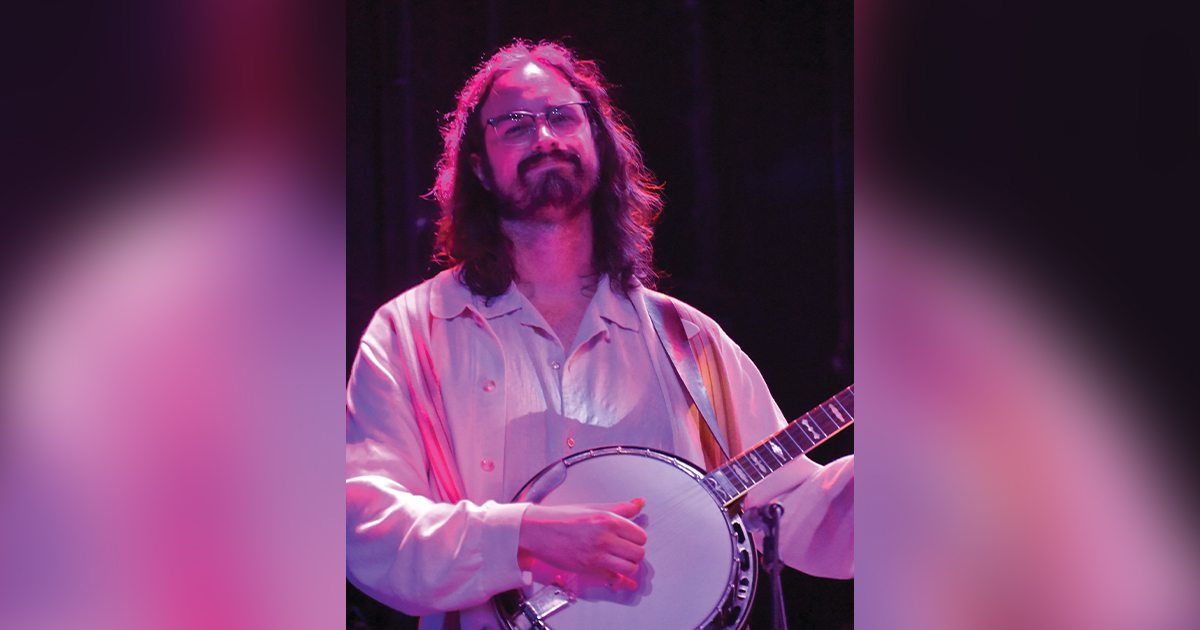
If you are a banjo player and explore YouTube as a source for learning how to play the 5-string, you have no doubt run across Eli Gilbert’s videos. If you search YouTube for “bluegrass banjo lessons,” Eli’s videos will pop up on the first page. One of the series of videos that Eli has created is called the “Absolute Beginner Banjo Course!—30 Days of Banjo.” The “Day 1” video in that series has an astounding 1.5 million views, and there are currently 109,000 subscribers to his YouTube channel.
In addition to the bluegrass banjo channel on YouTube, Eli also has a clawhammer banjo channel and a flatpicking guitar channel. In total, including all three channels, Eli has posted over 600 videos on YouTube, and he also maintains a Patreon presence to help support the material on his YouTube channels. With so many people working to learn banjo from Eli online, I thought it would be a great idea to let our readers know a bit more about Eli Gilbert.
Background
Eli Gilbert grew up just north of Portland, Maine, and although he played percussion and trombone in school, he said that he didn’t connect with those instruments. It wasn’t until he and a couple friends started to learn how to play the electric guitar and decided to start a band that music took a prominent role in his life. He said, “I heard Eddie Van Halen and thought that it was very exciting. That started an obsession with music. I was maybe 12 or 13.”
Eli’s interest in music was then expanded by a guitar teacher who introduced him to playing jazz on the guitar. After high school, he studied jazz guitar for a couple of years at the Peabody Institute, a music school at Johns Hopkins University in Baltimore, Maryland. Unfortunately, due to a nerve injury in his hand, Eli had to stop playing the guitar. He took a year off from studying and moved back home to Maine.
When he returned home at the age of 20 in 2012, Eli discovered that his father had become interested in bluegrass music. He said, “My dad grew up playing folk stuff on the guitar. When I got home, he asked if I wanted to go to a bluegrass festival, and we went to the Thomas Point Beach Bluegrass Festival. It was about 30-minutes from where we lived. I got to see the Seldom Scene and J.D. Crowe and a bunch of bands. Now I wish I remembered what that experience was like. At the time, I thought it was pretty interesting, and I thought that I would take up the banjo as a side hobby. I already knew who Béla Fleck was, and I was familiar with the Punch Brothers. I had been interested in what you would call ‘new acoustic music.’ I was coming from a different angle than coming from bluegrass, and what I was listening to wasn’t from the bluegrass side of their repertoire; it was everything else that they were doing that I was familiar with. To re-enter that through a traditional bluegrass lens gave new context to stuff that I had already heard.”
Although he had played rock and jazz and had been familiar with the jazzier side of some bluegrass bands, Eli said that once he started to learn how to play the banjo, it was all about J.D. Crowe and the traditional side of bluegrass. Within the first year of learning how to play the banjo, Eli developed a similar obsession with the banjo that he had with the guitar. He ended up enrolling at East Tennessee State University (ETSU) to, study bluegrass banjo, in 2013. He said, “I had no idea that I could have the opportunity to study banjo in school, but I wasn’t going to be going back to study guitar at Peabody, so I thought, ‘I’m trying to get a degree and I want to play music and banjo is the thing that I’m doing right now, so I went to East Tennessee State for three years, studied the banjo and graduated with their bluegrass degree.”
When asked how he first approached learning how to play the banjo after attending the Thomas Point Beach Festival, Eli said, “I had the benefit of having studied jazz pretty seriously for a number of years, and I had done transcribing, trying to learn how to improvise from other guitar players and horn players. When I first started to learn how to play banjo, I first took five or six lessons from Carter Logan, who lived just down the road. He helped me understand the technique. There was also a great banjo player in Portland, Ron Cody, who—among other things—was a great example of melodic style. He understands it fluently and can really speak that language. I didn’t really take a lot of lessons with Ron, but I spent a lot of time asking questions and watching him play, or we’d get together and play tunes. Aside from the melodic stuff, he really had a strong grasp of all of the stuff that had come before. I had a lot of questions answered through his playing in terms of the J.D. Crowe and Earl Scruggs stuff as well.
“A lot of the early stuff that I learned was from slowing down records and seeing if I could place what I was hearing on the instrument. The first thing that I transcribed was ‘Blue Ridge Cabin Home’ from the Bluegrass Album Band record. It is such a good lesson in presenting a melody in a strong way with some attitude and Crowe’s artistry. I also just really loved those records. So, I started with that song and went down the line and tried to learn everything off of the Bluegrass Album Band record.
“Luckily, for a lot of the Scruggs-style stuff, it was just one note after another, so I could slow it down enough to hear it. I was willing to take the time and figure out what was being played. You can transcribe anything, but it took me a little longer because I wasn’t familiar with the bluegrass language. Up until the point I went to East Tennessee State, transcribing J.D. Crowe solos was a lot of how I learned.”
Although Eli was coming from the jazz world and had an interest in what Béla Fleck and the Punch Brothers were doing, when he first started to learn how to play the banjo, he turned his focus towards more traditional style bluegrass and banjo playing. Regarding this decision, he said, “Béla and anyone who is really known for pushing the boundary of bluegrass is very upfront about how important their foundation in bluegrass was as a stepping stone for what they are doing now. I took that at face value and really just tried to learn the vocabulary that is known as the straight-ahead bluegrass stuff. About a year or two in, I did try to see if I could put some of the stuff that I understood from the jazz world onto the banjo. Then, once I became familiar with Noam Pikelny’s playing, especially his record Noam Pikelny Plays Kenny Baker Plays Bill Monroe, I learned a bunch of stuff off of that record. What I actually play now, in terms of bluegrass banjo, is more straight ahead, but certainly that album formed what I tried to have as a range of options of things to play.”
Although Eli’s early banjo playing focused on straight-ahead Scruggs-style, he did occasionally add a bit of melodic or single-string playing when someone would show those techniques to him. Eli remembers, “My favorite example of blending the three classic styles of banjo playing—Scruggs-style, single string, and melodic—is from Noam Pikelny. He blends them to the point where, when he is playing, you are not really hearing it as three distinct styles. It is all integrated into his playing. I listened to him with the Punch Brothers, but the record that I spent the most time with was Noam Pikelny Plays Kenny Baker Plays Bill Monroe. I remember that when that was getting ready to come out, he released singles, and I would learn what he played on that track and then wait for the next single to come out.”
East Tennessee State University
By the time Eli enrolled at ETSU, he had only been playing the banjo for about a year. He remembers, “It is truly not false modesty to say that by the time I got there and did the auditions for what band I was going to be in and who I was going to study with—and I watched everyone else play—I was truly struggling to keep up with what the standard was there. Some of the other freshmen were in professional touring bands already and had that level of experience. But I knew that I was capable of putting in the work to learn what I was supposed to learn. So, that is when the real practicing started.”
In addition to hearing others play at ETSU, Eli benefited from the knowledge and experience with bluegrass music that his classmates brought with them. He said, “I spent time with really great teachers there, but I would say that probably the space where I learned the most was from other students…hanging out, getting recommendations of what to listen to, or jamming. That ended up being the most productive way to figure out what I was trying to get out of the experience. There were some really great musicians there, even as students, that I learned so much from.”
Before arriving at ETSU, Eli had predominantly focused on the banjo playing of J.D. Crowe and Earl Scruggs. Regarding discovering other influential banjo players, he said that with the amount of streaming music available today, it was difficult for him to know what he should turn to in terms of discovering banjo players other than J.D. or Earl. His classmates and teachers at ETSU helped him find other players who inspired him, most notably, Don Reno. Eli said, “The stuff that ended up being most important for me, besides J.D. and Earl, was Don Reno. I spent a lot of time on him for a while. What he is often known for is the single-string or double-stop stuff, but I found his roll-based playing fascinating and spent some time with that.” Regarding some of the more modern players who caught his ear, Eli mentioned Ron Stewart, Jim Mills, Terry Baucom, and Kristin Scott Benson.
Since Eli had not had any experience performing with a band before he arrived at ETSU, he found that the band experience at the school was valuable. He said, “It is a common thing to spend a lot of time practicing alone. It is not until you are playing with other people that you learn that every choice you are making is in real time. You find that all of those things that you practiced don’t fit that great all of the time. You had to have more options, and you have to change the dynamics. You learn that you have to find a way to make choices in the moment rather than showing up ready to play the thing that you have been practicing alone.
“You have to be a participating member of the music rather than use the band as your backing track. I learned that it is helpful to have a really strong grasp of the melody and be able to play dynamically. The only way you can do that is if you are listening. You learn how to keep your head on a swivel in terms of whatever the band needs at any moment. Playing with other people, you learn really fast what you are comfortable with and what you are not comfortable with.
“I think that it was a lot more freeing to realize that it might not be the best choice to have all of this worked-up material that I was just waiting to plug in at a certain moment. Even though I wasn’t playing all of the specific ideas and licks that I had worked up and practiced, I might be making better music if I just listened to the band that was around me and tried to fit in there. I think you end up playing a lot less of the stuff that you practiced and a lot more stuff that actually sounds solid and good. So, it can feel like a sacrifice, but actually, it is very freeing. It really defines the difference between practicing and playing.”
Eli spent much of his time learning how to play the banjo by meticulously listening to his favorite players and transcribing what he heard. When asked about what that process of learning brings to the student of the banjo that is different from learning from a video or tablature, Eli said, “Things that someone may tell you in a video or that you read in tablature is technical information and can point you in the right direction, but it can’t actually bridge the gap between you and the music. At the time, I would have loved to have had someone that posted a video that said, ‘Here is everything that J.D. Crowe played on The Bluegrass Album, Volume 1,’ that would have been great. But, if I had watched that video and learned all of that stuff, I still would have had to spend the time with the record listening to actually learn where that technical information lines up with the truth of the music. So, it creates a potential problem to have unlimited resources. But the answer to that has always been the same…you just have to have the discipline to connect with the music personally, rather than look at it as intellectual. The resources can point you in the right direction, but they are not the answers themselves.”
Life After ETSU
After graduating from ETSU in 2016, Eli returned to Maine. He said, “At that point, I had a lot of ideas about things that I wanted to work on. I wasn’t feeling like I was ready to try and perform full-time. I was interested in practicing. I had a lot of stuff that I knew that I could develop in terms of my playing. I did some teaching, but I also started doing some local gigs with some really great players. Joe K. Walsh, Lincoln Meyers, and Steve Roy have a weekly gig on Tuesday that I would do with them. It was a great opportunity to play with some people, but also do some practicing on new music. But it wasn’t anything that required paying the bills by touring. It felt a little like laying low for a couple of years to continue what I had been working on at ETSU.”
A couple of years after graduating from ETSU, Eli began performing with some friends that he had made while in Tennessee in a band called Dream Catcher. That band lasted for about a year, and then he got a call from Dale Ann Bradley. He had met Dale Ann at a festival, and she called, looking for a banjo player to play a couple of gigs with her. Eli accepted the offer to join Dale Ann on those gigs, and that turned into being a regular member of Dale Ann’s band. Eli said, “For probably almost a year, I did all of the gigs that Dale Ann Bradley had until it became inconvenient to be living in Maine and touring with a band that is not based anywhere near Maine. That was in 2018. Around that time, I started posting on YouTube arrangements of tunes that I had been working on.”
When he first started posting on YouTube, Eli wasn’t producing the videos as banjo lessons; he was just playing tunes that he was working on himself, or demonstrations of things that he had transcribed from Don Reno or J.D. Crowe, and arrangements of tunes that he had come up with himself. It wasn’t until 2019 that he began posting videos that were instructional. He said, “From 2019 into 2020, creating instructional material for YouTube became a much bigger part of my life. I eventually turned that into my full-time gig. At the time, I was also teaching lessons at a high school and at Bates College.” Although he started posting banjo lessons on YouTube prior to the COVID pandemic shutdown, he said, “When I started to have a lot more free time in the spring of 2020, that was what allowed me to put in the time I needed to get better at producing videos. The shutdown was the thing that allowed me to have time to work on it. Otherwise, it would have been hard to get off the ground.”
After he started posting video lessons online, Eli received requests from viewers who asked about getting tablature for the material. He said, “Rather than responding to each person individually, I set up a Patreon and said, ‘Everything that I post will end up here, and you can find it there.’ I wasn’t really thinking that it would become a significant part of my life. After I began posting more videos, Patreon actually became a good place to organize all of that so that people could find all of the reference material for everything that I was posting on YouTube.”
Early in 2022, after performance venues and music festivals began to open up again, Eli got a call from Missy Raines. He remembers, “It was a similar situation that Dale Ann had; she needed a banjo player for a couple of gigs, and that turned into a full-time gig for about three years. I had not been looking for anything; I was just working on the videos. I hadn’t met Missy at that point, but I knew everyone in her band.”
When Missy hired Eli, she was transitioning from her band Missy Raines and The New Hip to Missy Raines and Allegany and bringing her music back to a more traditional sound. Eli said, “New Hip had not been bound by any particular genre. Allegany was intentionally going to be a bluegrass band. At that point, she had not had any regular banjo players in her band. Adding the banjo was, as she put it to me, going to define it as a bluegrass band.”
Eli stayed with Missy Raines and Allegany through mid-2025. Eli said that he loved the people he was playing music with and he loved the music he was playing, but he was ready to spend more time at home and focus on the instructional videos and his family.
Teaching Through YouTube and Patreon
When asked to give an overview of what people can expect to find if they study with him online, Eli said, “I use the YouTube channels to share the things that I have found interesting to study. You will find anything from transcriptions of some of my favorite banjo playing, and then enough lessons in between to help you understand how that all fits within the bluegrass language, with videos about playing backup or improvising or technique—all the tools that you would need to then understand all of those great players. It is a combination of the players I really love and the things that I learned from them, and some tools to help you understand that stuff. Patreon is what I used to share bonus content and tablature—things that are extra on top of all of the YouTube content. It ends up being a way that you can stay on top of all of the small details that are missed on YouTube.
When asked what advice he has for students of the banjo, Eli said, “Make sure that you are excited to learn what it is that you are working on, but patient enough to be thorough with it. If you can be guided by the music that you really care about, then it is going to be easier to decide what to practice. In terms of the early stages, practice roll patterns and learn chords and melodies. That is the ground floor of all this stuff. As you progress, if you are wondering what to practice, be guided by the music that you love listening to and want to play, then you will always have the answer to that question.”