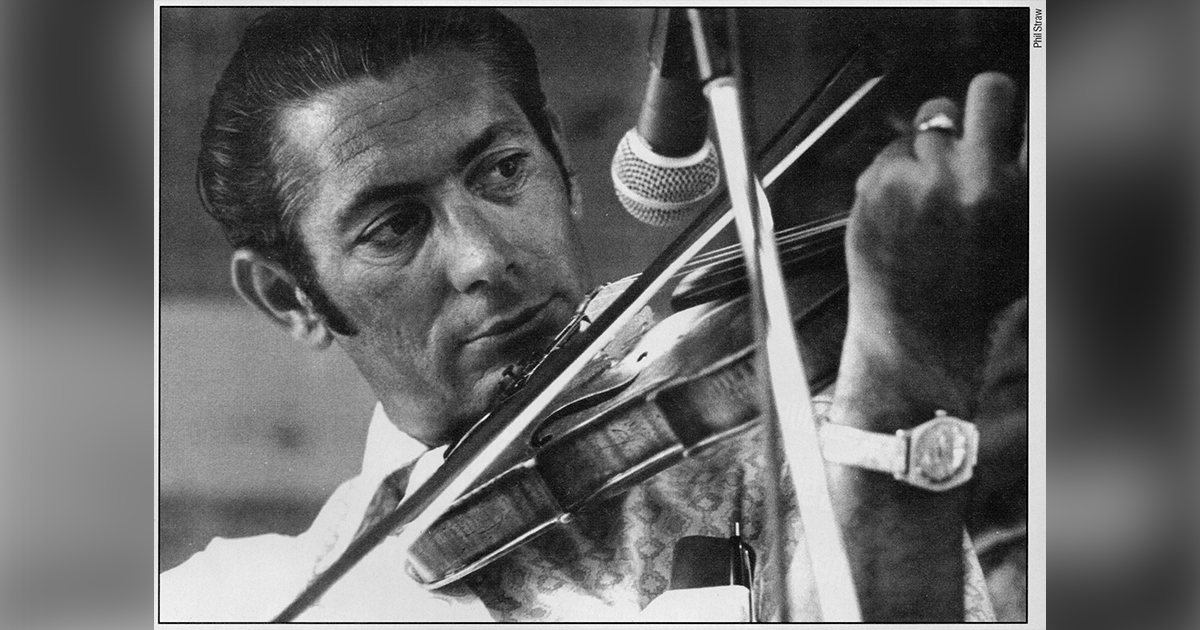
Billy Baker—Fiddler for Sixty Years and Counting
Reprinted from Bluegrass Unlimited Magazine
April 2013, Volume 47, Number 10
Among the better-known but under rated bluegrass musicians who have more than paid their dues, the name Billy Baker must rank as one of the more significant. At one time or another, this Virginia native worked as a regular or fill-in with about every group that played in the Washington/Baltimore area. Baker also recorded with many of them, served a stint as a Blue Grass Boy, fiddled on Del McCoury’s first solo album, and can still wield a bow with the best of them.
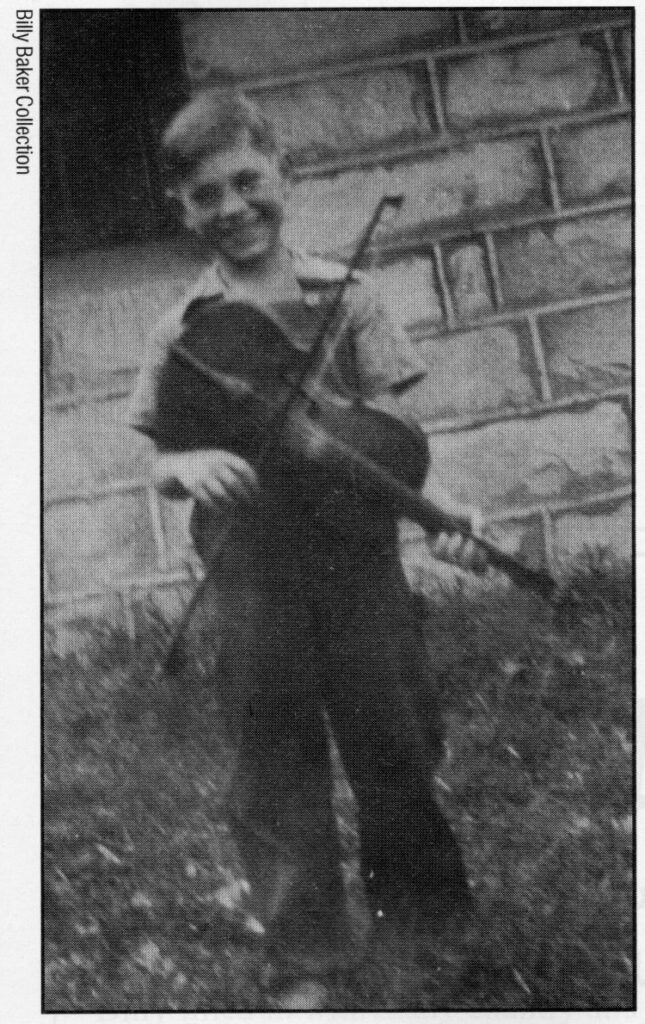
Billy Baker was born near Pound, Va., on July 5, 1936, to Eddie and Esther Baker. Some may recall Pound as the birthplace of the now nearly forgotten fated U-2 pilot Francis Gary Powers who made national headlines in 1960. Nearby Pound Gap is on the State line, only a few miles from Jenkins, Ky., hometown of fiddle legend Kenny Baker. In fact, Billy and Kenny are third cousins. Billy had musical influences in his own immediate family and first took up the fiddle at age six and played with his parents and siblings for home entertainment and community events such as pie suppers.
Outside the family circle, Billy began playing fiddle as a teenager in a band that included the Cooke Brothers. This threesome was comprised of the late Vernon C. “Jack” Cooke (guitar), a bluegrass veteran best known today for his decades of long service as a Clinch Mountain Boy; future Southern Gospel legend, Hubert (bass); and the less remembered oldest brother, Curtis (banjo). Playing a regular program on WNVA in Norton from 1951, the four adolescents developed their musical skills. After his service with the Cookes ended, Baker worked in another group at WCYB Bristol with banjo picker Porter Church, who like himself later made a name in the Washington, D.C., area with such bands as the Bluegrass Champs and Red Allen. From the mid-1950s, Billy lived in Manassas, Va., becoming a close friend of banjo-picking policeman, Smiley Hobbs. Returning to the mountains in middle age, Billy today makes his home in Norton.
With considerable experience behind him, Billy reunited with Jack Cooke who by this time had broadened his own musical horizons as a member of Bill Monroe’s Blue Grass Boys and recorded three Decca sessions with the master of his trade.
The two journeyed to Baltimore where they became members of Earl Taylor’s Stoney Mountain Boys, playing a radio show and working the clubs. The band at the time consisted of Walter Hensley on banjo, Sam “Porky” Hutchins on guitar, “Boatwhistle” Mclntire on bass, and Taylor himself on mandolin.
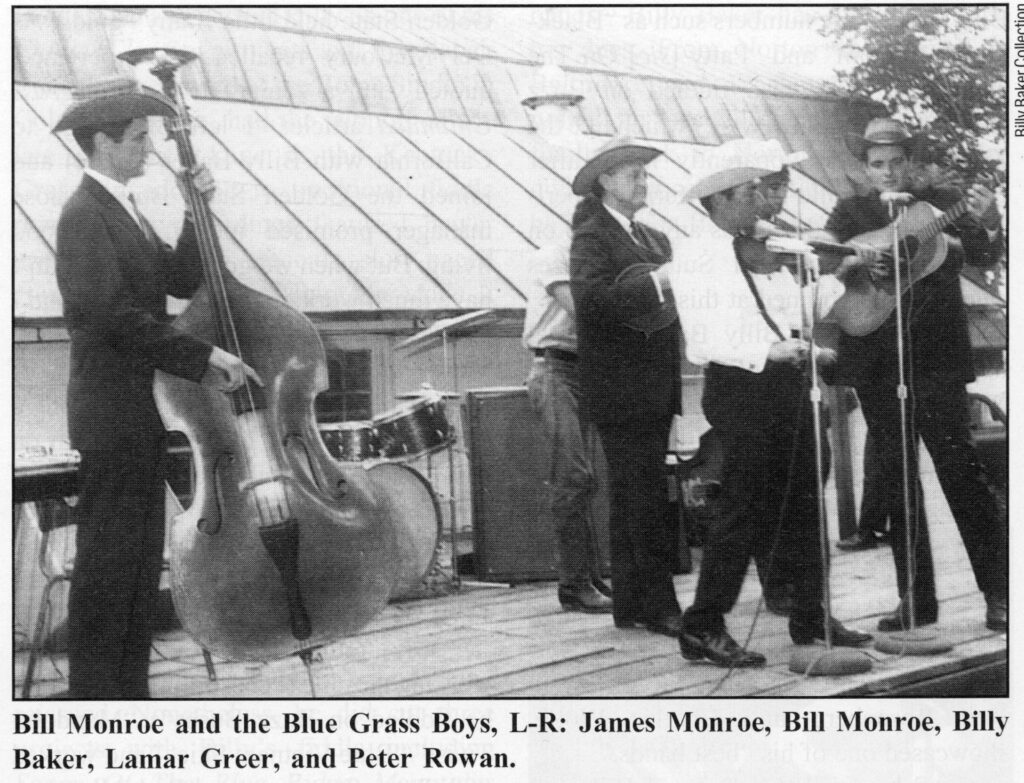
After a time, Hutchins departed and Jim McCall took his place. At some point. Bill Monroe passed through the area and Billy did a show with him. The Father of Bluegrass offered Billy a job as a Blue Grass Boy, but he didn’t take it. A couple of years later, the offer came again and, this time, Baker accepted the opportunity. Like most other bluegrass musicians in this period, Billy had a day job to support his bluegrass habit; in this case, road construction and asphalt work usually occupied his daylight hours.
After his stint with Earl Taylor ended, Billy continued to fiddle with numerous other bands in the Baltimore/Washington area. Perhaps one of the most significant from the point of his recording career was a combination known as the Shady Valley Boys. This band was started by Billy and Del McCoury, a young musician from Glen Rock, Pa. At various times, personnel included Charlie Tomlinson on bass, Jack Cooke on guitar, Smiley Hobbs on banjo, Russ Hooper on resonator guitar, and Billy on fiddle. McCoury did not appear on any of the band’s recordings, but Billy and Del worked together off and on for more than a decade.
Rebel Records recordings by the Shady Valley Boys and Billy Baker made up over twenty percent of the cuts of the four albums on the 70 Song Bluegrass Collection, with nine numbers credited to the Shady Valley Boys and seven fiddle tunes to Baker. In addition, his fiddling was heard on selections by Red Allen, Bill Carroll, Pete Pike, and Buzz Busby. Although never part of the Country Gentleman, he did play fiddle on some of their recordings of Christmas songs. While Billy sometimes played shows with the Franklin County Boys and Benny and Vallie Cain’s Country Clan, he doesn’t recall being on any of their recordings.
Three Rebel singles bore Baker’s credit, as did half of an album on Rebel’s budget label, Zap Publishing. The Shady Valley Boys also made a budget album under Dick Freeland’s direction that eventually saw release on the Sutton Records label entitled Hootenanny With The Van Dykes. It was marketed with a cover designed to appeal to urban folk music buffs.
The Zap album was shared with resonator guitar player Kenny Haddock under the title Dobro And Fiddle (Zap 103). Billy recalls that Smiley Hobbs did the banjo work on both sides of the album. Fiddle tunes on this LP included some of Billy’s signature numbers such as “Blackberry Blossom” and “Patty [sic] On The Turnpike.” Billy also fiddled on Buzz Busby’s “Mandolin Twist,” which like the Zap album was apparently made after Baker’s Nashville and California experiences. Whether there was any overlap on the varied Rebel and Sutton releases cannot be determined at this writing.
In 1963, both Billy Baker and Del McCoury accepted offers to join Bill Monroe’s Blue Grass Boys. As Billy recalls, Del had originally been hired to play banjo, but ended up playing guitar and singing lead. While Billy made no studio recordings as a Blue Grass Boy, some of the material from live shows in July 1963 at the Newport Folk Festival did feature his fiddle work with Monroe. It was later issued on Bear Family and according to Neil Rosenberg and Charles Wolfe, showcased one of his “best bands.”
In February 1964, Del and Billy left the Monroe band and traveled to California to become members of the Golden State Boys. This aggregation at one time or another included such notables as Don Parmley along with Vern and Rex Gosdin, but they were not part of the band at that time. The time spent in the Golden State held little if any “gold.” As Del McCoury recalled the experience, quoted in a June 1973 Bluegrass Unlimited article: “I left Bill to go to California with Billy Baker (fiddle) and joined the Golden State Boys, whose manager promised me a pretty good living. But when we got there, they didn’t have much work at all, so then Billy and I got a band up in Norwalk, Cal., the Shady Valley Boys [a West Coast version of their earlier group comprised of Steve Stevenson on banjo and Mel Durham on bass]. We played the bluegrass portion of a TV show every Sunday. We played clubs and the TV show, but there wasn’t enough work out there for a bluegrass band. In June, we came back…”
Billy returned to the D.C. area working the club scene, during which time he fiddled on Buzz Busby’s “Mandolin Twist”/“Blue Vietnam Skies” and worked with Patsy Stoneman and Red Allen in a group that also contained his old bandmate from WCYB, Porter Church.
Baker also continued working on a part-time basis with Del McCoury who went into logging with his dad after their misadventures in the Golden State. They played the area in Del’s adopted homeland of York County, Pennsylvania. Billy also played some shows with Alex Campbell and Ola Belle Reed in the late ‘60s, but did no recording with their New River Boys.
Baker did, however, play fiddle on Del McCoury Sings Bluegrass on the Arhoolie label. Recorded in December 1967, this album went a long way to secure Del’s reputation as a top-notch traditional vocalist. The instrumentation provided by Billy, Bill Emerson, Wayne Yates and Dewey Renfro complemented McCoury’s high lonesome sound that won the hearts of hardcore fans who had heard his live performances with the Blue Grass Boys four or five years earlier. Billy’s kickoff on several of the numbers and tasteful fiddling helped make this album one of real bluegrass classics of the ’60s.
Another album on which Billy fiddled in 1967, but did not see release for six years, was Won’t You Come And Sing For Me?, the second Hazel Dickens and Alice Gerrard release on Folkways. The first one had dated from 1963 on the Verve label, and the second was unissued until the pioneer girl team had signed with Rounder. Lamar Grier and David Grisman played on both discs, with Billy replacing Chubby Wise who had fiddled on the earlier effort. In addition to quality fiddle work throughout, Billy was featured on the Fiddlin’ Arthur Smith tune “Sugar Tree Stomp,” of which Neil Rosenberg noted “preserves all the features of Smith’s performance…but adds a few twists of his own.”
In 1969, on the strength of his successful Arhoolie album, Del McCoury put together his band the Dixie Pals. Given the fluctuating nature of personnel, the band could almost have been called the Dixie “Bills.” For several years, alternating fiddlers included Billy Baker, Bill Sage, and Bill Poffinberger, while Bill Runkle often did the banjo work. There were other sidemen, too—Dick Staber, Don Eldreth, Dewey Renfro, Jerry McCoury—but almost always one or two Bills. Billy can be seen and heard with the Dixie Pals and numerous fiddlers on the Carlton Haney motion picture Bluegrass: Country Soul recorded live at Camp Springs, N.C., in September 1971.
Although Billy had played some with Al Jones and the Spruce Mountain Boys over the years, he was not a regular member at the time, but he did the fiddle work when Al and Frank Necessary recorded their Rounder album (0050) in 1975. His work contributed to the quality of the entire project and was especially notable on such cuts as “Crying My Heart Out Over You,” the old Ernest Tubb favorite “Letters Have No Arms,” and Al’s own signature song “How The Story Had To End.” More recently, Billy has recorded some new material with Al Jones that remains unreleased at this writing.
Billy filled in with many country and bluegrass groups over the years. This included a tour with Don Reno and another with Jimmy Martin. One memorable country appearance consisted of a week-long engagement in November 1971 with country star Bobbie Gentry of “Ode To Billy Joe” fame at a Washington, D.C., hotel.
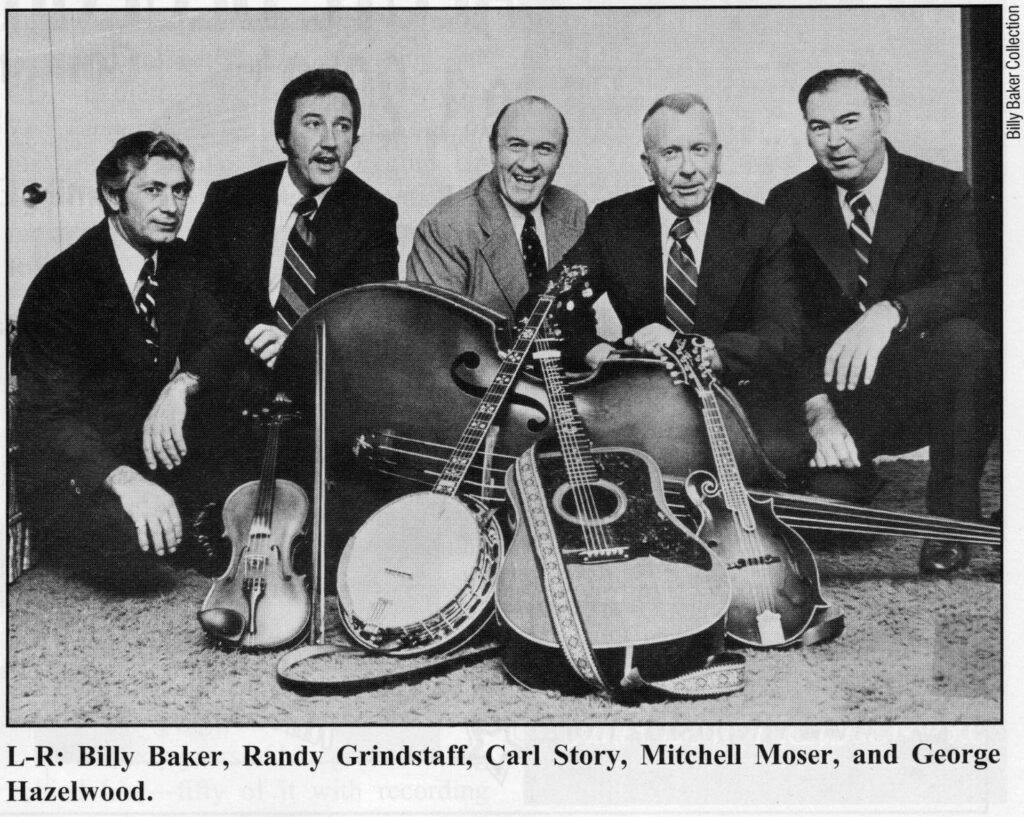
Later in the ’70s, Billy Baker moved back to southwest Virginia, settling first in Pound and then Norton, not far from his birthplace. In 1976, he joined a band from Grundy, the Bluegrass Kinsmen. In addition to Billy, this ensemble included Shelby and Ebby Jewell on guitar and banjo respectively, with Danny Anderson on mandolin and James Cole on bass. The Kinsmen recorded an album on Old Homestead and backed Billy on one of his Fiddle Classics projects on that label. The other, recorded at the Rome Studio in Columbus, Ohio, had the support of the late Lawrence Lane & the Kentucky Grass. In addition to traditional fiddle tunes, these recordings featured newer arrangements of recent slow-paced country hits such as “Help Me Make It Through The Night” and “Early Morning Rain” along with his original, “Baker Hill.”
Billy’s main exposure to the larger bluegrass audience from the late ’70s into the early ’90s came from fiddling with Carl Story & His Rambling Mountaineers. During this period, Carl did not record at the frantic pace that sometimes characterized his career, in part because so much of his earlier work was being reissued. Nonetheless, he did cut three projects with Billy’s fiddle including Songs Of The Blue Ridge Mountains (Maggard 5903) in 1979 and Live At The Lincoln Jamboree, in Hodgenville, Ky., released on a Plantation cassette in 1984. Ironically, both of these contained renditions of “Orange Blossom Special” which he had done on his Zap offering in the late ’60s. Billy also recorded another fiddle album, Wise County Special (Maggard 5902), with support from the Rambling Mountaineers.
After Carl Story’s passing, Baker remained regionally active. He played numerous times for dances at the Carter Family Fold in Hiltons, Va. He also played shows with a Kingsport, Tenn., band, Tennessee Skyline, recording one CD with them. It’s A Long, Long Way To The Tennessee Line. It included one of his original fiddle tunes “Digging Up Gold” which he describes as essentially a reworking of Bill Monroe’s “The Gold Rush.”
In recent years, the semi-retired fiddler who lives in Norton with his wife Nora Sue has often been heard wielding the bow with young East Tennessee traditionalist Kody Norris & the Watauga Mountain Boys. In fact, it was Norris who insisted that Billy deserved more credit for his contributions to the music than he has hitherto received. Billy fiddled on the 2011 release of Kody Norris, Live On The Road. Other Watauga Mountain Boys material featuring Billy on fiddle is currently in progress.
With sixty years of bluegrass fiddling behind him—fifty of it with recording bands—Billy Baker has more than paid his dues. From Norton and Bristol to Baltimore and Washington, with side junkets in Nashville and California, and finally back to Norton, he has distinguished himself in his field. What’s more, he isn’t even finished yet!