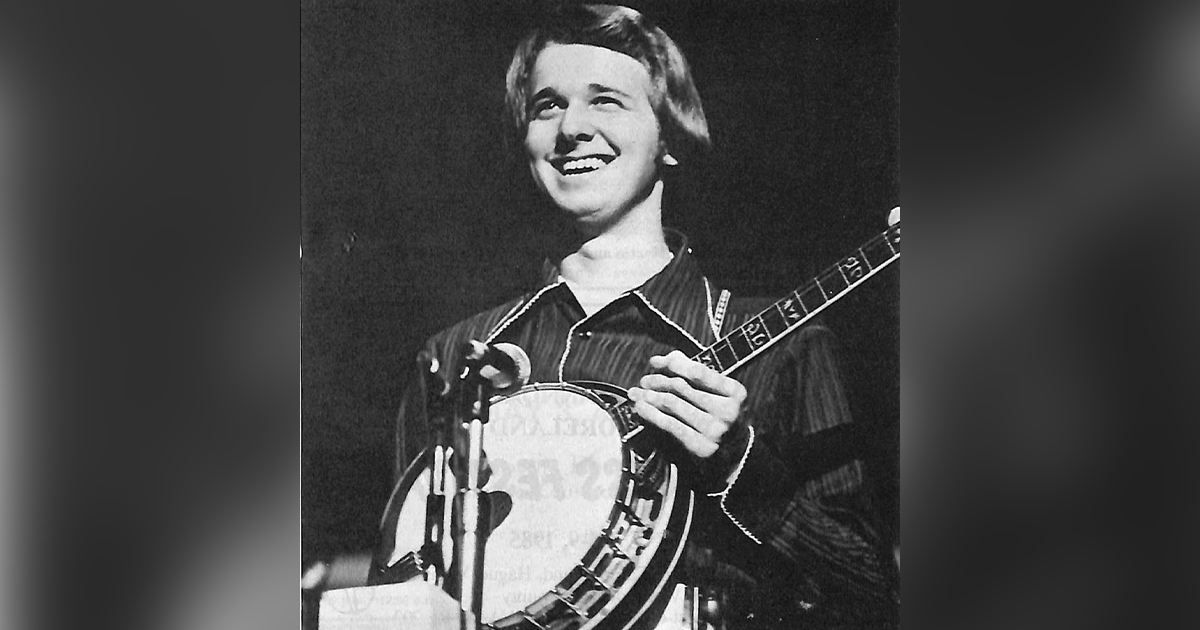
Marc Pruett Does It All
Reprinted from Bluegrass Unlimited Magazine
April 1985, Volume 19, Number 10
Marc Pruett’s office tells at least half the story. A ten by fifteen foot corner of his Pick ‘N’ Grin music store in Asheville, North Carolina, it exudes warmth and frenzied activity. Banjo parts lie scattered about wherever he could find space for a neck or tone ring. Brown boxes of albums form stacks climbing to the ceiling as the warehouse of Marc’s Skyline Records. A Flatt and Scruggs poster looks over a desk cluttered with seemingly random piles of slips of paper that represent some of the demands of his time. He finds room, however, for pictures of his wife and daughter. Marc makes time for them, too, despite wearing almost every bluegrass hat—banjo picker, band leader, record producer, songwriter, music store operator, record company president, and entertainer.
The thirty-three year old native of Haywood County, North Carolina manages to balance both all this work and his family life without losing his ready good humor or his concern for other people. Come to think of it, maybe those are two reasons why he can do so much.
Marc has paid the price so far by remaining little known to bluegrass fans outside of the southern Appalachians. His widest exposure in recent years has come from his contributions to Ricky Skaggs’ big selling albums. Asked about Marc, Skaggs asserted that he is “the best young banjo picker playing real bluegrass. He has the right technique and he goes about it the right way. He’s a fine fellow and has a real level head on his shoulders. I wish more people could hear him.”
Marc’s banjo style is pure Scruggs —clean, clear, and strong on melody with drive to spare. “I just try to bring out the melody and play in a clean, simple style,” Marc says. “I just want to play rhythm, and play the melody, and play as good as I can. What I think I do best is play what fits a band’s sound.” Marc came by his traditional approach naturally. He grew up listening to country and bluegrass music. His conversion to the banjo occurred at age eleven while enjoying the “Cornbread Matinee” on WHCC, Waynesville.
Relaxing behind his desk, Marc recalls the incident in his friendly, easy going manner: “It would come on right when I got home from school at 3:30 in the afternoon. They were featuring Flatt and Scruggs that day. I’d heard the banjo some before and never really paid much attention to it. For some reason, that day it just hit me square in the middle of the face. Bam! Here’s Earl Scruggs playing the “Flint Hill Special” and “Earl’s Breakdown,” and they were doing some of the old classic songs they did so well.
It drove me wild. I just set there with my eyes growing big listening to that. I asked my mother, ‘What is that instrument that that man is playing?’
“She said, ‘Son, that’s a banjo.’ I told my folks I wanted one for Christmas.” Marc first learned to pick Stephen Foster’s “Old Folks at Home” one string at a time with his mother telling him when he hit a wrong note. Soon experienced area musicians began to teach Marc the intricacies of the three finger roll. He formed his first band called the Starlight Ramblers with some friends from school. “We were so naive, we didn’t know that the Battle of the Bands was for rock ‘n’ rollers. We entered a bluegrass band and got an honorable mention,” Marc recalls with the exuberant grin that he flashes on stage.
He learned invaluable lessons about being a professional entertainer and musician while working summers as a banjo picker and bass man for Panhandle Pete [Howard Nash] at Ghost Town in Maggie Valley from 1967 through 1969. He earned $70 a week for seven 45 minute shows, six days each week. From 1970 through 1972, Marc spent his summers playing banjo and gun fighting in the mock saloons of Gold City in Franklin, North Carolina.
Toward the end of his last summer of Ghost Town, 16 August 1969 to be exact, Marc saw Jimmy Martin at the Maggie Valley Playhouse. “That was the first time I’d ever heard just a really top-notch, crack bluegrass band. I made up my mind then that I was really going to try and learn it and get a job with Jimmy Martin someday.” Marc took the first step that evening by giving Martin’s manager one of his cards.
A few days later Marc enrolled at Western Carolina University. Although he was graduated with a geology degree four years later, Marc allows that he “majored more than anything else in campusology and bluegrass music.” Much of his experience as a sideman with major artists occurred during his college years.
Banjoman Tom McKinney, meanwhile, gave Marc a post-graduate education in the Scruggs style. When James Monroe contacted McKinney in search of a banjo picker, he steered him to Marc. Marc began an eight month stint as a Midnight Rambler on 2 December 1972. That exciting period reached its apex at Bean Blossom in June 1973. Marc picked a blistering version of “Train 45” that appears on the James Monroe segment of the “Bean Blossom” album (MCA 2-8002).
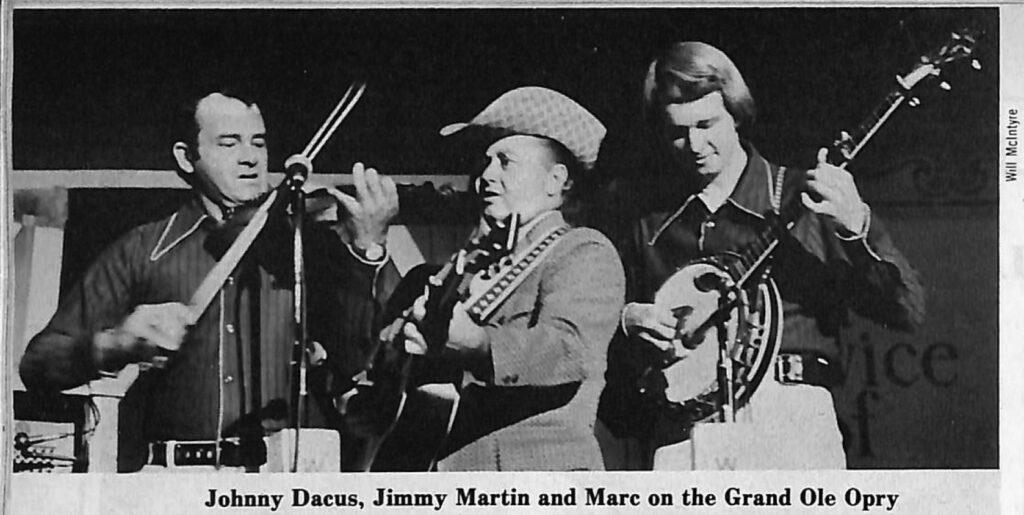
Shortly thereafter, Marc achieved his dream when he replaced Alan Munde as a Sunny Mountain Boy. Although he worked off and on with Jimmy Martin for two years, the fall of 1973 proved Marc’s only regular stint with him. That brief time, however, carried Marc to the stages of the Grand Ole Opry and New York’s Lincoln Center. Like many others, Marc credits Martin for improving his timing. “He understands rhythm for bluegrass music as good as any man alive.” His favorite memory of that time was when Ralph Stanley and Ricky Skaggs joined Martin to sing “White Dove” at Myrtle Beach.
Marc and Skaggs first met in 1972 and a friendship quickly developed “Even before Skaggs got big, I felt like he was the man who could do it,” Marc says. “Even though I never got to work with him on a professional basis, I guess he liked my picking enough to use me on four different albums that he did.”
Marc served his last stint as a big time sideman with Buck White and the Down Home Folks during the 1975 festival season. Only that the Whites did not perform very often that year made Marc’s participation possible for he had undertaken a time and capital intensive business.
As a senior in college Marc had cast about for ideas of how to make a living without giving up music or spending his life on the road. “So my brother and I decided to open up a music store in Asheville. That’s all I knew about it. I didn’t know how the business operated or even have a line of distributors or anything. I went into debt severely for that music store —a lot more money than a kid just out of college should go into debt for.”
Although the first few years proved difficult for the Pruett Brothers Music Center, it has grown into the successful Pick ‘N’ Grin. The store celebrated its eleventh anniversary in January, 1985. It sells acoustic and electric instruments, P.A. systems, and records, while maintaining an instructional staff of eight or nine.
“We’re recently involved in a real successful program in the Madison County high schools. Bucky Hanks of the Midnight Plowboys, and one of our good teachers, Dale McCoy, are teaching something like 250 kids how to play the guitar and banjo.”
As a result of his ties to the store, Marc did not follow up opportunities to work full-time with Jimmy Martin, Bill Monroe, Jim and Jesse, and the Country Gentlemen. He especially regrets not playing with Skaggs. “The original Boone Creek band we talked about was going to be Ricky, Keith Whitley, Randy Davis, Terry Baucom, and me. I couldn’t leave Asheville because I owed the Bank of Asheville too much money.”
Skaggs echoed Marc’s sentiments. “I regret that we couldn’t work together in Boone Creek. It was one of those things that wasn’t meant to be.”
The music store, on the other hand, permitted Marc to enjoy family life. He and Betsy, a kindergarten teacher, were wed in August 1975. On September 29th, 1981, their daughter Elizabeth was born.
Despite all these demands on his time and energy, Marc managed to maintain local bands throughout the seventies. After meeting James and Arlene Kesterson at Union Grove in 1969, he joined their Highland Minstrels. He played banjo on an album of theirs that also featured Bill Monroe alumnus Ralph Lewis.
Most of his work during the decade came with the New Day Country Band, which he founded with Earl Cowart. Marc says that Cowart “can stand in there and sing like Merle Haggard or Lester Flatt.” Only Marc appeared on both of the outfits’ eponymous albums (CEC RSR-269 and Wes Sound Shop RSR-866). The first LP with Cowart and several other leading western North Carolina musicians contains two compositions by Marc, one an excellent gospel tune, “Singing, Shouting, Praying.”
The New Day Country Band worked regularly at Buddy’s Bar-B-Q in Knoxville and played a number of festivals. Its’ biggest trip came in July 1976 as a sojourn to Poland, where the group found a strong response to their bluegrass and country music. After one performance an East European asked Marc for a set of finger picks. “I gave this guy a set of finger picks and he got down on his knees on the floor and just thanked me for it and I didn’t know how to react. If I’ve ever had some one thing stun me about this American society and Communist society, that was it. That woke me up to a lot of things as far as helping people when I get a chance.”
Marc achieved a major step in his plan to build a base of operations with the opening of Bill Stanley’s Barbecue and Bluegrass (See BU Sept. 1980) in downtown Asheville in October of 1979. He organized the Marc Pruett Band as the house outfit and they have averaged four nights a week there ever since. The lineup of experienced pickers demonstrates the wealth of the Asheville bluegrass scene. Bassman Randy Davis left Bill Monroe after five years and as many MCA albums. Able to handle several vocal parts, he replaced Buddy
Davis on lead in 1980. Buddy had appeared on their first album, “The Marc Pruett Band” (IRC 1083). Randy has developed into a strong and confident lead singer. Mike Hunter, who played mandolin with Jimmy Martin for two years in the mid-seventies, had also worked with Marc in the New Day Country Band. Likewise for Arvil Freeman, whose credits include fiddling with the Stanley Brothers, Carl Sauceman, and Reno & Smiley. When guitarist Buddy Davis departed in order to concentrate on bass, Steve Sutton took over on guitar and baritone. Steve had replaced Marc on banjo with the Sunny Mountain Boys and had worked off and on with Jimmy Martin from 1974 through 1977.
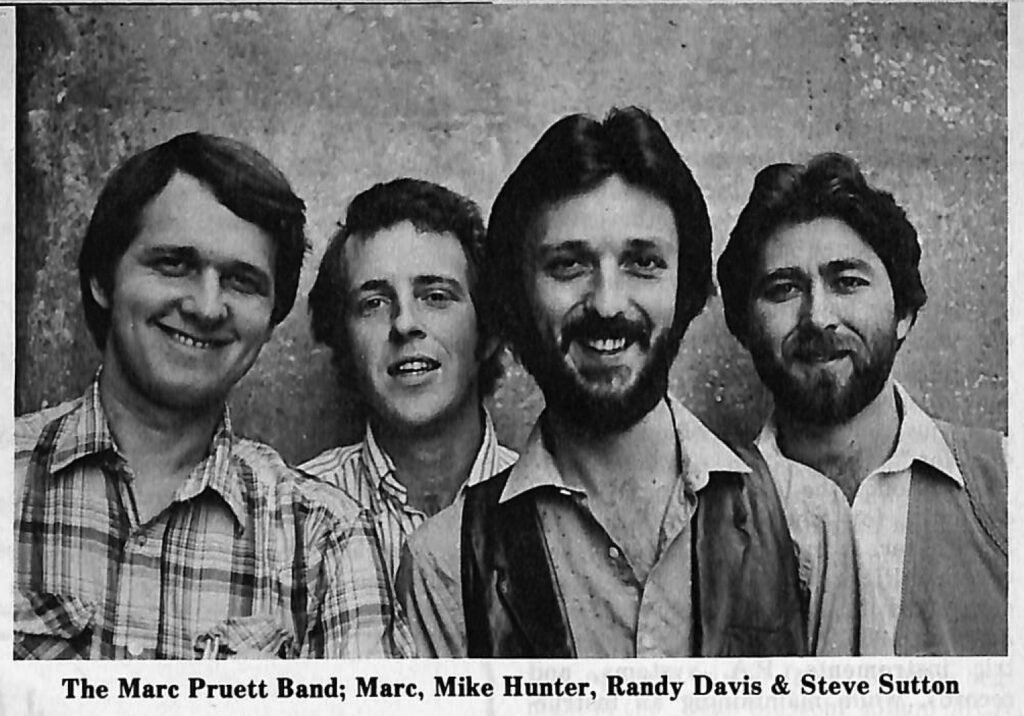
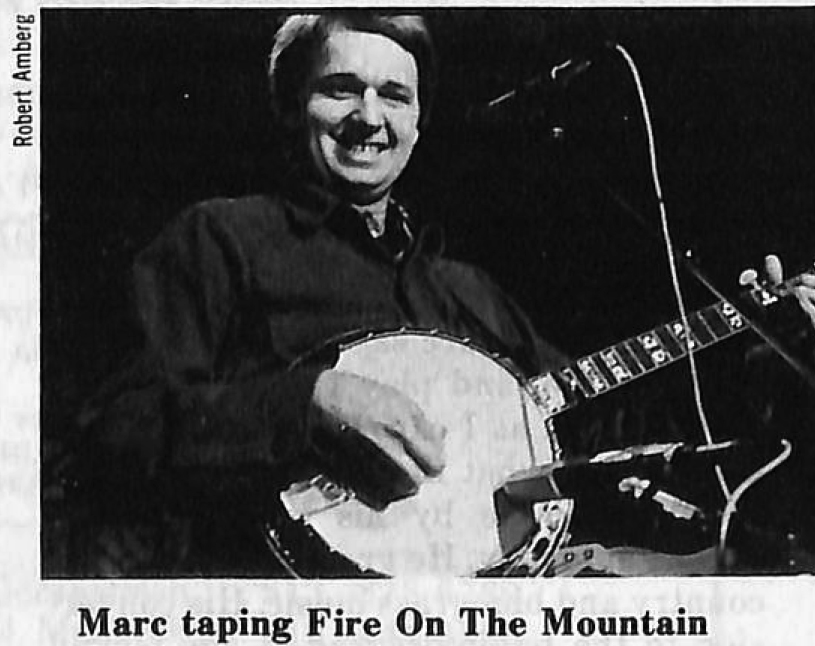
Marc stresses good fun as the most important image for the band. “Everything that we do on stage is geared toward trying to entertain people from the standpoint of the music we play.” Although the Asheville connection has kept the Marc Pruett Band little known, the group has gained wider exposure recently through appearances on the Linear Group’s “Fire on the Mountain” television series and “Liberty Flyer” radio show, and a week at the Knoxville World’s Fair.
Their 1981 album, “Moonlight Madness” (Marandee MR 001), contains ten original Marc Pruett compositions with a strong Flatt & Scruggs feel. Marc’s clean banjo work and Freeman’s classic bluegrass fiddling especially distinguish the record, which demonstrates what the band can do when it has the necessary control and freedom.
Like his picking, Marc’s songwriting emphasizes simplicity and he frequently evokes good humor. Successful country tunesmith Billy Edd Wheeler (“Jackson,” “Coward of the County”) has helped Marc with his compositions. One song they wrote together appeared on a National Geographic Society album about Daniel Boone that sold over 100,000 copies. “That was a fluke for me. I’ve tried ever since deliberately to be able to make it work for me. I keep writing. I keep learning.”
Marc created his own record label, Skyline Records, in 1980. He appears on three of the ten albums issued so far. His banjo album, “Streamline Cannonball” (Skyline SR 006), is a thoroughly enjoyable instrumental outing. The Marc Pruett Band backs him on five of the cuts, while the other five feature the Whites and Ricky Skaggs. “Dance Music: Square and Clog” (Skyline SR 007) finds both the Marc Pruett Band and the Midnight Plowboys playing lengthy instrumentals for dancing. “I Like To Smile” by Marc and Steve Heller appeared just before Christmas 1983. Including Bobby Hicks and a number of fine pickers, the album consists of fun-filled original children’s songs, containing simple morals. “In recent years, if I’ve had one thing inspire me more than anything else it was the birth of our daughter. That’s what threw me into this children’s album.” Skyline has also issued albums by Raymond Fairchild, the Crowe Brothers (a BU Highlight LP), Mike Hunter, Bo’s Bluegrass Band, the Cowbell Hollow String Band, the Carroll Best String Band, and the Midnight Plowboys.
Marc can’t name one most satisfying aspect of his varied bluegrass career. “All the things add up. All the experiences. Some have been more successful for me commercially and some have been very satisfying. I’ve always felt like whatever it is that I can do, if I just work at it, I’ll get what’s coming to me. I’m a dreamer and I keep working. I keep writing songs, and producing records, and selling guitars, and playing the banjo. I love it.”