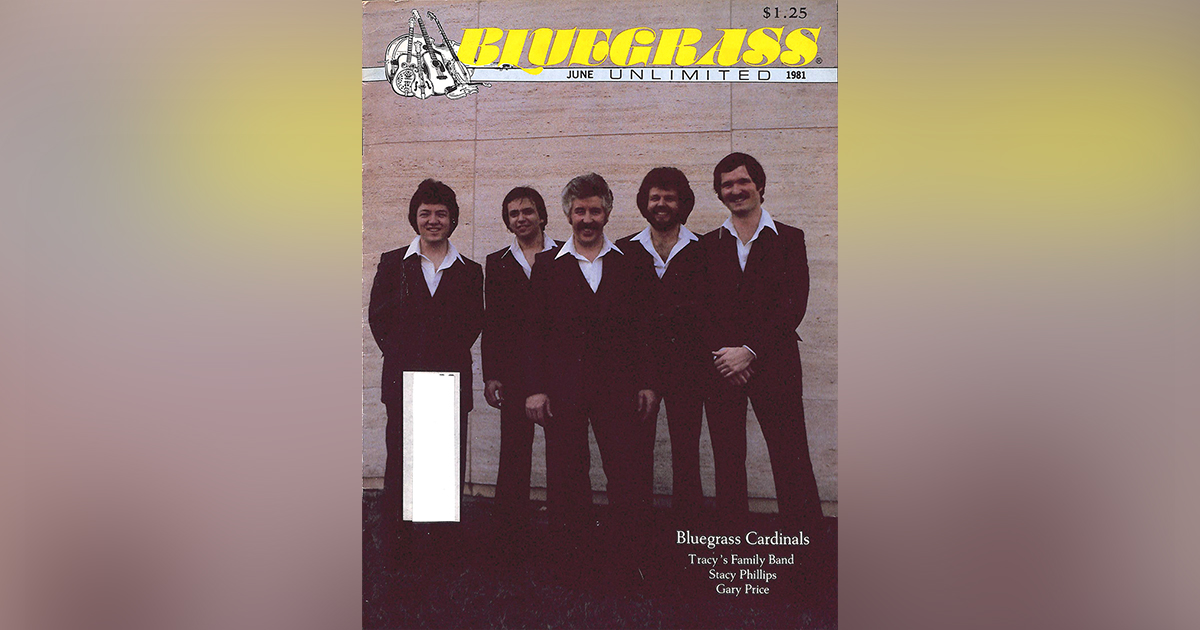
The Bluegrass Cardinals—Fast Closing In On the Ranks Of Bluegrass Superstardom
Reprinted fromBluegrass Unlimited Magazine
June 1981, Volume 15, Number 12
In a musical field where “an overnight success” simply does not exist and many years of “paying your dues” is the normal course for the fortunate few who attain top drawer status, as well as for the many others who don’t, The Bluegrass Cardinals have —totally on the merits of ability— achieved phenomenal success during barely five years as a working professional group.
Mention The Bluegrass Cardinals around almost any gathering of bluegrass fans or pickers and the immediate reaction runs to comments such as: “hey those guys are good!!”; “they sing some fine harmony don’t they?” or “I believe that David Parmley—that’s his name isn’t it?—is the best lead singer I ever heard!”
But despite the intense interest the group’s music has generated, there exists a certain degree of anonymity among casual fans regarding names of individual members of the Cardinals in the shadow of their instantly-recognized band name.
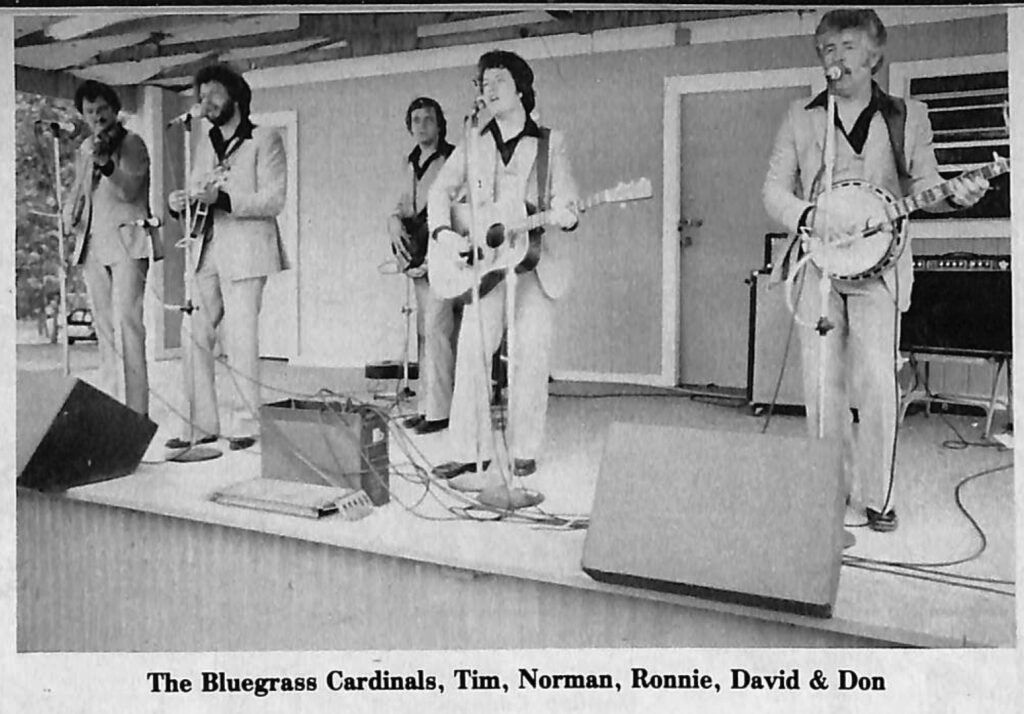
The group members themselves have in fact contributed to this “all for one and one for all” concept as witnessed by a live album recorded in 1979, during the course of which MC David Parmley casually remarks “our banjo player and fiddle player are gonna do a tune for you that they worked out…” No fanfare, no buildup, no name credits for the superb banjo picking and fiddle playing that was to follow. The banjo player is David’s dad, partner and best friend, the originator of the Bluegrass Cardinals, Don Parmley.
As in the case of The Statler Brothers or The Oak Ridge Boys, the “star” is The Bluegrass Cardinals. But by the same token, any member of the Cardinals would be quickly recognized by sight by most fans while walking around the grounds of a bluegrass festival as would Don Reid of the Statlers or Duane Allen of the Oaks at a country music show.
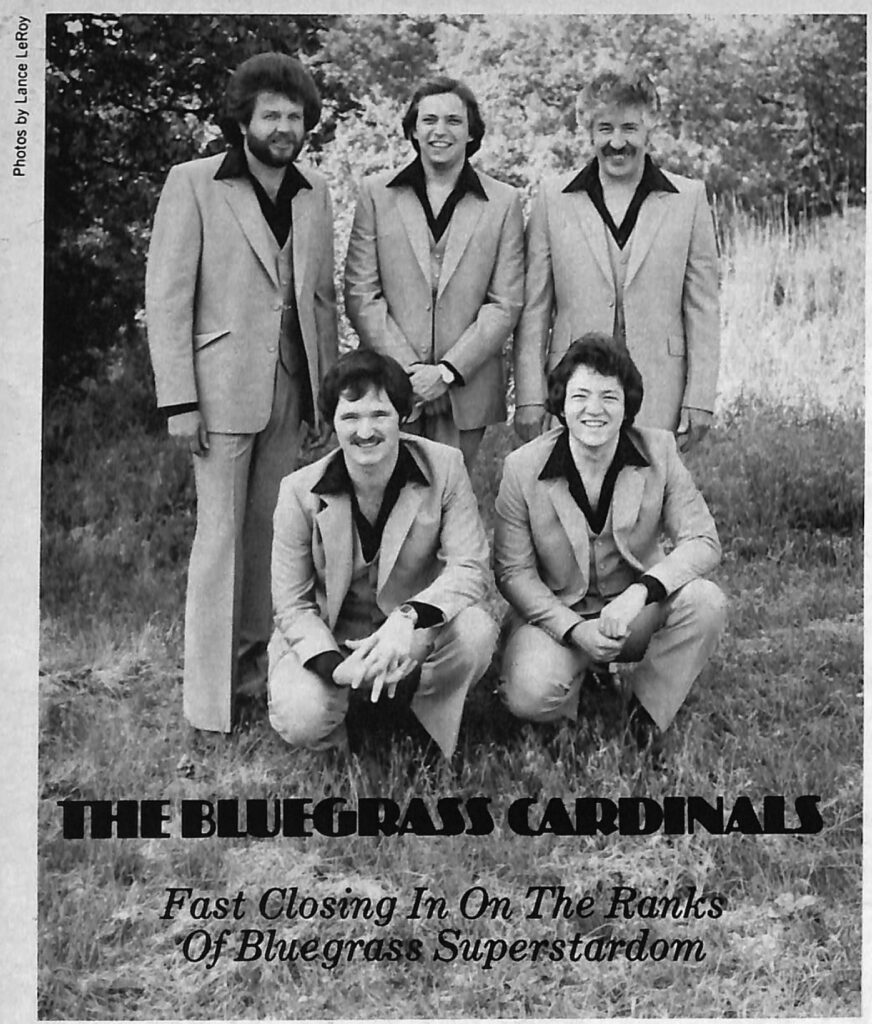
The story of The Bluegrass Cardinals consists in large measure of the story of Don Parmley, who organized in the Los Angeles area of California what is now one of the nation’s finest and most respected bluegrass music units. Born and reared near Monticello, Kentucky, he was inspired to learn the five string banjo by listening to Earl Scruggs on the 5:45 A.M. radio broadcasts from WSM in Nashville. In May, 1956, he married Betty Jean Abbott after his return home from service and shortly thereafter worked briefly playing banjo with Hylo Brown in Wheeling, West Virginia. During this period Lester Flatt & Earl Scruggs and The Foggy Mountain Boys were working six or seven days every week but most other professional bluegrass artists were in limited demand so Don soon realized he had to find something else.
“I had relatives in California,” he says. I went out there looking for a job in August, 1956 and worked for Continental Trailways twice, each time for about five years, driving a Silver Eagle on runs such as L.A. to Las Vegas and L.A. to Flagstaff, Arizona. Of course I was pickin’ part time here and there. I suppose it was around ‘64 that Curt Massey called and offered me the job of doing the studio background banjo work on the ‘Beverly Hillbillies’ network TV show. Curt was the producer of the show. Steve Stephenson had done the banjo playing for the first two years and I did it for the next nine years. There was quite a bit of banjo on each segment and it all had to be timed right to the second, like when Jed’s old pickup would fire up and go roaring out the driveway or Granny would throw a skillet at Jed. Our only child, David, was born in California and playin’ music just came natural to him. As he grew up he began to pick and to sing harmony parts but he never played in a regular group. When Butch (Don’s pet name for David) was about 15 we came up with the combination that we felt like had a chance of makin’ it. This was the original Bluegrass Cardinals and was on a part time basis to start with. Our first album was for Briar Records and was recorded in October, 1975 and released early in 1976. My wife gave The Bluegrass Cardinals their name. We get asked about that as often as anything on the road. She got the idea from this little decoration of a cardinal on our refrigerator door. It seemed like a good band name and then when she found out that the cardinal is the state bird of some of the states where bluegrass is played a lot, then it seemed real logical so we adopted it and had it registered in Washington.”
In addition to marvelous voices in harmony, a well known Cardinal trade- make is their occasional yet significant use of vocal syncopation to liven up what would normally be a less interesting sustained harmony line. Prime recorded examples are the 1975 Briar recording of “Are You Missing Me?” and the 1978 CMH recording of “I Wonder Where You Are Tonight.” “There was a guy we used to pick a little with, I think he was originally from Milwaukee, by the name of Jerry Wyskantowski—I’m not sure about the spelling—who came up with the idea for that and he rewrote the chorus line on ‘Are You Missing Me?’,” recalls David.
Now 22 and a well seasoned professional, David remembers how proud he was to be playing in his first organized band and to date the only one he has ever played in: “the original Bluegrass Cardinals consisted of my dad; Randy Graham; Steve Stephenson and myself. This was early in 1974 I’d guess when we first organized and before we went into it full time. I played upright bass at the time. I switched to guitar a little later when Bill Bryson joined us and played bass.
Lance LeRoy (their manager) recounts his recollections of this stage in the band’s career; “It was the last weekend in October, 1974 and Bill Monroe was putting on this festival about 50 miles out of Los Angeles. In terms of number of ‘names’ the cast would have been considered average for an eastern festival of that period but for the West coast it was a tremendously impressive bill and would be even today out there. I was working for Lester Flatt and besides Lester there was of course Bill and also Ralph Stanley on the festival. They had a flat bed trailer for a stage and the MC, Dan Crary, had gratuitously agreed for me to introduce my boss and the Nashville Grass to the audience. While we were standing on the steps waitin’ to go on, The Bluegrass Cardinals were performing and they did one of Lester and Earl’s old songs, ‘Cora Is Gone’.” Lester and Earl had recorded it with solo lead all the way through, only these boys did it with a trio at the bridge and it was something to hear! Then they went into their syncopated arrangement of ‘Are You Missing Me?’.” I could tell Lester was hangin’ on every word they sang but he tried not to show it and when they had finished his laid back manner and deadpan expression were back in full force. He turned to me and observed dryly, ‘when them guys open their mouths they don’t do nothin’ but sing, do they?’ It was his finest compliment.”
“Late that night and well after midnight in fact, a few of us were gathered around a log fire in the back end of the park. Don and David Parmley, Randy Graham and Bill Bryson of the Cardinals were singin’ some fabulous stuff and Keith Whitley, who was in Ralph Stanley’s band at the time, added another dimension to what they were doing. Trying to find something to say that would convey my highest regards, I informed the gathering when we broke up about 4:00 in the morning that if they ever needed a manager to look me up.”
LeRoy continues: “The following weekend we played another of Bill’s festivals in Payson, Arizona on the way back to Nashville. Early Sunday afternoon somebody brought word to me on Lester’s bus that some fellers wanted to see me. After makin’ my way through a light snow and a cold wind that seemed to almost cut you in two, I crawled up on a low topper on this late model pickup truck to find none other than Don, David and Randy, who had driven over 400 miles one way in that weather. My first thought was that maybe they had come because of my remark of the previous weekend concerning my availability if they ever needed a manager and I was real embarrassed because I hadn’t okayed it with Lester!” “It turned out to be a case that they were wanting to get a first hand opinion to how prospects would be for another full time bluegrass band in the eastern states. They were very seriously considering giving up their other jobs and going into music full time and wondered if I thought they could succeed. The burning anxiety in their eyes made it plain that they were at a crucial point in their careers and not one they took lightly. Deep down I knew they had something that would set a lot of east coast fans on fire but I was afraid to take on the responsibility of being an instigator. What if I helped encourage them to quit their full time jobs, pack their belongings and move 2,000 miles and then things didn’t work out? Instead of doing what I should have done and telling them what my real gut feelings were, I took the coward’s way out by saying diplomatically that they were plenty good enough to make it—which they definitely were—but that on the other hand there were some very good groups out our way that were having a tough time finding enough work to make it through the winters and that it was therefore risky.” LeRoy then concluded: “For a week or more after that it seemed I couldn’t get The Bluegrass Cardinals off my mind and I couldn’t escape the feeling that they must have resented the way I had straddled the fence while they were expecting answers. A couple of years later there appeared in Bluegrass Unlimited this little bitty ad with an illustration of a Cardinal using his wing to ‘thumb’ a ride by the side of a highway and a caption that read: ‘The Bluegrass Cardinals have migrated east. For booking call 703/860-2137.’ And I just grinned.”
“How that all came about,” says David, “we all had jobs and we’d been wantin’ to give ‘em up and go into music full time. Randy had already quit his job when one night my dad came in from work and said we had this 15 1/2 week engagement at Busch Gardens (entertainment complex) lined up so he was going ahead and turn in his notice to Trailways.
“In April and again in September of ‘76 we worked some bookings in the eastern states, Maryland, New Jersey, Pennsylvania, Ohio, New York and Washington, D.C. Playing those shows convinced us we had to go where the work was if we planned to stay in it professionally, which we were determined to do, so we moved to Virginia in November.”
“The response to our music was awfully encouraging—more so than we ever thought it would be—and we even got on the cover of Bluegrass Unlimited as a result of the April tour! [BU-May 1976]. The next year our second album, ‘Welcome To Virginia’ was finally released and we gave a concert on the White House Lawn for the President and his guests. Things were going good for us and they haven’t really been bad since at any time I can recall. In fact I’m thankful to say they’ve been very good.”
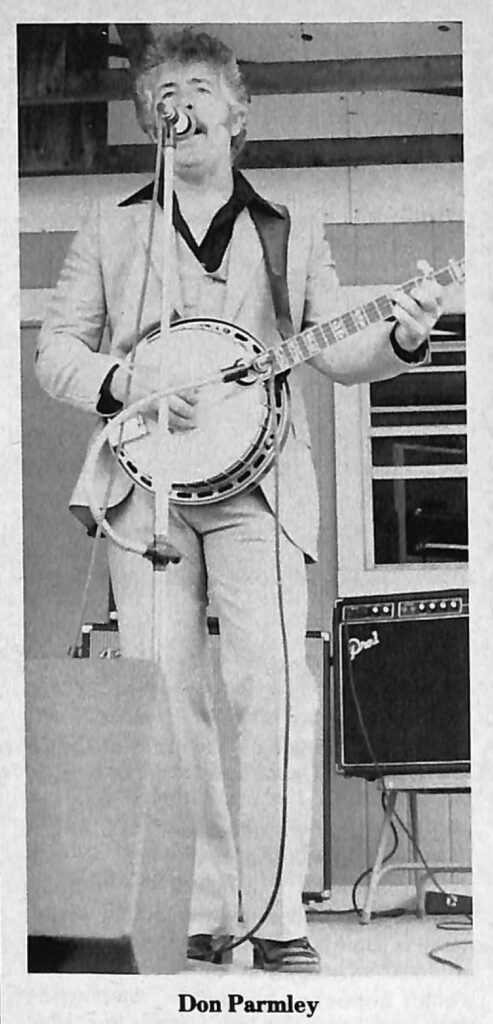
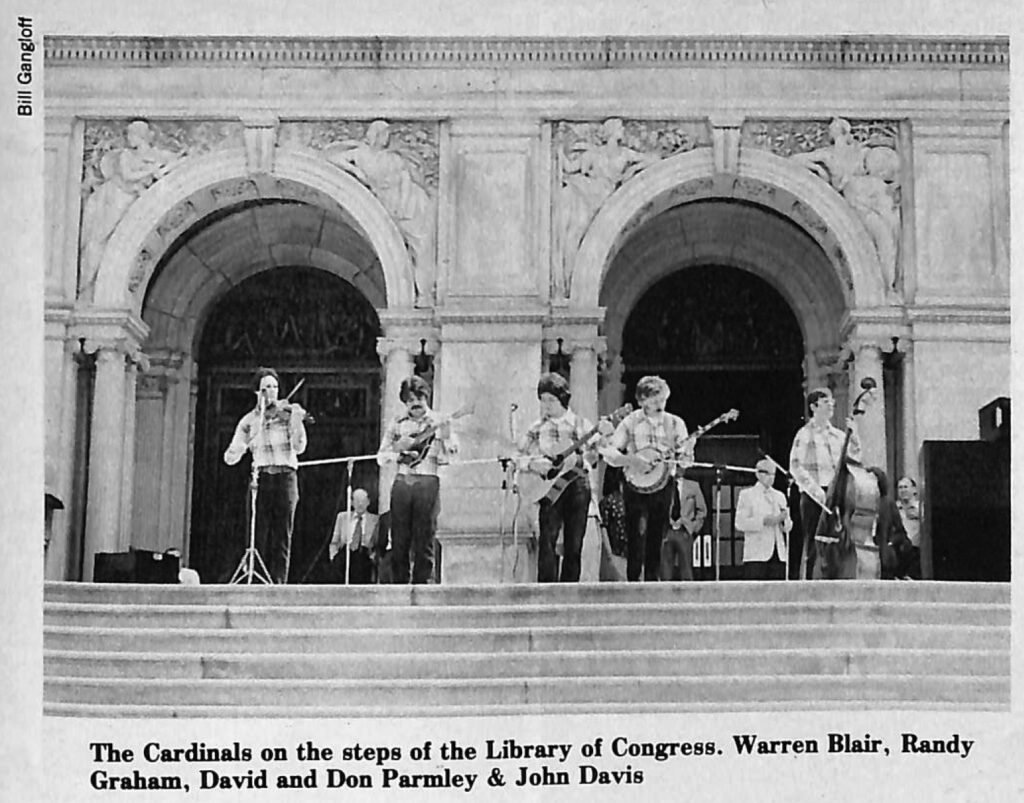
The first eastern musician to join the Cardinals following the move from California was John Davis, a fine bass player and vocalist. His dad, Jack Davis, was immediately elected spare time booking agent. For sheer energy and aggressiveness he had no peer. The band was soon working everything except “pool halls, barber shops and telephone booths and hey I think we worked a few of those too!!,” he says in his effervescent manner. With Warren Blair playing fiddle, Rounder records released in the summer of 1977 “Welcome To Virginia,” an album regarded by an impressive number of critics as one of the most definitive bluegrass sessions of the seventies.
It was the winter of that year that The Bluegrass Cardinals were to once again cross paths with Lance LeRoy. As a producer for CMH Records, LeRoy signed them to a recording contract with CMH. He then quickly accepted when Davis called a few months later to explain that the group was now in need of full time management and that Lance had been “unanimously elected.”
The first LP for the label, “Livin’ In The Good Old Days,” was taped during February and April, 1978 and released in August. There have since been four more successful albums for CMH—of which two were double-disc sets with guests— including the most recent, “Sunday Mornin’ Singin’ ” in August, 1980. Their sixth LP for CMH, to be titled “Where Rainbows Touch Down,” is planned for summer, 1981 release and will consist entirely of new song material.
Don, who sings the essential and difficult baritone part superbly while playing banjo, is quick to point out that despite some personnel changes the group has been able to maintain a consistent “sound” throughout because with David singing lead over his baritone it has never been necessary to change more than one voice in the trio vocals. They are also given to swapping parts when necessary in the manner of Charlie and the late Ira Louvin. Don and David’s voices blend as only blood kin can.
Lance LeRoy has continued to be closely identified with the Cardinals, working for them as manager and booking agent. He describes himself as more enthusiastic about the group’s future now than ever: “The Cardinals are just now reaching their full potential. They’ll take a country song or a new song, give it an arrangement that’s loaded with soul and sensitivity and sing it with the nicest, fullest trio harmony blend that I’ve heard. They’re doing some of the most creative and commercial things in bluegrass right now with a style and delivery that carries a strong impact, instead of going in one ear and out the other. In addition, they’ve been blessed with excellent-plus material.
I was at a festival in Wisconsin last Summer and in one afternoon two different groups introduced numbers with something to the effect of: ‘here’s a song we learned from a record by The Bluegrass Cardinals.’ Writers like to send them (song) demos because they’re on a good label, do a good job in the studio and they sell a lot of records for a bluegrass act.”
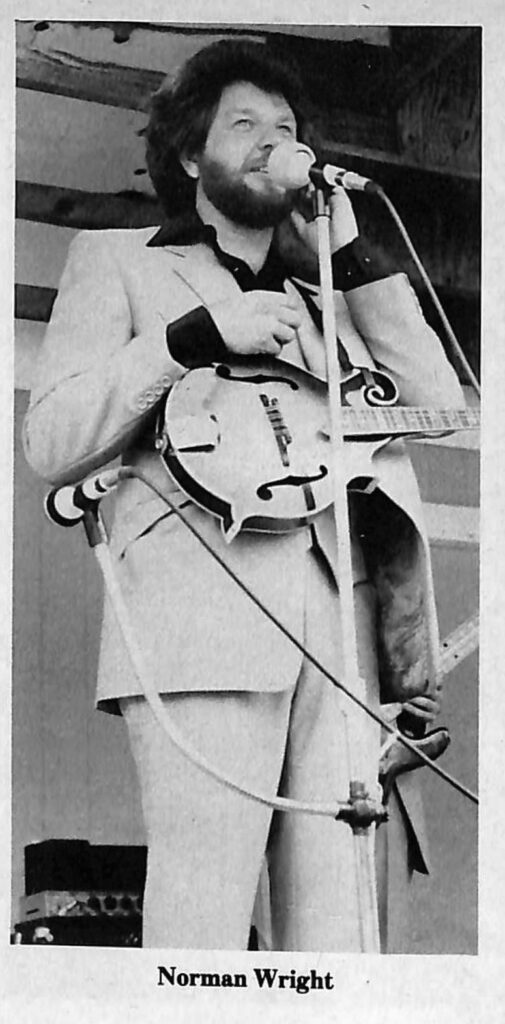
“Jack Davis wrote several fine songs for them early in their recording career. Don and David have both composed some jewels and are writing more and more lately. The mandolin player, Norman Wright from Nathalie, Virginia, sings high lead and tenor and like Don and David is a splendid writer as well as arranger. He wrote ‘Sunday Mornin’ Singin’ ’ and I wouldn’t be surprised to see other artists record it as time goes on, like maybe (Johnny) Cash. Like most things the Cardinals do the lyrics and melody lines are simple and to the point—and commercial.”
“But the preeminent songwriter in bluegrass today,” LeRoy asserts, “is Randall Hylton, who is also from Virginia but lives now in Nashville. I’d guess that The Lewis Family alone has recorded a minimum of 15 of his songs. Lester (Flatt) recorded two that I can recall. The Cardinals have been fortunate enough to get four of his that are already released and at least two more will be in their new album, including the title song. Such of Randall’s songs as ‘Uncle Billy Play Your Fiddle For Me’ and ‘32 Acres’ have come to be Cardinals standards, along with Don Parmley’s ‘Never Ending Sea Of Love’; ‘She Keeps Hangin’ On’ and ‘Mississippi River Man’.”
From his comfortable perch on a couch in the band’s custom-interior, GM 4104 touring bus, Norman Wright hesitates to pin a label on their vocal stylings: “when I think of what’s called ‘traditional’ I think you have to relate it to the age bracket of the listener. The new songs that the Cardinals sing are mostly about things that are happening today, stuff that’s real. The old songs that go way back are about things that were happening then. What we sing about is our kind of traditional. We’re all country boys but our music isn’t that much different from the music of people who grew up in a big city. And it’s good that we’ve been able to learn a lot about how things were in times past because there’s a feeling for that music that you don’t want that part of country music to die…” A comment often read in reviews of The Bluegrass Cardinals’ work is that they seem to breathe life into a song, sing it with feeling; “there’s nothing mechanical about our music,” Norman continues. “We put everything we’ve got into a song—sing from our hearts I guess is the way you’d describe it and sometimes when David sings the verses the soul is drippin’ off the ends of his toes! Since most of our stuff is three or four part harmony we try to sing to match his lead. No song we sing is ever precisely the same from one show to the next. A person’s mood or personality changes from day to day and whatever approach the lead singer takes, then the others fall in with it. Maybe most folks don’t notice the difference but we do because we’re so close to it.”
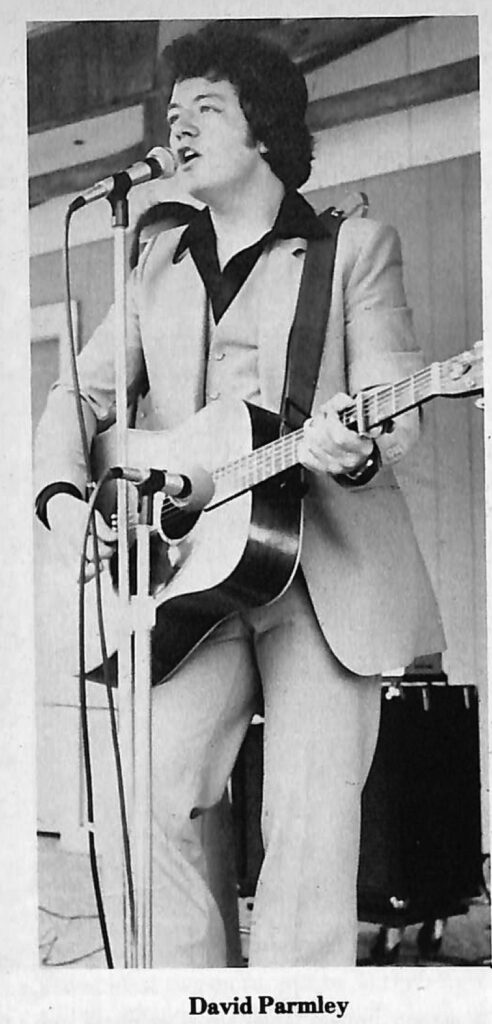
The unit has for several years now been recognized internationally as an important song stylist and likely one of the foremost architects of bluegrass music of the future. What direction then will the Cardinals’ music take in the next year or two? “I don’t see any need to change it,” says David. “Of course if we see a way to improve it we’ll do it but what we’re doing now has been very successful for us and we’re doing what we feel so I don’t think there’ll ever be any drastic changes made.”
Generally acclaimed by critics as a lead singer of the highest caliber, with enormous potential also as a country music artist should he ever seek to pursue it, David Parmely plays rhythm guitar with discerning taste and rock solid timing. He is equally recognized for his clean notes and stylings as a flatpicking lead guitar player, which he frequently demonstrates during the instrumental breaks.
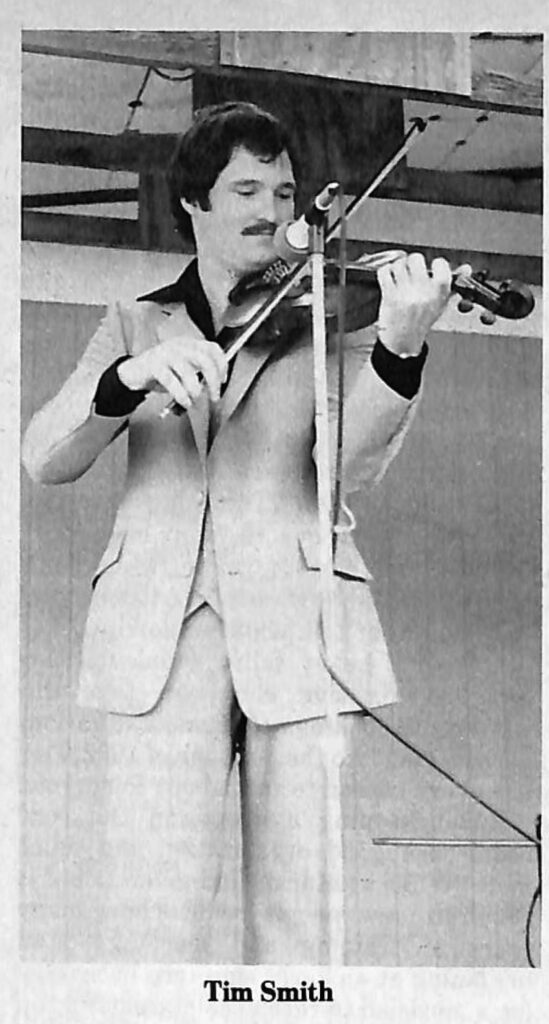
Tim Smith at age 25 is a native of Sparta, North Carolina. Just before joining the Cardinals he was accorded the title of “1978 World Champion” fiddler by virtue of winning first place fiddle at the prestigious Union Gove, North Carolina competition event. Tim now plays a beautiful five string fiddle with outstanding curly maple that was made especially for him by a Southwest Virginia maker. “It gives me more versatility and lets me get some sounds I couldn’t get with a conventional four string,” he says, “I really like it.”
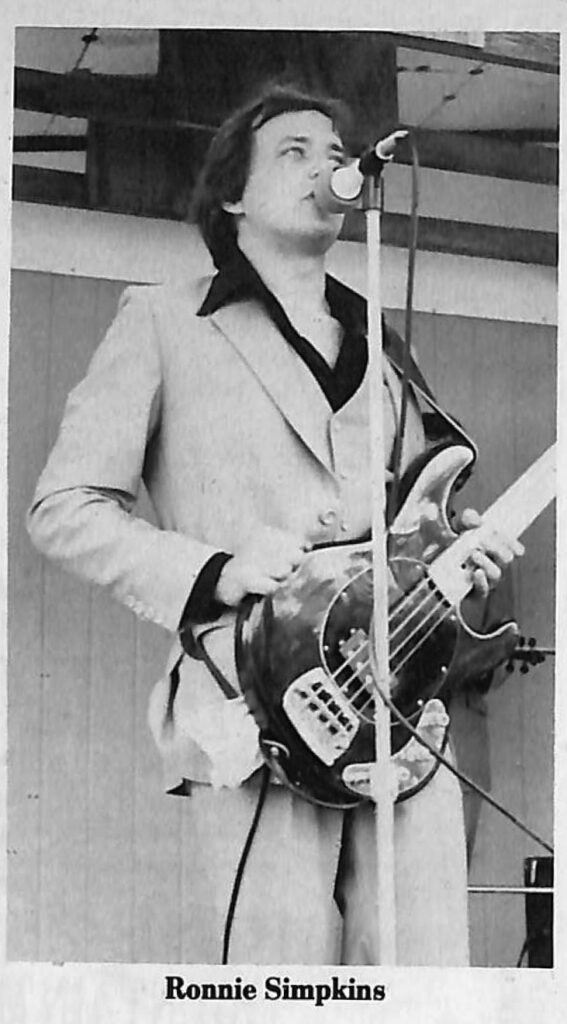
Ronnie Simpkins, from Christiansburg, Virginia is 22 and plays a solid, driving electric bass as well as singing bass in some of the vocal arrangements. Having taken up the bass at age 12 and being from a musical family, Ronnie is the first to play the electric bass with the Cardinals but is also capable of switching to acoustic bass if the occasion calls for it.
The fact of The Bluegrass Cardinals’ swift rise to prominence could lead some to believe that they were somehow able to bypass the “dues paying” period of apprenticeship—bordering on serfdom in a few instances—that has traditionally been an almost accepted prerequisite for an artisan of bluegrass to “make it” on his own. Don Parmley quickly puts this supposition to rest: “These boys are like me. We’ve all drove so many miles and picked for nothin’ for years ‘til we don’t hardly even like to think about those days. I’d a lot rather talk about tomorrow.”
With a heavy fall schedule already set, an extensive European tour this winter and bookings confirmed at various periods well into the summer of 1982, Don has every reason to talk about tomorrow.
But keeping a group on the road requires a good organization and much more. While a natural, God-given talent is required, few people realize how many years of training and learning—often beginning at an early age—are necessary for a musician to reach the status of a top professional. In addition, a great deal of investment in expensive instruments and accessories is a prerequisite. In the case of the Cardinals, their instruments are mostly of the rare and fine old Gibson and Martin variety that are irreplaceable in exact kind. Public address equipment and rolling stock are major items. “We carry a very good sound system,” Don says, “with eight microphones and four of the newest type stage monitor speakers. They’re very effective. Butch (David) is the engineer in the band. He sets levels and tone controls for us. We don’t always have to use our system though because most places we work already have one set up.” The Cardinals’ associations with the late bluegrass giant Lester Flatt were brief but each was ironic in its own way, including their recording of the Randall Hylton song, “A Tribute To Lester Flatt.” They had rehearsed the song to record while Lester was alive but his death made some last minute changes in the lyrics necessary. Most poignant was their singing of three hymns—two of them a cappella and one with light guitar accompaniment—at funeral home memorial services on Sunday following the star’s death on a Friday afternoon. The Lewis Family sang at interment services the following day. Thirteen months to the day after his funeral, The Bluegrass Cardinals were to again sing for Lester Flatt, this time at the auction sale of the late entertainer’s Hendersonville, Tennessee home.
It was at this point in the post-interview discussion that Don Parmley was told—in the manner of Paul Harvey’s “and now for the rest of the story!” radio commentary—that Lance LeRoy, who was Lester Flatt’s manager for more than ten years until the latter’s death, has stated to an interviewer that in early 1971 it became apparent to Lester that Vic Jordan would soon be leaving the newly-named “Nashville Grass” and that Lester was looking around for a banjo player. After listening to an all instrumental banjo album that Don had cut about 1962 for the Crescendo label, Lester was impressed with the solid banjo work and instructed Lance to locate this Don Parmley and offer him a job. The search was short lived however, and was abandoned when a Nashville musician who had known Don in California told Lance that he understood Don had taken a very secure job with good fringe benefits as a driver for Trailways and likely wouldn’t be interested in a music job again. Lester hired Haskel McCormick shortly thereafter.
Don appeared incredulous for a moment upon learning how through a simple misunderstanding of his situation he had missed out on what in 1971 was one of the very best jobs in bluegrass and more importantly would have been the opportunity to do what he had wanted most to do at the time, namely return to playing music on a full time basis. “I didn’t know that,” Don seemed deep in thought. “I never heard that. Lester nor Lance neither one ever told me about that but if he said it I’m sure it’s true.” Then, grinning from ear to ear, he added with emphasis as he put his hands on his knees and arose, “I’d of took it in a minute!!” When asked by Nashville Tennessean reporter Walter Carter about their current success, Don is quoted as replying typically “I can’t complain.” But aside from the obvious aesthetic values, one of the prime reasons for the band’s being increasingly sought after is definitely an economic one as indicated by West Virginia promoter Willard Mills: “the first time the Cardinals played our festival we were paying a good price for them and had frankly become concerned that they were costing us too much money because some of the local people we talked to didn’t know who they were. Selling gate tickets though we found they had a bigger following than we’d realized and when they went on stage and sang ‘Lord Don’t Give Up On Me’ you could have heard a pin hit the ground. I don’t believe I’ve ever seen a crowd really listen as intently as those people did to their singing. We have ‘em again this season.”
Writing in the November, 1980 issue of the Washington, D.C.-based Blueprint, Les McIntyre’s candid observation of bluegrass music said a great deal in remarkably few words, “…the mantle of creativity has been passed to a new generation…one such group is The Bluegrass Cardinals, who are fast closing in on the ranks of bluegrass superstardom.”