Nashville Banjo Company
Old Time in the Big City
If you haven’t visited Nashville in a while, let me warn you—things have changed. It used to be you could find a parking spot downtown if you were patient and were the praying kind. These days, I think the last open spot disappeared around 2021. In its place, we’ve gotten skyscraper cranes, pedal taverns, and whole busloads of howling bachelorette parties doing laps around Broadway like they’re qualifying for Daytona.
But if you look past the neon and noise, the Nashville I’ve loved for forty years is still here. The Ryman Auditorium still hosts the Opry during the winter months. The Station Inn still packs in the faithful for world-class picking. Gruhn Guitars still holds the finest collection of vintage instruments on earth—if you can talk George into taking you upstairs to see it. And if you time it right, Arnold’s Country Kitchen still dishes out meatloaf, turnip greens, and banana pudding that’ll have you singing like Stringbean at a barn dance.
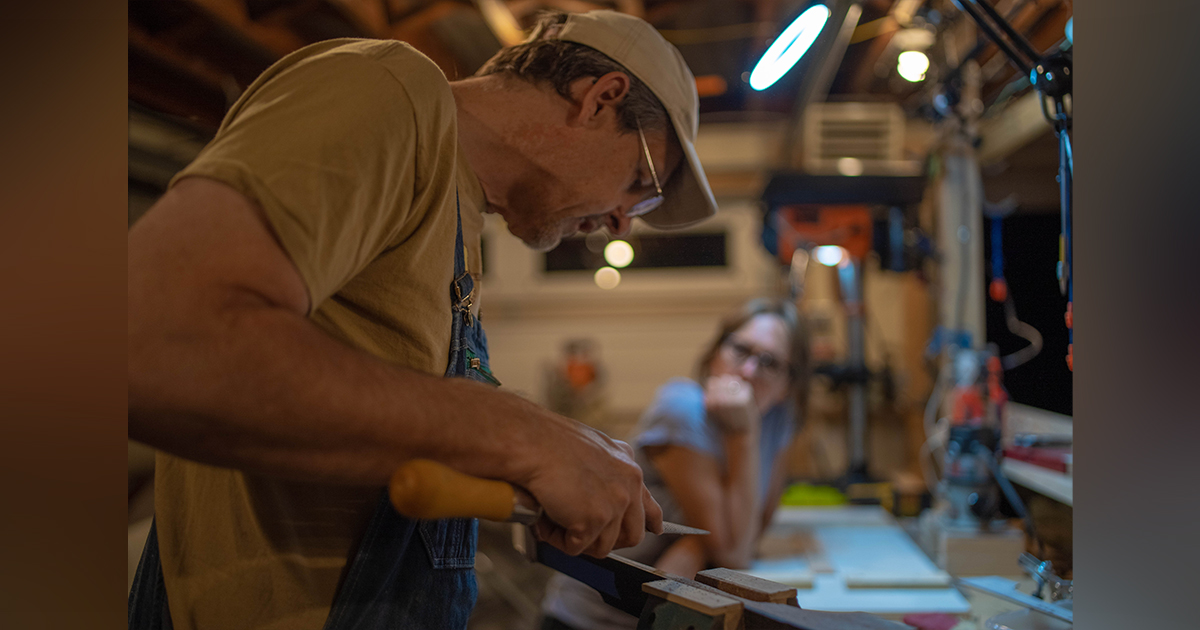
And just a few miles south of all that commotion, tucked away in a converted garage behind a quiet little house, there’s a little pocket of “old Nashville” that still feels like home. It’s one of my favorite corners of the city—the workshop of my friend Dave Dillard, who spends his days shaping wood, stretching skins, and turning out thoughtful, beautifully made open-back banjos, one at a time.
I drop by every week or so just to see what’s on his workbench and pick a tune before supper. Dave builds them one at a time from raw wood to final note—no factory shortcuts, no assembly lines—and over the years his banjos have found their way into the hands of players who know tone when they hear it: Grand Ole Opry star Mike Snider, old-time legend Dan Levenson, and tone pioneer John Balch.
How it All Began
Dave and I go back so far I can hardly remember a time before we were friends. I was in Nashville in the late ’80s, playing harmonica and guitar for Jerry Reed and trying to build a solo career. Someone at church asked me to help put together a little bluegrass group for Sunday mornings, and Dave’s name came up.
At the time, he was doing engineering work—some of it involving NASA, if you can believe it—and moonlighting on mandolin for Vassar Clements. We hit it off immediately, probably because our record collections were identical: Skaggs, Tony Rice, and more Tony Rice. We played together for the next thirty years — from festivals and concert halls to living rooms and plenty of back porches.
But seven years ago, on a little Easter trip gig down to Alys Beach, something shifted. Dave vanished into an upstairs room for most of the week, reappearing only with a notebook full of drawings and a very determined expression.
“Buddy,” he said, “I’m going to start building banjos. And I’m going to make a living doing it.”
I nearly choked on my sweet tea.
“You ever built a banjo before?”
“Nope. But I can see it in my head and hear it in my heart.”
Then he opened his notebook. It wasn’t just sketches—it was an entire he’d been shaping in his mind: a banjo that felt like Nashville before the neon, but clean and refined, almost as if it had been shrink-wrapped for a hundred years. Page after page, he showed me the curves, lines, and feel he’d been imagining. That’s when I realized he wasn’t guessing—he’d already built the thing in his mind. And right then, I knew: he was serious.
Building a Banjo Life
What followed is still one of the most surprising reinventions I’ve ever seen. Dave went from engineering to playing mandolin with legends, to mission work in Iraq, and then—of all things—into full-time banjo building.
He’s mostly self-taught, but he learned from all over: a class at the John C. Campbell Folk School, long conversations with master builder Glenn Carson, books, photos, schematics, old banjos taken apart and studied from the inside out. And he never shied away from mistakes.
“I’ve got notebooks full of them,” he says. “A success feels nice, but you don’t always know why it worked. A mistake? You have to chase that thing down and wrestle with it. Mistakes have been my best teachers.”
Working full-time, Dave now builds around two dozen banjos a year—each one from scratch, each one custom. Players from Australia, Germany, Hong Kong, Canada, and all across the United States have ordered his instruments. He recently finished #163, a short-scale cherry banjo with a red fox inlay, now settling into its new home up in Alaska.
The Look and Sound of a Nashville Banjo
The Music Emporium in Lexington, Massachusetts, carries Dave’s work from time to time and describes it this way: “The slim neck feel and easy playability, the warm and ducky sound, the restrained-yet-artful aesthetic, and the beautifully selected tonewoods…an instrument from the Nashville Banjo Co. stands toe-to-toe with the biggest names in the business.”
That about captures it—clean lines, honest materials, with a look and a voice that feels like it stepped off a front porch about 100 years ago.
“I’ve always loved the sound of a dark fiddle and a warm mandolin,” Dave says. “That’s what I wanted my banjos to sound like.”
Off to the Opry with Mike Snider
One of my favorite stories from those early days involves Nashville studio ace Jeff Taylor. Jeff dropped by, picked up a couple of Dave’s very first banjos, played a few notes, and said, “These need to be heard by somebody who matters.”
Before Dave knew what was happening, Jeff had him in the truck, headed straight to Mike Snider’s house.
Jeff whispered, “If Mike plays it for a minute, says ‘thank y’all for coming by,’ and hands it back, maybe don’t quit your day job. But if he keeps playing…”
Well, Mike kept playing it for three hours.
Before they left the driveway, Mike ordered a custom 13-inch walnut banjo.
A couple months later, he came by the shop to pick it up. Mike had Dave tighten the head tighter… tighter… tighter still.
“Tighten it until it splits,” he said, “then back it off a notch. That’s what Grandpa Jones taught.”
Dave laughs about it now, but that night he hid out in the basement, tuned into 650 AM, and held his breath—pretty sure that banjo head would explode right there on live radio. But Mike walked out onstage, let it rip, and the banjo held steady and true. Mike’s ordered another three banjos since.
George Gruhn’s Take
George Gruhn, Nashville’s resident sage of vintage instruments, had this to say: “Dave Dillard of the Nashville Banjo Company is building some of the finest sounding old-time 5-string banjos available today. They are meticulously crafted and expertly designed. The tone and playability compare very well to the finest vintage collectible instruments.”
Coming from George, that’s quite a benediction. He even added one of Dave’s banjos to his own collection.
The Heart of It All
Dave likes to say that many of his customers are just like him—they picked a little banjo back in college, set it aside during the busy years, and now want to connect again with the music they love. Clawhammer has a way of opening that door: simple, honest, soulful, and very accessible.
But I think there’s something deeper at work. When someone orders a Nashville Banjo Company banjo, they’re stepping into a community. Time after time, I’ve watched customers turn into friends, and those friendships keep growing long after the sawdust settles.
His waitlist grows every year, but it’s worth the wait.
Old-time in the big city indeed.
Every two months, Dave hosts Nashville Banjo LIVE—a free online hour of tunes, special guests, banjo-building, and plenty of good company. Hundreds of players from around the world pull up a chair.
A highlight of every session is Dave’s step-by-step clawhammer lesson, where he teaches a brand-new tune entirely from scratch. It’s an easy, welcoming on-ramp for beginners — and a great way for 3-finger pickers to give clawhammer a try without missing a beat.
More info at NashvilleBanjos.com. Scan the code to get on the invite list for the next Nashville Banjo LIVE.