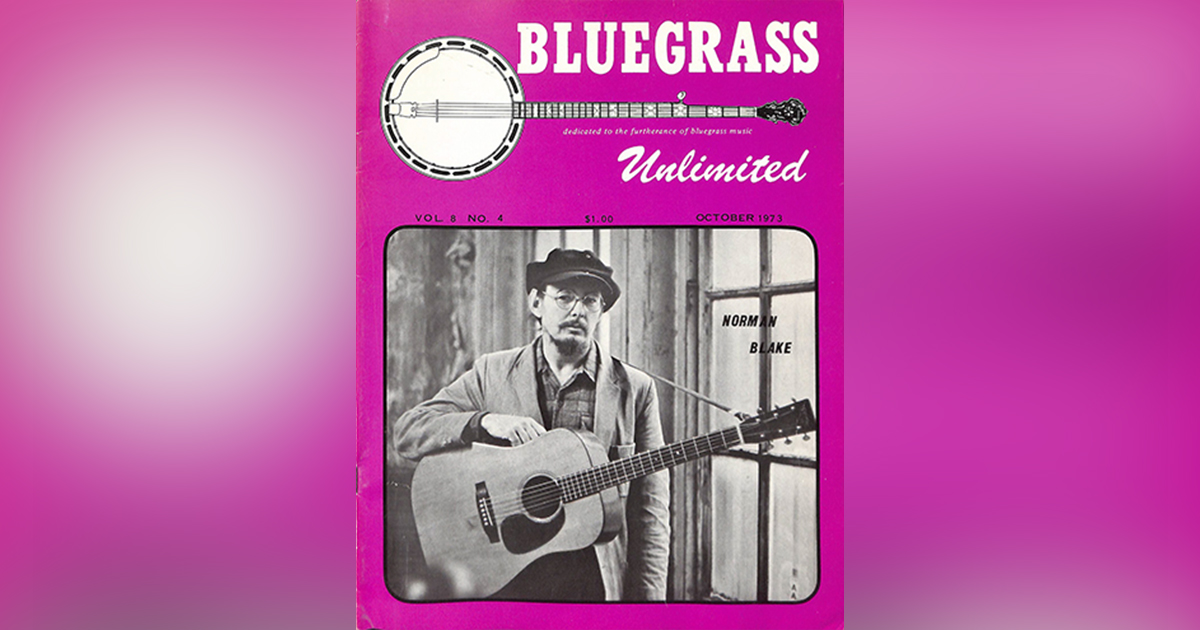
Norman Blake
Reprinted from Bluegrass Unlimited Magazine
October 1973, Volume 8, Number 4
“Who is Norman Blake?”
“One of the best pickers in the whole country. He’s got a lot of notes here and there, and puts them together in a very unpretentious way.”
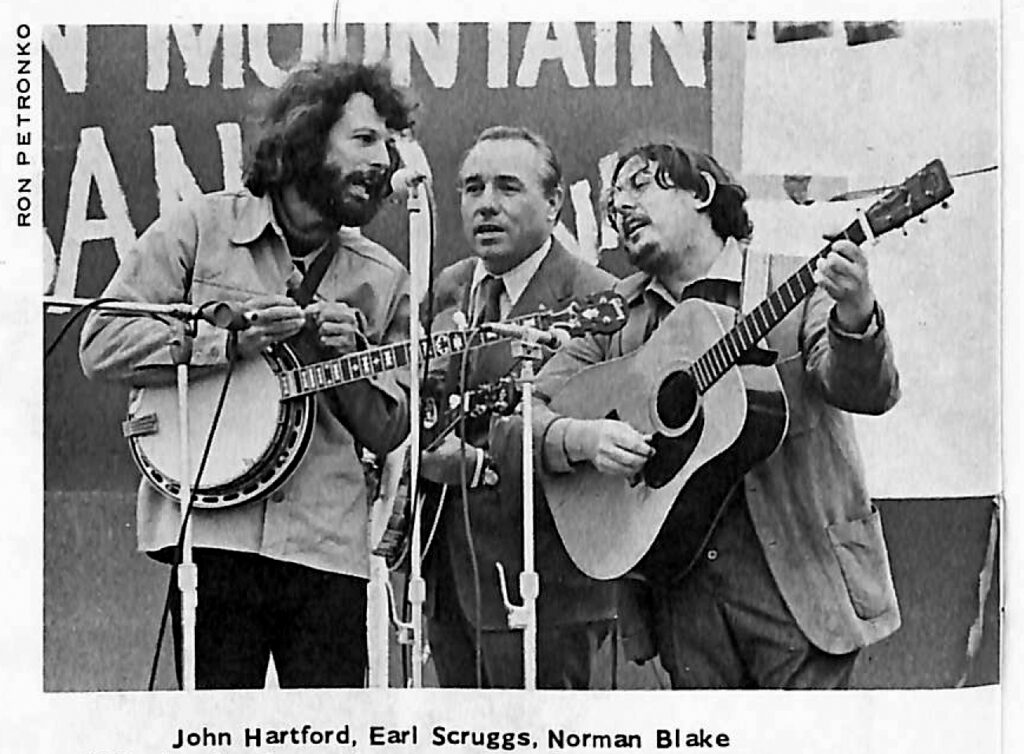
Such runs the opinion of those who know him. But a recent sampling of a midwest university coffee house crowd of 150, who had each paid S2.00 to hear Norman Blake indicated that approximately one-third of them had virtually no acquaintance with either him or his music. Fifty percent knew of him only as a backup for contemporaries as John Hartford, Kris Kristofferson, David Bromberg, Bob Dylan, and Joan Baez.
Only the remaining fifteen percent were aware of his country music and bluegrass associations with June Carter, Johnny Cash, Hylo Brown, and Doc Watson, and his bluegrass roots exemplified in his own album.
A few in the audience had the first Norman Blake album. On this first album tire two-thirds-life sized black and white photograph stares at its holder from behind circular wire-rimmed glasses in what appears to be an air of aloofness and self-contentment. (The impression disintegrates the minute the real person steps onto the stage.) Among these few the excitement and anticipation of the coming performance is perhaps most apparent. Among those who have never heard the boy-next-door voice which abounds more in intense feeling than in technical quality, and the set of flat-picking fingers which produce a sound overflowing with both of these elements, there is simply an air of eagerness as the warmup band finishes its assignment.
At last the waiting is over, and the small, almost delicate-looking man with angular features enters from stage right. The neatly corkscrewed pony tail taps the back of his shirt to urge him along with every step. Completing the picture are an ear-to-ear smile and a pair of scuffed-up hiking boots. In one hand he carries a well-used mandolin. In the other he gently swings a weathered old worn-down motley-looking 1935 Martin D-28 herringbone guitar.
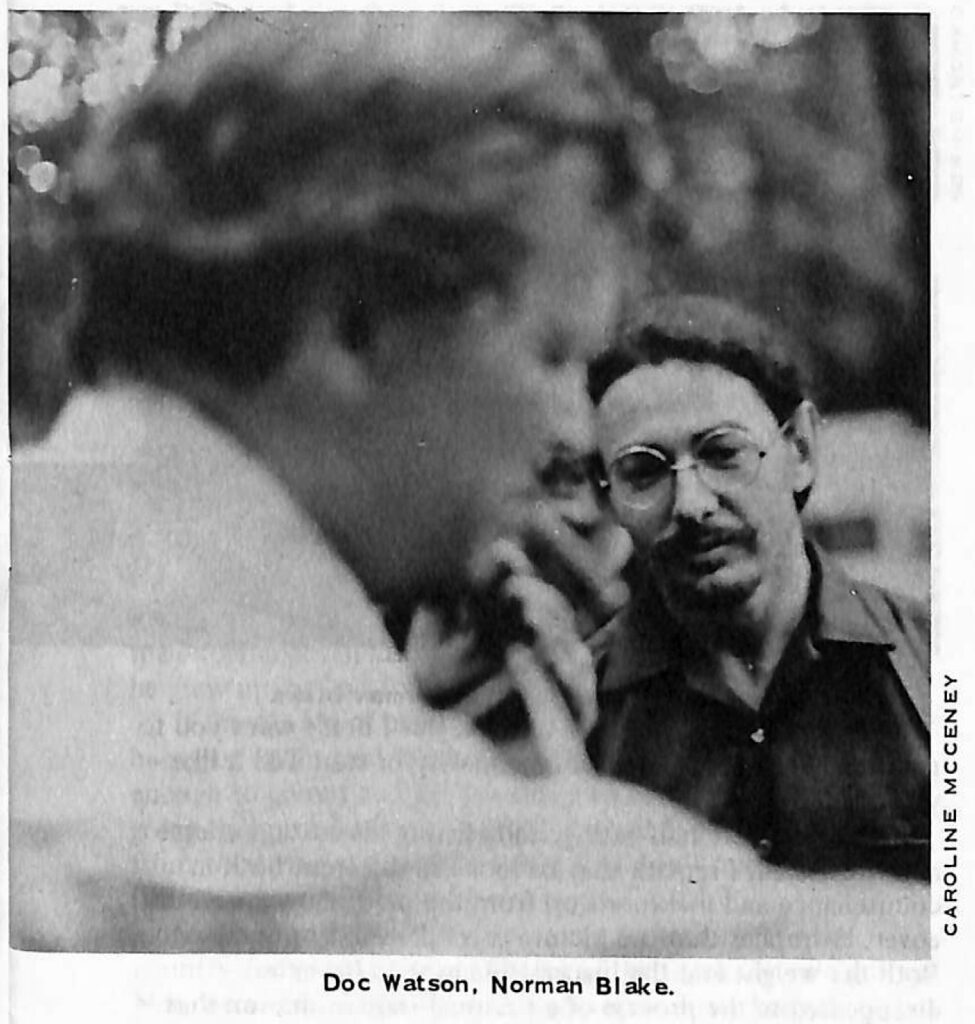
As he un-self-consciously makes himself at home on the provided bentwood chair, Norman Blake holds up his hand almost embarrassingly to halt the applause offered to him and his guitar backup, Grant Boatwright.
It seems to turn out all right, for the audience alternates spellbound silence with whistles and loud applause. After “Old Gray Mare” – a Blake-adapted instrumental full of syncopated enthusiasm accentuated by the pivoting of his guitar back and forth, and the bobbing of his head up and down or sideways as required for emphasis, he sits back exhausted.
“Oh, that sure was fun,” he offers appreciatively as the smiling eyes dart back and forth across the audience, tickled at the seemingly endless applause. “I think maybe I’ll just sit here a minute.” And while he sits there he opens up the door for a personal glimpse inside the man who instead of trampling down competitors in an effort to become number one in the guitar-picking circuit, has become content in his love for the music, and to pursue it with personal freedom:
“You can obviously tell I’m not into the commercial aspects of show business, because I feel that show business defeats a lot of creativity. Any time you’ve got to sell it, you’ve got to compromise it a little bit. I haven’t sat up a thousand nights burning the midnight oil to figure out a bunch of super peachy-keen arrangements. I just play the music I feel like playing when I’m on stage – and like that I want to hear. I usually play what’s in my head. That’s what comes out — good or bad — whether people like it or not. It’s no heavy intellectual number.”
After the show for which Norman is demanded back for two encores, he retreats to the solitude and privacy of a light yellow painted concrete block room. He is alone, save for a wooden coat tree on which half a dozen flimsy and misshapen wire hangers are offering further applause, assisted by the breezes produced by a window fan.
Off stage as well as on, the feeling that reaches out from Norman is that of a warm, spontaneous, fun-loving yet private, introspective, and deeply sensitive individual. When he talks, he pours forth a stream of vividly expressed and carefully collected insights. But tonight there is time for only a few brief get-acquainted comments: “We’re supposed to go somewhere. Could we get together maybe tomorrow? How about two o’clock?”
Two o’clock finds the “Do Not Disturb” sign hung on the outside of the motel room door. That, as it later turns out, is to keep the chamber maids from entering and disturbing the instruments.
“Do you know of a little restaurant where we can get a good fruit salad?” Norman asks as we head out the door toward the elevator. All the time he leads the way, with a bounce to his step that one sometimes finds in individuals who have a natural zest for life and are at peace with themselves and the world.
A few minutes later the trio heads into the Hilton toward the coffee shop. Norman proceeds uninhibitedly around the revolving door three times. “You don’t see these very often where I come from. I never could get much into social protocol. It’s a waste of time because it’s completely unnatural. It’s like going through a hurdle race. It’s like jumping a row of desks — like going through a bayonet course. These rules are set up for people who don’t know what to do. I’m sorry, but they are.”
“If somebody came up to you and asked you, ‘Who is Norman Blake?’, what would you say?”
“That’s a hard question to answer. But I don’t want you to make me look like some sort of celebrity or star. Tell it like you see it.”
As he sits there half-eating, half-stirring his cottage cheese and fruit salad, I remark that he looks so different both in countenance and in expression from the picture on the album cover. He replies that the picture was taken sixty pounds ago. Both the weight and the inaccessible look in his eyes disappeared in the process of a personal transformation that began two years back when Norman was playing the nightclub circuit in Greenwich Village, New York with Kris Kristofferson.
“People were coming up to me and saying they had seen my name on this and the other album, and telling me how great I was, and I realized these people had never really heard me play. They had only heard me backing up somebody in a style that I was unaccustomed to. In other words, they had heard me play my worst.”
That was the beginning — the turning point that would take Norman out of the more commercial music and all the way back to his bluegrass roots in tire hills of north Georgia.
It would take him back to the music he had listened to as a child and performed on T.V. as a teenager. It would take him back to the music that he loved the most.
“When the rock and roll thing came along, I was all but wiped out. You couldn’t sell country music. You couldn’t give away bluegrass.”
The demise of bluegrass cut to the core of Norman, and he took its de-popularization very personally. As a result, when he decided to try to return to it, and to try writing songs about the experiences in his life and the characters familiar to him as he grew up, he had to overcome a lot of personal hangups:
“I think a lot of musicians have gone through that. They’ve been put down, and it takes a lot to bolster your confidence enough to go out and get your trip on and say, ‘All right, I’m going to do it whether you like it or not. It’s a little different from what you’re used to hearing, and don’t put me down for it. Here it comes, I hope you’re ready for it.’ ”
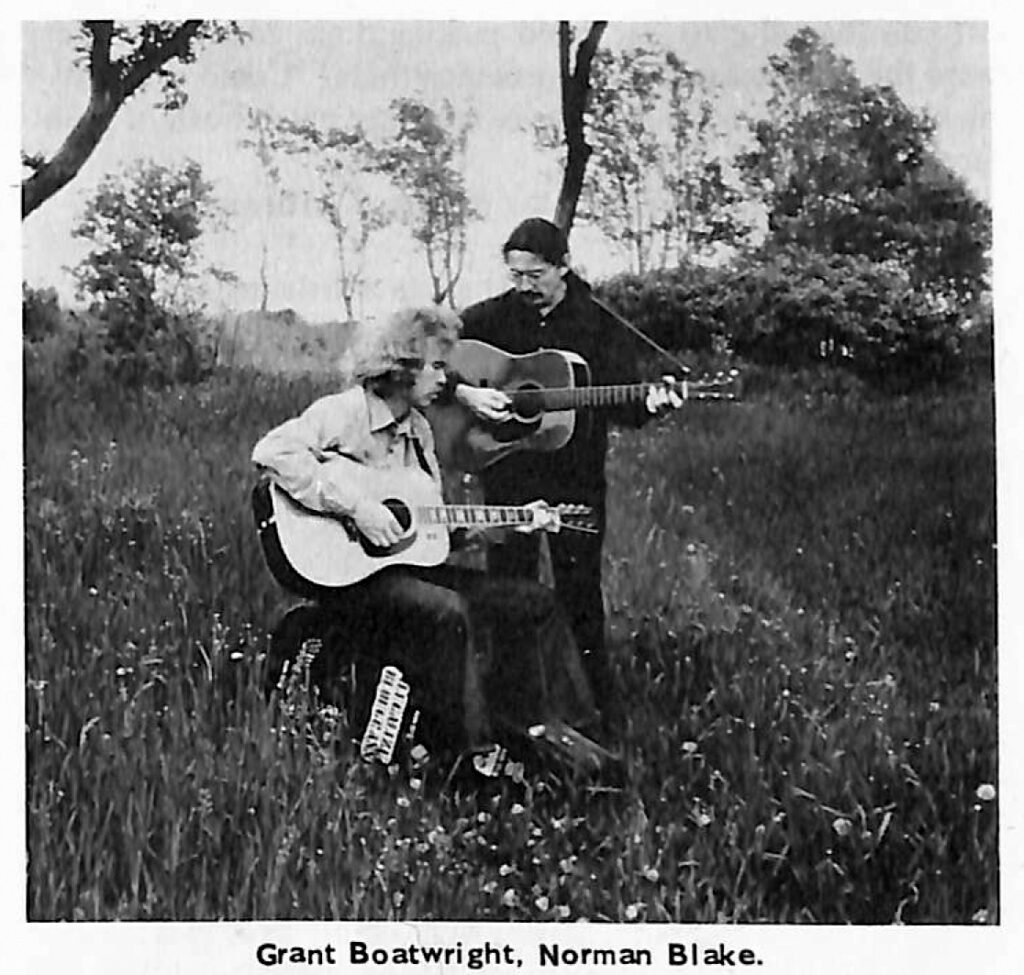
Finished with lunch, we are ready to head out to the country for some pictures. Riding in the trunk are two guitars. Norman’s is encased in an unpretentious dusty brown zippered cover. Grant’s (a late 1930’s Martin D-45) is coffered in a black portmanteau. Starkly emblazoned across the top, amid various symbols of Americana, is the motto “Legalize Bluegrass.” As we go, Norman sips a bottled Coke and talks more about his musical techniques and his songwriting.
In his songs, Norman typically draws with words vivid pictures of characters from his past, while at the same time offering insights into the people themselves and their way of life. Take, for instance, his song about Ginseng Sullivan, recorded on his own first album as well as on that of his group, for current release by GRC Corporation, and on that of at least one other bluegrass band. Sullivan is an old ginseng root gatherer living in north Georgia. Although he knows that his meager earnings from collecting and selling his produce will never afford him enough income to allow him to travel back to his muddy-water Mississippi delta home, he never loses hope:
“But next summer, if things turn right, the companies will pay high.
“I’ll make enough money to pay my bills and bid these mountains goodbye. Then he said with a sigh.”
But the real challenge is to try to get inside a creative mind for a few insights into how it works. It seems that few creative people can explain their mental processes. Their products just seem to emerge fully developed, as newborn children. Norman, however, with his keen introspective mind and his verbal sophistication, is an exception, and shares some of the secrets of his creativity:
“I usually get fairly moody before I write a song. I can be angered at something that will hurt me a little bit, or somebody will do something real good for me, and I will be really moved by it and feel warmed by it. I want to be involved in the songs in some way.”
The afternoon is getting late. The pair have to get back to the motel to prepare for the evening’s performance. We step out of the car to take pictures, and Norman and Grant, taking off into the tall grass, set about picking their guitars as if that were the sole reason for our presence there. “Could you just turn your heads around so the camera can catch both of your faces at once?”
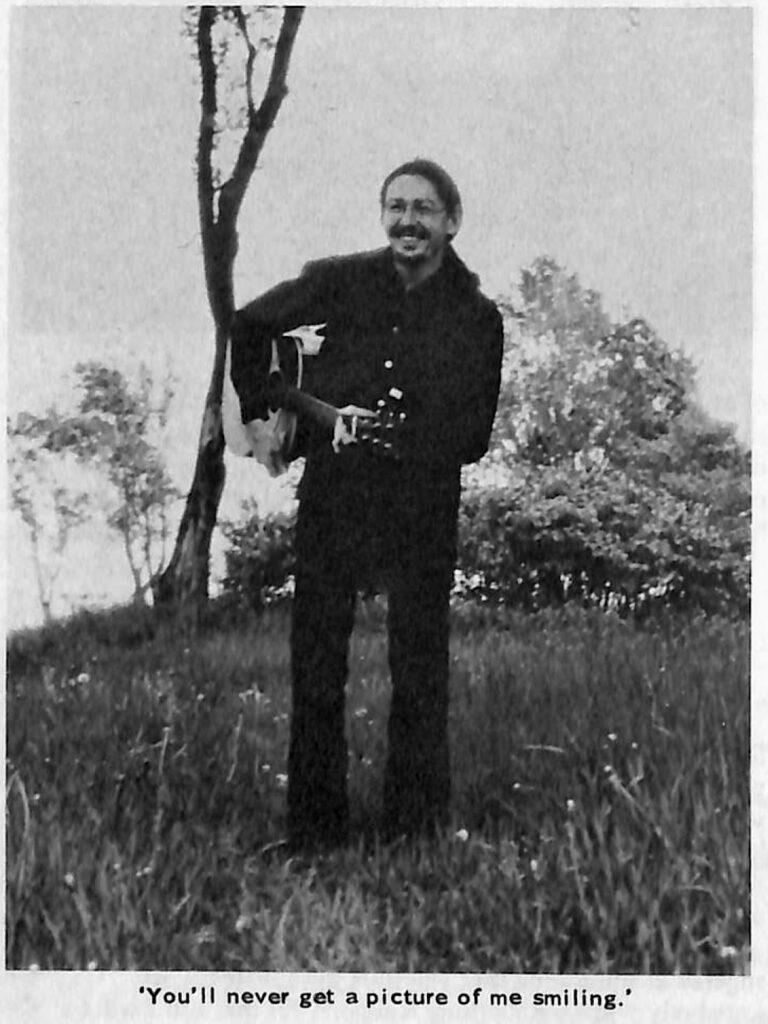
“I don’t believe in posing for pictures,” affirms Norman. “Just shoot.”
“Well, then, could you at least smile a little instead of looking so serious? People might like to know that you really have a fun and funny side.”
“I never smile for pictures. You’ll never get a picture of me smiling!”
But the inner spirit of a man whose most valuable possessions are his scuffed-up guitar and a mind which observes life and puts together both the words to describe it and the notes and arrangements to convey the surrounding feelings, gets the better of him as he frolic countryside. For it is impossible to keep one who is truly free of the normal burdens of success and constraints of society behind a facade of solemnity forever.