Lyman Enloe—A Stylist of the Old-Time Fiddle
Reprinted from Bluegrass Unlimited Magazine
January 1989, Volume 23, Number 7
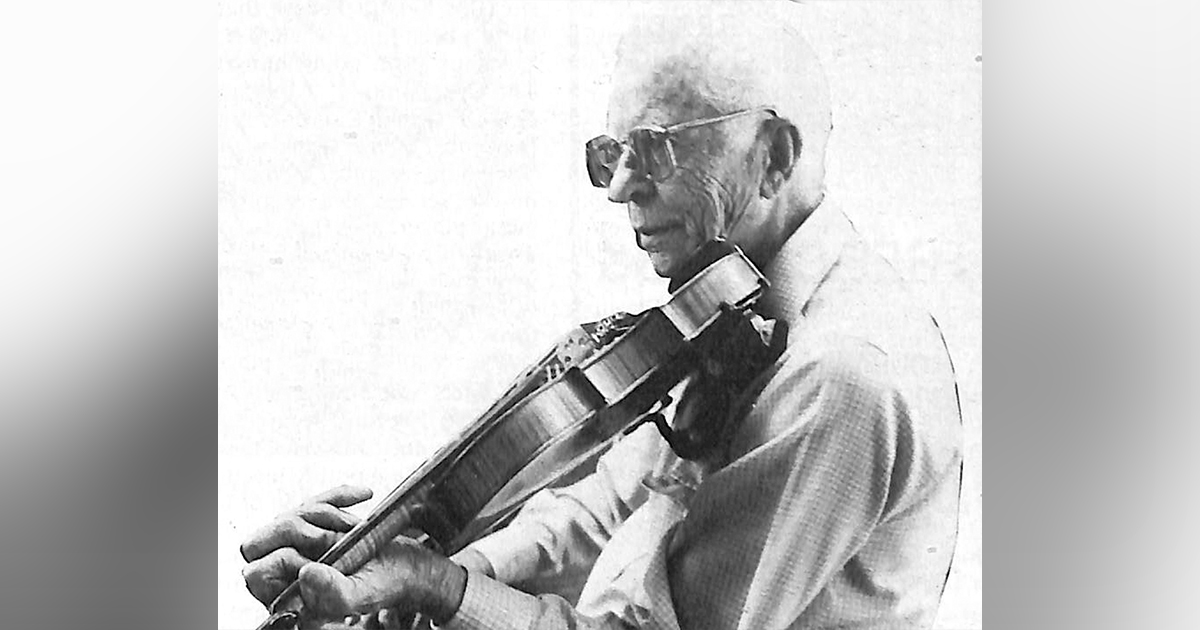
Lyman Enloe, a small, slimly built man in his 82nd year, is a nationally respected old-time fiddler and that’s what he’d rather be doing, as a rule. I notice that writers seem to bring out the nervous energy in him, as he clears his throat, stands to re-adjust his chair, lights another cigarette and takes another sip of black coffee. When refreshments are passed around to the friends and fans hanging around the camper, waiting for the picking to start, Lyman shakes his head in smiling disbelief. “I don’t know how people can eat, when they could be playing music,” he comments.
The silvery white hair and deeply lined face reflect a life of hard work, (fifty years in the painting and decorating business), and the recent grief of losing his wife. Myrtle Enloe was Lyman’s greatest fan, critic and the ‘‘adopted Mom” of the other pickers in the Bluegrass Association, a band popular in the Midwest through the 1970s. But there is a glint of fire in his eye and a grin on his face when he goes to pick up the fiddle. It is a pure joy to watch him play. If eagles were meant to fly, Rembrandt was meant to paint, Barishnokov was meant to dance and Monroe was meant to sing high tenor, then surely Lyman Enloe was meant to fiddle.
He plays a variety of old-time fiddle tunes, including several rarely heard songs recalled from boyhood years spent listening to his father and an uncle play, when he says he “didn’t dream of picking up the fiddle” himself. “They’re old, old tunes, all right,” he says. “Simple, but they’re good. Back in those days they didn’t put as many notes in there and fill them in like they do today. And that’s the way I still remember them. I don’t know what the devil to call some of them, but I’ll just have to think of something,” he laughs.
Lyman Enloe grew up on a farm between Jefferson City and Eldon, Missouri. He started out playing rhythm guitar for his brother, an uncle and his father, who was “in them days, noted as a pretty good fiddle player,” Lyman recalls. At age eighteen he took a job in a shoe factory and moved to Jefferson City, where he got acquainted with Jim Gilmore and his nephew, Tony Gilmore, a fiddler. After memorizing their tunes and playing rhythm guitar for them a while, Lyman got interested in the fiddle.
He was 22 years old in 1928; his father had died three years before. Actually, picking up the instrument was something between a joke and a dare from Lyman’s wife. “My dad had given me a little, old, cheap fiddle; it was hanging on the wall,” he recalls. “I was kidding with my wife one day, and I said, ‘I believe I’ll get that fiddle down and string it up and learn to play it.’ And she said, ‘That’ll be the day!” Later, Lyman’s wife used to tell folks that when he was first starting to play the fiddle, she thought she ought to go out in the yard, so that the neighbors wouldn’t think the sound of his practicing was her crying. “She was afraid that somebody might think I was beating her,” Lyman laughs.
Two years later Enloe had a regular date at radio station WOS, based out of the rotunda of the capital dome in Jefferson City. WOS, now KWOS, stood for the “Wonderful Old State” of Missouri, he says.
From then on he began to play “here and there” wherever he could find a jam session, and he entered every fiddle contest he could get to. Lyman won several competitions. “Back then they didn’t give trophies,” he recalls. “They’d just give you five dollars or so, and once in a while ten dollars.”
After the time spent in Jefferson City, Enloe and his wife decided to move back to the farm for the next ten years, mostly dairy farming. Next they started their own painting and decorating business in Kansas City, which was his main living and which he still does some of now.
Jim McGreevy, the banjo player with the Bluegrass Association and now the Bluegrass Brigade, recalls some stories Lyman told him of lean times in the 1930s. “Sometimes when he wasn’t sure where the next groceries were coming from; somebody would come by and say, ‘Why don’t you bring your fiddle and come and play this square dance Saturday night, and we’ll pay you five dollars.’ I guess a few times that fiddle kept the meat on the table,” Jim relates.
‘‘That’s true,” Lyman nods. “Years ago some of the more religious class of people thought the fiddle was a sin. But I don’t believe that, because there’s been times when that old fiddle saved us from going hungry back in The Depression.”
Of Lyman’s seven daughters and two sons, several became musicians. The youngest son, who was later killed in the service, was a good rhythm guitar player, as is the oldest daughter. The two of them had a family band with their dad for several years. The other son still plays jazz guitar and three of the girls had a vocal trio.
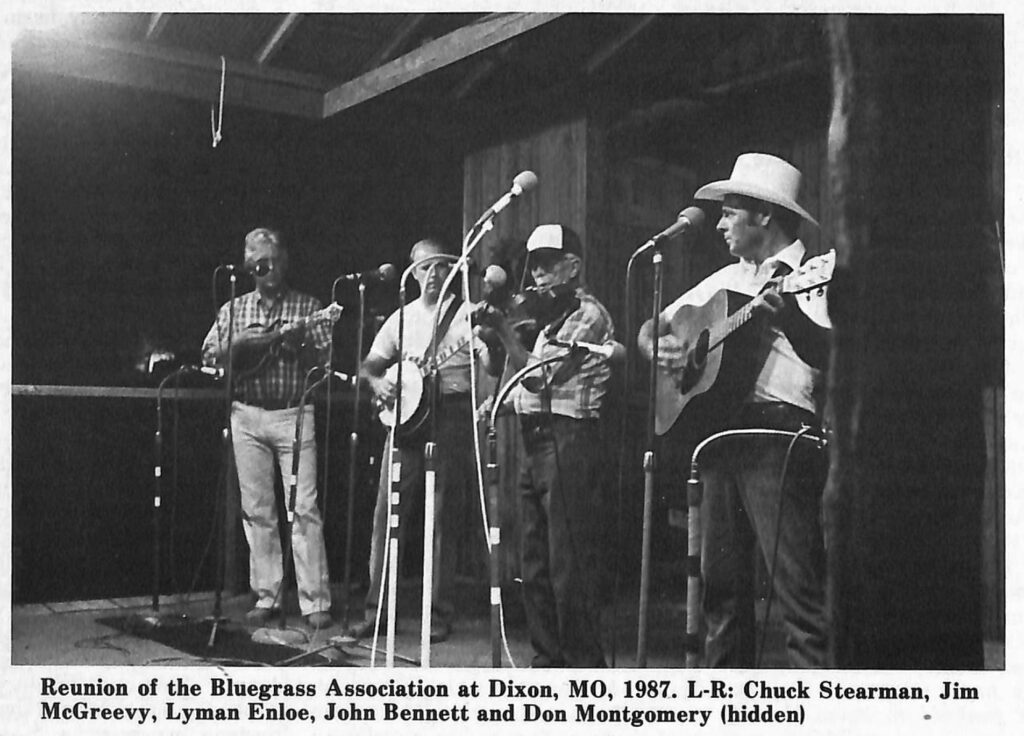
In 1966, Lyman and the three daughters met Slim Peterie, mandolinist; John Bennett, rhythm guitarist; and Jim McGreevy, banjo picker; at the monthly meetings of the Old Fiddlers Association of Kansas City, a branch of the Missouri Fiddlers Association. As “The Down Home Folks,” they rented a little school house on the edge of Kansas City, and they served coffee and doughnuts along with the music every Saturday night. After a switch to Chuck Stearman on mandolin, the group continued to play through 1968 for a few benefits and local service organizations. But the group really took off after the inspiration of the 1978 Bean Blossom festival. They decided to “put together some kind of a serious group,” McGreevy says, and called themselves the Bluegrass Association.
The summer of 1971 they played their first bluegrass festival at Dixon, Missouri, the third year of Bill Jones’ festival there. The band grew in popularity at festivals and shows all over the Midwest, with an occasional trip farther out.
The members stayed with the Bluegrass Association for the next thirteen years, a rare accomplishment for any band. Lyman Enloe fiddled and Audrey Enloe Belt sang. “She was the only one of the girls who could put up with the rest of us,” McGreevy explains. Chuck Stearman played mandolin and sang, John Bennett picked rhythm guitar and sang, Jim McGreevy played the banjo and sang and Don Montgomery played the bass fiddle.
The Association had just the right mix of traditional instrumentals and uniquely arranged, newer tunes. McGreevy says they were especially glad to have Lyman in the band because after stretching out into country or contemporary directions with vocal arrangements and material, they could always say, “Well, the next item up is an old-time fiddle tune” and get themselves “back in line.”
Having Enloe in the group “opened up a lot of doors for us too,” McGreevy adds. “There was a lot of people that admired his fiddling that would invite him to come play somewhere and of necessity they had to invite the rest of us,” he points out with a smile.
The Bluegrass Association recorded four albums. The first one, “One Tin Soldier,” (#4122 Cavern Custom Recording), featured vocals.
For the second album, the group encouraged Lyman to record some of his fiddle tunes, mainly those no longer in circulation, so that they would be preserved for future generations. The group played short versions and managed to fit 23 songs on the album. The songs are ones Lyman recalls from his boyhood days, before there were tape recorders available. “That old man Carpenter came to our house one time and I had the measles,” he recalls. “Boy, was I sick! I had a temperature and he and Dad went out in the other room, sat there, closed the door and played the oldies. That ‘Rugged Road,’ they played it over and over. It stayed with me and it’s on the second fiddle album. I don’t suppose there’s any of the older men left that remember those old tunes,” he muses. “I don’t know who they could be. My brother was the last one and he died seven years ago.”
That first fiddle album, “Fiddle Tunes I Recall,” has recently been repackaged, by David Freeman and released as County 762.
A second vocal album was recorded next: “Strings Today,” (#V42419 Cavern Custom Recording), and then another fiddle record followed, “Rugged Road.” This album, which had more of a bluegrass flavor and featured other instruments also taking leads, has gone out of print.
Like most groups, the Bluegrass Association members kept their day jobs to “support their music habit on weekends,” McGreevy says. They share many memories of driving hundreds of miles to some festival on a Friday night after everyone got off work and then coming back Sunday afternoon “all worn out and seeing too many white lines,” Lyman recalls. Although, he admits, “We’d drive for miles to some place that had biscuits and gravy, to get a good feed before we went home.”
Once the Bluegrass Association played a birthday party at the governor’s mansion when Kit Bond was governor of Missouri. They had gotten to know him as a fan at the SPBGMA festivals at the Lake of the Ozarks. “We had a doggone good time!” Lyman says. “You wouldn’t have know that he was any different. They really like that bluegrass music.”
During the Association years Lyman got the chance to visit and jam with several well-known musicians, including his biggest influence, Kenny Baker. “Baker was my idol. I really liked his playing, and I liked him,” Lyman states.
He met Ricky Skaggs when Ricky was fifteen years old and performing with Ralph Stanley. Lyman, Skaggs and Baker had a pretty wild jam session that weekend in Knob Noster, Missouri.
Lyman ran into Byron Berline at a fiddle contest near St. Joseph, Missouri, another time. When they both failed to qualify for the final rounds, Lyman says they “went way off into the parking lot and stayed there and jammed until they came looking for us to go home. And he (Berline) still remembers that,” Lyman says. “And so does Ricky Skaggs.”
Time and circumstances for all bands and around 1980—1981 it became more difficult for the Bluegrass Association to stay together. John Bennett bought a new home in the country, an hour’s drive away from Kansas City. Chuck Stearman moved to Kirksville, Missouri and became increasingly more involved with the SPBGMA—The Society for the Preservation of Bluegrass Music in America—organization he founded. And Lyman and Audrey had to drastically reduce their music activities in 1979 because of Mrs. Enloe’s poor health.
Jim McGreevy, the banjo picker and Don Montgomery, who switched from bass to fiddle, continued to play with Jack and Mae Burlison, founders of the Bluegrass Brigade, a very popular band on the midwest festival circuit for the past ten years now.
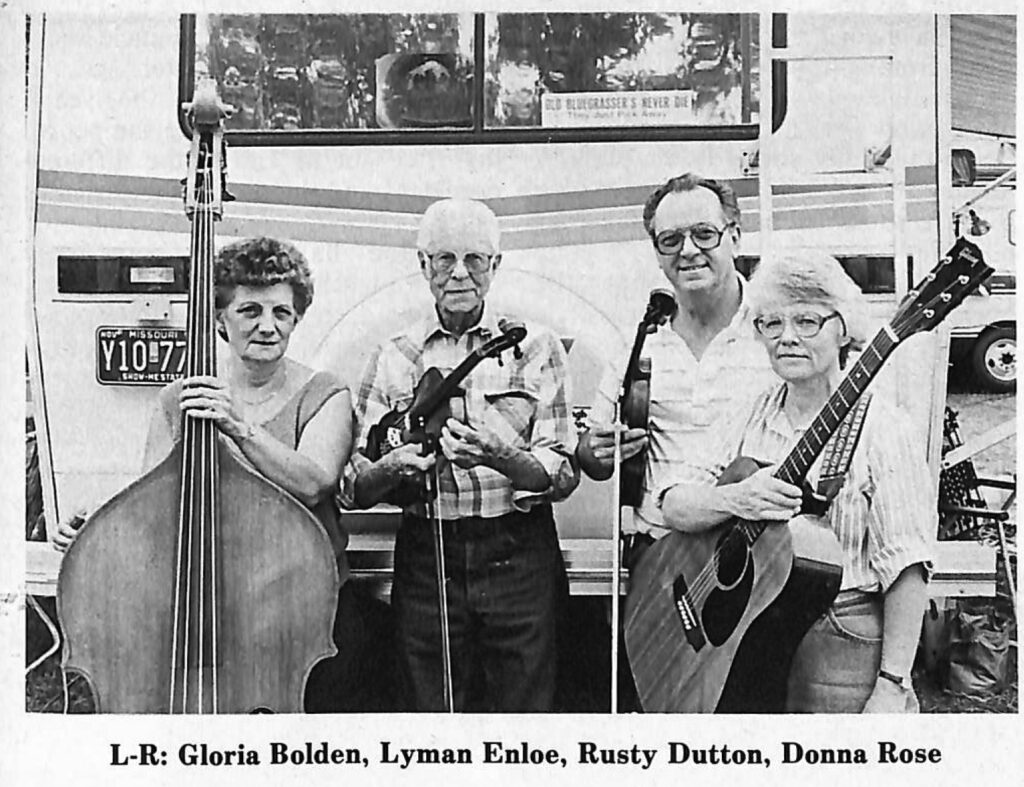
After Mrs. Enloe’s death, there was a time of no music for Lyman. But during the past five years Rusty Dutton, a fine fiddler in his own right, came around and began to make a “pest” of himself, asking Enloe to teach him the old tunes and how to work the bow. They had been performing regularly now with Donna Rose, a rhythm guitarist from Kansas City. Gloria Bolden, from California, Missouri, also plays bass fiddle with the group when her schedule permits.
“I’ve tried to convince Rusty that if he can really learn to play, he might be famous some day like I am,” Lyman jokes. “I don’t think he believes all of it.”
Rusty Dutton started out as a “would be fiddler,” he says, “scratching” through some square dances and playing flattop guitar behind most of the old-time fiddlers in his home town. But then he got into country music. The last band he played in before meeting Lyman was a popular show group out of Kansas City, headed up by Jimmy Dallas. “After 27 years of playing in the smoke dens, it finally got to me,” Rusty comments. “I realized I was missing something. The fun wasn’t there. It just wasn’t there any more. When I came back to the bluegrass, I found out that there still were people who knew how to play the good, old, basic music. And the fun returned,” he adds.
Some of the Kenny Baker waltzes Rusty and Lyman twin fiddle now are incredibly beautiful. Besides the older tunes, Lyman has also learned music from Byron Berline’s albums.
Rusty spends a lot of time trying to pin down and imitate Lyman’s natural bowing technique; “so slick, smooth, even and easy, he doesn’t even know he does it,” Dutton says.
“If you watch his arm, you will see him do certain little things. Maybe at the end of the bow there will be one little curl somewhere. But that makes that little different sound come out that is unique to Lyman,” he observes. “For an old time fiddler, he’s got the most extraordinary bow arm that I’ve ever seen,” Rusty notes. “Because a lot of them use a stiff arm and a stiff bow. His is not.”
Over the years Lyman has learned the importance of having a good quality bow, and he has re-trained himself to use more of it for “a nicer tone,” he says.
Enloe has never played much back up on the fiddle. “To my way of thinking,” Jim McGreevy observes, “Lyman always had every tune pretty well structured. It was established how to play the thing well in advance and practiced and for the most part there was not a deviation . . . That’s how it was to be played every time it was played.” Later one, the bluegrass style of playing back up and improvising “instant arrangements” developed, and “that just didn’t fit in with forty or fifty years of structured playing,” McGreevy says.
Kenny Baker, who has played quite a bit around and with Lyman through the years, also comments on Enloe’s smoothness and how particular he is about playing every part of an old tune correctly. “You know, a lot of fiddle players don’t,” Baker says. “They’ll play a couple of parts, and they’ll leave some parts out. But Lyman—when he plays one, he plays every part.”
Baker goes on to add, “Lyman Enloe is one of the finest old-time fiddlers I ever ran into . . . When I hear him, I don’t have to guess who it is. You might say he’s a kind of a stylist.”
Although Lyman owns three fiddles, you will usually find him playing his distinctive style of music on his favorite, a copy of a 1500s Guarnerius, made in 1875. He uses an old German silver-lined bow. “Every part of the metal, the grip and the wire around it, is silver wire,” he explains. “And all the metal on the frog, even the screws or tightener, is solid silver.”
Rusty and Lyman are using Prim strings on their fiddles now. They feel a little softer than the average set of strings, and sound good, according to Lyman.
Enloe learned about repairing and setting up instruments from an experienced friend and is now passing the information along to Rusty. “That’s interesting, to take the top off and look and see the inside—what the maker did to it,” Lyman says. “Some of these fiddles that sound real high pitched and bound down and won’t sound out,” he continues, “we’ll re-graduate and thin that wood; and you’d be surprised what a difference it makes.”
Looking back over Lyman’s experiences, one has to wonder what keeps a person fiddling for sixty years. “I just love to play and enjoy it,” Lyman explains. And he is also of the strong opinion that “the worst thing to do is to retire and go home and sit down. I just can’t stop,” he smiles.
Lyman is a little hesitant to offer much advice to younger fiddlers because he has noticed that many of them have got “a completely different style from our old-time style. It’s almost dying out,” he says. But for those who are interested, he adds, “Naturally, any young fiddle player / might advise, I’d try to get him to play Baker’s tunes as near like Baker as possible.”
McGreevy believes that the overabundance of notes in Texas-style fiddling and excursions into the jazz realm are phases, or cycles that most players go through. “I think that sooner or later most of them get that out of their system and kind of come back to the straighter, more old-time, standard way of playing tunes.”
Rusty adds, “If they want to play the other stuff, they can develop it as they go along. But they really should have a good, solid root base in old-time fiddling,” he emphasizes.
As for the future, Lyman says he is content to do “what I’m doing now. I enjoy the jam sessions and the bluegrass festivals. And as long as these guys will stick with me, I’ll keep trying to play.”
Rusty and Mike Allen, of radio station KANU, University of Kansas, Lawrence, Kansas, are working out details to obtain a state grant, from the historical aspect, to finance another album of traditional, previously unrecorded fiddle tunes that Lyman has recently “dredged out” of his memory, from the music of his father, Elijah Enloe, as well as an uncle and a fiddler named Lee Carpenter.
Looking back over the years, Lyman says, “I appreciate the people that I’ve got to know—the different musicians and the people that listen to us.”
Enloe has never considered himself a teacher, in the strictest sense of the word, to the many who have admired his music. But he is proud of the progress of Dan Grotewohl. “I started him from scratch on the fiddle when he was thirteen years old. He’d never had a fiddle in his hand, and he wanted to learn to play,” Lyman says. “I didn’t teach him all that he knows now, but just got him started to know what it’s all about . . . he’s turning out to be a nice fiddler.”
“And now Rusty’s learning the old tunes,” he adds with a grin “and I may have to break his bow too!”
It’s good to see the fiddling style of Lyman Enloe passed along in some way, before it is completely lost to the ages. “I was talking to Baker one time and he said that some day old-time fiddling and tunes will come back and I think it will too,” Enloe states. “Times change and go on, but that’s why we put all those tunes on that record. Some day some of the younger pickers might put them on.”
They might too, Lyman.